
Intelligent Surveying Unmanned Surface Vehicle Market
Report ID: SQMIG20A2568
Report ID: SQMIG20A2568
[email protected]
USA +1 351-333-4748
Report ID:
SQMIG20A2568 |
Region:
Global |
Published Date: February, 2026
Pages:
157
|Tables:
148
|Figures:
78


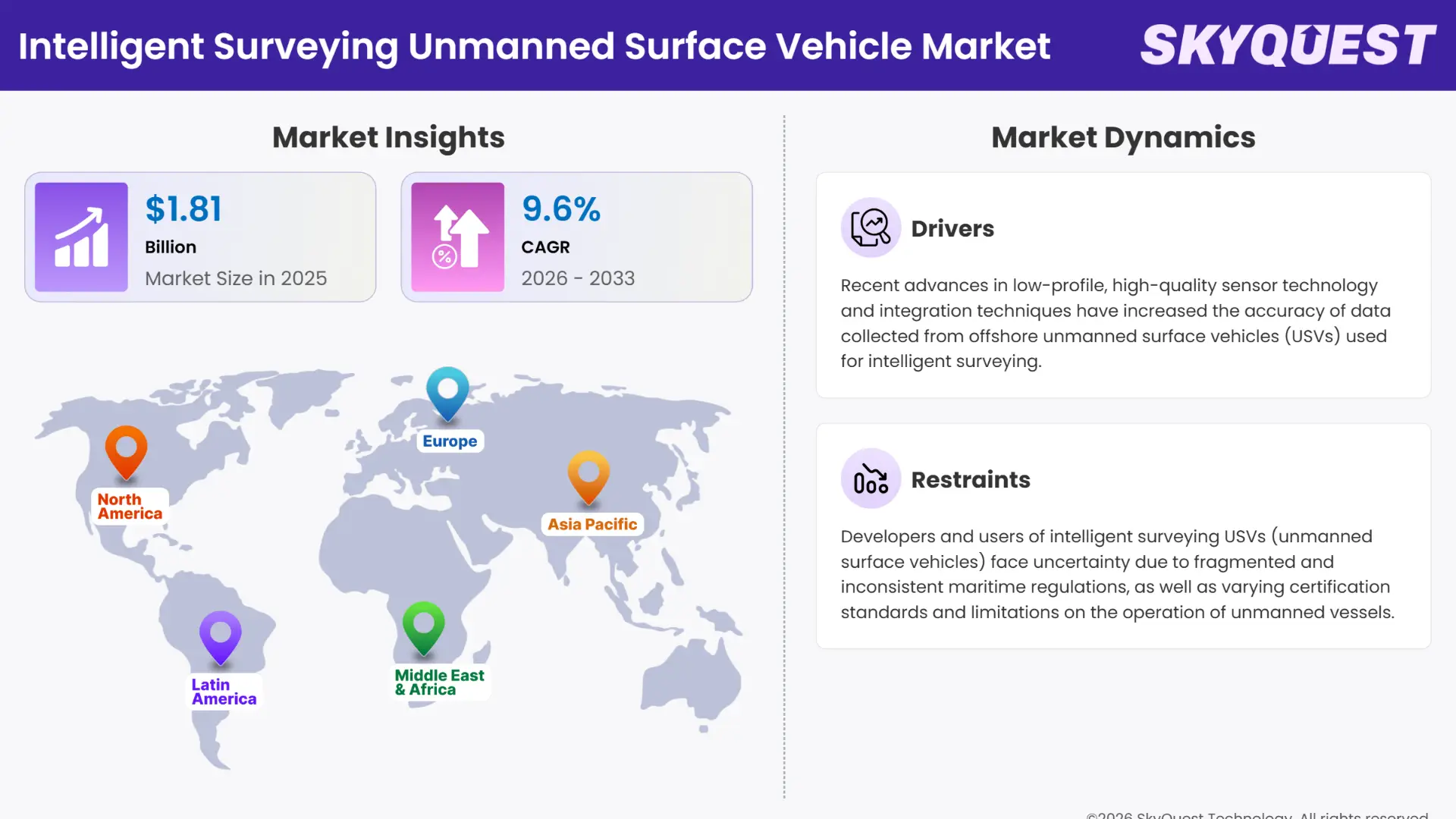
Global Intelligent Surveying Unmanned Surface Vehicle Market size was valued at USD 1.65 Billion in 2024 and is poised to grow from USD 1.81 Billion in 2025 to USD 3.77 Billion by 2033, growing at a CAGR of 9.6% during the forecast period (2026-2033).
The primary driver of the intelligent surveying unmanned surface vehicle market is demand for safer, faster and lower cost hydrographic and maritime asset data collection, which has changed how governments and industry map and monitor waterways. This market includes autonomous surface vessels fitted with GNSS, multibeam echosounders, LiDAR and AI for navigation and sensor fusion, and it matters because these systems reduce human exposure while generating higher resolution bathymetry and environmental datasets. Over the past decade the sector shifted from research prototypes to commercial platforms as sensor miniaturization, autonomy and enabling regulations matured, exemplified by ASV deployments for port surveys.
Advances in autonomy and sensor data fusion are the key trend driving the global intelligent surveying unmanned surface vehicle sector growth because they lower operating costs and extend mission endurance, which opens new applications and buyers. As navigation algorithms and onboard processing improved, operators shifted from supervised sorties to persistent beyond line of sight surveys, enabling pre construction mapping for offshore wind, subsea cable route clearance and routine dredging monitoring. This reduced vessel charter days and delivered near real time actionable maps for engineers and regulators. Consequently, commercial service models, SaaS analytics and fleet as a service offerings have proliferated, creating scalable revenue streams for industry stakeholders.
How is AI Improving Survey Accuracy in the Intelligent Unmanned Surface Vehicle Market?
In the field of intelligent unmanned surface vehicles, AI has led to an enhancement in the accuracy of survey measurements using methods such as enhanced sensor fusion, real-time data cleansing, and adaptive planning for missions. Some of the major developments included: automatic filtering of noise through sonar and lidar, contextual recognition of objects using vision systems, and anomaly recognition to alert an operator of unusual measurements that may require further investigation.
The current state shows AI integrated into autonomy stacks to better align georeferenced datasets and to reduce human error during deployments. Market demand for offshore energy projects and environmental monitoring is encouraging faster adoption. Examples include AI guided route planning that improves coverage fidelity and onboard quality control models that raise bathymetric reliability.
In February 2026, Demcon Unmanned Systems’ recent acquisition by a major contractor signaled broader commercial uptake and demonstrated how onboard AI for autonomy and sensor fusion reduces survey uncertainty, minimizes repeat passes, and accelerates data delivery to clients, thereby improving efficiency and supporting market growth.
To get more insights on this market click here to Request a Free Sample Report
Global intelligent surveying unmanned surface vehicle market is segmented by product type, platform size, propulsion type, application, end user industry and region. Based on product type, the market is segmented into autonomous USVs and remotely operated USVs. Based on platform size, the market is segmented into small, medium and large. Based on propulsion type, the market is segmented into diesel, electric and hybrid. Based on application, the market is segmented into hydrographic surveying equipment, seabed mapping & charting, environmental monitoring, offshore asset inspection, defense & surveillance and others. Based on end user industry, the market is segmented into government & defense, oil & gas, marine research institutions, environmental agencies and others. Based on region, the market is segmented into North America, Europe, Asia Pacific, Latin America and Middle East & Africa.
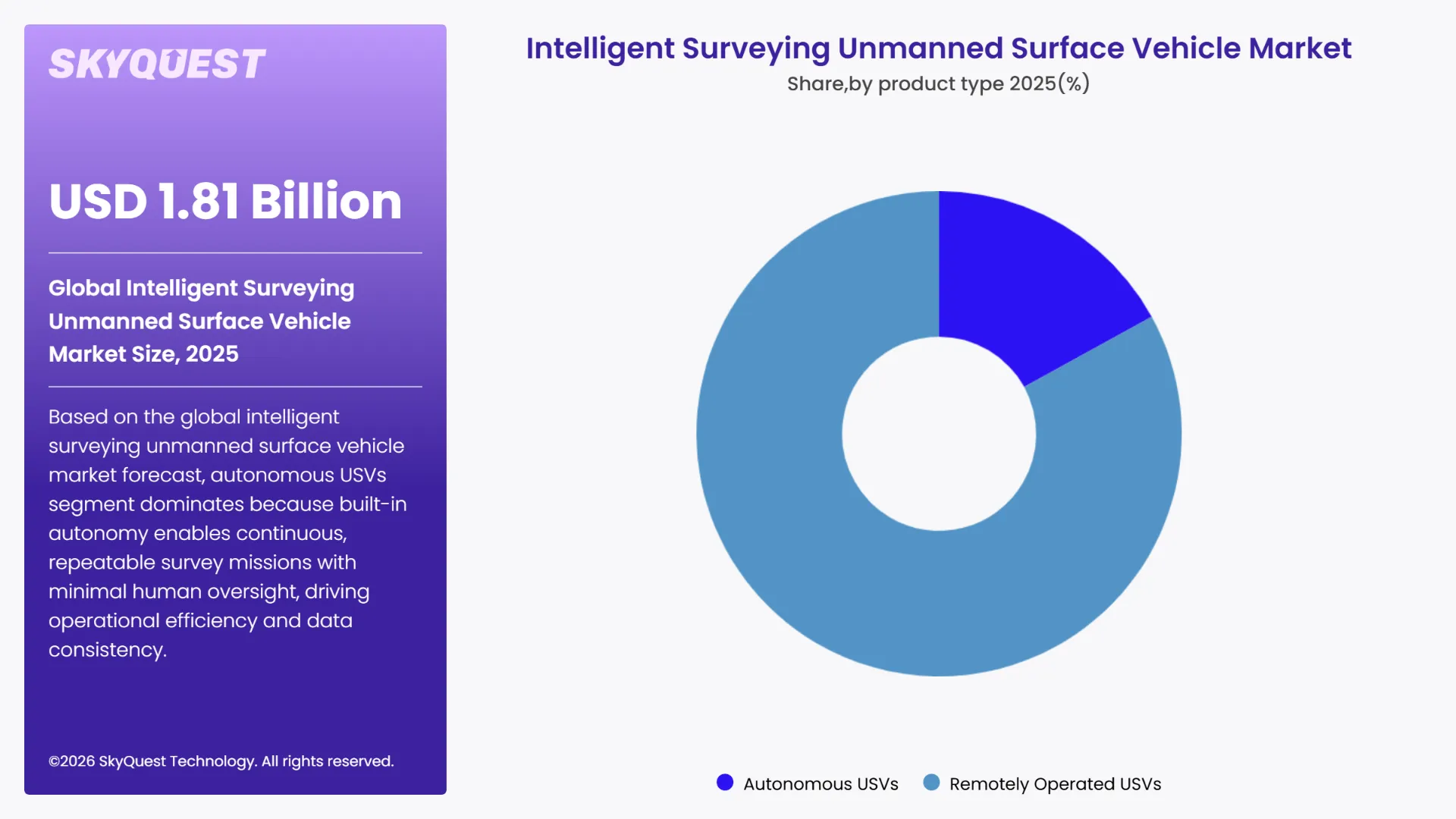
Based on the global intelligent surveying unmanned surface vehicle market forecast, autonomous USVs segment dominates because built-in autonomy enables continuous, repeatable survey missions with minimal human oversight, driving operational efficiency and data consistency. Onboard navigation and advanced fusion of sensors enable complex mission planning and adaptive path corrections, resulting in reduced downtime and lower operational risk. These capabilities attract demanding applications for precise mapping and extended operations, encouraging the investment in autonomous platforms, along with fully integrated software ecosystems that reinforce their leadership in the marketplace.
However, Remotely Operated USVs are emerging as the most rapidly expanding area, driven by stringent safety requirements, operator trust in manual control for complex or regulated missions, and lower barriers to certification. Increasing pressure and familiarity with current methods of control are causing an increase in inspections being completed under supervision; therefore, generating new models for providing services and increasing revenue for providers.
Diesel segment dominates because its high energy density and reliability enable long-duration missions and sustained power for demanding survey payloads, fostering confidence among operators performing extended missions. Provision of reliable onboard power supply for high-performance sensors and propulsion increases the likelihood of completion of missions and allows for design of larger platforms and therefore encourages more investment into diesel powered configurations as well as integration of advanced survey suites to generate comprehensive data for analysis.
However, Electric propulsion is witnessing the strongest growth momentum, driven by improvements in battery energy density, quieter operation suited to environmental monitoring, and regulatory emphasis on low-emission platforms. In sensitive survey environments, these attributes provide greater acceptance and encourage electric powertrain manufacturers to increase the pace of development for integrated electric powertrain charging and energy management system development.
To get detailed segments analysis, Request a Free Sample Report
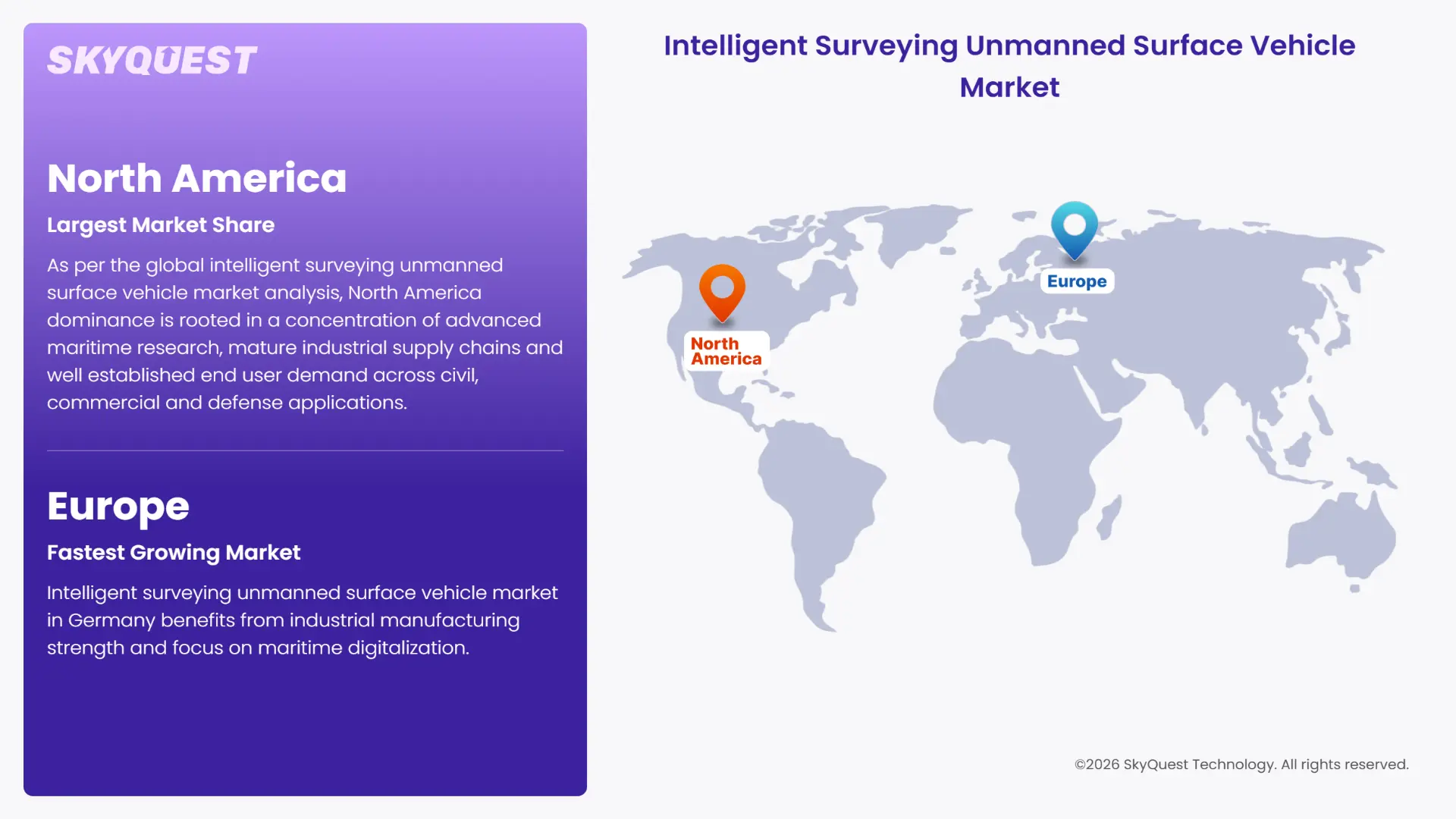
As per the global intelligent surveying unmanned surface vehicle market analysis, North America dominance is rooted in a concentration of advanced maritime research, mature industrial supply chains and well established end user demand across civil, commercial and defense applications. The quick build-up of sensor manufacturers, autonomous navigation developers and systems integrators is driving the commercial deployment of embedded systems and widening their applications. Regulatory frameworks and procurement scenarios that promote the trialing of these products continue to evolve in key markets. The development of densely connected port infrastructure, offshore energy activities and hydrographic survey service providers create a strong, ongoing requirement for accurate mapping and monitoring. In addition, their broad after-sales services for maintenance, training and data analysis further enhance market leadership by providing operational assurance and confidence to end users.
Intelligent surveying unmanned surface vehicle market in United States benefits from a deep base of defense procurement, commercial survey operations and offshore energy activity that drives sophisticated requirement definition and scale deployments. A vibrant ecosystem of technology vendors, research institutions and specialized service providers enables rapid product iteration and full service offerings. Emphasis on interoperability, data integration and operational support makes the market a proving ground for autonomous survey solutions.
Intelligent surveying unmanned surface vehicle market in Canada emphasizes coastal monitoring, inland waterway mapping and resource sector support requiring robust, adaptable platforms. Collaboration among provincial agencies, academic centers and regional service firms encourages tailored solutions and localized support. Focus on reliability in challenging environmental conditions and modular sensor payloads positions market participants to serve domestic needs and pursue export opportunities through quality engineering and responsive field service models and vendors.
Based on global intelligent surveying unmanned surface vehicle market regional forecast, rapid expansion in Europe is driven by convergence of supportive policy direction for maritime infrastructure, momentum in offshore renewables and demand from ports and coastal authorities for higher resolution mapping and environmental monitoring. Numerous innovative specialized marine engineering companies, sensor development, system integrators, etc. are continuously providing fuel for these innovative technologies through the development of pathways within their various maritime applications. Harmonized regulatory initiatives throughout the market and a growing tendency for commercial procurement of survey services (within the Government sector) are continuing to tear down the barriers previously erected for cross border deployment of these technologies.
Intelligent surveying unmanned surface vehicle market in Germany benefits from industrial manufacturing strength and focus on maritime digitalization. Domestic original equipment manufacturers and engineering firms prioritize robust platform design and precise sensor integration, enabling solutions for complex port and offshore environments. Collaboration between public research and private industry fosters pilot deployments and scaling. Emphasis on quality engineering, reliability and supply chain capabilities positions Germany as a hub for survey platforms.
Intelligent surveying unmanned surface vehicle market in United Kingdom is anchored by longstanding maritime institutions, hydrographic expertise and a services sector that supports operational deployments. Certifying bodies, professional survey companies and specialized integration/distributions create a market environment to validate new technologies (training & certifying) and to promote commercial use of items/technologies. Well-developed port infrastructure supports and procures services, creating diverse ways to use these products for things like coastal monitoring or paying close attention to the deeper ocean. This supports a market position as the primary place for these products in the region.
Intelligent surveying unmanned surface vehicle market in France is emerging through R&D efforts, growing interest from civil engineering firms and targeted support for maritime technology adoption. Local research centers and innovative firms are advancing sensor miniaturization and data processing workflows that suit coastal management and infrastructure inspection. Increasing pilot programs and partnerships with European integrators are creating pathways to broader commercial deployment and stronger local supply chain capabilities.
As per the global intelligent surveying unmanned surface vehicle market regional outlook, Asia Pacific is strengthening its position through a combination of rapid technology adoption, expansion of regional manufacturing capability and targeted investments in port and coastal infrastructure. Long-established shipbuilding facilities and established providers of marine electronics are re-tooling their production capabilities to develop low-cost, scalable unmanned surface vehicles with on-board various local sensor systems. Increased focus on disaster resilience, coastal surveying and mapping will increase the demand for unmanned surface vessels beyond the traditional hydrographic customers to include municipalities and environmental groups as a result of using unmanned surface vessels (USV) or Marine Survey Equipment (MSE). Multi-national joint ventures and joint ventures with technology companies worldwide provide opportunities for knowledge sharing between companies and quicken the process of meeting standards.
Intelligent surveying unmanned surface vehicle market in Japan benefits from precision engineering, robotics expertise and advanced sensor development that produce high performance autonomous platforms. Naval constructors and research organizations are working together to develop hybrid navigation systems and durable hull structures to withstand harsh coastal environments. Japan has positioned itself to be a leader in technology through emphasis on reliability, quality assurance, and provision of services that provide the international marketplace with something valuable.
Intelligent surveying unmanned surface vehicle market in South Korea leverages shipbuilding and marine electronics strengths to support local production of autonomous surface platforms. Through collaboration between integrators and naval architects, solutions for inspection and environmental monitoring are developed and customized according to the requirements of port operators and offshore service firms. Port operators, integration companies, and naval engineers work together to provide solutions for checking and observing the environment. The focus on fast-turn arounds for prototypes, cost competitive production, and tight relationships with suppliers aids the successful selling of these solutions commercially.
To know more about the market opportunities by region and country, click here to
Buy The Complete Report
Advances In Sensor Technology
Recent advances in low-profile, high-quality sensor technology and integration techniques have increased the accuracy of data collected from offshore unmanned surface vehicles (USVs) used for intelligent surveying. Increased accuracy of data collection will improve mapping and monitoring operations using USVs by allowing surveyors and marine service providers to replace many types of supplemental equipment with only one high-precision sensor. The availability of high-precision sensors, along with their ease of use, will provide greater incentive for surveyors and marine service providers to incorporate USVs into their current operations. The enhanced sensor technologies will also improve the perception of USVs, thus allowing for autonomous navigation and performing complex missions on a more efficient platform.
Autonomy and Navigation Improvements
The developments of autonomous control (e.g., systems to perform algorithms) and of robust navigation (i.e., navigation systems that can operate independently) lessen the operator’s burden and permit longer, more thorough survey missions to be accomplished without continuous human involvement. Improved autonomy allows USVs to execute predefined workflows, adapt to changing marine conditions, and coordinate with other platforms, which broadens operational use cases. These capabilities make intelligent surveying USVs more attractive for repetitive, time consuming, or hazardous tasks by increasing efficiency and safety while reducing manpower requirements. As autonomy matures, organizations are more willing to integrate USVs into regular survey operations, supporting the global intelligent surveying unmanned surface vehicle market growth.
Regulatory Uncertainty and Restrictions
Developers and users of intelligent surveying USVs (unmanned surface vehicles) face uncertainty due to fragmented and inconsistent maritime regulations, as well as varying certification standards and limitations on the operation of unmanned vessels. Divergent rules across jurisdictions complicate operational planning and require tailored compliance efforts, which increase project complexity and deter some buyers. The lack of clarity around liability frameworks and the barriers to project implementation makes it difficult for some companies or organizations to make a substantial commitment to full adoption until they see how others are doing or learning from their experiences. The uncertainty in regulations delays the entry of goods into the marketplace and makes it hard to get them to sell because they are now available for sale even though their technology is ready.
High Implementation and Maintenance Costs
Implementation and continuing maintenance of intelligent surveying USV systems is expensive for organizations with limited budgetary resources as well as small-sized service providers, thus limiting the potential of those products. Expenditure on specialized platforms, integration with survey equipment, operator training, and ruggedization for harsh marine environments raises the total cost of ownership. Recurring expenses for upkeep, calibration, and mission planning further strain operational budgets and create reluctance to replace traditional manned methods. The delay in the purchase of goods and/or an increase in purchasing per dollar spent due to the reasons outlined; thus limiting overall economic growth, even though such purchases will show strong evidence of monetary effectiveness.
Request Free Customization of this report to help us to meet your business objectives.
Competitive landscape in global intelligent surveying unmanned surface vehicle market outlook features established integrators and agile entrants competing on payload integration, endurance and regulatory approvals; competition is driven by demand for compliant, high-quality mapping and recurring service contracts. Firms pursue production agreements and sensor integrations as differentiation, for example Saildrone’s Austal USA production agreement and Thales sensor integration, ACUA Ocean’s certification and Seasats’ recent Series A to scale operations.
SkyQuest’s ABIRAW (Advanced Business Intelligence, Research & Analysis Wing) is our Business Information Services team that Collects, Collates, Correlates, and Analyses the Data collected by means of Primary Exploratory Research backed by robust Secondary Desk research.
As per SkyQuest analysis, the global intelligent surveying unmanned surface vehicle industry is being driven primarily by demand for safer, faster and lower-cost hydrographic and maritime asset data collection and further accelerated by advances in autonomy and sensor data fusion that lower operating costs and extend mission endurance; however, regulatory uncertainty and fragmented certification frameworks remain a significant restraint, complicating cross-jurisdiction deployments and increasing compliance costs. North America currently dominates the market thanks to established maritime research, supply chains and procurement, while autonomous USVs lead on the product side because their continuous, repeatable missions and onboard sensor fusion deliver higher-resolution data and operational efficiencies that attract commercial and government buyers.
| Report Metric | Details |
|---|---|
| Market size value in 2024 | USD 1.65 Billion |
| Market size value in 2033 | USD 3.77 Billion |
| Growth Rate | 9.6% |
| Base year | 2024 |
| Forecast period | 2026-2033 |
| Forecast Unit (Value) | USD Billion |
| Segments covered |
|
| Regions covered | North America (US, Canada), Europe (Germany, France, United Kingdom, Italy, Spain, Rest of Europe), Asia Pacific (China, India, Japan, Rest of Asia-Pacific), Latin America (Brazil, Rest of Latin America), Middle East & Africa (South Africa, GCC Countries, Rest of MEA) |
| Companies covered |
|
| Customization scope | Free report customization with purchase. Customization includes:-
|
To get a free trial access to our platform which is a one stop solution for all your data requirements for quicker decision making. This platform allows you to compare markets, competitors who are prominent in the market, and mega trends that are influencing the dynamics in the market. Also, get access to detailed SkyQuest exclusive matrix.
Table Of Content
Executive Summary
Market overview
Parent Market Analysis
Market overview
Market size
KEY MARKET INSIGHTS
COVID IMPACT
MARKET DYNAMICS & OUTLOOK
Market Size by Region
KEY COMPANY PROFILES
Methodology
For the Intelligent Surveying Unmanned Surface Vehicle Market, our research methodology involved a mixture of primary and secondary data sources. Key steps involved in the research process are listed below:
1. Information Procurement: This stage involved the procurement of Market data or related information via primary and secondary sources. The various secondary sources used included various company websites, annual reports, trade databases, and paid databases such as Hoover's, Bloomberg Business, Factiva, and Avention. Our team did 45 primary interactions Globally which included several stakeholders such as manufacturers, customers, key opinion leaders, etc. Overall, information procurement was one of the most extensive stages in our research process.
2. Information Analysis: This step involved triangulation of data through bottom-up and top-down approaches to estimate and validate the total size and future estimate of the Intelligent Surveying Unmanned Surface Vehicle Market.
3. Report Formulation: The final step entailed the placement of data points in appropriate Market spaces in an attempt to deduce viable conclusions.
4. Validation & Publishing: Validation is the most important step in the process. Validation & re-validation via an intricately designed process helped us finalize data points to be used for final calculations. The final Market estimates and forecasts were then aligned and sent to our panel of industry experts for validation of data. Once the validation was done the report was sent to our Quality Assurance team to ensure adherence to style guides, consistency & design.
Analyst Support
Customization Options
With the given market data, our dedicated team of analysts can offer you the following customization options are available for the Intelligent Surveying Unmanned Surface Vehicle Market:
Product Analysis: Product matrix, which offers a detailed comparison of the product portfolio of companies.
Regional Analysis: Further analysis of the Intelligent Surveying Unmanned Surface Vehicle Market for additional countries.
Competitive Analysis: Detailed analysis and profiling of additional Market players & comparative analysis of competitive products.
Go to Market Strategy: Find the high-growth channels to invest your marketing efforts and increase your customer base.
Innovation Mapping: Identify racial solutions and innovation, connected to deep ecosystems of innovators, start-ups, academics, and strategic partners.
Category Intelligence: Customized intelligence that is relevant to their supply Markets will enable them to make smarter sourcing decisions and improve their category management.
Public Company Transcript Analysis: To improve the investment performance by generating new alpha and making better-informed decisions.
Social Media Listening: To analyze the conversations and trends happening not just around your brand, but around your industry as a whole, and use those insights to make better Marketing decisions.
REQUEST FOR SAMPLE
 REQUEST FREE CUSTOMIZATION
Global Intelligent Surveying Unmanned Surface Vehicle Market size was valued at USD 1.65 Billion in 2024 and is poised to grow from USD 1.81 Billion in 2025 to USD 3.77 Billion by 2033, growing at a CAGR of 9.6% during the forecast period (2026-2033).
Competitive landscape features established integrators and agile entrants competing on payload integration, endurance and regulatory approvals; competition is driven by demand for compliant, high-quality mapping and recurring service contracts. Firms pursue production agreements and sensor integrations as differentiation, for example Saildrone’s Austal USA production agreement and Thales sensor integration, ACUA Ocean’s certification and Seasats’ recent Series A to scale operations. 'Ocean Infinity', 'Teledyne Marine', 'ASV Global', 'SeaMachines Robotics', 'Eelume', 'Maritech Systems', 'ABB Marine & Ports', 'XOcean', 'Kongsberg Maritime', 'Bluefin Robotics', 'Harkand', 'Intelligent Surface Vehicles', 'Genasys', 'Subsea Tech', 'Riptide Autonomous Solutions', 'Mariana Tech', 'Saildrone', 'iXblue', 'Dynamics in Marine', 'Ocean Aero'
Improvements in compact, high resolution sensors and integration methods enhance data fidelity and situational awareness for intelligent surveying USVs, enabling more reliable mapping and monitoring operations. Better sensors reduce the need for supplementary equipment and simplify deployment, which encourages broader adoption by surveyors and marine service providers. Enhanced perception supports autonomous navigation and complex mission profiles, increasing platform utility and operational efficiency. As data quality and mission reliability improve, customers perceive greater value, which drives demand for advanced USV solutions across commercial and institutional applications.
Integrated Sensor And Data Fusion: Adoption of multi sensor suites and advanced data fusion is enabling intelligent USVs to deliver richer context aware outputs. Edge processing and standardized interfaces allow heterogeneous sensors to be combined into coherent geospatial products, improving situational understanding. This trend fosters demand for platforms that can integrate acoustic, optical and environmental payloads, promoting interoperable software ecosystems and cloud enabled workflows. Operators gain streamlined data validation and faster decision cycles, encouraging deployment of unmanned surface vessels across commercial and scientific surveying applications.
Why does North America Dominate the Global Intelligent Surveying Unmanned Surface Vehicle Market? |@12
Intelligent surveying unmanned surface vehicles (USVs) are autonomous or remotely operated vessels designed to perform marine tasks such as hydrography, oceanography, environmental monitoring, and seabed mapping. These vehicles are widely used for surveying, inspection, and data collection in offshore environments without risking human life.
Key challenges include limited battery life and high development and maintenance costs. Energy constraints restrict long-range operations, while advanced technologies used in these vehicles increase overall costs, limiting adoption among smaller organizations.


Want to customize this report? This report can be personalized according to your needs. Our analysts and industry experts will work directly with you to understand your requirements and provide you with customized data in a short amount of time. We offer $1000 worth of FREE customization at the time of purchase.
Feedback From Our Clients


 USA (+1) 351-333-4748

