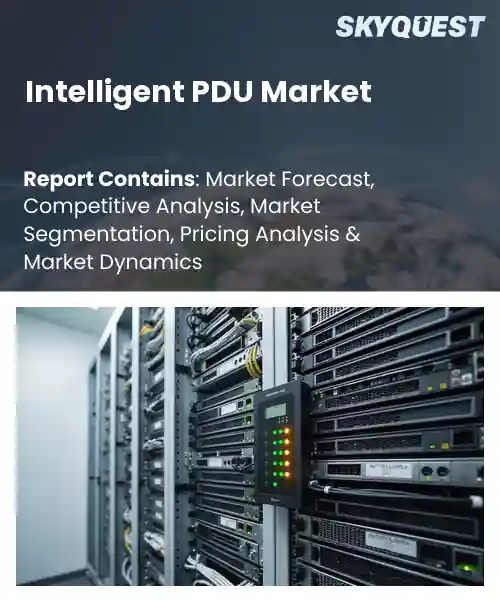
Intelligent PDU Market
Report ID: SQMIG45K2233
Report ID: SQMIG45K2233
[email protected]
USA +1 351-333-4748
Report ID:
SQMIG45K2233 |
Region:
Global |
Published Date: February, 2026
Pages:
157
|Tables:
151
|Figures:
78


Global Intelligent PDU Market size was valued at USD 2.83 Billion in 2024 and is poised to grow from USD 3.03 Billion in 2025 to USD 5.14 Billion by 2033, growing at a CAGR of 6.86% during the forecast period (2026-2033).
The global intelligent PDU market outlook is now undergoing significant change as companies require more efficient power management solutions which results from their increased need for efficient power distribution systems. Intelligent power distribution units are getting increasingly popular as more companies realize how crucial it is to utilize less energy. The devices enable organizations to monitor their power usage in real time while they save energy which allows them to make better decisions about their energy consumption. The market for intelligent PDUs is expected to expand significantly as more companies prioritize sustainability.
Moreover, the global intelligent PDU market growth is driven because of upcoming technological developments. The intelligent PDU market undergoes transformation through the introduction of advanced remote management features together with environmental monitoring capabilities and predictive analytics tools. Businesses today require solutions which power distribution systems will fulfil their present operational needs and their future sustainability requirements. Smart PDUs enable organizations to achieve better operational performance which leads to reduced carbon emissions. The smart PDUs function as vital elements which help organizations move toward intelligent infrastructure development. Market stakeholders must track new technologies and changing customer preferences to handle the business opportunities which emerge from this dynamic market environment.
Why Is AI Becoming Essential in Intelligent PDUs?
The global intelligent PDU sector is experiencing rapid transformation through artificial intelligence (AI) which enables data centers and industrial sites to monitor power usage in real time while predicting power needs and distributing electrical loads. AI uses environmental data and usage patterns to decrease energy waste while maintaining power distribution efficiency at safe levels and preventing overloads. The modern PDUs developed by Eaton and other companies feature artificial intelligence (AI) powered analytics dashboards which enable operators to detect problems before they occur. AI-driven predictive maintenance will experience enhancements through upcoming edge computing and machine learning advancements which will take place. The implementation of this technology will produce advanced PDUs which have self-optimizing capabilities to enhance energy efficiency and system reliability across essential infrastructure sites.
Market snapshot - 2026-2033
Global Market Size
USD 3.0 Billion
Largest Segment
Three Phase
Fastest Growth
Three Phase
Growth Rate
8.7% CAGR
To get more insights on this market click here to Request a Free Sample Report
The global intelligent PDU market is segmented into type, end user, power source, connection type, and region. By type, the market is classified into basic PDU, metered PDU, monitored PDU, and smart PDU. Depending on end user, it is divided into data centres, telecommunication, healthcare, and retail. According to power source, the market is categorized into single phase and three phase. As per the connection type, it is trifurcated into horizontal, vertical, and rack mounted. Regionally, the market is analysed across North America, Europe, Latin America, Middle East & Africa, and Asia-Pacific.
As per the global intelligent PDU market analysis, the most advanced version of intelligent PDUs exists in smart PDUs because their remote energy monitoring and control abilities allow users to handle energy distribution. The system provides three essential functions which include real-time data assessment and outlet supervision and DCIM system link establishment. Eaton develops smart rack PDUs which data centers use in their hyperscale operations to provide network access and environmental monitoring functions. The company leads the market because its products enable customers to achieve higher operational performance and extended uptime.
However, the monitored PDUs category is anticipated to lead the market because consumers prefer to track power usage in real time without needing to operate complex switching systems. The modern IT racks of today need these devices because they provide users with remote access to both environmental data and load monitoring capabilities.
According to the global intelligent PDU market forecast, the market reaches its highest level through data centers which operate with increasing numbers of digital technology users who use cloud services and AI-enabled computing. Intelligent PDUs function as essential components which deliver power distribution services to high-density server racks. The world uses Schneider Electric and other companies' intelligent rack PDUs to run data centers while they control energy consumption. The need for internet traffic and data storage capabilities creates a situation where this technology maintains its market position.
However, the telecommunication category is anticipated to have the highest intelligent PDU market share. The expansion of 5G infrastructure with edge computing nodes and network densification makes reliable power management essential for modern operations. Vertiv and other companies produce smart PDUs which network infrastructure and telecom base stations use to run their systems. These PDUs provide two essential functions which sustain system functionality while delivering power distribution throughout the system.
To get detailed segments analysis, Request a Free Sample Report
As per the intelligent PDU market regional forecast, factors that exist in North America have achieved their maximum potential because all necessary conditions for fast tracking intelligent power distribution system implementation have reached their optimal state. The advanced PDU market development in North America results from three main factors which include hyperscale data centers, enterprise data centers, and companies that operate both campus sites and edge network infrastructure. The market leaders have established themselves through three core factors which include their strong vendor presence that operates local research and development facilities, their established research relationship between IT teams and facilities teams, and their governmental connection to energy efficiency standards.
The Intelligent PDU sector in the United States operates through three main components which include hyperscalers who maintain their own data centers and colocation providers who operate established data center facilities. The market demand focuses specifically on three core requirements which include remote monitoring solutions and scalable power distribution systems and integrated management platforms. The IT and facilities teams work together with vendors and system integrators to create tailored solutions that provide exceptional resilience. The two main factors which drive adoption in commercial and public spaces and enterprise systems include the regulatory focus on energy efficiency and the development of strong channel networks.
The Intelligent PDU Market in Canada focuses on reliable power systems which satisfy environmental needs of public sector organizations and telecom companies and colocation facility operators. The market requires service providers to deliver adaptable services which provide energy monitoring capabilities and remote management functions while ensuring compliance with regional standards. Channel partners and systems integrators adapt global platforms for local conditions, prioritizing resilience and deployment. The local markets establish cross border supply relationships which enable companies to obtain advanced hardware solutions and managed services that strengthen their enterprise operations.
The European market is experiencing rapid growth because three main factors have created an environment which includes mandatory energy efficiency standards from government regulations and companies who actively practice sustainable business operations and data centers that are moving toward advanced power management systems. The three main drivers of demand originate from businesses that update their outdated facilities, telecom companies who modernize their systems, and the expanding market for managed power services and analytics. The vendor strategy involves two main elements which require their products to work with existing systems of building management and data centers while their products must comply with national procurement standards.
The Intelligent PDU Market in Germany operates through a sophisticated industrial base which requires two main criteria: high system availability and power efficiency. The market demand for engineering solutions originates from three main sources: the establishment of strict engineering standards, vendors who create solutions together with system integrators, and vendors who develop their own manufacturing standards for research and data center operations. The suppliers provide three core benefits through their products which include modular design options and advanced monitoring capabilities and their products maintain compatibility with the energy policies of the country. The service providers extend their support for infrastructure systems through two main functions: lifecycle maintenance and infrastructure maintenance support.
The Intelligent PDU Market in the United Kingdom operates through two essential systems, including the cloud service sector and the financial services sector, which both need two specific system functions, flexible power systems and remote operational system access. The organization selects products which meet both existing IT system requirements and current buying standards. The system integrators work as critical team members who implement the specific system designs. The company needs to create flexible systems which provide both edge facilities and colocation facilities while supporting their green business objectives across all market segments and expansion targets.
The Intelligent PDU Market in France experiences a current surge due to active modernization projects which target data infrastructure systems, while companies develop local solutions to meet strict sustainability requirements. The product demand requires three core elements which include energy monitoring capabilities and shared deployment models and system interfaces with the national electricity system. The local service companies concentrate their efforts on two main services which include complete system installation and ongoing maintenance of analytical systems. The equipment manufacturers and cloud service providers and integrators work together to speed up market adoption because their carbon reduction targets and operational efficiency requirements determine their buying decisions.
Asia Pacific strengthens its industry position through three key strategies which include expanding cloud and telecom infrastructure, creating strong government support for digitalization, and investing in edge computing to meet growing local demand. The technologies developed by local manufacturers and solution providers get customized to fit regional needs through their focus on modularity and telecom network integration and language and service localization capabilities. The combination of strategic partnerships with global vendors and growing power electronics expertise and a dynamic services ecosystem allows intelligent PDUs to be installed faster in various settings which include industrial sites and hyperscale facilities. The market momentum demonstrates that organizations are currently prioritizing two main objectives which involve building resilience and optimizing energy usage and creating systems that work with existing IT and facilities management systems.
The Intelligent PDU Market in Japan provides high quality engineering services which meet the specialized requirements of various industrial applications. The market demand requires systems with two essential features which are strong redundancy capacity and compact design for small areas together with complete compatibility for both facility management systems and IT management software. The domestic vendors team up with global partners to supply local customers with firmware solutions and technical support while the service providers concentrate on delivering preventive maintenance services and reliability maintenance programs. Energy monitoring systems and efficient power distribution technology together with operational resilience become crucial for organizations because they need to meet their sustainability requirements.
The Intelligent PDU Market in South Korea receives benefits from three main elements which include integrated telecom system upgrades and high concentration of data centers and manufacturing operation needs. The market demand requires compact systems which provide high performance together with direct network operations links and edge computing system links. The local vendors of the country and international suppliers work together to provide their clients with local support together with service delivery and maintenance which uses data analytics. The strong channel networks which commercial and industrial and hyperscale environments show their energy efficiency and resilience capabilities provide support for advancing technology deployment.
To know more about the market opportunities by region and country, click here to
Buy The Complete Report
Increasing Need For Energy Efficiency
The enhanced energy efficiency requirements which data centers and enterprise facilities impose directly drive the adoption of intelligent PDUs because the technology allows detailed power monitoring and control functions which help decrease energy waste while improving load management. Organizations need systems which deliver immediate visibility together with automated power anomaly responses to decrease their operational costs and environmental footprint. Intelligent PDUs enable organizations to achieve corporate sustainability targets and efficiency projects through their capacity to control power systems and generate necessary sustainability reports.
Expansion Of Edge Data Centers
The explosive growth of edge data centers forces businesses to find intelligent power distribution systems which are both compact and capable of performing consistently across numerous remote sites that have restricted staffing resources. Intelligent PDUs enable power management by providing remote monitoring functions together with customizable outlets and automated alert systems which reduce the frequency of required site visits across multiple small facilities. Intelligent PDUs enable operators to manage system uptime while implementing standard power management rules which create mandatory components for all edge infrastructure projects that require both cloud resource control and strategic power management to maintain operational continuity.
High Initial Deployment Costs
The costs associated with intelligent PDU hardware and installation together with installation work and system integration lead to delays in procurement processes because they require businesses to make large initial capital investments. Organizations perceive power system costs as barriers which lead them to protect their current capital instead of investing in power system upgrades which would deliver operational efficiency advantages to their business. Organizations face two main challenges which stop them from spending money on intelligent PDUs: budget limits and their need to choose between different infrastructure projects. The market will experience slow growth because organizations will take extended periods to adopt intelligent PDUs until their complete advantages become evident.
Complex Integration With Legacy Systems
The need to connect intelligent PDUs with existing power and management systems creates multiple integration obstacles because different systems require their own specific interoperability solutions which need dedicated engineering work. The project needs three components for its success because it requires teams to unify their communication protocols with management software systems and physical interface elements. Organizations will wait until they achieve their establishment of integration pathways and vendor ecosystems reach maturity before beginning their market presence. The buyers who want uninterrupted operations with small disruptions must wait until the technology proves it works and operates without problems before they make their intelligent PDU purchases.
Request Free Customization of this report to help us to meet your business objectives.
The intelligent PDU market only has minor competition from major companies which include Schneider Electric and Eaton and Vertiv and APC and ABB. The companies compete through their product creation process which they use to develop new products while they establish product links with DCIM which stands for data center infrastructure management and they create artificial intelligence-based analytics and they discover energy-saving methods. The security control functions and remote monitoring systems and predictive maintenance capabilities and packaged service offerings represent valuable opportunities to establish a distinct market position. Manufacturers use cloud connectivity and strategic alliances and lifecycle services as essential methods to maintain their competitive advantage while they work to meet customer requirements from telecom and data center operations.
SkyQuest’s ABIRAW (Advanced Business Intelligence, Research & Analysis Wing) is our Business Information Services team that Collects, Collates, Correlates, and Analyses the Data collected by means of Primary Exploratory Research backed by robust Secondary Desk research.
As per SkyQuest analysis, the global intelligent PDU market will experience rapid growth because organizations need energy efficiency solutions which data centers require for their growing edge data center needs. The market now prefers rack-mounted solutions which offer direct server compatibility because they enable simpler installation procedures. North America leads the market because it has a concentrated base of hyperscaler and enterprise data center facilities which operate with established channel distribution systems. The high costs required for initial system deployment remain the main obstacle which prevents smaller operators from upgrading their systems. Vendors develop software-enabled modular solutions which use AI-driven analytics to help customers boost operational performance while they work to solve integration issues and achieve growth targets.
| Report Metric | Details | ||
|---|---|---|---|
| Market size value in 2024 | USD Market size value in 2033 | USD Growth Rate | 6.86% |
| Base year | 2024 | ||
| Forecast period | 2026-2033 | ||
| Forecast Unit (Value) | USD Data-ccp-parastyle="Normal | ||
| Segments covered |
|
||
| Regions covered | North America (US, Canada), Europe (Germany, France, United Kingdom, Italy, Spain, Rest of Europe), Asia Pacific (China, India, Japan, Rest of Asia-Pacific), Latin America (Brazil, Rest of Latin America), Middle East & Africa (South Africa, GCC Countries, Rest of MEA) | ||
| Companies covered |
|
||
| Customization scope | Free report customization with purchase. Customization includes:-
|
To get a free trial access to our platform which is a one stop solution for all your data requirements for quicker decision making. This platform allows you to compare markets, competitors who are prominent in the market, and mega trends that are influencing the dynamics in the market. Also, get access to detailed SkyQuest exclusive matrix.
Table Of Content
Executive Summary
Market overview
Parent Market Analysis
Market overview
Market size
KEY MARKET INSIGHTS
COVID IMPACT
MARKET DYNAMICS & OUTLOOK
Market Size by Region
KEY COMPANY PROFILES
Methodology
For the Intelligent PDU Market, our research methodology involved a mixture of primary and secondary data sources. Key steps involved in the research process are listed below:
1. Information Procurement: This stage involved the procurement of Market data or related information via primary and secondary sources. The various secondary sources used included various company websites, annual reports, trade databases, and paid databases such as Hoover's, Bloomberg Business, Factiva, and Avention. Our team did 45 primary interactions Globally which included several stakeholders such as manufacturers, customers, key opinion leaders, etc. Overall, information procurement was one of the most extensive stages in our research process.
2. Information Analysis: This step involved triangulation of data through bottom-up and top-down approaches to estimate and validate the total size and future estimate of the Intelligent PDU Market.
3. Report Formulation: The final step entailed the placement of data points in appropriate Market spaces in an attempt to deduce viable conclusions.
4. Validation & Publishing: Validation is the most important step in the process. Validation & re-validation via an intricately designed process helped us finalize data points to be used for final calculations. The final Market estimates and forecasts were then aligned and sent to our panel of industry experts for validation of data. Once the validation was done the report was sent to our Quality Assurance team to ensure adherence to style guides, consistency & design.
Analyst Support
Customization Options
With the given market data, our dedicated team of analysts can offer you the following customization options are available for the Intelligent PDU Market:
Product Analysis: Product matrix, which offers a detailed comparison of the product portfolio of companies.
Regional Analysis: Further analysis of the Intelligent PDU Market for additional countries.
Competitive Analysis: Detailed analysis and profiling of additional Market players & comparative analysis of competitive products.
Go to Market Strategy: Find the high-growth channels to invest your marketing efforts and increase your customer base.
Innovation Mapping: Identify racial solutions and innovation, connected to deep ecosystems of innovators, start-ups, academics, and strategic partners.
Category Intelligence: Customized intelligence that is relevant to their supply Markets will enable them to make smarter sourcing decisions and improve their category management.
Public Company Transcript Analysis: To improve the investment performance by generating new alpha and making better-informed decisions.
Social Media Listening: To analyze the conversations and trends happening not just around your brand, but around your industry as a whole, and use those insights to make better Marketing decisions.
REQUEST FOR SAMPLE
 REQUEST FREE CUSTOMIZATION
Global Intelligent Pdu Market size was valued at USD 3.0 Billion in 2024 and is poised to grow from USD 3.26 Billion in 2025 to USD 6.36 Billion by 2033, growing at a CAGR of 8.7% during the forecast period (2026-2033).
The intelligent PDU competitive landscape is consolidation-driven and tech-led, with incumbents using strategic acquisitions, partnerships, and product innovation to secure enterprise and hyperscale contracts; examples include Eaton’s 2021 Tripp Lite acquisition and Legrand’s acquisition of Server Technology to broaden outlet-level and rack solutions while vendors deepen DCIM and cloud integration through partnerships and modular outlet-level metering innovations. 'Schneider Electric', 'Eaton', 'Vertiv', 'APC', 'Cyber Power Systems', 'Raritan', 'ABB', 'Legrand SA', 'Tripp Lite', 'Cisco Systems', 'Geist', 'Rittal', 'Delta Electronics', 'Anord Critical Power', 'Siemens', 'Enlogic', 'Black Box Corporation', 'Gude Systems GmbH', 'Emerson Electric', 'PDU Expert UK'
The push for improved energy efficiency in data centers and enterprise facilities directly supports intelligent PDU adoption by enabling more granular power monitoring and control, which reduces waste and optimizes load distribution. Organizations prioritize systems that provide real-time visibility and automated responses to power anomalies to lower operational expenses and environmental impact. Intelligent PDUs offer the necessary controls and reporting to align with corporate sustainability goals and efficiency initiatives, making them a preferred choice when upgrading power infrastructure to achieve measurable improvements in energy utilization and operational resilience.
North America Dominates the Global Intelligent PDU Market


Want to customize this report? This report can be personalized according to your needs. Our analysts and industry experts will work directly with you to understand your requirements and provide you with customized data in a short amount of time. We offer $1000 worth of FREE customization at the time of purchase.
Feedback From Our Clients


 USA (+1) 351-333-4748

