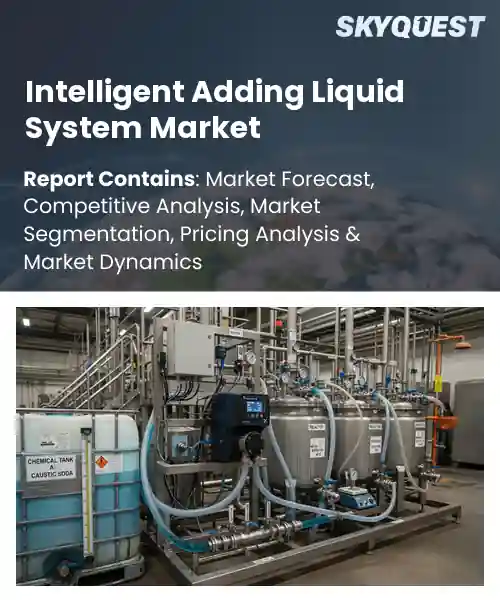
Intelligent Adding Liquid System Market
Report ID: SQMIG20I4023
Report ID: SQMIG20I4023
[email protected]
USA +1 351-333-4748
Report ID:
SQMIG20I4023 |
Region:
Global |
Published Date: August, 2026
Pages:
157
|Tables:
118
|Figures:
77


Global Intelligent Adding Liquid System Market size was valued at USD 918.0 Million in 2024 and is poised to grow from USD 994.19 Million in 2025 to USD 1881.48 Million by 2033, growing at a CAGR of 8.3% during the forecast period (2026-2033).
The Intelligent Adding Liquid System market revolves around automated equipment that precisely meters, mixes, and dispenses liquids in industrial processes. Its primary driver is the demand for higher product quality and regulatory compliance, especially in pharmaceuticals, food‑beverage, and chemicals. Over the past two decades the technology has evolved from basic PLC‑controlled pumps to AI‑enabled closed‑loop platforms that adjust flow rates in time based on sensor feedback. This evolution matters because it cuts material waste, shortens cycle times, and safeguards safety. For example, Pfizer adopted dosing rigs to formulate mRNA vaccines, while Nestlé uses systems to ensure flavor intensity across batches.
Building on that foundation, the most influential growth factor now is the integration of advanced data analytics and IoT connectivity, which transforms simple dosing into a predictive manufacturing capability. When viscosity, temperature, and concentration data feed an AI model, the system can anticipate deviations and automatically recalibrate, preventing off‑spec product before it leaves the line. This capability opens opportunities in contract manufacturing, where clients demand rapid changeover without compromising quality, and in biotech where batch failures can cost millions. Companies such as Lonza have deployed adding stations that log volumes, enabling traceability for regulators and fostering trust among downstream partners.
How is AI automation transforming the intelligent adding liquid system market?
AI automation is reshaping the intelligent adding liquid system market by embedding predictive analytics and real‑time feedback into fluid delivery hardware. Machine‑learning models now anticipate cooling demand, adjusting pump speed and valve position without human intervention. Integrated sensors feed temperature and flow data to cloud platforms, enabling remote optimization and early fault detection. This reduces energy consumption, extends equipment life and improves overall reliability. Vendors are packaging these capabilities into modular controllers that can be retrofitted to existing racks, making the technology accessible to a broad range of data centers. The result is a faster adoption cycle and a more resilient cooling infrastructure.
In July 2021, Emerson Electric was highlighted for its advanced liquid‑addition solutions, demonstrating how intelligent control can boost efficiency and support market growth. The company’s system leverages AI‑driven monitoring to fine‑tune flow rates, reducing waste and enabling tighter thermal margins across data center deployments. Such innovations illustrate the practical impact of automation on operational cost and sustainability.
Market snapshot - (2026-2033)
Global Market Size
USD 918.0 Million
Largest Segment
Automatic Liquid Dosing Systems
Fastest Growth
Semi-Automatic Liquid Dosing Systems
Growth Rate
8.3% CAGR
To get more insights on this market click here to Request a Free Sample Report
Global intelligent adding liquid system market is segmented by product type, technology, application, end user and region. Based on product type, the market is segmented into Automatic Liquid Dosing Systems and Semi-Automatic Liquid Dosing Systems. Based on technology, the market is segmented into Sensor-Based Systems, PLC-Based Systems and AI-Enabled Systems. Based on application, the market is segmented into Chemical Processing, Water & Wastewater Treatment, Food & Beverage, Pharmaceuticals and Other Industrial Applications. Based on end user, the market is segmented into Manufacturing Industries, Utilities and Research Laboratories. Based on region, the market is segmented into North America, Europe, Asia Pacific, Latin America and Middle East & Africa.
AI enabled systems segment dominates because it integrates advanced analytics with real time feedback, allowing precise dosing adjustments that meet stringent quality standards. This capability reduces waste, improves process efficiency, and supports compliance with evolving regulatory frameworks. The convergence of machine learning, connectivity, and predictive maintenance creates a compelling value proposition that drives widespread adoption across complex industrial environments. Operators benefit from intuitive interfaces that simplify troubleshooting and enable rapid scaling of production lines.
Meanwhile, sensor based systems segment emerges as the fastest growing area because its low cost deployment and ease of integration accelerate adoption in legacy plants. Continuous monitoring capabilities enable real time adjustments without extensive reengineering, attracting operators seeking incremental upgrades. This momentum expands market reach and fuels new opportunities for modular solutions.
Automatic liquid dosing systems segment dominates because it delivers fully programmed dosing cycles that eliminate manual intervention, ensuring consistent product quality and high throughput. The seamless integration with plant control architectures reduces human error and labor costs while meeting strict safety protocols. Its reliability and repeatability make it the preferred choice for high volume operations where precision and speed are critical to competitive performance. Customers also appreciate the reduced downtime associated with automated cleaning cycles.
On the other hand, semi automatic liquid dosing systems segment is witnessing the strongest growth momentum because it offers a cost effective bridge for facilities transitioning from manual to fully automated processes. The flexibility to combine operator oversight with automated precision appeals to mid sized plants seeking incremental investment. This trend broadens market adoption and stimulates development of hybrid control solutions.
To get detailed segments analysis, Request a Free Sample Report
The dominance of North America stems from a mature industrial base combined with a strong culture of technological innovation. Companies in the region benefit from deep integration of advanced control systems and a robust supply chain that supports high‑performance adding equipment. Close collaboration between equipment manufacturers, chemical producers, and research institutions accelerates product development and drives adoption across multiple sectors. Regulatory frameworks encourage efficiency and environmental stewardship, prompting manufacturers to invest in intelligent solutions that optimize dosing accuracy and reduce waste. This ecosystem of expertise, infrastructure, and proactive policy creates a self‑reinforcing cycle that keeps North America at the forefront of market leadership.
Intelligent Adding Liquid System Market in the United States thrives on a convergence of high‑tech expertise and large‑scale industrial demand. The presence of leading automation firms and a deep talent pool fuels continuous improvement in sensor integration and data analytics. End‑users prioritize operational resilience and cost efficiency, prompting rapid uptake of adaptive dosing technologies. Collaborative research initiatives further enhance system intelligence, ensuring that solutions remain aligned with evolving production requirements.
Intelligent Adding Liquid System Market in Canada benefits from a strong emphasis on sustainable manufacturing and a supportive regulatory environment. Environmental priorities drive companies to adopt precise liquid addition methods that minimize waste and improve product consistency. Close ties between academic research centers and industry accelerate the deployment of advanced monitoring tools. The market’s growth is reinforced by a collaborative network that shares best practices, fostering confidence in intelligent solutions across a diverse range of processing sectors.
Europe’s rapid expansion is powered by rigorous environmental standards and a strategic focus on process efficiency. Strong engineering heritage across the continent fuels innovation in sensor technology, data connectivity, and smart control algorithms. Collaborative frameworks among industry groups, research institutes, and standards bodies promote harmonized solutions that can be readily deployed across borders. The emphasis on circular economy principles encourages precise liquid dosing to reduce material loss and improve product quality. Together, these factors create a fertile ground for intelligent adding systems to become integral to modern European manufacturing.
Intelligent Adding Liquid System Market in Germany is anchored by world‑class engineering and a long tradition of precision manufacturing. The strong presence of automation specialists supports the development of highly reliable dosing equipment. Industry participants prioritize integration with existing digital platforms, ensuring seamless data exchange and process optimization. Continuous investment in research drives enhancements in sensor accuracy and predictive maintenance capabilities, reinforcing Germany’s leadership in the sector.
Intelligent Adding Liquid System Market in the United Kingdom is characterized by rapid adoption driven by a dynamic startup ecosystem and aggressive efficiency goals. Companies embrace modular, software‑driven solutions that enable quick scaling and integration with cloud‑based analytics. The focus on reducing operational expenditures aligns closely with intelligent dosing technologies that deliver higher accuracy and lower waste. Collaborative initiatives between academia and industry accelerate knowledge transfer, positioning the United Kingdom as a fast‑moving hub for intelligent adding innovations.
Intelligent Adding Liquid System Market in France is emerging through strong governmental support for advanced manufacturing and sustainability initiatives. French firms are increasingly valuing precision dosing as a means to meet stringent quality and environmental expectations. Partnerships with research laboratories foster the development of bespoke solutions tailored to niche process requirements. This emerging momentum is creating a fertile environment for intelligent adding technologies to gain broader acceptance across diverse industrial applications.
Asia Pacific is strengthening its position by leveraging rapid industrialization and a growing emphasis on smart manufacturing. The region’s manufacturers are keen to adopt technologies that enhance productivity while meeting tightening environmental expectations. Investment in digital infrastructure and connectivity enables seamless integration of intelligent adding solutions with broader factory automation systems. Local equipment providers are collaborating closely with global innovators to adapt advanced functionalities to regional process nuances. This combination of demand for efficiency, supportive policy environments, and collaborative innovation is elevating Asia Pacific’s role in the global landscape.
Intelligent Adding Liquid System Market in Japan benefits from a culture of meticulous quality control and a strong focus on automation. Leading electronics and chemical manufacturers drive the demand for precise liquid dosing to maintain high product standards. Integration of advanced robotics and real‑time monitoring aligns with Japan’s broader smart factory initiatives, ensuring that intelligent adding technologies are embedded within highly coordinated production lines. Continuous improvement philosophies further promote adoption of adaptive dosing solutions.
Intelligent Adding Liquid System Market in South Korea is propelled by a vibrant high‑tech sector and government incentives encouraging digital transformation. Manufacturers seek to enhance throughput and reduce variability through sophisticated dosing equipment that leverages AI‑enabled analytics. Close collaboration between semiconductor producers and system integrators accelerates the refinement of ultra‑precise liquid addition capabilities. This focus on cutting‑edge automation solidifies South Korea’s emerging prominence in the intelligent adding arena.
To know more about the market opportunities by region and country, click here to
Buy The Complete Report
Adopting Advanced Control Algorithms
Growing Integration With IoT Platforms
Regulatory Compliance Challenges
High Initial Capital Investment
Request Free Customization of this report to help us to meet your business objectives.
The competitive landscape is shaped by aggressive M&A activity, strategic partnerships with equipment manufacturers, and rapid tech innovation such as AI‑driven dosing algorithms and IoT‑enabled monitoring, which are accelerating product differentiation and market entry for new players. Established firms are acquiring niche sensor developers, while startups collaborate with large chemical processors to integrate intelligent control modules, driving faster adoption of precision liquid‑adding solutions.
Top Player’s Company Profile
SkyQuest’s ABIRAW (Advanced Business Intelligence, Research & Analysis Wing) is our Business Information Services team that Collects, Collates, Correlates, and Analyses the Data collected by means of Primary Exploratory Research backed by robust Secondary Desk research.
As per SkyQuest analysis, the global intelligent adding liquid system market is driven primarily by the adoption of advanced control algorithms that deliver precise dosing and predictive maintenance. A second key driver is the growing integration with IoT platforms, which enables real‑time monitoring, remote optimization and data‑driven decision making. The main restraint remains regulatory compliance challenges that can delay procurement and increase development costs. North America continues to dominate the market due to its mature industrial base and strong innovation ecosystem, while AI‑enabled systems lead the technology segment by offering adaptive, data‑rich dosing solutions.
| Report Metric | Details |
|---|---|
| Market size value in 2024 | USD 918.0 Million |
| Market size value in 2033 | USD 1881.48 Million |
| Growth Rate | 8.3% |
| Base year | 2024 |
| Forecast period | (2026-2033) |
| Forecast Unit (Value) | USD Million |
| Segments covered |
|
| Regions covered | North America (US, Canada), Europe (Germany, France, United Kingdom, Italy, Spain, Rest of Europe), Asia Pacific (China, India, Japan, Rest of Asia-Pacific), Latin America (Brazil, Rest of Latin America), Middle East & Africa (South Africa, GCC Countries, Rest of MEA) |
| Companies covered |
|
| Customization scope | Free report customization with purchase. Customization includes:-
|
To get a free trial access to our platform which is a one stop solution for all your data requirements for quicker decision making. This platform allows you to compare markets, competitors who are prominent in the market, and mega trends that are influencing the dynamics in the market. Also, get access to detailed SkyQuest exclusive matrix.
Table Of Content
Executive Summary
Market overview
Parent Market Analysis
Market overview
Market size
KEY MARKET INSIGHTS
COVID IMPACT
MARKET DYNAMICS & OUTLOOK
Market Size by Region
KEY COMPANY PROFILES
Methodology
For the Intelligent Adding Liquid System Market, our research methodology involved a mixture of primary and secondary data sources. Key steps involved in the research process are listed below:
1. Information Procurement: This stage involved the procurement of Market data or related information via primary and secondary sources. The various secondary sources used included various company websites, annual reports, trade databases, and paid databases such as Hoover's, Bloomberg Business, Factiva, and Avention. Our team did 45 primary interactions Globally which included several stakeholders such as manufacturers, customers, key opinion leaders, etc. Overall, information procurement was one of the most extensive stages in our research process.
2. Information Analysis: This step involved triangulation of data through bottom-up and top-down approaches to estimate and validate the total size and future estimate of the Intelligent Adding Liquid System Market.
3. Report Formulation: The final step entailed the placement of data points in appropriate Market spaces in an attempt to deduce viable conclusions.
4. Validation & Publishing: Validation is the most important step in the process. Validation & re-validation via an intricately designed process helped us finalize data points to be used for final calculations. The final Market estimates and forecasts were then aligned and sent to our panel of industry experts for validation of data. Once the validation was done the report was sent to our Quality Assurance team to ensure adherence to style guides, consistency & design.
Analyst Support
Customization Options
With the given market data, our dedicated team of analysts can offer you the following customization options are available for the Intelligent Adding Liquid System Market:
Product Analysis: Product matrix, which offers a detailed comparison of the product portfolio of companies.
Regional Analysis: Further analysis of the Intelligent Adding Liquid System Market for additional countries.
Competitive Analysis: Detailed analysis and profiling of additional Market players & comparative analysis of competitive products.
Go to Market Strategy: Find the high-growth channels to invest your marketing efforts and increase your customer base.
Innovation Mapping: Identify racial solutions and innovation, connected to deep ecosystems of innovators, start-ups, academics, and strategic partners.
Category Intelligence: Customized intelligence that is relevant to their supply Markets will enable them to make smarter sourcing decisions and improve their category management.
Public Company Transcript Analysis: To improve the investment performance by generating new alpha and making better-informed decisions.
Social Media Listening: To analyze the conversations and trends happening not just around your brand, but around your industry as a whole, and use those insights to make better Marketing decisions.
REQUEST FOR SAMPLE
 REQUEST FREE CUSTOMIZATION
Global Intelligent Adding Liquid System Market size was valued at USD 918.0 Million in 2024 and is poised to grow from USD 994.19 Million in 2025 to USD 1881.48 Million by 2033, growing at a CAGR of 8.3% during the forecast period (2026-2033).
The competitive landscape is shaped by aggressive M&A activity, strategic partnerships with equipment manufacturers, and rapid tech innovation such as AI‑driven dosing algorithms and IoT‑enabled monitoring, which are accelerating product differentiation and market entry for new players. Established firms are acquiring niche sensor developers, while startups collaborate with large chemical processors to integrate intelligent control modules, driving faster adoption of precision liquid‑adding solutions. 'ProMinent GmbH', 'Grundfos Holding A/S', 'SEKO S.p.A.', 'Watson-Marlow Fluid Technology Solutions', 'Dover Corporation', 'IDEX Corporation', 'Verder International B.V.', 'Emerson Electric Co.', 'Endress+Hauser Group', 'SUEZ SA', 'Xylem Inc.', 'LMI Pumps', 'Blue-White Industries Ltd.', 'Milton Roy LLC', 'LEWA GmbH', 'SPX FLOW, Inc.', 'Ingersoll Rand Inc.', 'Bürkert Fluid Control Systems', 'Valmet Oyj', 'Flowrox Oy'
Adopting advanced control algorithms enables precise dosing, real‑time adjustments, and predictive maintenance, which collectively enhance operational efficiency and product quality. By reducing manual intervention, manufacturers experience lower error rates and faster cycle times, fostering confidence in automated liquid handling. This technological capability also supports customization for diverse formulations, expanding applicability across industries and encouraging broader market acceptance. Consequently, the perceived value of intelligent adding systems rises, driving increased investment and adoption among end users. The improved reliability also reduces downtime, allowing continuous production and reinforcing supply chain stability.
Digital Integration Drive: Manufacturers are embedding advanced sensors, AI analytics, and cloud connectivity into intelligent adding liquid systems to enable real‑time monitoring of viscosity, temperature, and flow rates. This digital integration facilitates predictive maintenance, remote troubleshooting, and seamless data exchange with enterprise resource planning platforms. As a result, operators achieve higher uptime, reduce waste, and gain actionable insights for process optimization. The shift toward fully connected equipment is reshaping procurement criteria, encouraging vendors to offer interoperable, software‑defined solutions that align with Industry 4.0 strategies.
Why does North America Dominate the Global Intelligent Adding Liquid System Market? |@12


Want to customize this report? This report can be personalized according to your needs. Our analysts and industry experts will work directly with you to understand your requirements and provide you with customized data in a short amount of time. We offer $1000 worth of FREE customization at the time of purchase.
Feedback From Our Clients


 USA (+1) 351-333-4748

