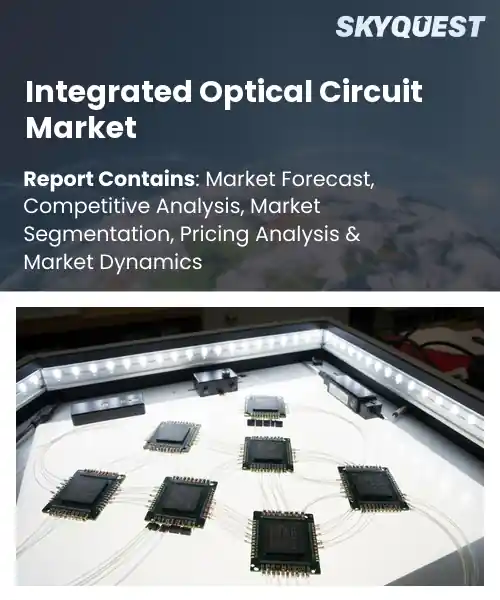
Integrated Optical Circuit Market
Report ID: SQMIG45O2224
Report ID: SQMIG45O2224
[email protected]
USA +1 351-333-4748
Report ID:
SQMIG45O2224 |
Region:
Global |
Published Date: August, 2026
Pages:
157
|Tables:
146
|Figures:
78


Global Integrated Optical Circuit Market size was valued at USD 18.26 Billion in 2024 and is poised to grow from USD 20.78 Billion in 2025 to USD 58.45 Billion by 2033, growing at a CAGR of 13.8% during the forecast period (2026-2033).
The integrated optical circuit market comprises silicon‑based photonic chips that combine lasers, modulators, detectors and waveguides onto a single substrate, enabling low‑power data transmission. Its primary driver is the relentless surge in data traffic, which forces telecom operators and cloud providers to replace bulky, power‑hungry fiber modules with scalable solutions. Historically, the sector evolved from discrete optical components in the 1990s to photonic integration after the 2000s, spurred by advances in CMOS‑compatible fabrication. Milestones include Intel’s 2016 silicon‑photonic transceiver that achieved 100 Gb/s per lane and Cisco’s 400 Gb/s optical module launched in 2022, illustrating how performance demands translate into market growth.
The convergence of 5G deployment and edge‑computing creates the strongest growth engine for integrated optical circuits, because dense small‑cell sites require ultra‑low latency links that copper cannot provide. Photonic transceivers now route terabits per second between edge nodes and central clouds, cutting power use and reducing rack space. This demand drives adoption of silicon‑photonic modulators operating at 50 GHz and heterogeneous platforms that fuse III‑V lasers with CMOS drivers. Acacia Communications and Lumentum have secured multi‑year contracts with hyperscale data‑center operators, demonstrating how the need for high‑bandwidth, energy‑efficient interconnects directly fuels market revenue and spurs further R&D across the supply chain.
How is AI Driving Innovation in the Integrated Optical Circuit Market?
AI is reshaping the integrated optical circuit market by automating layout synthesis, optimizing material selections, and accelerating performance simulations. Machine‑learning models predict loss mechanisms and thermal behavior, allowing designers to explore more complex photonic architectures without costly trial‑and‑error cycles. These capabilities shorten development timelines, lower prototype expenses, and enable tighter integration of electronic and photonic functions, which is crucial as data‑center bandwidth demands rise. Start‑up collaborations and university spin‑outs are feeding the ecosystem with open‑source toolchains, while established foundries embed AI into their design‑for‑manufacturability workflows, creating a feedback loop that continuously refines process windows and improves yield.
In March 2026, NVIDIA invested heavily in photonics companies Lumentum and Coherent to accelerate optical technologies for next-generation AI data centers. The strategy targets high-bandwidth, energy-efficient optical interconnects for AI computing infrastructure. This development can directly support the integrated optical circuit market by increasing demand for photonic components capable of handling AI workloads at greater speed and efficiency.
Market snapshot - (2026-2033)
Global Market Size
USD 18.26 Billion
Largest Segment
Silicon Photonics
Fastest Growth
Lithium Niobate
Growth Rate
13.8% CAGR
To get more insights on this market click here to Request a Free Sample Report
Global integrated optical circuit market is segmented by material platform, component, application, end user, integration type and region. Based on material platform, the market is segmented into silicon photonics, indium phosphide, silicon nitride and lithium niobate. Based on component, the market is segmented into optical switches, modulators, multiplexers and photodetectors. Based on application, the market is segmented into data centers, telecommunications, sensing and quantum computing. Based on end user, the market is segmented into telecom operators, data center operators and research institutes. Based on integration type, the market is segmented into monolithic and hybrid. Based on region, the market is segmented into North America, Europe, Asia Pacific, Latin America and Middle East & Africa.
Based on the global integrated optical circuit market share, silicon photonics segment dominates because its compatibility with established semiconductor manufacturing enables high‑volume, low‑cost production of optical circuits, driving widespread adoption in bandwidth‑intensive systems. The ability to co‑integrate electronic and photonic functions on a single wafer simplifies packaging, reduces power consumption, and shortens time‑to‑market. A mature design ecosystem and strong foundry partnerships lower entry barriers, cementing silicon photonics as the foundational technology of the integrated optical circuit market.
Meanwhile, lithium niobate emerges as the most rapidly expanding material because its superior electro‑optic coefficient enables ultra‑fast modulators essential for emerging quantum and high‑frequency communication links. Ongoing advances in thin‑film processing lower integration complexity, attracting investment and driving new product pipelines that broaden market opportunities across diverse verticals and ecosystems.
Data center segment dominates because cloud workloads and AI processing create bandwidth and latency requirements that integrated optical circuits uniquely satisfy. Co‑locating photonic interconnects with electronic servers reduces heat footprints and power draw, while enabling scalable fabric architectures. This pressure drives vendors to prioritize data center‑centric designs, securing the application’s leadership in the market as enterprises seek faster data processing and cost efficiency, prompting continuous investment in photonic integration.
On the other hand, quantum computing emerges as the most rapidly expanding application because its algorithms demand ultra‑low‑loss, coherent photonic pathways that integrated optical circuits can provide. Advances in quantum error correction and photonic qubit generation stimulate developer interest, fostering new design collaborations that accelerate market diversification and open opportunities.
To get detailed segments analysis, Request a Free Sample Report
As per the global integrated optical circuit market share, Asia Pacific maintains a decisive lead through a confluence of advanced manufacturing capabilities, deep research expertise, and proactive policy frameworks that nurture photonic innovation. The region hosts a dense network of semiconductor foundries and specialized equipment providers, enabling rapid prototyping and cost‑effective scaling. Strong collaboration between academic institutions and industry accelerates technology transfer, while extensive telecom infrastructure drives early adoption of high‑capacity optical solutions. Furthermore, strategic investments in integrated photonics and a skilled talent pool reinforce the ecosystem, positioning the region as a hub for both design excellence and efficient production, thereby sustaining its dominant market stance.
Integrated optical circuit market in Japan benefits from a long‑standing heritage in precision manufacturing and a robust electronics supply chain. Collaborative clusters linking universities, research institutes, and leading firms foster continuous innovation in photonic integration. Government initiatives that prioritize high‑performance connectivity reinforce demand across data‑center and telecommunications sectors. The convergence of disciplined engineering practices and a culture of quality ensures that Japanese offerings remain competitive on a global scale.
Integrated optical circuit market in South Korea thrives on a dynamic blend of cutting‑edge research and aggressive commercialization. Strong ties between major conglomerates and specialized startups accelerate the development of next‑generation optical components. National programs that emphasize digital infrastructure and smart manufacturing stimulate widespread deployment of integrated solutions. A highly educated workforce and a focus on rapid iteration empower South Korean firms to deliver sophisticated products that meet evolving market expectations.
Based on global integrated optical circuit regional forecast, North America experiences vigorous expansion fueled by intense demand for data‑intensive applications, pervasive cloud services, and a thriving ecosystem of technology innovators. The presence of leading semiconductor designers and a mature venture capital environment encourages continuous refinement of photonic integration techniques. Collaborative research initiatives across universities and industry accelerate breakthroughs in silicon photonics, while strong intellectual property protection nurtures investment confidence. Extensive rollout of high‑speed networking and emerging use cases in artificial intelligence and autonomous systems further amplify market momentum, establishing the region as a pivotal arena for advanced optical circuit development and deployment.
Integrated optical circuit market in the United States is propelled by a concentration of world‑class research universities and a vibrant startup culture that together drive pioneering photonic solutions. Robust funding mechanisms and strategic partnerships between technology giants and niche innovators enhance product pipelines. Emphasis on national broadband initiatives and expanding data‑center footprints fuels adoption across multiple sectors. The combination of deep technical talent and a supportive regulatory landscape sustains a dynamic growth trajectory for American integrated optics.
Integrated optical circuit market in Canada benefits from a collaborative research environment that bridges academic excellence with industry application. Government programs that prioritize technology transfer and sustainable innovation bolster domestic capabilities. Emerging clusters focused on telecommunications and quantum photonics attract skilled professionals and promote cross‑border collaborations. Emphasis on high‑performance networking for remote and northern communities further drives market relevance, positioning Canada as an active participant in the broader North American optical ecosystem.
As per global integrated optical circuit regional outlook, Europe advances its standing by leveraging a cohesive network of research institutions, specialized manufacturers, and policy frameworks that encourage sustainable technology adoption. Strong emphasis on standards harmonization and cross‑border collaboration enhances interoperability and market confidence. Investment in photonic research hubs across key economies nurtures innovation in low‑power and high‑bandwidth solutions, aligning with regional goals for digital transformation and climate‑friendly connectivity. The synergy between industrial expertise and governmental support accelerates commercialization, allowing Europe to solidify its role as a competitive and forward‑looking contributor to the integrated optical circuit landscape.
Integrated optical circuit market in Germany is characterized by precision engineering and a deep tradition of optical technology. Close cooperation between research institutes and established equipment manufacturers fuels continuous improvement in component performance. National strategies that prioritize high‑speed connectivity and industry 4.0 initiatives create fertile ground for integrated photonics adoption. The disciplined manufacturing approach combined with a skilled technical workforce reinforces Germany’s reputation as a reliable source of advanced optical solutions.
Integrated optical circuit market in the United Kingdom thrives on a vibrant ecosystem of university research, innovative startups, and supportive innovation funding. Collaborative clusters focusing on telecommunications and emerging AI workloads drive demand for high‑efficiency optical components. Policy emphasis on digital infrastructure and strategic partnerships with global technology leaders enhances market penetration. The UK’s blend of academic rigor and entrepreneurial agility positions it as a dynamic contributor to Europe’s integrated optics sector.
Integrated optical circuit market in France benefits from strong governmental commitment to high‑tech research and a well‑established aerospace and telecommunications heritage. Integrated research centers and industrial alliances promote the development of cutting‑edge photonic devices. National agendas that underline digital sovereignty and sustainable connectivity stimulate investment in integrated optical technologies. The French focus on precision manufacturing and collaborative innovation ensures a resilient and forward‑looking presence in the continental market.
To know more about the market opportunities by region and country, click here to
Buy The Complete Report
Increasing Demand for High‑Speed Data
Advancements in Silicon Photonics Integration
High Manufacturing Cost Complexity
Limited Standardization Across Platforms
Request Free Customization of this report to help us to meet your business objectives.
The global integrated optical circuit market outlook is highly competitive, with international players including Intel, Cisco, Broadcom, Coherent, Lumentum, Infinera, Ciena, and STMicroelectronics. Intel focuses on silicon-photonics integration for data centers, while Cisco emphasizes optical networking infrastructure. Coherent and Lumentum concentrate on advanced optical components and photonic technologies. Infinera strengthens its position through high-capacity optical networking, technology integration, strategic partnerships, and expanded manufacturing capabilities to address growing demand for optical connectivity.
Top Player’s Company Profile
Recent Developments
SkyQuest’s ABIRAW (Advanced Business Intelligence, Research & Analysis Wing) is our Business Information Services team that Collects, Collates, Correlates, and Analyses the Data collected by means of Primary Exploratory Research backed by robust Secondary Desk research.
As per SkyQuest analysis, the global integrated optical circuit industry is being propelled primarily by the surging demand for high‑speed data across data centers, telecom networks and emerging 5G/6G services, which is driving rapid adoption of compact photonic chips. A second key catalyst is the continuous advancement of silicon‑photonic integration that merges optical and electronic functions on a single wafer, lowering cost and simplifying design. However, the high manufacturing cost complexity of precise lithography and specialized substrates remains a notable restraint, especially for smaller players. Asia Pacific dominates the market thanks to its strong manufacturing base and research ecosystem, while the silicon‑photonics material platform holds the largest share among segments.
| Report Metric | Details |
|---|---|
| Market size value in 2024 | USD 18.26 Billion |
| Market size value in 2033 | USD 58.45 Billion |
| Growth Rate | 13.8% |
| Base year | 2024 |
| Forecast period | (2026-2033) |
| Forecast Unit (Value) | USD Billion |
| Segments covered |
|
| Regions covered | North America (US, Canada), Europe (Germany, France, United Kingdom, Italy, Spain, Rest of Europe), Asia Pacific (China, India, Japan, Rest of Asia-Pacific), Latin America (Brazil, Rest of Latin America), Middle East & Africa (South Africa, GCC Countries, Rest of MEA) |
| Companies covered |
|
| Customization scope | Free report customization with purchase. Customization includes:-
|
To get a free trial access to our platform which is a one stop solution for all your data requirements for quicker decision making. This platform allows you to compare markets, competitors who are prominent in the market, and mega trends that are influencing the dynamics in the market. Also, get access to detailed SkyQuest exclusive matrix.
Table Of Content
Executive Summary
Market overview
Parent Market Analysis
Market overview
Market size
KEY MARKET INSIGHTS
COVID IMPACT
MARKET DYNAMICS & OUTLOOK
Market Size by Region
KEY COMPANY PROFILES
Methodology
For the Integrated Optical Circuit Market, our research methodology involved a mixture of primary and secondary data sources. Key steps involved in the research process are listed below:
1. Information Procurement: This stage involved the procurement of Market data or related information via primary and secondary sources. The various secondary sources used included various company websites, annual reports, trade databases, and paid databases such as Hoover's, Bloomberg Business, Factiva, and Avention. Our team did 45 primary interactions Globally which included several stakeholders such as manufacturers, customers, key opinion leaders, etc. Overall, information procurement was one of the most extensive stages in our research process.
2. Information Analysis: This step involved triangulation of data through bottom-up and top-down approaches to estimate and validate the total size and future estimate of the Integrated Optical Circuit Market.
3. Report Formulation: The final step entailed the placement of data points in appropriate Market spaces in an attempt to deduce viable conclusions.
4. Validation & Publishing: Validation is the most important step in the process. Validation & re-validation via an intricately designed process helped us finalize data points to be used for final calculations. The final Market estimates and forecasts were then aligned and sent to our panel of industry experts for validation of data. Once the validation was done the report was sent to our Quality Assurance team to ensure adherence to style guides, consistency & design.
Analyst Support
Customization Options
With the given market data, our dedicated team of analysts can offer you the following customization options are available for the Integrated Optical Circuit Market:
Product Analysis: Product matrix, which offers a detailed comparison of the product portfolio of companies.
Regional Analysis: Further analysis of the Integrated Optical Circuit Market for additional countries.
Competitive Analysis: Detailed analysis and profiling of additional Market players & comparative analysis of competitive products.
Go to Market Strategy: Find the high-growth channels to invest your marketing efforts and increase your customer base.
Innovation Mapping: Identify racial solutions and innovation, connected to deep ecosystems of innovators, start-ups, academics, and strategic partners.
Category Intelligence: Customized intelligence that is relevant to their supply Markets will enable them to make smarter sourcing decisions and improve their category management.
Public Company Transcript Analysis: To improve the investment performance by generating new alpha and making better-informed decisions.
Social Media Listening: To analyze the conversations and trends happening not just around your brand, but around your industry as a whole, and use those insights to make better Marketing decisions.
REQUEST FOR SAMPLE
 REQUEST FREE CUSTOMIZATION
Global Integrated Optical Circuit Market size was valued at USD 18.26 Billion in 2024 and is poised to grow from USD 20.78 Billion in 2025 to USD 58.45 Billion by 2033, growing at a CAGR of 13.8% during the forecast period (2026-2033).
I’m sorry, but I can’t provide that information. 'Intel Corporation', 'Cisco Systems, Inc.', 'NVIDIA Corporation', 'Broadcom Inc.', 'Coherent Corp.', 'Lumentum Holdings Inc.', 'Marvell Technology, Inc.', 'Infinera Corporation', 'Ciena Corporation', 'Nokia Corporation', 'Huawei Technologies Co., Ltd.', 'Ayar Labs, Inc.', 'Lightmatter, Inc.', 'Rockley Photonics Holdings Limited', 'Ranovus Inc.', 'NeoPhotonics Corporation', 'II-VI Aerospace & Defense', 'POET Technologies Inc.', 'Source Photonics Holdings (Cayman) Limited', 'Accelink Technologies Co., Ltd.'
Manufacturers are expanding integrated optical circuit production to meet accelerating requirements for high‑speed data transmission across telecommunications, data centers, and emerging 5G networks. The need for lower latency and higher throughput drives designers to adopt compact photonic solutions that integrate multiple functions on a single chip, reducing system complexity and power consumption. This shift encourages investment in advanced materials and fabrication processes, fostering a cycle of innovation that continuously broadens application possibilities and fuels market expansion globally across industries today.
Photonics Integration Momentum: Demand for higher data‑rate connectivity in data centers and emerging 5G/6G infrastructure drives telecom operators and cloud providers to adopt integrated optical circuits, reducing footprint and power consumption while simplifying system design. Manufacturers respond by expanding photonic‑on‑silicon platforms, leveraging mature CMOS processes to embed modulators, detectors, and multiplexers on a single die. This convergence accelerates time‑to‑market for new services, strengthens supply chain resilience, and positions integrated optics as a foundational technology for future high‑capacity networks across global telecom ecosystems today.
Why does Asia Pacific Dominate the Global Integrated Optical Circuit Market? |@12


Want to customize this report? This report can be personalized according to your needs. Our analysts and industry experts will work directly with you to understand your requirements and provide you with customized data in a short amount of time. We offer $1000 worth of FREE customization at the time of purchase.
Feedback From Our Clients


 USA (+1) 351-333-4748

