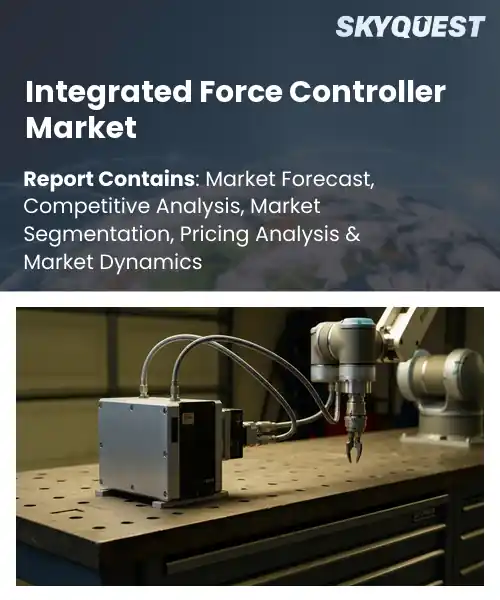
Integrated Force Controller Market
Report ID: SQMIG20D2574
Report ID: SQMIG20D2574
[email protected]
USA +1 351-333-4748
Report ID:
SQMIG20D2574 |
Region:
Global |
Published Date: March, 2026
Pages:
157
|Tables:
118
|Figures:
77


Global Integrated Force Controller Market size was valued at USD 13.5 Billion in 2024 and is poised to grow from USD 14.43 Billion in 2025 to USD 24.61 Billion by 2033, growing at a CAGR of 6.9% during the forecast period (2026-2033).
Key Takeaways: Market Trends & Insights
The global integrated force controller market strategies comprise specialized controllers that combine force and torque sensing, control algorithms, and motion interfaces into compact modules for robotic systems. This market matters because force-aware control enables compliant contact, precision assembly, and safer human-robot collaboration, which reduces defects and accelerates automation adoption. Historically, the industry evolved from discrete sensors and PLC-based control to embedded controllers and model-based algorithms, as manufacturers shifted from rigid position-only robots to force-capable systems. A primary driver has been the surge in flexible production and cobot deployment; for example, automotive and electronics assembly increasingly require force control to cope with variability.
Because manufacturers require adaptable and safe automation, integrated force controllers are becoming essential components that enable operational capabilities and business models. Lower sensor and processor costs cause vendors to offer more compact controllers whose adoption reduces cycle time and scrap by enabling compliant insertions and adaptive assembly, as seen in automotive fastener systems and PCB component placement. Industry 4.0 connectivity leads to force-derived process analytics that drive predictive maintenance and quality control, and software and service revenue. Regulatory emphasis on worker safety further accelerates deployment in collaborative tasks, producing opportunities for tiered products and retrofittable modules aimed at medium enterprises.
How is AI Enhancing Precision in the Integrated Force Controller Market?
Integrated force controllers pair force sensing with motion control and advanced algorithms to manage physical contact between robots and their environment. AI improves precision and adapting force profiles in real time so robots maintain gentle but accurate contact during sanding insertion and assembly. The market is moving toward embedded AI on controllers and edge computing to reduce manual tuning and speed deployment while supporting safer human robot collaboration. Practical examples include sensor fusion of torque and tactile inputs and adaptive impedance strategies that improve surface finish and repeatability across varied materials.
In May 2025, ABB unveiled the OmniCore controller with Force Control enabled GoFa cobots and AI supported demos. This development shows how AI driven force profiling and sensor fusion reduce setup effort and increase consistent contact precision which supports faster adoption and greater efficiency in contact rich manufacturing.

To get more insights on this market click here to Request a Free Sample Report
Global integrated force controller market is segmented by control architecture, sensor technology compatibility, axis configuration, application domain and region. Based on control architecture, the market is segmented into hardware-based controllers, software-integrated controllers and robot-integrated. Based on sensor technology compatibility, the market is segmented into strain gauge based, piezoelectric sensors and optical/capacitive force sensors. Based on axis configuration, the market is segmented into single-axis force control and multi-axis/6-DOF force-torque control. Based on application domain, the market is segmented into robotic assembly, grinding, deburring & polishing, material testing & quality control and collaborative robots (cobots) safety. Based on region, the market is segmented into North America, Europe, Asia Pacific, Latin America and Middle East & Africa.
As per the global integrated force controller market growth, hardware-based controllers segment dominates because dedicated processing and fixed-function architectures deliver deterministic, low-latency force loops that industrial users rely on for repeatable contact tasks. The dependability reduces the complexity of integration and facilitates faster safety certification so that OEMs can adopt them in large-scale production lines. OEMs like them due to the proven robust performance in difficult operating environments; they will have compatibility with the existing motion controller systems they are using.
However, software-integrated controllers are witnessing the strongest growth momentum as modular software enables rapid feature updates, adaptive tuning, and integration with vision and force algorithms. The adoption of adaptable, upgradeable systems in custom assembly and service robotics is increasing due to demand from users, resulting in a more rapid deployment of advanced force control technologies and the emergence of new application business models.
Robotic assembly segment dominates because integrated force controllers are essential for precision mating, compliant insertion, and adaptive contact management in complex assembly processes. The adoption of force-aware control by manufacturers to help reduce component failures and maximize production has led to its integration into existing automation production facilities. Additionally, implementation will continue to increase in production-type applications that seek reliable force application in terms of cycle repeatability, consistent end effector interface, and reduced cycle times through the use of force-aware control technology.
However, collaborative robots (cobots) safety is emerging as the fastest growing area as integration of force controllers enables safe, contact-aware interactions and predictable stop-on-contact behavior. Demand for human-robot collaboration and safety standards drives rapid uptake; this creates retrofit opportunities and expands markets for force-control suppliers across service and light industrial robots.

To get detailed segments analysis, Request a Free Sample Report
Based on the global Integrated force controller market share, Asia Pacific dominance is rooted in a dense manufacturing and automation ecosystem that combines advanced robotics capabilities with deep supplier networks and strong integration expertise. Regional advantages are defined by an increased level of precision electronic-based knowledge, overall system level integration capabilities, and a focus on the specialised nature of engineering within the region which include reliability and miniaturisation for large volume manufacturing. Companies collaborate closely with their domestic manufacturers, research organizations, and suppliers in designing products that meet local industrial needs. Suppliers are geographically located near manufacturers, resulting in quicker prototyping, customized products, and an effective supply chain, thus allowing all vendors to provide solutions to domestic markets as well as international markets while maintaining high levels of quality and technical performance.
Integrated force controller market in Japan benefits from advanced manufacturing ecosystems, deep robotics expertise, and integration with precision automation suppliers. Suppliers, engineers, and a commitment to quality drive the growth of demand for equipment across all industries, including medical and industrial applications. Collaboration among equipment manufacturers, systems integrators, and research organizations fosters innovation through technical advancements as well as; accelerating the development of customized equipment designed specifically for either domestic or export markets.
Integrated force controller market in South Korea is driven by strong electronics supply chains, rapid industrial automation uptake, and collaboration between conglomerates and innovative startups. Emphasis on smart manufacturing, semiconductor equipment integration, and compact high precision systems creates tailored demand. Regional competitiveness and technology development and global adoption are supported by export-oriented strategies and high-quality production, while research institutes and local system integrators enable rapid prototyping and implementation.
As per global integrated force controller regional outlook, expansion in North America is propelled by alignment between advanced manufacturing needs and a mature ecosystem of robotics OEMs, automation integrators, and industrial software providers. Investments from companies in all sectors are being driven by customer demand for flexible, safe, and accurate force control in assembly, testing, and collaboration in robotics. The strong emphasis placed on standards, services, infrastructure, and aftermarket support helps build confidence among those who adopt these products. There are many opportunities for creating synergy between research and development at universities, technology start-up firms, and traditional component manufacturers that will continue to accelerate innovation; however, due to the number of different end-user markets, the commercial demand for products with a high degree of customization will add to the depth of local markets as well as providing companies with a way to differentiate themselves from their competitors.
Integrated force controller market in United States benefits from a diverse industrial base, strong research networks, and early adoption across automotive, aerospace, and electronics sectors. Collaboration among system integrators, software vendors, and component manufacturers enables tailored solutions. Robust after sales services, clear certification practices, and available technical talent support scale up efforts. Integration with industrial automation ecosystems and emphasis on safety and interoperability encourages enterprise deployments and advanced research collaborations.
Integrated force controller market in Canada benefits from concentrated manufacturing hubs, collaborative research ecosystems, and targeted industrial programs that promote automation integration. Varied applications are driven by medical devices, agriculture, and environmentally conscious products. The cooperation of educational institutions and the sourcing of system integration from manufacturers allows for unique solutions and testing to occur. Workforce development, export assistance and dependable supply chain development lead to greater commercial support for businesses in both domestic and foreign markets.
Based on global integrated force controller regional forecast, Europe is reinforcing its role through strategic focus on industrial digitization, harmonized regulatory frameworks, and an emphasis on standards and safety that align with advanced automation needs. Focusing on Sustainability, Energy Efficiency, and High Quality Engineering all support creating Differentiated Value Propositions. By creating partnerships across borders, consolidating suppliers, and increasing public-private sector collaboration, we are able to transfer Knowledge, scale up manufacturing capability, and customize implementations that enhance not only the global competitiveness but also the Technology Resilience of regions. By investing in developing the Workforce and collaborating with Universities and Industry, that will be able to turn research into commercial products.
Integrated force controller market in Germany benefits from long standing engineering strengths, precision machine tool industries, and close integration between OEMs and research institutes. Demand for strong, dependable force control solutions in the automotive, machine, and precision production sectors drives this market. Local supply companies and system integrators focus on modular architecture, industrial grade components, and compliance with standard automation practices that help drive their use and allow for ongoing operational advancements through all production facilities.
Integrated force controller market in United Kingdom benefits from a vibrant cluster of automation firms, strong research universities, and expertise in collaborative robotics. Industries such as manufacturing, healthcare, and logistics want safe and precise solutions for controlling force - with ease of use at the forefront. The focus is on standardisation, human-centric design and scalable software frameworks; this allows for rapid development and easy integration by both equipment manufacturers and system integrators, leading to increased industrial development and innovation throughout the different sectors involved.
Integrated force controller market in France is shaped by strong ties between research institutions, engineering schools, and specialized automation providers. Adaptable and safety-oriented force control systems have great demand due to their application in high-precision medical devices, aerospace and luxury manufacturing. The speed of solution tailoring and pilot projects is enhanced by the collaboration between startup companies and established component suppliers and integrators. National innovation programs as well as export oriented strategies provide opportunities for converting technological advances into commercial opportunities in both domestic and international markets.

To know more about the market opportunities by region and country, click here to
Buy The Complete Report
Growing Demand for Industrial Automation
Advancements In Sensors and Control
High Implementation And Integration Costs
Regulatory And Safety Compliance Challenges
Request Free Customization of this report to help us to meet your business objectives.
Competitive landscape in the global integrated force controller market outlook is driven by differentiation on sensor integration and embedded control software, prompting targeted acquisitions, distribution partnerships, and platform bundling. For example, TE Connectivity has purchased First Sensor; Omron has signed distribution agreements with OnRobot; and Novanta combined to form ATI to strengthen their power sensing and power control solutions. Manufacturers are also pushing integration between tactile sensors and full system OEMs.
SkyQuest’s ABIRAW (Advanced Business Intelligence, Research & Analysis Wing) is our Business Information Services team that Collects, Collates, Correlates, and Analyses the Data collected by means of Primary Exploratory Research backed by robust Secondary Desk research.
As per SkyQuest analysis, the global integrated force controller industry is poised for steady growth. A key driver is growing demand for industrial automation that requires compliant, force-aware robots, and a second driver is rapid advancement in sensors and AI-driven adaptive control improving precision and deployment speed. The cost and expert specialization of developing, implementing, and calibrating has slowed implementation of robotics for smaller manufacturers. Asia Pacific has the largest concentration of robotics installations due to having the largest ecosystem of manufacturers and supply chain systems globally. Hardware-based controllers will drive adoption with the highest levels of reliability, repeatability and deterministic Low Latency performance in production environments around the world.
| Report Metric | Details |
|---|---|
| Market size value in 2024 | USD 13.5 Billion |
| Market size value in 2033 | USD 24.61 Billion |
| Growth Rate | 6.9% |
| Base year | 2024 |
| Forecast period | 2026-2033 |
| Forecast Unit (Value) | USD Billion |
| Segments covered |
|
| Regions covered | North America (US, Canada), Europe (Germany, France, United Kingdom, Italy, Spain, Rest of Europe), Asia Pacific (China, India, Japan, Rest of Asia-Pacific), Latin America (Brazil, Rest of Latin America), Middle East & Africa (South Africa, GCC Countries, Rest of MEA) |
| Companies covered |
|
| Customization scope | Free report customization with purchase. Customization includes:-
|
To get a free trial access to our platform which is a one stop solution for all your data requirements for quicker decision making. This platform allows you to compare markets, competitors who are prominent in the market, and mega trends that are influencing the dynamics in the market. Also, get access to detailed SkyQuest exclusive matrix.
Table Of Content
Executive Summary
Market overview
Parent Market Analysis
Market overview
Market size
KEY MARKET INSIGHTS
COVID IMPACT
MARKET DYNAMICS & OUTLOOK
Market Size by Region
KEY COMPANY PROFILES
Methodology
For the Integrated Force Controller Market, our research methodology involved a mixture of primary and secondary data sources. Key steps involved in the research process are listed below:
1. Information Procurement: This stage involved the procurement of Market data or related information via primary and secondary sources. The various secondary sources used included various company websites, annual reports, trade databases, and paid databases such as Hoover's, Bloomberg Business, Factiva, and Avention. Our team did 45 primary interactions Globally which included several stakeholders such as manufacturers, customers, key opinion leaders, etc. Overall, information procurement was one of the most extensive stages in our research process.
2. Information Analysis: This step involved triangulation of data through bottom-up and top-down approaches to estimate and validate the total size and future estimate of the Integrated Force Controller Market.
3. Report Formulation: The final step entailed the placement of data points in appropriate Market spaces in an attempt to deduce viable conclusions.
4. Validation & Publishing: Validation is the most important step in the process. Validation & re-validation via an intricately designed process helped us finalize data points to be used for final calculations. The final Market estimates and forecasts were then aligned and sent to our panel of industry experts for validation of data. Once the validation was done the report was sent to our Quality Assurance team to ensure adherence to style guides, consistency & design.
Analyst Support
Customization Options
With the given market data, our dedicated team of analysts can offer you the following customization options are available for the Integrated Force Controller Market:
Product Analysis: Product matrix, which offers a detailed comparison of the product portfolio of companies.
Regional Analysis: Further analysis of the Integrated Force Controller Market for additional countries.
Competitive Analysis: Detailed analysis and profiling of additional Market players & comparative analysis of competitive products.
Go to Market Strategy: Find the high-growth channels to invest your marketing efforts and increase your customer base.
Innovation Mapping: Identify racial solutions and innovation, connected to deep ecosystems of innovators, start-ups, academics, and strategic partners.
Category Intelligence: Customized intelligence that is relevant to their supply Markets will enable them to make smarter sourcing decisions and improve their category management.
Public Company Transcript Analysis: To improve the investment performance by generating new alpha and making better-informed decisions.
Social Media Listening: To analyze the conversations and trends happening not just around your brand, but around your industry as a whole, and use those insights to make better Marketing decisions.
REQUEST FOR SAMPLE
 REQUEST FREE CUSTOMIZATION
Global Integrated Force Controller Market size was valued at USD 13.5 Billion in 2024 and is poised to grow from USD 14.43 Billion in 2025 to USD 24.61 Billion by 2033, growing at a CAGR of 6.9% during the forecast period (2026-2033).
Competitive landscape in the global integrated force controller market is driven by differentiation on sensor integration and embedded control software, prompting targeted acquisitions, distribution partnerships, and platform bundling. Examples include TE Connectivity acquiring First Sensor and Omron signing distribution agreements with OnRobot, while Novanta consolidated ATI to broaden force sensing and control capabilities; vendors also push tactile sensor and system level OEM integrations. 'ABB Ltd.', 'Fanuc Corporation', 'KUKA AG', 'Yaskawa Electric', 'Mitsubishi Electric', 'Stäubli International', 'Omron Corporation', 'OnRobot A/S', 'Robotiq Inc.', 'ATI Industrial Automation', 'Honeywell', 'Schunk GmbH', 'Siemens AG', 'Denso Wave', 'Kawasaki Heavy Industries', 'NXP Semiconductors', 'Teradyne', 'Comau S.p.A.', 'PushCorp, Inc.', 'Epson Robots'
Integrated force controllers enable precise and repeatable force application in automated assembly and machining processes, supporting higher product quality and reduced defect rates. By allowing equipment to adapt to part variability and perform delicate tasks reliably, these controllers ease integration of advanced robotics into production lines. This reduces reliance on manual intervention, streamlines workflow, and encourages manufacturers to adopt automated solutions. As a result, market demand grows because suppliers and integrators prioritize components that enhance consistency, flexibility, and efficiency across diverse industrial operations.
Edge Computing Integration: Integration of edge computing with integrated force controllers is enabling lower latency responses, localized decision making, and improved reliability in distributed systems. Suppliers and system integrators are emphasizing local processing to reduce dependency on networks and to support complex control tasks closer to actuation points. This trend fosters resilience in uncertain network environments, simplifies data governance, and accelerates development of adaptive control strategies, while encouraging new models for software updates, lifecycle management, and collaboration between device manufacturers and platform providers.
Asia Pacific Dominate the Global Integrated Force Controller Market.
An integrated force controller is an advanced control system used in robotics and automation to regulate force, torque, and motion during industrial operations, ensuring high precision, safety, and operational efficiency.
Major industries driving market demand include automotive manufacturing, electronics assembly, aerospace, healthcare robotics, semiconductor production, and industrial automation sectors.
AI enhances integrated force control systems through predictive maintenance, adaptive motion control, machine learning-based optimization, and improved human-robot collaboration in dynamic industrial environments.


Want to customize this report? This report can be personalized according to your needs. Our analysts and industry experts will work directly with you to understand your requirements and provide you with customized data in a short amount of time. We offer $1000 worth of FREE customization at the time of purchase.
Feedback From Our Clients


 USA (+1) 351-333-4748

