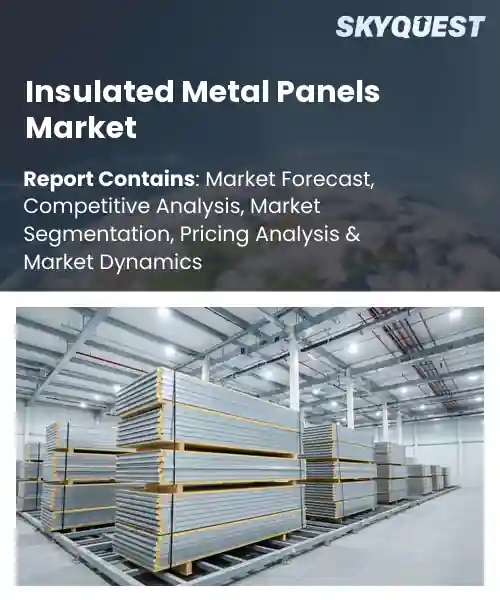
Insulated Metal Panels Market
Report ID: SQMIG20B2158
Report ID: SQMIG20B2158
[email protected]
USA +1 351-333-4748
Report ID:
SQMIG20B2158 |
Region:
Global |
Published Date: June, 2026
Pages:
157
|Tables:
173
|Figures:
79


Global Insulated Metal Panels Market size was valued at USD 9.4 Billion in 2024 and is poised to grow from USD 10.03 Billion in 2025 to USD 16.85 Billion by 2033, growing at a CAGR of 6.7% during the forecast period (2026-2033).
The insulated metal panels industry is driven by the imperative to improve building energy performance, a factor that has reshaped envelope design over decades. With tightening industry standards, labor shortages, and increasing energy costs, the use of insulated metal panels evolved from basic industrial wall cladding systems to architectural facades and pre-assembled modular building enclosures. Examples include refrigerated transportation centers for eCommerce, pre-built cold room systems for food processing, and the finished building envelope of schools that saved money on their total cost of ownership (TCO) through decreased thermal bridging and shortened construction schedules.
The global insulated metal panels industry is also being affected by stricter energy regulations and more corporations committing to decarbonization policies. Higher demand for higher performance building envelopes will require developers and owners to select insulated metal panels as the leading envelope material of choice. With the implementation of new and improved building codes, such as increasing minimum R-value requirements, and owners trying to reduce their operating costs through improved energy performance over time, many building developers will select prefabrication as a means to reduce their construction schedule and decrease the amount of onsite labor, which will drive demand for insulated metal panel manufacturers to increase production capacity by developing new core chemistries and improving their joint systems.
How is IoT enabling predictive maintenance in the insulated metal panels market?
IoT is turning insulated metal panels into actively monitored building elements that support predictive maintenance. Sensors placed on seams, roofs and service penetrations track temperature, moisture and structural movement. Edge analytics and cloud models spot deviations from normal behavior and trigger condition based work orders. The market context favors this shift because owners of cold storage, data centers and commercial facilities prioritize uptime and lifecycle value. Practical deployments range from wireless moisture probes at panel joints to thermal imaging and automated alerts that let teams schedule repairs before damage spreads.
Kingspan in April 2026, the company launched PowerPanel integrated solar roofing which pairs high performance panels with photovoltaic systems and creates a natural platform for energy and environmental sensors. Embedding IoT monitoring supports predictive maintenance by reducing unexpected repairs, extending panel life, and making insulated metal panel solutions more efficient and appealing to owners.
Market snapshot - (2026-2033)
Global Market Size
USD 9.4 Billion
Largest Segment
Wall Panels
Fastest Growth
Cold Storage Panels
Growth Rate
6.7% CAGR
To get more insights on this market click here to Request a Free Sample Report
Global insulated metal panels market is segmented by product type, insulation material, application, end user, skin material, distribution channel and region. Based on product type, the market is segmented into Wall Panels, Roof Panels, Cold Storage Panels and Architectural Panels. Based on insulation material, the market is segmented into Polyurethane (PU), Polyisocyanurate (PIR), Mineral Wool and Expanded Polystyrene (EPS). Based on application, the market is segmented into Industrial Buildings, Commercial Buildings, Cold Storage Facilities, Residential Buildings and Others. Based on end user, the market is segmented into New Construction and Renovation & Retrofit. Based on skin material, the market is segmented into Steel, Aluminum and Others. Based on distribution channel, the market is segmented into Direct Sales and Distributors & Dealers. Based on region, the market is segmented into North America, Europe, Asia Pacific, Latin America and Middle East & Africa.
Wall panels segment dominates with large insulated metal panels market share because wall panels form the primary building envelope where insulated metal panels deliver combined thermal performance, structural support and visual finish. Their applicability across industrial and commercial building envelopes, adaptability to varied heights and load conditions, and straightforward integration with openings make them a preferred choice.
As per insulated metal panels market outlook, architectural panels are witnessing the strongest growth momentum because they pair high performance insulation with aesthetic customization demands. Rising interest in distinctive facades, advanced coatings and complex geometries pushes manufacturers toward new finishes and fabrication techniques. This expands opportunities in premium builds and retrofits that seek both energy performance and visual differentiation.
As per insulated metal panels market forecast, polyurethane (PU) segment dominates because polyurethane cores deliver a favorable combination of thermal efficiency, low weight and ease of fabrication that aligns with panel manufacturers’ production needs. Its closed cell chemistry enables strong adhesion to metal skins and predictable long term thermal stability, simplifying on site handling and reducing installed thickness requirements.
As per insulated metal panels market analysis, polyisocyanurate (PIR) is witnessing the strongest growth momentum as specifiers and manufacturers focus on enhanced fire performance and higher service temperature stability. Innovations in PIR formulations and regulatory emphasis on fire safety in building envelopes drive specification shifts. That dynamic accelerates research and development, expands production investment and opens new high-performance applications where stricter standards create premium demand.
To get detailed segments analysis, Request a Free Sample Report
As per insulated metal panels industry analysis, North America is the leading region for the market. Established manufacturers and fabricators build extensive product catalogs, technical expertise and strong distribution channels providing speedy project delivery and customized solutions. Demand is led by commercial, industrial and cold chain industries. Retrofit activity and new construction both lean towards panelized systems for speed and thermal integrity. Close integration of architect, engineer and contractor enables understanding of specification as well as confidence in system performance. Suppliers investment in research and development, product standardization and quality assurance, and robust supply chains and service networks all strengthen leadership by enabling the supplier to meet complicated project needs across diverse climatic circumstances.
As per insulated metal panels market regional outlook, Demand for United States is mature in the commercial, industrial and cold storage sectors. The demand is being spurred by a focus on energy efficiency and increased retrofit activities. Strong specification culture among architects and engineers, wide supplier chains and attention on performance for durability and fire safety underlie acceptance. Manufacturers are focusing on system integration, customisation and compliance with stringent standards to meet complicated project needs and regional climatic circumstances.
As per insulated metal panels market regional forecast, Canada reflects demand shaped by cold climate priorities and stringent energy codes, prompting focus on thermal performance and airtightness. Adoption is driven by both commercial and industrial projects, including logistics and institutional facilities, where durability and ease of installation matter. Domestic and cross border manufacturers prioritize tailored solutions, robust service networks and value, while specification habits among designers promote systemized approaches for building envelope performance.
Rapid growth in Asia Pacific is fueled by increased urbanization, growing industrial and logistic facilities and increasing focus on energy efficient building envelopes. Building owners and developers are focused on speed of construction and lifecycle performance, and select insulated metal panel solutions for modular and large scale applications. Local manufacturers are ramping up production and customizing items for area climate and fire performance needs, while investments in prefabrication and supply chain maturity are shortening lead times and prices. As knowledge of sustainability and operational energy savings increases, designers and building owners are specifying them. Partnerships with established global suppliers and cross border knowledge transfer contribute to enhanced product quality and offer customized solutions for varied market sectors in the region.
Japan insulated metal panels market is defined by a requirement for high performance and aesthetics, with tight quality demands and seismic considerations influencing specification. Manufacturers focus on precise fabrication, fire resistance and longevity of material to fulfill dense urban and industrial needs. Energy management strategies and modular construction technologies enable effective project deadlines. Working with architects, contractors and specialist suppliers provides creative panel solutions that are designed to address site constraints and efficiency requirements.
South Korea is shaped by manufacturing ecosystem and emphasis on technology building solutions. Demand stems from industrial facilities, logistics hubs and urban construction where speed, performance and fire safety are prioritized. Local producers focus on innovation, product refinement and integration with prefabrication processes to meet exacting standards. Collaboration among suppliers, fabricators and design professionals supports tailored solutions that align with sustainability and operational efficiency objectives.
Europe is strengthening its position through a combination of stringent energy and safety regulations, active renovation activity and strong commitments to sustainability and circularity. Manufacturers around the region are investing in better quality materials, testing and product refinement to meet exacting fire, heat and durability criteria. Panelized systems are preferred by a growing trend in public and commercial procurement for solutions offering lifespan performance and decreased operating energy use. More sophisticated prefabrication and modular construction techniques are emerging, while collaboration between research institutions and industry facilitates innovation and harmonization of standards. Suppliers are able to provide solutions that balance aesthetic, performance and environmental priorities across diverse markets.
Germany is driven by engineering standards with strong emphasis on energy efficient building envelopes. Demand originates from industrial facilities, logistics centers and commercial projects where durability and fire performance are critical. Domestic manufacturers prioritize precision manufacturing, lifecycle and integration with prefabrication methods to optimize installation. Collaboration among research institutes, fabricators and construction firms supports product development and alignment with sustainability and circular economy principles.
United Kingdom focus on retrofit and new construction driven by energy performance and sustainability. Support adoption with architects and contractors that want modular systems for better delivery and quality Suppliers supply complete envelope systems for commercial, healthcare and logistical facilities that meet fire and durability regulations. Manufacturers, installers and specifiers working in partnership, offer bespoke solutions to meet lifespan cost and operational efficiency.
France is influenced by renovation activity and a focus on architectural quality and thermal performance. Demand covers commercial, industrial and logistics projects where façade appearance, insulation and durability matter. Local producers emphasize customizable finishes, modular assembly and compliance with safety standards. Collaboration among designers, builders and suppliers supports specification of panel systems that balance aesthetics with lifecycle performance and maintenance and regional manufacturing capacity expansion.
To know more about the market opportunities by region and country, click here to
Buy The Complete Report
Growing Demand For Energy Efficiency
Infrastructure and Industrial Growth
High Raw Material Price Volatility
Limited Skilled Installation Workforce
Request Free Customization of this report to help us to meet your business objectives.
Consolidation, technology differentiations and strategic partnerships have formed the competitive landscape with Large Scale M&A transactions like Nucor's purchase of Cornerstone's insulated panel division along with product focused transactions (i.e. DuPont's purchase of ArmorWall) establishing new levels of scale and capability. As manufacturers are faced with pressures from lower cost foreign competitors and domestic insulation core innovations (e.g., Kingspan's QuadCore) they have to aggressively pursue joint ventures, create certified installer networks and automate their factories to defend margins from further erosion.
SkyQuest’s ABIRAW (Advanced Business Intelligence, Research & Analysis Wing) is our Business Information Services team that Collects, Collates, Correlates, and Analyses the Data collected by means of Primary Exploratory Research backed by robust Secondary Desk research.
As per SkyQuest analysis, the global insulated metal panels market growth is propelled primarily by growing demand for energy efficiency and further supported by expanding infrastructure and industrial development, which favor rapid, prefabricated envelope solutions. However, high raw material price volatility remains a key restraint, pressuring margins and complicating procurement. North America continues to dominate the market due to mature construction practices, strict performance codes and strong manufacturer networks, while wall panels are the leading product segment because they combine thermal performance, structural support and aesthetic versatility for commercial and industrial envelopes. Continued innovation in core chemistries and smart monitoring will shape future competitive dynamics.
| Report Metric | Details |
|---|---|
| Market size value in 2024 | USD 9.4 Billion |
| Market size value in 2033 | USD 16.85 Billion |
| Growth Rate | 6.7% |
| Base year | 2024 |
| Forecast period | (2026-2033) |
| Forecast Unit (Value) | USD Billion |
| Segments covered |
|
| Regions covered | North America (US, Canada), Europe (Germany, France, United Kingdom, Italy, Spain, Rest of Europe), Asia Pacific (China, India, Japan, Rest of Asia-Pacific), Latin America (Brazil, Rest of Latin America), Middle East & Africa (South Africa, GCC Countries, Rest of MEA) |
| Companies covered |
|
| Customization scope | Free report customization with purchase. Customization includes:-
|
To get a free trial access to our platform which is a one stop solution for all your data requirements for quicker decision making. This platform allows you to compare markets, competitors who are prominent in the market, and mega trends that are influencing the dynamics in the market. Also, get access to detailed SkyQuest exclusive matrix.
Table Of Content
Executive Summary
Market overview
Parent Market Analysis
Market overview
Market size
KEY MARKET INSIGHTS
COVID IMPACT
MARKET DYNAMICS & OUTLOOK
Market Size by Region
KEY COMPANY PROFILES
Methodology
For the Insulated Metal Panels Market, our research methodology involved a mixture of primary and secondary data sources. Key steps involved in the research process are listed below:
1. Information Procurement: This stage involved the procurement of Market data or related information via primary and secondary sources. The various secondary sources used included various company websites, annual reports, trade databases, and paid databases such as Hoover's, Bloomberg Business, Factiva, and Avention. Our team did 45 primary interactions Globally which included several stakeholders such as manufacturers, customers, key opinion leaders, etc. Overall, information procurement was one of the most extensive stages in our research process.
2. Information Analysis: This step involved triangulation of data through bottom-up and top-down approaches to estimate and validate the total size and future estimate of the Insulated Metal Panels Market.
3. Report Formulation: The final step entailed the placement of data points in appropriate Market spaces in an attempt to deduce viable conclusions.
4. Validation & Publishing: Validation is the most important step in the process. Validation & re-validation via an intricately designed process helped us finalize data points to be used for final calculations. The final Market estimates and forecasts were then aligned and sent to our panel of industry experts for validation of data. Once the validation was done the report was sent to our Quality Assurance team to ensure adherence to style guides, consistency & design.
Analyst Support
Customization Options
With the given market data, our dedicated team of analysts can offer you the following customization options are available for the Insulated Metal Panels Market:
Product Analysis: Product matrix, which offers a detailed comparison of the product portfolio of companies.
Regional Analysis: Further analysis of the Insulated Metal Panels Market for additional countries.
Competitive Analysis: Detailed analysis and profiling of additional Market players & comparative analysis of competitive products.
Go to Market Strategy: Find the high-growth channels to invest your marketing efforts and increase your customer base.
Innovation Mapping: Identify racial solutions and innovation, connected to deep ecosystems of innovators, start-ups, academics, and strategic partners.
Category Intelligence: Customized intelligence that is relevant to their supply Markets will enable them to make smarter sourcing decisions and improve their category management.
Public Company Transcript Analysis: To improve the investment performance by generating new alpha and making better-informed decisions.
Social Media Listening: To analyze the conversations and trends happening not just around your brand, but around your industry as a whole, and use those insights to make better Marketing decisions.
REQUEST FOR SAMPLE
 REQUEST FREE CUSTOMIZATION
Global Insulated Metal Panels Market size was valued at USD 9.4 Billion in 2024 and is poised to grow from USD 10.03 Billion in 2025 to USD 16.85 Billion by 2033, growing at a CAGR of 6.7% during the forecast period (2026-2033).
Competitive landscape is shaped by consolidation, technology differentiation and strategic partnerships, with large scale M&A such as Nucor's acquisition of Cornerstone's insulated panel business and product centered deals like DuPont's ArmorWall purchase driving scale and capability shifts. Pressure from lower cost international suppliers and insulation core innovations such as Kingspan's QuadCore raise competitive stakes. Manufacturers pursue joint ventures, certified installer networks and factory automation to defend margins. 'Nucor Corporation', 'Kingspan Group', 'Cornerstone Building Brands', 'Tata Steel', 'ArcelorMittal', 'Manni Group', 'Assan Panel', 'Ruukki Construction', 'Hoesch Bausysteme', 'Romakowski', 'Zhongjie Group', 'Lattonedil', 'Italpannelli', 'Dana Group', 'Tonmat Group', 'Balex Metal', 'Panelco SA', 'Metecno Group', 'BRUCHAPaneel', 'Isomec'
Insulated metal panels offer high thermal performance and enable buildings to meet tighter energy efficiency expectations, which encourages specification by designers and owners seeking lower operational costs and improved environmental profiles. Their integration into building envelopes simplifies compliance with evolving efficiency guidelines and supports corporate sustainability objectives, creating preference for insulated metal panels in new construction and retrofit projects. This alignment with energy priorities increases demand for these products as stakeholders prioritize durable, thermally effective cladding systems that contribute to long term performance and reduced energy consumption.
Sustainable Building Certification Demand: Sustainable codes and voluntary green certification frameworks are driving greater specification of insulated metal panels as architects and developers prioritize embodied carbon reduction, thermal performance and durability. Manufacturers emphasize recyclable cores, recycled content and third party environmental declarations to align with lifecycle targets. Focus on adaptive reuse elevates preference for panels that simplify enclosure detailing. Procurement practices increasingly reward materials that support certification narratives, creating sustained demand for high performance insulated metal panels across commercial, institutional and industrial building sectors.
Why does North America Dominate the Global Insulated Metal Panels Market? |@12


Want to customize this report? This report can be personalized according to your needs. Our analysts and industry experts will work directly with you to understand your requirements and provide you with customized data in a short amount of time. We offer $1000 worth of FREE customization at the time of purchase.
Feedback From Our Clients


 USA (+1) 351-333-4748

