Inspection Camera System Market
Report ID: SQMIG45J2477
Report ID: SQMIG45J2477
[email protected]
USA +1 351-333-4748
Report ID:
SQMIG45J2477 |
Region:
Global |
Published Date: June, 2026
Pages:
157
|Tables:
119
|Figures:
77


Global Inspection Camera System Market size was valued at USD 378.0 Million in 2024 and is poised to grow from USD 419.47 Million in 2025 to USD 964.59 Million by 2033, growing at a CAGR of 10.97% during the forecast period (2026-2033).
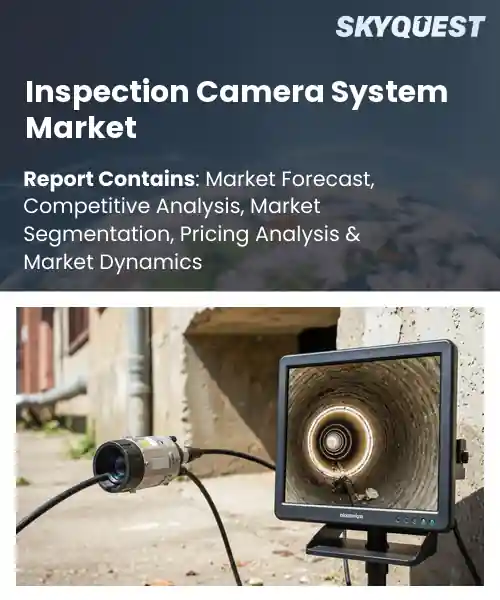
The primary driver of the inspection camera system market is the intersecting pressure of aging infrastructure and stricter safety and regulatory regimes that force asset owners to move from sampling-based checks to continuous visual diagnostics. Inspection camera systems, including borescopes, videoscopes, crawler and drone-mounted cameras, provide high-resolution internal and external views of pipes, turbines and structures so operators can detect corrosion, cracks and foreign object debris before failures occur. Over the last two decades the market evolved from low-resolution analog probes to compact digital systems with onboard storage and wireless links, exemplified by portable videoscopes replacing fiberscopes in industrial maintenance.
A critical factor accelerating inspection camera system growth is integration of advanced imaging with analytics and connectivity, because when high-fidelity visual data is combined with AI and cloud monitoring, organizations can shift from reactive repairs to predictive maintenance. For example, power utilities that deploy videoscopes linked to anomaly-detection algorithms identify insulation breakdown earlier, which reduces unplanned outages and extends asset life. Likewise, oil and gas operators using drone-mounted cameras to inspect pipelines avoid costly shutdowns while improving safety. These dynamics open opportunities in software services, retrofitting legacy assets, and subscription maintenance models as vendors bundle hardware with actionable data-driven insights.
How is AI driving market growth for inspection camera systems?
AI is reshaping inspection camera systems by enabling automated image analysis, intelligent anomaly recognition, and edge inference that turn video streams into actionable findings. Key aspects include camera AI models that flag defects, contextual tagging that links images to asset metadata, and integration with cloud archives for trend analysis. The market is shifting from manual review toward augmented workflows where technicians receive prioritized alerts and guided views for faster decisions. This transition raises demand for smarter optics, ruggedized compute, and software subscriptions. Examples include robotic PTZ systems with embedded AI and platforms producing 3D inspection twins to focus inspections where risk is highest.
Waygate Technologies February 2026, introduced the Mentor Zoom PTZ inspection camera with an onboard AI hardware accelerator, showing how AI running on device speeds defect recognition and reduces manual review. This development highlights how AI embedded in cameras improves inspection throughput and lowers operational friction.
Market snapshot - (2026-2033)
Global Market Size
USD 378.0 Million
Largest Segment
Hardware
Fastest Growth
Services
Growth Rate
10.97% CAGR
To get more insights on this market click here to Request a Free Sample Report
Global inspection camera system market is segmented by component, video quality, application, end use and region. Based on component, the market is segmented into Hardware, Services and Others. Based on video quality, the market is segmented into SD and HD and Full HD and 4K. Based on application, the market is segmented into Pipeline Inspection, Drain and Sewer Inspection, Tank and Vessel Inspection, Medical Inspection and Others. Based on end use, the market is segmented into Industrial, Commercial, Municipal and Others. Based on region, the market is segmented into North America, Europe, Asia Pacific, Latin America and Middle East & Africa.
Hardware segment dominates because physical components such as cameras, cables, probes and illumination form the foundational value of inspection camera systems; robust optics, sensor fidelity and rugged enclosures directly determine operational reliability and suitability across demanding environments. Investments in durable materials and modular mechanical designs reduce downtime and simplify integration with control platforms, which encourages adoption by system OEMs and end users seeking dependable field performance and long lifecycle support in inspection workflows.
However, services are the fastest growing area because managed inspection and remote diagnostics shift investment to ongoing operational support and analytics. Outsourced calibration, predictive maintenance and remote expert assistance reduce onsite burdens, speed problem resolution and enable subscription models that increase utilization and create scalable recurrent revenue across inspection camera offerings.
SD and HD segment dominates because many inspection tasks prioritize robustness, low bandwidth needs and cost efficiency over ultra high resolution; operators favor systems that balance adequate imaging with simple storage and transmission requirements. Compatibility with established infrastructure and proven sensor designs reduces integration complexity for long-running maintenance programs, driving procurement choices toward reliable, easy-to-maintain devices that meet most routine diagnostic and clearance inspection needs without excessive processing demands.
However, Full HD and 4K are the most rapidly expanding area because ultra high resolution enables finer defect detection and advanced machine vision analytics. Sensor miniaturization and improved compression reduce deployment barriers, expanding applications in complex diagnostics and enabling AI-driven inspection workflows that create higher-value service and analytics opportunities.
To get detailed segments analysis, Request a Free Sample Report
North America leads the market owing to a confluence of technological leadership, a mature industrial base, and deep integration of inspection into asset management practices. A dense network of OEMs, specialized service providers, and rental channels supports rapid uptake and customization for varied end uses. High emphasis on safety, regulatory compliance, and predictive maintenance drives demand for advanced imaging, connectivity, and data analytics features. Robust R and D ecosystems and venture and corporate investment enable continuous innovation, while close collaborations between end users and vendors facilitate tailored solutions, extensive aftersales services, and rapid commercialization of improvements that reinforce market leadership and operational excellence.
Inspection Camera System Market in United States is characterized by concentrated demand from energy, aerospace, manufacturing, and infrastructure sectors, high uptake of advanced imaging and connectivity features, and active participation from OEMs and specialized service providers. Emphasis on safety compliance, predictive maintenance, and integration with asset management systems drives customization and aftermarket services. Strong institutional procurement and established rental channels support rapid technology adoption and continuous innovation across industry verticals.
Inspection Camera System Market in Canada reflects strong demand across natural resources and utilities sectors, with emphasis on remote inspection solutions and corrosion monitoring. Service providers and distributors focus on ruggedized equipment and training programs suited to dispersed operations and harsh environments. Collaboration between local integrators and global OEMs enhances availability of inspection packages, while regulatory emphasis on maintenance and asset integrity encourages steady procurement and investment in inspection capabilities.
Expansion in Asia Pacific is driven by a broad industrialization wave, strong electronics and manufacturing clusters, and rising demand for automated and remote inspection across industries. Rapid uptake of smart factory concepts, robotics integration, and miniaturized imaging technologies supports deployment across production, energy, and transportation sectors. Local manufacturers and technology partners are adapting solutions to regional operational conditions, while partnerships with global vendors accelerate capability transfer. Emphasis on infrastructure maintenance, retrofitting aging assets, and workforce training further stimulates market growth and strengthens the region as a dynamic arena for innovation and localized service models.
Inspection Camera System Market in Japan is shaped by advanced manufacturing, precision engineering, and stringent quality assurance in automotive, semiconductor, and energy sectors. Domestic OEMs and specialized suppliers prioritize miniaturized imaging, resolution optics, and integration with advanced robotics for automated inspection. Emphasis on preventive maintenance and regulatory compliance encourages adoption of sophisticated diagnostic tools. Collaboration between technology providers and end users drives customization, service offerings, and refinement of inspection workflows.
Inspection Camera System Market in South Korea benefits from a dynamic electronics and automotive manufacturing ecosystem, strong capabilities in sensors and imaging, and active integration of inspection systems within automated production lines. Local suppliers collaborate with global technology partners to deliver compact, high performance devices suited to high volume assembly and maintenance environments. Focus on digitalization, smart factory initiatives, and operator training promotes widespread deployment and competitiveness of inspection solutions.
Europe is reinforcing its market position through a combination of industrial specialization, stringent regulatory frameworks, and a focus on interoperability and sustainability. Strong clusters in automotive, aerospace, rail, and energy demand advanced inspection systems that integrate with predictive maintenance and enterprise platforms. Regional suppliers and integrators emphasize standardization, modularity, and retrofit capabilities to serve both new and aging assets. Collaborative research, public procurement for infrastructure integrity, and extensive service ecosystems support innovation, localized customization, and robust aftersales programs that enhance reliability and market resilience.
Inspection Camera System Market in Germany is driven by precision manufacturing, automotive excellence, and a strong industrial automation sector that demands robust, high fidelity inspection tools. Suppliers emphasize integration with production line controls, machine vision, and predictive maintenance platforms to meet rigorous quality and safety requirements. Local system integrators and specialized manufacturers offer tailored solutions for heavy industry components, while service networks support calibration, training, and deployment across industrial applications.
Inspection Camera System Market in United Kingdom is driven by services, maritime clusters, and infrastructure maintenance that create demand for versatile inspection tools. Providers develop portable remote inspection systems suited for confined spaces and complex assemblies, with emphasis on interoperability and operator ergonomics. Collaboration among integrators, test labs, and training providers enhances solution reliability and supports lifecycle services that improve maintenance planning and asset integrity across multiple sectors and markets.
Inspection Camera System Market in France benefits from a diverse industrial base including aerospace, energy, and transportation, with strong focus on safety and environmental compliance that drives demand for inspection solutions. Suppliers emphasize modular systems, intuitive interfaces, and integration with enterprise maintenance platforms to support retrofit and asset monitoring. Partnerships among manufacturers, research institutions, and service providers foster innovation and enable tailored implementation and training for inspection programs across industries.
To know more about the market opportunities by region and country, click here to
Buy The Complete Report
Increasing Demand For Remote Inspection
Advances In Imaging and Connectivity
High Initial Procurement Costs
Limited Interoperability With Systems
Request Free Customization of this report to help us to meet your business objectives.
Intense vendor rivalry in the global inspection camera system market is driven by demand for AI enabled edge analytics and turnkey remote visual inspection solutions, prompting consolidation, strategic partnerships, and product led differentiation. Recent acquisition activity exemplified by Teledyne's purchase of FLIR, vendor alliances to embed AI into camera workflows such as RinnoVision with Pallon, and edge vision module integrations led by GrAI Matter Labs and ADLINK illustrate concrete competitive strategies.
SkyQuest’s ABIRAW (Advanced Business Intelligence, Research & Analysis Wing) is our Business Information Services team that Collects, Collates, Correlates, and Analyses the Data collected by means of Primary Exploratory Research backed by robust Secondary Desk research.
As per SkyQuest analysis, one key driver is aging infrastructure and stricter safety and regulatory regimes that push asset owners toward more frequent visual diagnostics. A second driver is the integration of advanced imaging with AI and cloud connectivity, which enables predictive maintenance and higher-value software and service offerings. However, a restraint is high initial procurement costs that slow adoption among budget-constrained buyers. The dominating region is North America, supported by a mature industrial base, strong research and development and extensive aftersales services, while the dominating segment remains hardware, where rugged optics, sensors and cabling provide the essential reliability operators require.
| Report Metric | Details |
|---|---|
| Market size value in 2024 | USD 378.0 Million |
| Market size value in 2033 | USD 964.59 Million |
| Growth Rate | 10.97% |
| Base year | 2024 |
| Forecast period | (2026-2033) |
| Forecast Unit (Value) | USD Million |
| Segments covered |
|
| Regions covered | North America (US, Canada), Europe (Germany, France, United Kingdom, Italy, Spain, Rest of Europe), Asia Pacific (China, India, Japan, Rest of Asia-Pacific), Latin America (Brazil, Rest of Latin America), Middle East & Africa (South Africa, GCC Countries, Rest of MEA) |
| Companies covered |
|
| Customization scope | Free report customization with purchase. Customization includes:-
|
To get a free trial access to our platform which is a one stop solution for all your data requirements for quicker decision making. This platform allows you to compare markets, competitors who are prominent in the market, and mega trends that are influencing the dynamics in the market. Also, get access to detailed SkyQuest exclusive matrix.
Table Of Content
Executive Summary
Market overview
Parent Market Analysis
Market overview
Market size
KEY MARKET INSIGHTS
COVID IMPACT
MARKET DYNAMICS & OUTLOOK
Market Size by Region
KEY COMPANY PROFILES
Methodology
For the Inspection Camera System Market, our research methodology involved a mixture of primary and secondary data sources. Key steps involved in the research process are listed below:
1. Information Procurement: This stage involved the procurement of Market data or related information via primary and secondary sources. The various secondary sources used included various company websites, annual reports, trade databases, and paid databases such as Hoover's, Bloomberg Business, Factiva, and Avention. Our team did 45 primary interactions Globally which included several stakeholders such as manufacturers, customers, key opinion leaders, etc. Overall, information procurement was one of the most extensive stages in our research process.
2. Information Analysis: This step involved triangulation of data through bottom-up and top-down approaches to estimate and validate the total size and future estimate of the Inspection Camera System Market.
3. Report Formulation: The final step entailed the placement of data points in appropriate Market spaces in an attempt to deduce viable conclusions.
4. Validation & Publishing: Validation is the most important step in the process. Validation & re-validation via an intricately designed process helped us finalize data points to be used for final calculations. The final Market estimates and forecasts were then aligned and sent to our panel of industry experts for validation of data. Once the validation was done the report was sent to our Quality Assurance team to ensure adherence to style guides, consistency & design.
Analyst Support
Customization Options
With the given market data, our dedicated team of analysts can offer you the following customization options are available for the Inspection Camera System Market:
Product Analysis: Product matrix, which offers a detailed comparison of the product portfolio of companies.
Regional Analysis: Further analysis of the Inspection Camera System Market for additional countries.
Competitive Analysis: Detailed analysis and profiling of additional Market players & comparative analysis of competitive products.
Go to Market Strategy: Find the high-growth channels to invest your marketing efforts and increase your customer base.
Innovation Mapping: Identify racial solutions and innovation, connected to deep ecosystems of innovators, start-ups, academics, and strategic partners.
Category Intelligence: Customized intelligence that is relevant to their supply Markets will enable them to make smarter sourcing decisions and improve their category management.
Public Company Transcript Analysis: To improve the investment performance by generating new alpha and making better-informed decisions.
Social Media Listening: To analyze the conversations and trends happening not just around your brand, but around your industry as a whole, and use those insights to make better Marketing decisions.
REQUEST FOR SAMPLE
 REQUEST FREE CUSTOMIZATION
Global Inspection Camera System Market size was valued at USD 378.0 Million in 2024 and is poised to grow from USD 419.47 Million in 2025 to USD 964.59 Million by 2033, growing at a CAGR of 10.97% during the forecast period (2026-2033).
Intense vendor rivalry in the global inspection camera system market is driven by demand for AI enabled edge analytics and turnkey remote visual inspection solutions, prompting consolidation, strategic partnerships, and product led differentiation. Recent acquisition activity exemplified by Teledyne's purchase of FLIR, vendor alliances to embed AI into camera workflows such as RinnoVision with Pallon, and edge vision module integrations led by GrAI Matter Labs and ADLINK illustrate concrete competitive strategies. 'Hikvision', 'Dahua Technology', 'Canon', 'Axis Communications', 'Bosch Security Systems', 'FLIR Systems', 'Fujifilm Holdings', 'Hanwha Vision', 'Nikon', 'Panasonic', 'Samsung Electronics', 'Sony Group', 'Teledyne Technologies', 'Vivotek', 'IDIS', 'Pelco', 'Avigilon', 'Uniview', 'Tiandy', 'Mobotix'
Remote inspection needs across industries have increased the adoption of inspection camera systems because they enable safe visual assessment of confined or hazardous areas without exposing personnel to risk. By providing high-resolution imaging, real-time transmission, and access through small apertures, these systems reduce the need for disruptive shutdowns and manual entry, streamline maintenance workflows, and support condition-based decision making. As organizations prioritize operational continuity and asset integrity, the ability of inspection cameras to deliver actionable visual information has become a key factor driving procurement and integration efforts.
Ai Driven Image Interpretation: Advances in machine learning are enabling inspection cameras to move beyond passive image capture toward intelligent defect detection, automated pattern recognition, and contextual prioritization of anomalies. Vendors are integrating edge analytics to reduce reliance on human review, accelerate decision cycles, and standardize reporting across heterogeneous environments. This trend fosters tighter collaboration between hardware makers and software providers, spurring solutions tailored to industry workflows and reducing subjective variability in inspection outcomes while enabling faster, more consistent maintenance planning and operational resilience.
Why does North America Dominate the Global Inspection Camera System Market? |@12


Want to customize this report? This report can be personalized according to your needs. Our analysts and industry experts will work directly with you to understand your requirements and provide you with customized data in a short amount of time. We offer $1000 worth of FREE customization at the time of purchase.
Feedback From Our Clients


 USA (+1) 351-333-4748

