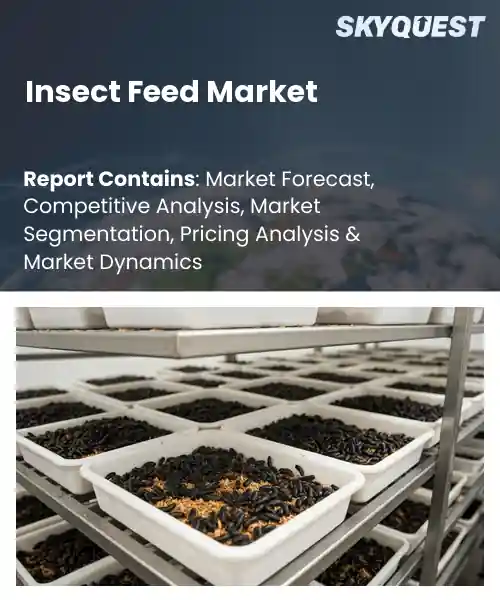
Insect Feed Market
Report ID: SQMIG30C2206
Report ID: SQMIG30C2206
[email protected]
USA +1 351-333-4748
Report ID:
SQMIG30C2206 |
Region:
Global |
Published Date: June, 2026
Pages:
157
|Tables:
156
|Figures:
78


Global Insect Feed Market size was valued at USD 1.2 Billion in 2024 and is poised to grow from USD 1.28 Billion in 2025 to USD 2.08 Billion by 2033, growing at a CAGR of 6.3% during the forecast period (2026-2033).
The principal catalyst for the insect feed market is the pressing demand for sustainable, high-quality protein, as aquaculture and livestock industries grow against diminishing land, water, and soymeal resources. The market generates insect meals and oils from species like black army fly and mealworm to partially substitute fishmeal in animal feed.
In the past decade, the sector transitioned from experiments and pilots to commercial operations, spearheaded by businesses like Protix, Ÿnsect, and Enterra, bolstered by funding, scale-ups, and regulatory frameworks. An essential determinant influencing the global expansion of insect feed is industrial-scale economics, as reduced unit prices facilitate its acceptance in aquaculture, poultry, and pet food industries. When producers enhance rearing practices, automate larval harvesting, and get inexpensive feedstocks such as food processing leftovers, production costs decrease and profit margins increase, leading feed formulators to integrate insect meals.
Practical instances encompass salmon enterprises replacing segments of fishmeal and pet brands introducing insect-derived hypoallergenic solutions, wherein initial agreements confirm demand and draw commercial collaborators. Investment in larger facilities leads to economies of scale that further reduce prices, while enhanced regulatory clarity facilitates approvals and broadens market access, so bolstering investor confidence.
How is AI enhancing production efficiency in the insect feed market?
Artificial Intelligence improves production efficiency in the insect feed industry by integrating sensors, computer vision, predictive analytics, and automation into unified production systems. Essential components encompass automatic climate regulation, early disease identification via image analysis, optimal feed composition, and predictive maintenance of machinery. The present situation indicates an increasing number of pilots transitioning to larger-scale operations as firms implement AI-driven monitoring to minimize waste, stabilize yields, and expedite production cycles. Concrete examples encompass platforms that connect IoT sensors to computer vision for assessing colony health, as well as innovative solutions that mitigate production bottlenecks in black soldier fly culture while enhancing throughput and resilience.
In June 2026, Innovafeed secured money to expedite commercial development and invest in industrial equipment that facilitates automation. This investment facilitates enhanced utilization of AI-powered sensors and control systems to augment yield consistency, reduce variability, and optimize production efficiency.
Market snapshot - (2026-2033)
Global Market Size
USD 1.2 Billion
Largest Segment
Insect Meal
Fastest Growth
Insect Protein Concentrate
Growth Rate
6.3% CAGR
To get more insights on this market click here to Request a Free Sample Report
Global insect feed market is segmented by type, source insect, form, application, end user and region. Based on type, the market is segmented into Whole Insects, Insect Meal, Insect Oil/Fat, Insect Protein Concentrate and Others. Based on source insect, the market is segmented into Black Soldier Fly, Mealworms, Crickets, Houseflies, Grasshoppers and Others. Based on form, the market is segmented into Dry, Liquid, Pellets, Powder and Others. Based on application, the market is segmented into Poultry Feed, Aquaculture Feed, Swine Feed, Pet Food, Livestock Feed and Others. Based on end user, the market is segmented into Animal Feed Manufacturers, Aquaculture Farms, Pet Food Producers, Livestock Farms and Others. Based on region, the market is segmented into North America, Europe, Asia Pacific, Latin America and Middle East & Africa.
Insect meal segment dominates with large insect feed market share because it integrates seamlessly with standard feed formulation and processing practices, offering a familiar powder form that nutritionists and manufacturers can adopt without major recipe changes. Its consistent nutrient profile and ease of storage and transport reduce operational friction, while supplier investments in drying and milling create dependable quality, driving broad acceptance across feed producers and creating stable procurement patterns.
As per insect feed market outlook, insect protein concentrate is emerging as the fastest growing segment due to demand for higher-purity protein ingredients in aquaculture and premium pet feeds. Advances in concentration and fractionation technologies improve functional properties and buyer willingness to pay for performance, while innovation and regulatory clarity expand use cases, unlocking new revenue streams and accelerating market development.
As per insect feed market analysis, black soldier fly segment dominates because its larvae convert low-value organic streams into dense protein and fat with rapid lifecycle efficiency, offering a scalable, cost-competitive raw material for feed makers. Robust production protocols, high feed conversion efficiency, and broad industry adoption reduce supply risk and lower feed input costs, which in turn encourages formulators to specify black soldier fly products as a primary insect-derived ingredient.
As per insect feed market forecast, mealworms are the most rapidly expanding source because they meet rising demand for palatable, nutrient-dense ingredients in companion animal and specialty aquaculture feeds. Improvements in automated rearing and harvesting, combined with favorable sensory and functional attributes for certain species, attract investment and product development, creating new niche applications and expanding supplier portfolios toward higher-value markets.
To get detailed segments analysis, Request a Free Sample Report
As per insect feed market regional outlook, Europe spearheads worldwide adoption of insect feed due to cohesive regulatory frameworks, well-established research networks, and a developed livestock and aquaculture supply chain that promotes sustainable ingredient replacement. Progressive regulations, coordinated industry groups, and advanced manufacturing skills have established an ecosystem in which pilot programs evolve into commercial-scale operations. Heightened consumer knowledge regarding environmental effects and a responsive feed industry foster collaboration among startups, established feed manufacturers, and academic institutions. Strong logistics, closeness to feed-intensive marketplaces, and favorable certification frameworks diminish adoption barriers. Concentrated investment in processing technology and quality control infrastructure supports product uniformity and acceptance. The amalgamation of these characteristics fosters a self-reinforcing cycle of innovation, supply chain resilience, and market credibility that maintains leadership in insect-derived feed ingredients.
As per insect feed market regional forecast, Germany benefits from strong research clusters, progressive industry partnerships, and advanced processing capabilities that support quality assurance and regulatory compliance. Concentrated supplier networks and proximity to major livestock and aquaculture processors enable efficient scale up. Collaboration between technical institutes and commercial operators accelerates product refinement, while a culture of sustainability and innovation fosters early adoption and continuous improvement across the feed value chain.
As per insect feed industry analysis, United Kingdom is shaped by collaborative research, progressive industry engagement, and a dynamic feed manufacturing base that emphasizes traceability and quality. Strong linkages between academia, technology providers, and feed producers facilitate product validation and acceptance. Market participants prioritize sustainable sourcing, certification pathways, and consumer transparency, which support credibility and uptake. Robust testing infrastructure and a focus on performance outcomes drive confidence among livestock and aquaculture operators.
France benefits from strong agricultural tradition, regional innovation hubs, and cooperative networks that support scaling of insect based feed ingredients. Emphasis on quality control, traceability, and integration with existing feed systems encourages industry acceptance. Public private partnerships and research collaborations promote technical advancement, while market actors focus on demonstration projects and value chain alignment. Cultural interest in sustainable agriculture and active stakeholder engagement underpin progress.
North America is witnessing swift growth in the adoption of insect feed, driven by a combination of commercial demand, entrepreneurial investment, and increasing regulatory clarity that promotes innovative feed components. Extensive livestock and aquaculture enterprises pursue robust protein alternatives that correspond with sustainability objectives and supply chain diversification plans. Venture activity and factory expansion enhance academic research and pilot projects, facilitating technical validation and cost reduction. Dominant players in the feed business, cohesive supply chains, and well-established distribution networks expedite commercialization. Increasing interest from ingredient formulators and feed compounders propels product development customized for regional species and production systems. Intersectoral collaboration and practical policy involvement create a setting in which commercial experiments lead to wider market adoption. Industry associations actively engage in information dissemination and standard establishment throughout the region.
United States is propelled by an innovation ecosystem and established feed manufacturing networks that enable product development and scale up. Collaboration between research institutions and commercial operators provides performance validation across diverse livestock and aquaculture systems. Demand from integrators and formulators seeking resilient protein alternatives encourages incorporation of insect derived ingredients into feeds. Active dialogue with regulatory bodies and industry associations supports pathway clarity and commercialization.
Canada is strengthened by a strong research base, collaborative industry initiatives, and diverse agricultural and aquaculture sectors that value sustainable inputs. Partnerships between provincial research centers, feed producers, and processing start ups enable technical optimization and local supply chain integration. Emphasis on quality assurance and traceability through regional demonstration projects builds producer trust, while policy engagement and industry forums support alignment and market readiness and growth.
Asia Pacific region is enhancing its position in the insect feed market by means of focused research investment, strategic alliances, and the adaption of technology to local production methods. Industry stakeholders concentrate on creating processing methods tailored to local raw materials and species-specific nutritional requirements, hence improving product applicability for aquaculture and livestock farmers. Cooperative engagement among academic institutions, private companies, and trade associations expedites information dissemination and pilot implementations. The advancement of regional supply chains, the expansion of contract farming collaborations, and the interest from feed formulators promote commercialization. Regulatory discussions and advancing certification measures foster trust, while customized marketing and outreach efforts enhance awareness among producers. Private investment and partnership with global partners enhance market infrastructure and expertise.
Japan benefits from strong scientific expertise, precision manufacturing capability, and integration with advanced aquaculture and livestock production systems. Collaboration between research institutions and commercial entities drives formulation refinement and quality assurance practices tailored to domestic species. Market actors emphasize traceability, feed safety, and performance outcomes, aiding producer confidence. Strategic pilot programs and close industry regulator engagement facilitate validation, while consumer awareness of sustainable inputs supports acceptance.
South Korea is advancing through concentrated research efforts, processing innovation, and close industry academic collaboration that address specific nutritional needs for domestic aquaculture and livestock. Emphasis on product standardization, safety testing, and integration with existing feed supply chains builds confidence. Pilot scale demonstrations and partnerships with feed manufacturers foster commercial readiness. Active dialogue between regulators and industry participants helps clarify pathways to adoption and market integration.
To know more about the market opportunities by region and country, click here to
Buy The Complete Report
Rising Demand For Sustainable Protein
Supportive Regulatory Frameworks
High Production Costs and Scalability
Cultural Resistance and Consumer Perceptions
Request Free Customization of this report to help us to meet your business objectives.
The competitive landscape in the global insect feed industry is consolidating as mid and large players pursue strategic partnerships, joint ventures, and industrial scale investments to secure feedstock and distribution. Notable moves include Tyson Foods equity and joint venture with Protix for a US production facility, Innovafeed’s industrial tie up with ADM in Decatur and extended commercial contract with Cargill, and vendor partnerships to industrialize processing systems.
SkyQuest’s ABIRAW (Advanced Business Intelligence, Research & Analysis Wing) is our Business Information Services team that Collects, Collates, Correlates, and Analyses the Data collected by means of Primary Exploratory Research backed by robust Secondary Desk research.
As per SkyQuest analysis, the global insect feed market growth is propelled by an urgent need for sustainable, high‑quality protein to replace shrinking traditional feedstocks and by rapid adoption of AI driven production efficiencies that improve yield consistency and lower waste. Despite these drivers, high production costs and scalability challenges remain a key restraint, limiting rapid mainstream adoption. Europe remains the dominant region thanks to regulatory clarity, research networks and established supply chains, while the insect meal segment leads market share due to its compatibility with existing feed formulations and ease of handling. Continued investment and circular partnerships will shape near term commercialization. The global insect feed market trend driven by the increasing demand for sustainable and alternative protein sources in animal nutrition.
| Report Metric | Details |
|---|---|
| Market size value in 2024 | USD 1.2 Billion |
| Market size value in 2033 | USD 2.08 Billion |
| Growth Rate | 6.3% |
| Base year | 2024 |
| Forecast period | (2026-2033) |
| Forecast Unit (Value) | USD Billion |
| Segments covered |
|
| Regions covered | North America (US, Canada), Europe (Germany, France, United Kingdom, Italy, Spain, Rest of Europe), Asia Pacific (China, India, Japan, Rest of Asia-Pacific), Latin America (Brazil, Rest of Latin America), Middle East & Africa (South Africa, GCC Countries, Rest of MEA) |
| Companies covered |
|
| Customization scope | Free report customization with purchase. Customization includes:-
|
To get a free trial access to our platform which is a one stop solution for all your data requirements for quicker decision making. This platform allows you to compare markets, competitors who are prominent in the market, and mega trends that are influencing the dynamics in the market. Also, get access to detailed SkyQuest exclusive matrix.
Table Of Content
Executive Summary
Market overview
Parent Market Analysis
Market overview
Market size
KEY MARKET INSIGHTS
COVID IMPACT
MARKET DYNAMICS & OUTLOOK
Market Size by Region
KEY COMPANY PROFILES
Methodology
For the Insect Feed Market, our research methodology involved a mixture of primary and secondary data sources. Key steps involved in the research process are listed below:
1. Information Procurement: This stage involved the procurement of Market data or related information via primary and secondary sources. The various secondary sources used included various company websites, annual reports, trade databases, and paid databases such as Hoover's, Bloomberg Business, Factiva, and Avention. Our team did 45 primary interactions Globally which included several stakeholders such as manufacturers, customers, key opinion leaders, etc. Overall, information procurement was one of the most extensive stages in our research process.
2. Information Analysis: This step involved triangulation of data through bottom-up and top-down approaches to estimate and validate the total size and future estimate of the Insect Feed Market.
3. Report Formulation: The final step entailed the placement of data points in appropriate Market spaces in an attempt to deduce viable conclusions.
4. Validation & Publishing: Validation is the most important step in the process. Validation & re-validation via an intricately designed process helped us finalize data points to be used for final calculations. The final Market estimates and forecasts were then aligned and sent to our panel of industry experts for validation of data. Once the validation was done the report was sent to our Quality Assurance team to ensure adherence to style guides, consistency & design.
Analyst Support
Customization Options
With the given market data, our dedicated team of analysts can offer you the following customization options are available for the Insect Feed Market:
Product Analysis: Product matrix, which offers a detailed comparison of the product portfolio of companies.
Regional Analysis: Further analysis of the Insect Feed Market for additional countries.
Competitive Analysis: Detailed analysis and profiling of additional Market players & comparative analysis of competitive products.
Go to Market Strategy: Find the high-growth channels to invest your marketing efforts and increase your customer base.
Innovation Mapping: Identify racial solutions and innovation, connected to deep ecosystems of innovators, start-ups, academics, and strategic partners.
Category Intelligence: Customized intelligence that is relevant to their supply Markets will enable them to make smarter sourcing decisions and improve their category management.
Public Company Transcript Analysis: To improve the investment performance by generating new alpha and making better-informed decisions.
Social Media Listening: To analyze the conversations and trends happening not just around your brand, but around your industry as a whole, and use those insights to make better Marketing decisions.
REQUEST FOR SAMPLE
 REQUEST FREE CUSTOMIZATION
Global Insect Feed Market size was valued at USD 1.2 Billion in 2024 and is poised to grow from USD 1.28 Billion in 2025 to USD 2.08 Billion by 2033, growing at a CAGR of 6.3% during the forecast period (2026-2033).
The competitive landscape in the global insect feed market is consolidating as mid and large players pursue strategic partnerships, joint ventures, and industrial scale investments to secure feedstock and distribution. Notable moves include Tyson Foods equity and joint venture with Protix for a US production facility, Innovafeed’s industrial tie up with ADM in Decatur and extended commercial contract with Cargill, and vendor partnerships to industrialize processing systems. 'Ynsect', 'InnovaFeed', 'Protix B.V.', 'AgriProtein Holdings Ltd.', 'EnviroFlight LLC', 'Entomo Farms', 'Hexafly', 'NextProtein', 'Enterra Feed Corporation', 'Aspire Food Group', 'Beta Hatch', 'Insectta', 'Loopworm', 'Nutrition Technologies', 'Protenga', 'Entobel', 'Fair Insects', 'Koppert Biological Systems', 'Bühler Group', 'Archer Daniels Midland Company'
In response to consumer and industry preference for environmentally friendly sources, insect feed offers a resource efficient alternative that aligns with sustainability commitments across livestock and aquaculture sectors. Producers are increasingly seeking inputs that reduce pressure on traditional feedstocks while supporting circular production models, which makes insect derived ingredients attractive. This acceptance by manufacturers and feed formulators encourages investment in rearing facilities and supply chains, fostering market expansion as more companies integrate insects into feed strategies to meet corporate sustainability goals and stakeholder expectations.
Circular Economy Partnerships: Insect farms and feed manufacturers are increasingly forming integrated partnerships with food processors, waste aggregators and agricultural firms to channel organic residues into insect bioconversion systems. This collaborative model emphasizes resource recovery, reduced waste streams and multi stakeholder value creation, enabling closed loop nutrient cycles and differentiated sustainability claims. These alliances foster technology sharing, contractual stability and market access while aligning with circularity commitments and brand reputations, accelerating mainstreaming of insect derived feed ingredients across livestock sectors.
Why does Europe Dominate the Global Insect Feed Market? |@12


Want to customize this report? This report can be personalized according to your needs. Our analysts and industry experts will work directly with you to understand your requirements and provide you with customized data in a short amount of time. We offer $1000 worth of FREE customization at the time of purchase.
Feedback From Our Clients


 USA (+1) 351-333-4748

