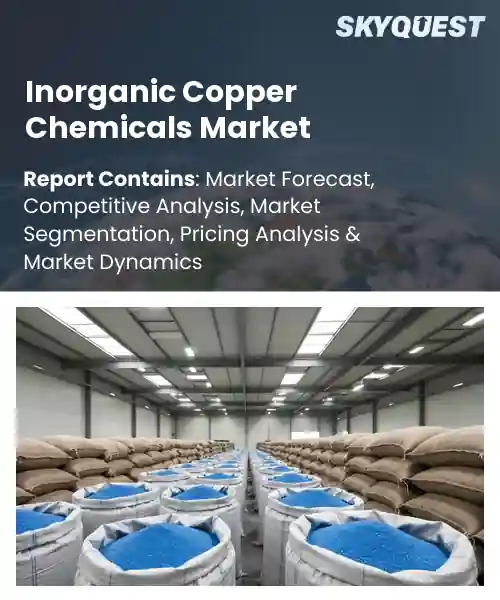
Inorganic Copper Chemicals Market
Report ID: SQMIG15E3303
Report ID: SQMIG15E3303
[email protected]
USA +1 351-333-4748
Report ID:
SQMIG15E3303 |
Region:
Global |
Published Date: February, 2026
Pages:
157
|Tables:
116
|Figures:
77


Global Inorganic Copper Chemicals Market size was valued at USD 2.2 Billion in 2024 and is poised to grow from USD 2.3 Billion in 2025 to USD 3.24 Billion by 2033, growing at a CAGR of 4.4% during the forecast period (2026-2033).
Growing demand for electroplating chemicals, rising use of copper compounds in electronics manufacturing, increasing adoption in agricultural fungicides, expanding applications in catalysts and pigments, and advancements in specialty copper chemical production are driving demand for inorganic copper chemicals.
The availability of raw materials and regulatory compliance are key market influencers for copper chemicals, particularly for copper salt synthesis due to copper material fluctuations and environmental regulations that stimulate innovation in recycling technology, copper refining methods, and high-purity salt synthesis. This has enabled the chemical manufacturers of copper to create an opportunity for the provision of pure copper chemicals for the electronics manufacturing industry and standardized copper chemicals for the agricultural sector that adhere to international residue regulations in new manufacturing hubs in Southeast Asia and Latin America. Copper sulfate and copper oxide inorganic copper chemicals find applications in electroplating on printed circuit boards, the manufacture of pigments, as well as the control of diseases in plants, hence bridging the gap between copper mining operations. Growing electrification and expansion of electronics manufacturing around the world are expected to primarily drive inorganic copper chemicals market growth.
On the contrary, volatility in raw copper prices, environmental and regulatory restrictions on copper-based chemicals, supply chain constraints in raw material sourcing, and competition from alternative chemical formulations are anticipated to slow down inorganic copper chemicals market penetration in the future.
How is AI Optimizing Production Efficiency for Inorganic Copper Chemical Manufacturers?
AI is improving production efficiency in the inorganic copper chemicals market by combining sensor-based monitoring, advanced analytics, and digital process optimization. Predictive maintenance systems help detect issues in plating and electrowinning equipment before failures occur, reducing downtime. Real-time quality monitoring also helps manufacturers identify defects early, which lowers rework and improves product consistency. Machine learning is also helping companies develop and scale new chemical formulations more quickly.
In May 2025, BASF announced a stronger focus on copper hydrometallurgy research and development. The company is consolidating its leaching activities and using advanced analytics and AI-supported experiment planning to optimize leaching aids and accelerate scale-up. This approach helps increase production throughput, reduce reagent waste, and shorten time to market.
Market snapshot - (2026-2033)
Global Market Size
USD 2.2 Billion
Largest Segment
Copper Sulfate
Fastest Growth
Copper Oxide
Growth Rate
4.4% CAGR
To get more insights on this market click here to Request a Free Sample Report
Global inorganic copper chemicals market is segmented by product type, formulation type, end-use industry, sales channel, and region. Based on product type, the market is segmented into copper sulfate, copper oxide, and copper chloride. Based on formulation type, the market is segmented into liquid formulations and solid formulations. Based on end-use industry, the market is segmented into agriculture, mining, and chemical manufacturing. Based on sales channel, the market is segmented into direct sales, distributors, and e-commerce. Based on region, the market is segmented into North America, Europe, Asia Pacific, Latin America, and Middle East & Africa.
The copper sulfate segment is projected to spearhead the global inorganic copper chemicals market revenue generation in the future. Broad compatibility of this material across agricultural fungicides, industrial catalysts, and water treatment applications helps this segment hold sway over others. The positive solubility characteristics of the chemical and regulatory acceptance simplify the complexity of the formulation process while ensuring a reliable supply chain for the chemical, thereby making manufacturers eager to produce the chemical. Therefore, the supply chain for the chemical is centered on the key inorganic copper chemical, copper sulfate.
However, copper oxide is emerging as the most rapidly expanding segment as per this inorganic copper chemicals market forecast. Its applicability in advanced electronics, specialty pigments, and battery precursors is creating new business scope across the study period. Its favorable thermal stability and compatibility with advanced materials formulations accelerate innovation, opening new application pathways and supplier differentiation that expand market opportunity.
The distributors segment is forecasted to account for the highest global inorganic copper chemicals market share in the future. Established networks of distributors bridge manufacturers and diverse end users, enabling bulk inventory management, which helps this segment maintain its dominant stance. The credit facilities and trade relationships that they have reduce friction for downstream industries, while the regional stocking strategies and product training help improve product adoption for downstream industries, thereby acting as a stabilizing force for both the manufacturers and the buyers.
Nevertheless, the e-commerce segment is recording the strongest growth momentum by facilitating quick and transparent procurement of specialty inorganic copper products for a broader category of buyers. The platform’s analytics and simplified ordering process help create a conducive environment for new entrants and stimulate demand for specialty products, hence accelerating growth.
To get detailed segments analysis, Request a Free Sample Report
Strong industrial demand, concentrated electronics manufacturing, and integrated supply chains help Asia Pacific lead the global adoption of inorganic copper chemicals in the future. Regional strengths lie in the high-level materials R&D, existing chemical processing capabilities, and the availability of copper feedstock sources to reduce logistical issues. The high density of manufacturers and converters allows for economies of scale and specialization by product grade and application. Strong working relationships between the industry and research facilities accelerate improvement of formulation and quality control. Additionally, trade relationships and investment patterns are favorable to the region due to the existing balance of domestic consumption and export-oriented markets. The overall result of the existing ecosystems of manufacturers, technical workforce, strategic raw material availability, and existing regulatory environments to balance the needs of the environment and industrial growth ensures the continuity of operations.
Strong electronics manufacturing ecosystem, rigorous quality control standards, and integration with research institutions are helping shape inorganic copper chemicals demand in Japan. Demand for the product is driven by high-end applications in semiconductors, printed circuit components, and specialty coatings. Mutual working between the manufacturers and the original equipment makers helps in product customization and innovation, thus maintaining market position in regional value chains.
A robust electronics and semiconductor manufacturing base, specialized chemical processing capabilities, and agile supply chain networks make the country a key market for inorganic copper chemicals vendors. The focus is on high purity formulation work, customized intermediates, and response to OEM needs. Working with research centers helps accelerate performance improvement and optimization. Emphasis on export-oriented manufacturing and value-added product development helps supplier competitiveness and further reinforces integration into regional manufacturing systems.
Diversified end use demand, focused innovation in specialty formulations, and efforts to strengthen supply chain resilience are creating new opportunities for inorganic copper chemicals companies in North America. The region has advanced material research and experience engineering commercial products resulting from collaboration between chemical manufacturers and end markets in the OEM industry. The continued adoption of electrification technologies, high performance electronics and other infrastructure upgrades requiring reliable and high purity copper intermediates have supported this growth. Additionally, buyers have increased confidence in sourcing materials used for critical industrial applications from suppliers that place emphasis on certifying and traceability; thus leading to an increase in supplier-to-supplier differentiation. Thus, there are strong networks of contract manufacturers, toll processors and specialty distributors that offer flexible manufacturing alternatives and aid in facilitating rapid market entry for innovative new compounds.
Sophisticated manufacturing infrastructure, a strong innovation ecosystem, and high demand from electronics and automotive electrification help boost inorganic copper chemicals adoption in the United States. Suppliers focus on high purity products, quality systems, and technical service capabilities. Collaborations between the industry and national labs drive innovations in processes and testing of applications. Emphasis on a secure supply chain and compliance drives investment in local production assets and specialty products to meet customer specifications.
High emphasis on resource integration, advanced manufacturing clusters, and collaborations bridging raw material suppliers are driving steady adoption of inorganic copper chemicals in the country. The importance of environmental compliance and process safety impacts production methods and product offerings. Suppliers seek to provide traceable and high-quality products to the electronics assembly industry, industrial coatings industry, and the clean technology arena. Strategic partnerships are maintained with universities and technology centers to enhance product development in Canada.
Increasing industrial modernization, sustainability focused policy frameworks, and investment in high value specialty chemistries drive steady sales of inorganic copper chemicals in Europe. Manufacturers within the region will implement closed-loop systems, tracking all materials used in their production processes to ensure they comply with all required regulations, while also providing products for sophisticated end-uses. Due to the strong mechanical and automotive engineering clusters within Europe, as well as a high concentration of advanced electronics manufacture and coatings manufacturers, there will continue to be a significant demand for customized intermediate products. Adopting circular economy principles and developing new ways to recycle materials will also improve the security of raw materials and minimize companies’ vulnerability to external supply disruptions. As a result of these factors, the European market is very competitive, with quality, environmental performance, and technical support being key differentiators.
High emphasis on precision manufacturing, engineering expertise, and close ties between chemical producers and automotive equipment sectors help support consistent inorganic copper chemicals demand in the country. inorganic copper chemicals vendors focused on reproducible quality, environmental management systems, and specific formulations are popular in Germany. Emphasis on certification, traceability, and lifecycle assessment supports uptake in broader strategic applications and reinforces Germany as a hub for advanced, compliance driven inorganic copper intermediates.
A strong research base, research clusters, a service supply chain, and a focus on advanced coatings and electronics applications can contribute to the growth of the use of inorganic copper chemicals in the UK. Industry, academia, and technology centers can work together to drive the product validation and scale-up efforts. The industry is open to niche players within the industry, with a focus on service, unique intermediates, and high levels of traceability to meet the requirements of the customer base.
Chemical industry capabilities, emphasis on sustainable production, and collaboration between research institutions and industrial partners shape inorganic copper chemicals adoption in France. There are public private initiatives and cluster networks to aid commercialization. The market favors those who can provide strong documentation, lifecycle understanding, and technical cooperation to meet changing customer needs for demanding applications.
To know more about the market opportunities by region and country, click here to
Buy The Complete Report
Rising Electrical And Electronics Demand
Continuous growth in electrical and electronics manufacturing will ensure a strong demand for high-purity inorganic copper chemicals for plating, etching, and conductive paste applications, thereby supporting the growth of the copper chemicals market as manufacturers will look for these chemicals in their operations. The demand for copper chemicals will ensure a continuous demand for these chemicals, which will, in turn, boost their production, thus supporting the growth of the copper chemicals market outlook.
Growth In Renewable Energy Projects
Increased development of renewable energy projects results in the requirement for copper-based products and surface treatments. This results in the requirement for inorganic copper chemicals that ensure efficient electrical connections for renewable energy modules, turbines, and storage facilities. This is a significant factor for the growth of the inorganic copper chemicals market. The adaptation of the product offerings of the suppliers to the long-term project requirements encourages investment in the scale and quality of the products. The integration of the requirements for renewable energy with the materials results in a predictable adoption rate.
Environmental Regulation Compliance Costs
The increasing stringency of environmental regulations also adds to the complexity and cost of operations for manufacturers of inorganic copper chemicals, thereby limiting the growth of the market as the need to comply with regulations diverts their attention towards managing their operations for controlling emissions, managing waste disposal, and reporting requirements. The burden of regulatory requirements can also be overwhelming for smaller-scale manufacturers, thereby limiting the competitive landscape. The need to comply with regulations can also limit the entry of new players into the market.
Volatility In Raw Material Availability
Variations or interruptions in the supply of copper feedstock or precursor chemicals can also limit the smoothness of production processes or the growth of the market due to increased uncertainties or changes to alternative materials or sources that may have different performance characteristics. Such an unstable supply chain may require manufacturers to adopt conservative business practices or risk mitigation strategies to the detriment of growth or innovation. The question of supply reliability can also prompt users to adopt alternative materials or processes, thereby limiting predictable demand for products.
Request Free Customization of this report to help us to meet your business objectives.
The competitive landscape is defined by technology led differentiation, targeted M&A and downstream partnerships that secure application channels and feedstock. Incumbents pursue acquisitions of nano copper technology as with Element Solutions acquiring Kuprion to gain proprietary nano copper capabilities, while start ups such as Aintech form commercial alliances with incumbents like Melón and recycling specialists such as WeeeCycling compete by locking circular copper supply.
SkyQuest’s ABIRAW (Advanced Business Intelligence, Research & Analysis Wing) is our Business Information Services team that Collects, Collates, Correlates, and Analyses the Data collected by means of Primary Exploratory Research backed by robust Secondary Desk research.
As per SkyQuest analysis, rising demand for copper compounds in electronics manufacturing and increasing use of copper-based chemicals in agricultural applications are anticipated to drive the demand for inorganic copper chemicals going forward. However, volatility in raw copper prices and strict environmental regulations on copper-based chemical usage are slated to slow down the adoption of inorganic copper chemicals in the future. Asia-Pacific is slated to spearhead the demand for inorganic copper chemicals owing to strong electronics manufacturing activity, expanding agricultural production, and the presence of large-scale chemical processing industries. Advancements in high-purity copper chemical production and increasing adoption of recycling and closed-loop recovery technologies are anticipated to be key trends driving the inorganic copper chemicals sector through 2033 and beyond.
| Report Metric | Details |
|---|---|
| Market size value in 2024 | USD 2.2 Billion |
| Market size value in 2033 | USD 3.24 Billion |
| Growth Rate | 4.4% |
| Base year | 2024 |
| Forecast period | (2026-2033) |
| Forecast Unit (Value) | USD Billion |
| Segments covered |
|
| Regions covered | North America (US, Canada), Europe (Germany, France, United Kingdom, Italy, Spain, Rest of Europe), Asia Pacific (China, India, Japan, Rest of Asia-Pacific), Latin America (Brazil, Rest of Latin America), Middle East & Africa (South Africa, GCC Countries, Rest of MEA) |
| Companies covered |
|
| Customization scope | Free report customization with purchase. Customization includes:-
|
To get a free trial access to our platform which is a one stop solution for all your data requirements for quicker decision making. This platform allows you to compare markets, competitors who are prominent in the market, and mega trends that are influencing the dynamics in the market. Also, get access to detailed SkyQuest exclusive matrix.
Table Of Content
Executive Summary
Market overview
Parent Market Analysis
Market overview
Market size
KEY MARKET INSIGHTS
COVID IMPACT
MARKET DYNAMICS & OUTLOOK
Market Size by Region
KEY COMPANY PROFILES
Methodology
For the Inorganic Copper Chemicals Market, our research methodology involved a mixture of primary and secondary data sources. Key steps involved in the research process are listed below:
1. Information Procurement: This stage involved the procurement of Market data or related information via primary and secondary sources. The various secondary sources used included various company websites, annual reports, trade databases, and paid databases such as Hoover's, Bloomberg Business, Factiva, and Avention. Our team did 45 primary interactions Globally which included several stakeholders such as manufacturers, customers, key opinion leaders, etc. Overall, information procurement was one of the most extensive stages in our research process.
2. Information Analysis: This step involved triangulation of data through bottom-up and top-down approaches to estimate and validate the total size and future estimate of the Inorganic Copper Chemicals Market.
3. Report Formulation: The final step entailed the placement of data points in appropriate Market spaces in an attempt to deduce viable conclusions.
4. Validation & Publishing: Validation is the most important step in the process. Validation & re-validation via an intricately designed process helped us finalize data points to be used for final calculations. The final Market estimates and forecasts were then aligned and sent to our panel of industry experts for validation of data. Once the validation was done the report was sent to our Quality Assurance team to ensure adherence to style guides, consistency & design.
Analyst Support
Customization Options
With the given market data, our dedicated team of analysts can offer you the following customization options are available for the Inorganic Copper Chemicals Market:
Product Analysis: Product matrix, which offers a detailed comparison of the product portfolio of companies.
Regional Analysis: Further analysis of the Inorganic Copper Chemicals Market for additional countries.
Competitive Analysis: Detailed analysis and profiling of additional Market players & comparative analysis of competitive products.
Go to Market Strategy: Find the high-growth channels to invest your marketing efforts and increase your customer base.
Innovation Mapping: Identify racial solutions and innovation, connected to deep ecosystems of innovators, start-ups, academics, and strategic partners.
Category Intelligence: Customized intelligence that is relevant to their supply Markets will enable them to make smarter sourcing decisions and improve their category management.
Public Company Transcript Analysis: To improve the investment performance by generating new alpha and making better-informed decisions.
Social Media Listening: To analyze the conversations and trends happening not just around your brand, but around your industry as a whole, and use those insights to make better Marketing decisions.
REQUEST FOR SAMPLE
 REQUEST FREE CUSTOMIZATION
Global Inorganic Copper Chemicals Market size was valued at USD 2.2 Billion in 2024 and is poised to grow from USD 2.3 Billion in 2025 to USD 3.24 Billion by 2033, growing at a CAGR of 4.4% during the forecast period (2026-2033).
The competitive landscape is defined by technology led differentiation, targeted M&A and downstream partnerships that secure application channels and feedstock. Incumbents pursue acquisitions of nano copper technology as with Element Solutions acquiring Kuprion to gain proprietary nano copper capabilities, while start ups such as Aintech form commercial alliances with incumbents like Melón and recycling specialists such as WeeeCycling compete by locking circular copper supply. 'Old Bridge Chemicals', 'KGHM Polska Miedź S.A.', 'Albemarle', 'Jiangxi Copper Corporation', 'Aurubis AG', 'Phibro Animal Health', 'Kanto Chemical', 'Boliden', 'Grupo México', 'TIB Chemicals', 'Sumitomo Metal Mining Co., Ltd.', 'Sincerity Chemicals', 'Pan-Continental', 'Manica S.p.A.', 'Vink Chemicals', 'Chemtrade Logistics Inc.', 'Dowa Holdings Co., Ltd.', 'Metallo', 'Nihon Kagaku Sangyo', 'American Chemet'
The sustained expansion of electrical and electronics manufacturing increases demand for high purity inorganic copper chemicals used in plating, etching, and conductive pastes, which supports market growth by creating steady procurement requirements and encouraging suppliers to scale production and innovate formulations. Manufacturers prioritize reliability and conductivity, prompting procurement of specialized copper salts and complexes that meet performance specifications. This steady industrial demand fosters long term contracts and investment in production capacity, enabling firms to expand offerings and reinforce supply chains in response to sector needs.
Supply Chain Integration: Producers and distributors are increasingly pursuing deeper integration across the value chain to secure consistent quality, improve traceability, and capture higher margins. Strategic partnerships with downstream manufacturers, localized production near end-use markets, and collaborative product development are enhancing responsiveness to customer specifications and regulatory diversity. Emphasis on digital tracking and supplier consolidation reduces disruption risk while enabling faster adaptation to shifting end-market preferences. This trend supports differentiation through tailored formulations, stronger customer relationships, and more resilient supply dynamics and scalability.
Why does Asia Pacific Dominate the Global Inorganic Copper Chemicals Market? |@12


Want to customize this report? This report can be personalized according to your needs. Our analysts and industry experts will work directly with you to understand your requirements and provide you with customized data in a short amount of time. We offer $1000 worth of FREE customization at the time of purchase.
Feedback From Our Clients


 USA (+1) 351-333-4748

