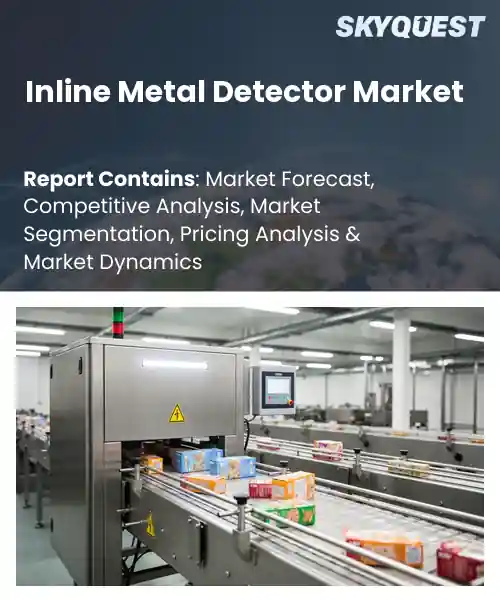
Inline Metal Detector Market
Report ID: SQMIG20I2640
Report ID: SQMIG20I2640
[email protected]
USA +1 351-333-4748
Report ID:
SQMIG20I2640 |
Region:
Global |
Published Date: February, 2026
Pages:
157
|Tables:
123
|Figures:
77


Global Inline Metal Detector Market size was valued at USD 1.5 Billion in 2024 and is poised to grow from USD 1.57 Billion in 2025 to USD 2.21 Billion by 2033, growing at a CAGR of 4.4% during the forecast period (2026-2033).
The global inline metal detector market strategies focuses on equipment placed directly on production lines to detect ferrous, nonferrous and mixed-metal contaminants in packaged and bulk products, and it matters because detection prevents recalls, meets regulation and protects brand reputation. The primary driver has been increasingly stringent food and pharmaceutical safety standards combined with costly publicized recalls that forced manufacturers to adopt inline solutions. Over time the market shifted from off-line laboratory devices to compact, high-speed inline units as sensor sensitivity, digital signal processing and conveyor engineering advanced; for example bakeries began adoption in the 1990s while pharmaceutical producers accelerated integration in 2000s.
Building on earlier adoption trends, the market's key growth factor is technological convergence: as manufacturers automated, demand for inline detectors linking to factory networks rose because real-time rejection data reduces contamination risk and production downtime. Consequently vendors innovate with greater sensitivity, smarter algorithms and telemetry, producing opportunities for retrofits on legacy lines and for service-based monitoring. In practice a confectionery plant using networked detectors can trace contamination events to a specific shift and component, which narrows recall scope and lowers insurance premiums, and expansion into Asia and Latin America follows rising processed food output and tightening of local safety rules.
How is AI Improving Detection Accuracy in the Inline Metal Detector Market?
AI improves detection accuracy in the inline metal detector market by using machine learning to recognize true contamination patterns and filter out product noise. These systems combine multi frequency signals and sensor fusion to separate metal signatures from challenging product effects and varying line speeds. Adaptive algorithms reduce false alarms and raise sensitivity while simplifying setup and calibration for operators. Vendors also pair smarter software with remote diagnostics to keep performance steady across product changeovers. The net effect is more reliable contamination control, less product waste, and smoother integration into modern food and packaging lines.
Sesotec, September 2025, unveiled the INTUITY NEX with AI based THiNK Technology, which enhances signal and image clarity to detect smaller contaminants and reduce false alarms, supporting higher throughput and lower waste and helping the market adopt more efficient inline inspection solutions.
Market snapshot - (2026-2033)
Global Market Size
USD 1.5 Billion
Largest Segment
Pipeline Model
Fastest Growth
Portable Model
Growth Rate
4.4% CAGR
To get more insights on this market click here to Request a Free Sample Report
Global inline metal detector market is segmented by product type, technology type, application, end user and region. Based on product type, the market is segmented into bench model, portable model and pipeline model. Based on technology type, the market is segmented into electromagnetic and X-ray. Based on application, the market is segmented into food, textile, pharmaceutical, plastics, semiconductor industry, battery manufacturing industry, automobile, smartphone, rubber and others. Based on end user, the market is segmented into manufacturers, retailers and others. Based on region, the market is segmented into North America, Europe, Asia Pacific, Latin America and Middle East & Africa.
Based on the global inline metal detector market forecast, food segment dominates because food producers face stringent contamination control requirements and high recalls risk that compel integration of inline metal detectors across processing lines. Demand is driven by the need to protect consumer safety, maintain product quality, and comply with strict safety protocols. Continuous processing and high throughput in food manufacturing make inline systems essential, creating persistent investment priorities and driving suppliers to tailor rugged, sanitary detector designs effectively.
Textile application is expected to be the fastest growing segment in the global inline metal detector market due to increasing quality control requirements, export compliance standards, and rising automation in garment manufacturing. As a result of the increasing demand from global brands to be able to detect broken needles and metal pieces in textiles; Worldwide Modern Laundry Facilities are becoming more widespread.
Electromagnetic segment leads because electromagnetic detection delivers reliable, real time identification of metallic contaminants with relatively low operational complexity and flexible installation across inline processing equipment. Technological maturity of the system will minimize the occurrence of false positive results and greatly simplify the calibration of the system which subsequently will encourage manufacturers to adopt the system due to its focus on increasing uptime and production throughput. The supplier’s focus on electromagnetic solutions is driven by achieving a balance between sensitivity, cost and ease of integration which will expedite the standardization of the system and provide for a more widespread implementation of the system in various manufacturing environments.
X-ray technology is projected to be the fastest growing in the global inline metal detector market due to its superior ability to detect both metallic and non-metallic contaminants with high precision. Increasing food safety regulations, demand for advanced inspection accuracy, and rising automation in high-speed production lines are driving industries to adopt X-ray systems over conventional detection technologies.
To get detailed segments analysis, Request a Free Sample Report
As per the global inline metal detector market analysis, Asia Pacific dominance is driven by robust manufacturing base, strong food and beverage processing industries, rapid adoption of automation, and stringent quality and safety standards. To maintain high levels of quality and compliance at each point of production, automotive and electronic manufacturers are needing to have integrated systems into each area of production. In addition, local component manufacturers provide customized technologies that complement these needs and can compete on an economical basis due to being supported by a well-developed network of distributors and service operations. As a result; investments into automation and further emphasis on meeting export quality requirements create sustained demand for inline metal detection devices across all process sectors. The speed at which the processing industry is able to implement these types of advanced detection solutions are accelerated due to collaborative efforts between equipment manufacturers (OEMs) and end users (processors), while being further driven by regulatory enforcement and consumer confidence with regard to brand image.
Inline metal detector market in Japan benefits from advanced manufacturing ecosystems and high standards in electronics and food processing. System integrators and local engineers will help support the use of precision inspection equipment domestically. This equipment is in high demand due to the need for contaminant control in delicate assembly lines, as well as meeting expectations from customers regarding safety. Many manufacturers establish strong relationships with their tier suppliers so they can work together to create customized solutions for detection devices.
Inline metal detector market in South Korea reflects strong demand from electronics manufacturing and advanced food processing sectors. Inline detection is being increasingly regarded as a critical component of automated production lines due to the emphasis placed on product quality and compliance with international export regulations. Local suppliers and local equipment manufacturers around the world work together to provide highly sensitive, compact inline detection solutions that can be integrated into high density assembly/packaging operations.
Rapid expansion in North America is propelled by strong emphasis on food safety, robust industrial automation adoption, and broad modernization of processing lines across diversified manufacturing sectors. Inline detection technology investment is driven by increasing consumer and retailer demand for contamination-free products. The industry's interest in providing modular, scalable systems as part of their ongoing maintenance efforts has led to a collaborative effort to develop and deliver detection systems that work with existing control systems and predictive maintenance programs. The implementation of private certification programs and regulatory enforcement will continue to drive both the need for replacement or upgrade cycles for existing detectors as well as support for continued growth through active aftermarket services and training programs. End users and vendors working closely together helps accelerate the deployment of custom-tailored solutions for all Food, Pharma, and Industrial manufacturing operations. In addition, the strength of the logistics and supplier industry will allow for quick scalability of systems installed, while procurement strategies will assist in reducing the lead time for new equipment.
Inline metal detector market in United States is shaped by large scale food processing, strong retailer enforcement, and advanced manufacturing across sectors. High throughput detection systems integrated with an automated platform for traceability are preferred in the market. Private certification and supply chain quality requirements drive upgrades. Vendors, integrators and brand owners collaborate together to create customised solutions. Validation of these tailored solutions also takes place across production networks.
Inline metal detector market in Canada is supported by a diverse processing industry and emphasis on food safety across domestic channels. They also have strong distributor/installer/service provider networks to help ensure installation and calibration support to minimize any disruption to manufacturing operations. Technology vendor and processor partnerships promote trials and build confidence in performance, and therefore encourage increased usage of detection technologies throughout the food and industrial sector across the United States.
Europe is strengthening position through a combination of regulatory rigor, concentrated industrial clusters, and a strong emphasis on quality assurance within food and pharmaceutical sectors. Regional manufacturers and technology developers focus on improving their sensors, the accuracy of contamination detection and integration with traceability systems to comply with strict buyer specifications. Retrofit and upgrade projects for aging manufacturing lines, coupled with a need for compact and energy-efficient solutions drive supplier innovation. International standards and certification programs foster harmonized acceptance, while cooperation between suppliers and research institutions accelerates verification of advanced detection technologies for complex product forms. Well-established service organization networks and skilled integrators reduce installation barriers, which helps small and medium processors to adopt. Focus on digitalization provides remote diagnostic capabilities and integration with quality management processes to provide added value from operations.
Inline metal detector market in Germany benefits from strong industrial engineering capabilities and a focus on process optimization across food sectors. Equipment manufacturers and system integrators often have close collaborations to provide customized implementations and efficient retrofit projects. Because of established industry standards and the export requirements for detection technology used to preserve the integrity of products, both are important driving factors for investments to ensure traceable methods of producing goods.
Inline metal detector market in United Kingdom demonstrates strong adoption across food and beverage processing driven by retailer requirements and quality assurance. Operators need compact, flexible detectors to support multiple product lines. Consulting and integration services help in selecting and validating the system. By emphasizing on supply chain visibility and certification, they encourage operators to purchase technologies that detect contaminants reliably but also allow for digital reporting and integrated quality control through production lines.
Inline metal detector market in France is characterized by demand from diverse food sectors that prioritize safety and product quality. Engineering companies and integrators in a local area typically partner with their suppliers to provide installation services and validation of 'retrofit' installations. There is growing emphasis on compliance to related regulatory agencies and export readiness as well as traceability, resulting in implementation of technologies related to detection that help maintain a company's reputation and quality standards in operation.
To know more about the market opportunities by region and country, click here to
Buy The Complete Report
Stringent Food Safety Regulations
Due to the increased strain of new food safety laws on manufacturers and food processors alike, contamination control becomes a necessary part of food production to guarantee compliance with these regulations and to minimize the probability of product recalls. Inline metal detection is among the greatest investment being made to improve food safety, providing continuous, automated inspection during the production process, integrating into certification and quality programs, and providing additional support for meeting both suppliers and retailers’ requirements and enabling traceability efforts. The growing regulatory focus on preventing contaminated food from being sold to consumers has resulted in the creation and use of reliable detection technologies.
Rising Consumer Quality Expectations
Rising consumer quality expectations motivate food and pharmaceutical brands to prioritize contamination prevention as a core element of product positioning, prompting greater investment in global inline metal detector market growth that can demonstrate consistent inspection and enhance safety assurance. To protect their brand reputation, maintain relationships with retailers and meet requirements for private-label products and export markets, manufacturers have responded to consumer demand by installing detection technology on primary production lines. Manufacturers are encouraged to modernize their inspection processes in order to reliably deliver safe, defect-free products and thereby purchase new advanced inline detection technologies across all industries.
High Capital Investment Requirements
Inline metal detectors require large capital investments to acquire and integrate into existing production lines, this may stop manufacturers from upgrading their production lines with new inspection technologies or purchasing brand new production lines with inline metal detectors. This will inhibit market growth. Initial expenditures for equipment, installation, staff training, and process validation create budgetary constraints that favor gradual or selective deployment rather than broad adoption. The perceived cost burden, particularly for companies with thin margins or low-volume production, slows procurement decisions and prolongs replacement cycles, reducing the pace at which detection systems are introduced across diverse production facilities.
Technical Integration Complexity
Technical integration complexity when installing inline metal detectors into existing production environments can impede adoption by increasing project duration and requiring specialized engineering resources, which raises perceived implementation risk. Challenges such as ensuring compatibility with control systems, adapting conveyor or packaging lines, and validating inspection processes demand cross-functional coordination and extended commissioning time. These barriers to installation deter many manufacturers who are concerned about production interruptions or do not have sufficient in-house technical know-how to warrant making investments in these types of systems; this results in delays in deploying the systems and limits the ability of companies to grow via product sales, as the speed and scale of system installation will be restricted.
Request Free Customization of this report to help us to meet your business objectives.
Global inline metal detector market outlook in competitive landscape is shaped by consolidation among legacy equipment manufacturers and rapid sensor innovation from new entrants. To enhance their capabilities, large vendors rely on acquisitions that are aimed at specific capabilities (e.g., Fortress Technology acquired Dynamic Inspection), while the major inspection groups' platform integrations package together various types of metal detection, X ray, and vision in order to provide additional value to their customers.
Aprisium: Established in 2022, they offers cloud-based analytical data allowing operators to monitor multiple contamination levels in tanks: immediately, remotely and easily! Support the environment today by purchasing Aprisium's equipment – your company can be a part of helping to save the planet. Recent development: completed an oversubscribed Series A round led by Deep-Tech Venture Partners and Cocoon Capital and has deployed analyzers in Singapore Philippines and Australia to support industrial monitoring and water quality programs. The technology profiles heavy metals and PFAS onsite to reduce lab turnaround times.
ELROILAB: Established in 2020, their main objective is to deliver hyperspectral imaging and AI to detect foreign materials inline on food production lines and reduce recalls. Recent development: secured Series A funding and commercial partnerships with camera vendors to roll out spectral AI solutions for baby food and other sensitive product segments and reported deployments with food manufacturers to integrate HSI with line conveyors for automated removal and traceability. They raised venture funding to support international pilot programs.
SkyQuest’s ABIRAW (Advanced Business Intelligence, Research & Analysis Wing) is our Business Information Services team that Collects, Collates, Correlates, and Analyses the Data collected by means of Primary Exploratory Research backed by robust Secondary Desk research.
As per SkyQuest analysis, strong food safety regulations are one of the main drivers of the global inline metal detector industry, and the substantial upfront costs associated with purchasing inline metal detectors are a major barrier to entry for smaller processor companies. The food segment represents the largest share of the inline metal detector market, particularly in the Asia Pacific region, where rapid processing rates and stringent contamination controls lead to repeat orders for inline metal detectors as well as strong preferences for sanitary designs. Additionally, consumers' quality expectations are continually increasing, driving companies to invest heavily in inline inspection as part of their traceability and brand protection strategies.
| Report Metric | Details |
|---|---|
| Market size value in 2024 | USD 1.5 Billion |
| Market size value in 2033 | USD 2.21 Billion |
| Growth Rate | 4.4% |
| Base year | 2024 |
| Forecast period | (2026-2033) |
| Forecast Unit (Value) | USD Billion |
| Segments covered |
|
| Regions covered | North America (US, Canada), Europe (Germany, France, United Kingdom, Italy, Spain, Rest of Europe), Asia Pacific (China, India, Japan, Rest of Asia-Pacific), Latin America (Brazil, Rest of Latin America), Middle East & Africa (South Africa, GCC Countries, Rest of MEA) |
| Companies covered |
|
| Customization scope | Free report customization with purchase. Customization includes:-
|
To get a free trial access to our platform which is a one stop solution for all your data requirements for quicker decision making. This platform allows you to compare markets, competitors who are prominent in the market, and mega trends that are influencing the dynamics in the market. Also, get access to detailed SkyQuest exclusive matrix.
Table Of Content
Executive Summary
Market overview
Parent Market Analysis
Market overview
Market size
KEY MARKET INSIGHTS
COVID IMPACT
MARKET DYNAMICS & OUTLOOK
Market Size by Region
KEY COMPANY PROFILES
Methodology
For the Inline Metal Detector Market, our research methodology involved a mixture of primary and secondary data sources. Key steps involved in the research process are listed below:
1. Information Procurement: This stage involved the procurement of Market data or related information via primary and secondary sources. The various secondary sources used included various company websites, annual reports, trade databases, and paid databases such as Hoover's, Bloomberg Business, Factiva, and Avention. Our team did 45 primary interactions Globally which included several stakeholders such as manufacturers, customers, key opinion leaders, etc. Overall, information procurement was one of the most extensive stages in our research process.
2. Information Analysis: This step involved triangulation of data through bottom-up and top-down approaches to estimate and validate the total size and future estimate of the Inline Metal Detector Market.
3. Report Formulation: The final step entailed the placement of data points in appropriate Market spaces in an attempt to deduce viable conclusions.
4. Validation & Publishing: Validation is the most important step in the process. Validation & re-validation via an intricately designed process helped us finalize data points to be used for final calculations. The final Market estimates and forecasts were then aligned and sent to our panel of industry experts for validation of data. Once the validation was done the report was sent to our Quality Assurance team to ensure adherence to style guides, consistency & design.
Analyst Support
Customization Options
With the given market data, our dedicated team of analysts can offer you the following customization options are available for the Inline Metal Detector Market:
Product Analysis: Product matrix, which offers a detailed comparison of the product portfolio of companies.
Regional Analysis: Further analysis of the Inline Metal Detector Market for additional countries.
Competitive Analysis: Detailed analysis and profiling of additional Market players & comparative analysis of competitive products.
Go to Market Strategy: Find the high-growth channels to invest your marketing efforts and increase your customer base.
Innovation Mapping: Identify racial solutions and innovation, connected to deep ecosystems of innovators, start-ups, academics, and strategic partners.
Category Intelligence: Customized intelligence that is relevant to their supply Markets will enable them to make smarter sourcing decisions and improve their category management.
Public Company Transcript Analysis: To improve the investment performance by generating new alpha and making better-informed decisions.
Social Media Listening: To analyze the conversations and trends happening not just around your brand, but around your industry as a whole, and use those insights to make better Marketing decisions.
REQUEST FOR SAMPLE
 REQUEST FREE CUSTOMIZATION
Global Inline Metal Detector Market size was valued at USD 1.5 Billion in 2024 and is poised to grow from USD 1.57 Billion in 2025 to USD 2.21 Billion by 2033, growing at a CAGR of 4.4% during the forecast period (2026-2033).
Global inline metal detector competitive landscape is shaped by consolidation among legacy equipment manufacturers and rapid sensor innovation from new entrants. Large vendors pursue targeted acquisitions to add capabilities such as Fortress Technology acquiring Dynamic Inspection, and platform integrations from major inspection groups to bundle metal detection with X ray and vision. Deep tech startups drive differentiation with hyperspectral imaging and real-time analytics exemplified by Aprisium and ELROILAB deployments. 'Mettler-Toledo International Inc.', 'Thermo Fisher Scientific Inc.', 'Allen-Bradley', 'Fortress Technology Inc.', 'Loma Systems', 'Ishida Co., Ltd.', 'Metal Detection Services', 'Safeline Ltd.', 'CEIA S.p.A.', 'Anritsu Corporation', 'S+S Separation and Sorting Technology GmbH', 'EAGLE Product Inspection', 'Bunting Magnetics Co.', 'Sesotec GmbH', 'Weymouth Holdings', 'Minelab Electronics Pty Ltd.', 'C-Trak Metal Detectors', 'Eriez Manufacturing Co.', 'Detection Technology PLC', 'Sciemetric Instruments Inc.'
Stringent food safety regulations compel manufacturers and processors to implement reliable contamination control measures, prompting increased adoption of inline metal detection systems that ensure regulatory compliance and reduce the risk of recalls. By providing continuous, automated inspection within production lines, these systems integrate with certification and quality management programs, reinforce supplier and retailer requirements, and support traceability efforts. The regulatory emphasis on preventing contaminated products from reaching consumers encourages investment in proven detection technologies, improving product integrity and incentivizing upgrades across diverse manufacturing segments.
As per the global inline metal detector market analysis, Asia Pacific dominance is driven by robust manufacturing base, strong food and beverage processing industries, rapid adoption of automation, and stringent quality and safety standards


Want to customize this report? This report can be personalized according to your needs. Our analysts and industry experts will work directly with you to understand your requirements and provide you with customized data in a short amount of time. We offer $1000 worth of FREE customization at the time of purchase.
Feedback From Our Clients


 USA (+1) 351-333-4748

