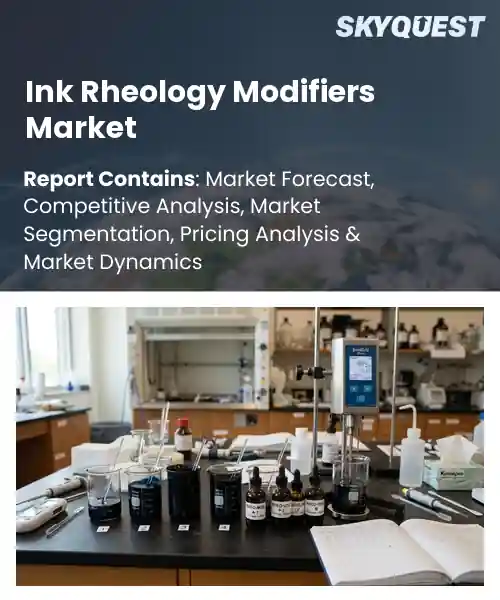
Ink Rheology Modifiers Market
Report ID: SQMIG15E4431
Report ID: SQMIG15E4431
[email protected]
USA +1 351-333-4748
Report ID:
SQMIG15E4431 |
Region:
Global |
Published Date: September, 2026
Pages:
157
|Tables:
128
|Figures:
77


Global Ink Rheology Modifiers Market size was valued at USD 522.9 Million in 2024 and is poised to grow from USD 545.38 Million in 2025 to USD 763.8 Million by 2033, growing at a CAGR of 4.3% during the forecast period (2026-2033).
An ink rheology modifiers market is defined by chemicals that adjust viscosity, flow behavior, and stability of printing inks across diverse substrates. Its primary driver is the accelerating demand for high‑resolution digital and flexographic printing, which requires inks that can deliver fine line definition without clogging printheads. Historically, the market emerged in the late 1990s when solvent‑based inks dominated, but the shift toward water‑based and UV‑curable formulations forced manufacturers to adopt polymeric thickeners and surfactant blends. For example, major pigment dispersions now incorporate polyethylene glycol grafts to prevent sedimentation, illustrating how formulation complexity has created sustained commercial interest for producers. An equally pivotal factor propelling the ink rheology modifiers market is the surge in sustainable packaging and printed electronics, which creates opportunities for additive suppliers. Brands aiming for recyclable cartons and flexible circuits demand inks that preserve flow under low‑temperature drying and roll‑to‑roll operation; this requirement pushes the shift toward bio‑based thickeners such as starch‑derived nanocellulose. Consequently, firms able to deliver viscosity while lowering volatile organic compounds secure competitive advantage, as demonstrated by a European coating company that doubled its market share after introducing a biodegradable modifier line. This cause‑effect dynamic fuels R&D spending, accelerating innovation and expanding market size.
How is AI-driven formulation automation impacting the ink rheology modifiers market?
AI-driven formulation automation is reshaping the ink rheology modifiers market by accelerating the design of additives that control viscosity, flow and stability. Machine‑learning models evaluate countless molecular combinations, allowing formulators to predict performance before physical testing. This reduces trial‑and‑error cycles, cuts material waste and shortens time‑to‑market for new ink systems. Suppliers are integrating these tools into their R&D pipelines, enabling rapid response to evolving printer technologies and sustainability demands. The result is a more agile market where customized rheology solutions can be delivered with greater precision, fostering innovation across packaging, graphic and industrial printing sectors.Recent activity in 2024 highlighted a major ink chemicals producer launching an AI‑enabled formulation platform, demonstrating how the technology streamlines additive selection and supports faster product launches while improving consistency.
Market snapshot - (2026-2033)
Global Market Size
USD 522.9 Million
Largest Segment
Associative Rheology Modifiers
Fastest Growth
Cellulose-Based Modifiers
Growth Rate
4.3% CAGR
To get more insights on this market click here to Request a Free Sample Report
Global ink rheology modifiers market is segmented by modifier type, ink type, application, end user and region. Based on modifier type, the market is segmented into Associative Rheology Modifiers, Non-Associative Rheology Modifiers, Cellulose-Based Modifiers, Polyurethane-Based Modifiers, Acrylic-Based Modifiers, Clay-Based Modifiers and Others. Based on ink type, the market is segmented into Water-Based Inks, Solvent-Based Inks, UV-Curable Inks, Oil-Based Inks and Other Specialty Inks. Based on application, the market is segmented into Packaging Printing, Publication Printing, Textile Printing, Decorative Printing, Industrial Printing and Others. Based on end user, the market is segmented into Printing and Packaging, Textile, Consumer Goods, Industrial Manufacturing and Others. Based on region, the market is segmented into North America, Europe, Asia Pacific, Latin America and Middle East & Africa.
Associative rheology modifiers segment dominates because they provide strong thixotropic control while maintaining low viscosity, enabling precise jetting and stable print runs. Their molecular architecture forms reversible networks that quickly recover after shear, which is essential for high speed printing equipment. This combination meets the industry’s demand for consistent ink flow, reduces nozzle clogging, and supports a broad range of formulations, making them the preferred choice for manufacturers.
Meanwhile, cellulose based modifiers segment emerges as the fastest growing because they are derived from renewable resources and offer biodegradable options that align with sustainability goals. Their natural polymer chains provide shear thinning behavior suitable for water based systems, attracting conscious ink formulators and expanding applications in packaging, thereby accelerating market expansion.
UV curable inks segment dominates because they require precise viscosity management to ensure rapid film formation under UV exposure. Rheology modifiers tailored for these inks deliver instant shear thinning and rapid recovery, supporting high speed digital printing while preserving pigment stability. The need for low VOC, fast cure solutions drives formulators to prioritize these modifiers, reinforcing UV curable inks as the core platform for advanced printing technologies across diverse substrate selections and market.
On the other hand, solvent based inks segment is witnessing the strongest growth because emerging industrial printing applications demand robust solvent systems that tolerate harsh substrates. Enhanced rheology modifiers improve tack resistance and drying speed, attracting manufacturers seeking versatile performance. This momentum expands the market by opening new channels for sectors.
To get detailed segments analysis, Request a Free Sample Report
The region benefits from a concentration of high‑technology printing and packaging firms that demand precise control over ink flow and stability. Robust research institutions collaborate closely with manufacturers, accelerating the development of specialty modifiers that meet rigorous performance criteria. Cost‑effective production capabilities combined with extensive downstream supply chains enable rapid scaling of new formulations. Strong demand from consumer electronics, automotive interiors, and high‑volume publishing drives continual innovation, while supportive regulatory frameworks encourage the adoption of advanced rheological solutions. Together, these factors create a synergistic ecosystem that reinforces Asia Pacific’s leadership in the ink rheology modifiers space.
Ink Rheology Modifiers Market in Japan is characterized by a deep integration of precision engineering expertise with cutting‑edge chemical development. Local manufacturers prioritize high performance and environmental compliance, fostering a culture of continual improvement. Close ties between universities and industry accelerate the translation of lab‑scale breakthroughs into commercial products. The market responds swiftly to the nuanced requirements of sophisticated printing equipment, emphasizing consistency, low toxicity, and adaptability across diverse substrate types.
Ink Rheology Modifiers Market in South Korea is propelled by a vibrant electronics and display sector that demands exacting ink behavior for high‑resolution outputs. Government‑backed innovation programs support the creation of next‑generation polymeric additives tailored for fast‑drying and low‑viscosity applications. Manufacturers leverage advanced process control technologies, ensuring tight quality tolerances and rapid time‑to‑market. Collaborative networks between chemical firms and equipment suppliers enhance the customization of rheology solutions, reinforcing the country’s reputation for technical excellence in ink formulation.
A strong emphasis on sustainability and performance optimization guides North American demand for advanced ink additives. Consumers and regulators alike pressure brands to deliver high‑quality prints with reduced waste, prompting manufacturers to adopt modifiers that improve flow, reduce drying time, and enhance substrate adhesion. Significant investment in research and development across academic and corporate institutions fuels continuous product refinement. The presence of major printing equipment manufacturers creates a feedback loop that accelerates the integration of innovative rheological technologies. Moreover, the region’s diverse end‑use sectors—from packaging to digital signage—require tailored solutions, further amplifying market momentum.
Ink Rheology Modifiers Market in the United States is shaped by a sizable commercial printing industry that seeks reliable, high‑performance additives to meet complex design demands. Collaboration between chemical suppliers and print service providers drives the development of customizable formulations that address rapid throughput and environmental considerations. Strong intellectual property infrastructure supports the protection of novel rheology technologies, encouraging ongoing investment. The market responds to evolving customer expectations for vivid color reproduction and consistent print quality across variable media.
Ink Rheology Modifiers Market in Canada reflects a focus on specialty applications within graphic arts and label production. Close partnerships between research centres and niche manufacturers foster the creation of modifiers that balance viscosity control with eco‑friendly attributes. The market benefits from a regulatory environment that encourages the adoption of low‑VOC and biodegradable solutions, prompting firms to prioritize sustainable formulations. Industry players emphasize flexibility, enabling rapid adaptation to changing market trends and diverse substrate requirements.
Europe leverages a legacy of chemical expertise and rigorous quality standards to enhance its role in the ink rheology arena. Collaborative networks spanning universities, research institutes, and industrial consortia drive the development of high‑precision modifiers that cater to demanding printing processes. Emphasis on regulatory compliance and environmental stewardship pushes manufacturers toward greener additive chemistries without compromising performance. The region’s diverse manufacturing base—from luxury packaging to high‑speed newspaper printing—creates a fertile ground for tailored solutions. Strategic investment in digital printing technologies further expands the need for sophisticated rheology control, solidifying Europe’s growing influence in the global market.
Ink Rheology Modifiers Market in Germany is anchored by a strong engineering culture that prioritizes precision and reliability. Close cooperation between chemical firms and mechanical printing equipment producers yields additives optimized for high‑speed, high‑quality output. Research initiatives focus on enhancing stability under demanding process conditions while meeting stringent environmental guidelines. The market’s reputation for technical excellence attracts multinational customers seeking consistent performance across varied applications.
Ink Rheology Modifiers Market in the United Kingdom is driven by an active creative publishing sector and a growing demand for sustainable packaging solutions. Universities and industry partners collaborate to innovate modifiers that improve print clarity and reduce energy consumption. Regulatory pressures encourage the shift toward low‑impact chemistries, prompting manufacturers to develop bio‑based alternatives. The market responds swiftly to evolving design trends, ensuring that ink formulations remain adaptable to new artistic and commercial challenges.
Ink Rheology Modifiers Market in France benefits from a vibrant graphic design community and a strong emphasis on high‑end luxury printing. Collaborative research programs focus on achieving exceptional color fidelity and substrate compatibility. Environmental considerations guide the formulation of additives that minimize volatile emissions while delivering superior flow characteristics. The market’s agility enables rapid incorporation of innovative rheology solutions into both traditional and emerging digital printing platforms.
To know more about the market opportunities by region and country, click here to
Buy The Complete Report
Growing Demand For High‑Performance Inks
Adoption Of Advanced Rheology Additives
High Cost Of Specialized Modifiers
Regulatory Scrutiny on Chemical Compositions
Request Free Customization of this report to help us to meet your business objectives.
Top Player’s Company Profile
Recent Developments
SkyQuest’s ABIRAW (Advanced Business Intelligence, Research & Analysis Wing) is our Business Information Services team that Collects, Collates, Correlates, and Analyses the Data collected by means of Primary Exploratory Research backed by robust Secondary Desk research. As per SkyQuest analysis, the market is propelled primarily by the growing demand for high‑performance inks that require precise viscosity control, while the adoption of advanced rheology additives serves as a second catalyst enabling finer line work and faster drying. The sector faces a restraint in the high cost of specialized modifiers, which can limit uptake among cost‑sensitive printers. Asia Pacific dominates the landscape, driven by a dense cluster of printing and packaging firms alongside strong R&D ecosystems. Within product categories, associative rheology modifiers lead the market owing to their superior thixotropic control and low shear viscosity. Together these forces shape a robust growth trajectory.
| Report Metric | Details |
|---|---|
| Market size value in 2024 | USD 522.9 Million |
| Market size value in 2033 | USD 763.8 Million |
| Growth Rate | 4.3% |
| Base year | 2024 |
| Forecast period | (2026-2033) |
| Forecast Unit (Value) | USD Million |
| Segments covered |
|
| Regions covered | North America (US, Canada), Europe (Germany, France, United Kingdom, Italy, Spain, Rest of Europe), Asia Pacific (China, India, Japan, Rest of Asia-Pacific), Latin America (Brazil, Rest of Latin America), Middle East & Africa (South Africa, GCC Countries, Rest of MEA) |
| Companies covered |
|
| Customization scope | Free report customization with purchase. Customization includes:-
|
To get a free trial access to our platform which is a one stop solution for all your data requirements for quicker decision making. This platform allows you to compare markets, competitors who are prominent in the market, and mega trends that are influencing the dynamics in the market. Also, get access to detailed SkyQuest exclusive matrix.
Table Of Content
Executive Summary
Market overview
Parent Market Analysis
Market overview
Market size
KEY MARKET INSIGHTS
COVID IMPACT
MARKET DYNAMICS & OUTLOOK
Market Size by Region
KEY COMPANY PROFILES
Methodology
For the Ink Rheology Modifiers Market, our research methodology involved a mixture of primary and secondary data sources. Key steps involved in the research process are listed below:
1. Information Procurement: This stage involved the procurement of Market data or related information via primary and secondary sources. The various secondary sources used included various company websites, annual reports, trade databases, and paid databases such as Hoover's, Bloomberg Business, Factiva, and Avention. Our team did 45 primary interactions Globally which included several stakeholders such as manufacturers, customers, key opinion leaders, etc. Overall, information procurement was one of the most extensive stages in our research process.
2. Information Analysis: This step involved triangulation of data through bottom-up and top-down approaches to estimate and validate the total size and future estimate of the Ink Rheology Modifiers Market.
3. Report Formulation: The final step entailed the placement of data points in appropriate Market spaces in an attempt to deduce viable conclusions.
4. Validation & Publishing: Validation is the most important step in the process. Validation & re-validation via an intricately designed process helped us finalize data points to be used for final calculations. The final Market estimates and forecasts were then aligned and sent to our panel of industry experts for validation of data. Once the validation was done the report was sent to our Quality Assurance team to ensure adherence to style guides, consistency & design.
Analyst Support
Customization Options
With the given market data, our dedicated team of analysts can offer you the following customization options are available for the Ink Rheology Modifiers Market:
Product Analysis: Product matrix, which offers a detailed comparison of the product portfolio of companies.
Regional Analysis: Further analysis of the Ink Rheology Modifiers Market for additional countries.
Competitive Analysis: Detailed analysis and profiling of additional Market players & comparative analysis of competitive products.
Go to Market Strategy: Find the high-growth channels to invest your marketing efforts and increase your customer base.
Innovation Mapping: Identify racial solutions and innovation, connected to deep ecosystems of innovators, start-ups, academics, and strategic partners.
Category Intelligence: Customized intelligence that is relevant to their supply Markets will enable them to make smarter sourcing decisions and improve their category management.
Public Company Transcript Analysis: To improve the investment performance by generating new alpha and making better-informed decisions.
Social Media Listening: To analyze the conversations and trends happening not just around your brand, but around your industry as a whole, and use those insights to make better Marketing decisions.
REQUEST FOR SAMPLE
 REQUEST FREE CUSTOMIZATION


Want to customize this report? This report can be personalized according to your needs. Our analysts and industry experts will work directly with you to understand your requirements and provide you with customized data in a short amount of time. We offer $1000 worth of FREE customization at the time of purchase.
Feedback From Our Clients


 USA (+1) 351-333-4748

