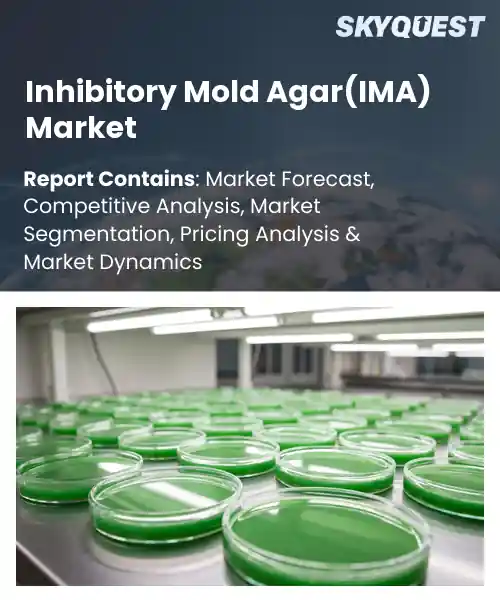
Inhibitory Mold Agar(IMA) Market
Report ID: SQMIG35J2245
Report ID: SQMIG35J2245
[email protected]
USA +1 351-333-4748
Report ID:
SQMIG35J2245 |
Region:
Global |
Published Date: March, 2026
Pages:
157
|Tables:
116
|Figures:
77


Global Inhibitory Mold Agar (IMA) Market size was valued at USD 1.8 Billion in 2024 and is poised to grow from USD 1.92 Billion in 2025 to USD 3.28 Billion by 2033, growing at a CAGR of 6.9% during the forecast period (2026-2033).
The rising need for precise and specific methods to detect fungi in food safety and clinical testing. Inhibitory mold agar functions as a specialized culture medium which permits filamentous fungi growth while it inhibits bacterial development, thus enabling mold identification to prevent food spoilage, decrease mycotoxin risks, and aid in infection control. The global inhibitory mold agar (IMA) market growth is driven from basic products which small labs used to full-scale standard products which major food companies and hospital reference laboratories adopted. The global market became more common because testing expanded through contracted testing and because regulatory changes occurred after contamination outbreaks.
The global inhibitory mold agar (IMA) industry experiences regulatory oversight as its main driving force which testing activities have increased throughout supply chains. Food safety regulators tighten contamination limits, which compels manufacturers to increase their environmental testing and product testing, thus creating a need for IMA plates in control labs that operate at high throughput. Suppliers need to increase production capabilities while they create new product formulas that enhance shelf stability and improve product selection processes, thus enabling beverage and baking businesses to identify Aspergillus and Penicillium contamination earlier in the process, leading to fewer product recalls. Contract testing laboratories and hospital mycology units discover their ability to provide quick screening solutions which result in continuous revenue generation for their businesses.
How is AI-driven Analytics Influencing Demand Forecasting in the Inhibitory Mold Agar Market?
AI-based analytics improves demand prediction accuracy within the Inhibitory Mold Agar (IMA) sector by enabling suppliers to forecast needs instead of responding to orders. Internal sales data, inventory records, laboratory test volumes, and seasonal purchasing patterns form the core machine learning system which analyzes both internal and external factors. Distributors and laboratories currently utilize the tools to balance their supply needs, select appropriate packing dimensions, and decide which shipments should go to their most significant customers. Environmental events prompt clinical and food safety laboratories to order more products while manufacturers change their production schedules. The contextual intelligence system enhances distribution efficiency by decreasing item shortages while it increases product distribution performance throughout different regional distribution systems.
The Defense Logistics Agency awarded Fisher Scientific a delivery order for inhibitory mold agar, which demonstrates how institutional procurement produces unexpected demand surges for inert product supplies which will occur in November 2025. AI-driven forecasting enables suppliers to anticipate ordering patterns while they manage their production processes and inventory distribution, which enhances market operations and delivery timing.
Market snapshot - (2026-2033)
Global Market Size
USD 1.8 Billion
Largest Segment
Standard IMA
Fastest Growth
IMA with Gentamicin/Chloramphenicol
Growth Rate
6.9% CAGR
To get more insights on this market click here to Request a Free Sample Report
The global inhibitory mold agar (IMA) market is segmented based on formulation type, physical form, application or test target, end user, and region. In terms of formulation type, the market is divided into standard IMA, IMA with gentamicin or chloramphenicol, and enriched or blood-based IMA. Based on physical form, it is categorized into pre-poured Petri dishes and dehydrated culture media. By application or test target, the market includes pathogenic fungi isolation, opportunistic yeasts, and environmental mold testing. In terms of end users, it is segmented into diagnostic laboratories, pharmaceutical and biotech quality control, and academic and food research institutes. Regionally, the market is analyzed across North America, Europe, Asia Pacific, Latin America, and the Middle East & Africa.
As per the global inhibitory mold agar (IMA) market analysis, the Enriched/Blood-based IMA segment leads the market because enriched formulations deliver nutrient-dense matrices which support the growth of difficult-to-culture fungal pathogens, resulting in better identification through improved recovery and colony morphology. Clinical laboratories select these formulations because they offer crucial sensitivity and organism viability advantages which make them suitable for routine diagnostic testing. The better recovery process enables clinical testing through faster identification of all pathogens, which makes hospitals prefer to buy products from companies leading the market.
However, the IMA product category which contains Gentamicin/Chloramphenicol has become the fastest expanding section because it enables users to achieve selective bacterial contamination control while they work on fungal identification from contaminated materials. The pharmaceutical industry uses the products for quality control while environmental monitoring needs these products to establish standardized selective media requirements, which leads to product refinements that create new procurement and operational demands.
According to the global inhibitory mold agar (IMA) market forecast, the Pre-poured Petri Dishes segment leads the market because pre-prepared plates enable users to skip the media preparation process while they maintain uniform agar thickness and surface sterility for everyday fungal culture needs. The pre-poured formats establish themselves as the preferred choice for laboratories which want to maximize their operational effectiveness while maintaining consistent results in high-throughput testing and quality control activities. The laboratory process improvement through decreased technician time and reduced method differences accelerates laboratory results delivery while laboratories can follow their established testing procedures, which leads institutional buyers to establish purchasing agreements and build stable demand while decreasing contamination risks.
Laboratories need cost-effective, scalable solutions which offer extended shelf life and easy storage handling, which drives the strong growth of dehydrated culture media. Its bulk production capabilities and its ability to customize products make the solution attractive to both manufacturers and large laboratories, while the improved formulation and fast rehydration processes enable laboratories to create plates whenever needed, which expands adoption and generates business opportunities for both suppliers and contract manufacturers.
To get detailed segments analysis, Request a Free Sample Report
As per the inhibitory mold agar (IMA) market regional forecast, North America achieves its market leadership through a combination of extensive laboratory facilities, established systems for food and clinical testing, and manufacturing and distribution networks that specialize in developing culture media products. The market maintains its dominant position because regulatory agencies collaborate to enforce environmental and product safety regulations which lead to the regular application of selective media. The combination of established laboratory networks and research institutions with contract testing services establishes continuous demand for new product formulation.
The IMA market in the United States operates through existing laboratory facilities which serve clinical and food and environmental testing requirements. Businesses that produce major products and testing services work to develop special products because they stay in contact with users of their services. Organizations that establish rules and create accreditation standards expect all laboratories to use media that has received official validation. Product development through testing facilities requires testing environments to maintain testing processes which support product development.
The performance of Canadian IMA market shows how public health system between public health sector and food safety sector operates through government rules and local testing facilities. The need for quality assurance together with environmental testing requirements drives the demand for selective media products. Local distributors create partnershipss with international suppliers to provide special products, while laboratories build capacity, and their staff receive training to extend product utilization in clinical and industrial and research testing areas.
The European market is growing rapidly because businesses need to meet European Union regulations, and customers demand safe food products, which businesses require to verify their products through environmental testing and clinical testing procedures. The region benefits from an active local production industry which operates close to research centers that help to develop and prove new products. Testing procedures become standardized through food and pharmaceutical cross-border trade, while laboratories choose to implement validated media because accreditation and certification standards require such media usage. The market reach of specialized distributors improves through their value-added services, which provide both technical training and method support. Laboratory infrastructure upgrades through public and private sector funding to create partnerships between businesses and research centers and regulatory organizations which help to improve regional development and increase usage of new IMA formulations.
The inhibitory mold agar (IMA) market penetration in Germany depends on industrial testing facilities and laboratory supply companies which manufacture laboratory equipment. The food and pharmaceutical and environmental testing laboratories need validated media solutions because of the rigorous certification standards and regulatory requirements. The distribution system between technical experts and distributors and customers enables businesses to improve their products while achieving wide product distribution throughout various testing locations.
The UK IMA market shows fast growth in business and testing methods because private laboratories and research institutions boost the market. The selective media usage rises because procurement processes become faster, and diagnostic workflow progress occurs, and contract testing services grow. Quality control in food production and environmental testing practices together with strong technical support from suppliers lead to faster market growth and product usage expansion.
French laboratories are adopting IMA testing as their laboratories undergo updates to meet local quality and safety standards. The rising demand for food safety testing and environmental testing leads to increased use of selective media products in testing. Academic research teams work with industry suppliers in collaborative projects to create validation studies which use dedicated distribution networks to deliver special testing solutions to various testing environments.
Asia Pacific improves its market standing through planned laboratory infrastructure growth and industrial testing demand growth and local production capacity development for culture media. The regional manufacturers and distributors extend their product range in technical assistance to fulfill various climate and application needs through their international partnerships which speed up technology transfer process and help improve product formulations. The accreditation process together with workforce training program implementation leads to improved testing standards which increase trustworthiness of selective media testing. The food processing and export sector growth together with increased public health monitoring needs results in more people using medical testing services. The region increases its testing capacity through laboratory automation combined with IMA implementation across clinical testing environments and environmental research sites and industrial testing facilities.
The Inhibitory Mold Agar (IMA) Market in Japan operates according to high technical requirements which demand products to maintain their quality and work together with automated laboratory equipment. The local manufacturing and distribution companies provide essential support for food safety and environmental monitoring and clinical diagnostics through their specialized product development and product validation procedures. The existing supply chain connections between suppliers and laboratory networks create a dependable system which supports laboratories through technical training and product delivery for their testing needs.
The Inhibitory Mold Agar (IMA) Market in South Korea receives support from its active biotechnology industry which quickly adopts innovative testing procedures. The contract testing industry together with food manufacturers who export their products creates a demand for validated selective media. Organizations work closely with its international supply chain partners combined with dedicated funding for laboratory growth and accreditation process to deliver new product developments and advanced technical support into their clinical and environmental testing facilities and industrial testing spaces.
To know more about the market opportunities by region and country, click here to
Buy The Complete Report
Increasing Demand for Accurate Microbial Detection
The adoption of inhibitory mold agar is driven by increased awareness of needing to identify microbes accurately in clinical and food safety and environmental testing situations because laboratories need media that prevents fast-growing fungi from interfering with isolating important organisms. The IMA solution delivers specific results which help laboratories work efficiently because it minimizes the need for repeat tests and makes it easier to see colony shapes which accelerates decision-making and builds result trust. Testing facilities make their procurement decisions based on the need for selective testing and clear results,which leads to wider adoption across all testing facilities.
Expansion of Pharmaceutical and Biotechnology Testing
The testing market for pharmaceutical and biotechnology testing programs needs specialized culture media to rise because their expansion drives business for selective media which enables precise fungal separation during sterility test and contamination assessment procedures. The laboratories in this industry require media which delivers dependable fungal recovery results and maintains optimal growth control to support their process validation and product safety testing activities. The testing capacity growth in biopharma and biotech companies leads to a market shift toward dependable selective media which results in institutional purchasing and extended supply contracts driving market growth.
High Cost of Specialized Culture Media
The high costs of producing and obtaining specialized culture media, which includes inhibitory mold agar, results in limited market expansion because smaller laboratories with restricted funds find it difficult to implement that media. The financial situation requires organizations to spend their budgeted funds on media which provides general functions or on equipment which the organization develops itself because they perceive less value from using selective media. The financial obstacle affects the cycles of procurement which leads to decreased interest in using premium selective media and results in slower market entry into price-sensitive segments despite the technical benefits.
Stringent Regulatory Quality and Validation Requirements
The media used in clinical and pharmaceutical testing must meet extensive regulatory standards and quality assurance criteria which prevent new suppliers from entering the market while laboratories need established media which has been proven through testing. The need to show consistent performance together with documentation maintenance and validation support requirements creates excessive resource demands which prevent quick media formulation switching or new media procurement. Organizations face high compliance demands which create operational difficulties that benefit established vendors with validated product lines while smaller manufacturers face market entry barriers which limit their product variety in inhibitory mold agar products.
Request Free Customization of this report to help us to meet your business objectives.
The global market for inhibitory mold agar experiences competition because businesses differentiate their products and expand their production capacities, which leads them to pursue laboratory contracts through specific M&A deals and distribution agreements and product formulation advancements. Major vendors have introduced improved IMA formulations while they have expanded their pre-poured media production capacity and established research partnerships to fast track the creation of selective media.
Expanded Applications in Food Safety: The food quality concerns related to mold contamination have increased awareness among supply chain stakeholders about IMA as a necessary tool for their regular screening processes. The sensitive culture media products have become essential for manufacturers and processors and testing laboratories because these products protect their products from contamination. The trend drives suppliers to create new product formulations that last longer on shelves while they develop special packaging solutions for different types of food products. Media producers and analytical service providers are working together to enhance their market growth by providing customers with solutions that perform consistently and operate easily within their current quality assurance systems.
Digital Laboratory Integration: Laboratory automation and digital imaging technology developments create a demand for culture media that works with automated systems and image analysis systems. The stakeholders demand media formulations which deliver stable colony morphology results that machine systems recognize because these results speed up throughput while decreasing manual process differences. Laboratory information management systems and reporting tools enable test facilities to track their progress while decentralized networks use laboratory information management systems and reporting tools to guide their decision-making process. The diagnostic and contract laboratories will easily adopt products through suppliers who provide standardized product specifications along with technical support and validation guidance.
SkyQuest’s ABIRAW (Advanced Business Intelligence, Research & Analysis Wing) is our Business Information Services team that Collects, Collates, Correlates, and Analyses the Data collected by means of Primary Exploratory Research backed by robust Secondary Desk research.
As per SkyQuest analysis, the international market for IMA is growing because food safety and clinical diagnostics require precise fungal detection, which regulatory authorities now enforce through increased testing activities across supply chains. The high cost of specialized culture media products creates a major obstacle which prevents smaller labs from using these products. North America leads the market because its laboratory infrastructure density and strong industry networks provide a better base for business operations while clinical use of enriched blood-based IMA formulations dominates because these formulations achieve better results in recovering fastidious fungi. The market will keep expanding through pharmaceutical and biotech quality control adoption and through product developments that match automated laboratory systems which process high volumes of work.
| Report Metric | Details |
|---|---|
| Market size value in 2024 | USD 1.8 Billion |
| Market size value in 2033 | USD 3.28 Billion |
| Growth Rate | 6.9% |
| Base year | 2024 |
| Forecast period | (2026-2033) |
| Forecast Unit (Value) | USD Billion |
| Segments covered |
|
| Regions covered | North America (US, Canada), Europe (Germany, France, United Kingdom, Italy, Spain, Rest of Europe), Asia Pacific (China, India, Japan, Rest of Asia-Pacific), Latin America (Brazil, Rest of Latin America), Middle East & Africa (South Africa, GCC Countries, Rest of MEA) |
| Companies covered |
|
| Customization scope | Free report customization with purchase. Customization includes:-
|
To get a free trial access to our platform which is a one stop solution for all your data requirements for quicker decision making. This platform allows you to compare markets, competitors who are prominent in the market, and mega trends that are influencing the dynamics in the market. Also, get access to detailed SkyQuest exclusive matrix.
Table Of Content
Executive Summary
Market overview
Parent Market Analysis
Market overview
Market size
KEY MARKET INSIGHTS
COVID IMPACT
MARKET DYNAMICS & OUTLOOK
Market Size by Region
KEY COMPANY PROFILES
Methodology
For the Inhibitory Mold Agar(IMA) Market, our research methodology involved a mixture of primary and secondary data sources. Key steps involved in the research process are listed below:
1. Information Procurement: This stage involved the procurement of Market data or related information via primary and secondary sources. The various secondary sources used included various company websites, annual reports, trade databases, and paid databases such as Hoover's, Bloomberg Business, Factiva, and Avention. Our team did 45 primary interactions Globally which included several stakeholders such as manufacturers, customers, key opinion leaders, etc. Overall, information procurement was one of the most extensive stages in our research process.
2. Information Analysis: This step involved triangulation of data through bottom-up and top-down approaches to estimate and validate the total size and future estimate of the Inhibitory Mold Agar(IMA) Market.
3. Report Formulation: The final step entailed the placement of data points in appropriate Market spaces in an attempt to deduce viable conclusions.
4. Validation & Publishing: Validation is the most important step in the process. Validation & re-validation via an intricately designed process helped us finalize data points to be used for final calculations. The final Market estimates and forecasts were then aligned and sent to our panel of industry experts for validation of data. Once the validation was done the report was sent to our Quality Assurance team to ensure adherence to style guides, consistency & design.
Analyst Support
Customization Options
With the given market data, our dedicated team of analysts can offer you the following customization options are available for the Inhibitory Mold Agar(IMA) Market:
Product Analysis: Product matrix, which offers a detailed comparison of the product portfolio of companies.
Regional Analysis: Further analysis of the Inhibitory Mold Agar(IMA) Market for additional countries.
Competitive Analysis: Detailed analysis and profiling of additional Market players & comparative analysis of competitive products.
Go to Market Strategy: Find the high-growth channels to invest your marketing efforts and increase your customer base.
Innovation Mapping: Identify racial solutions and innovation, connected to deep ecosystems of innovators, start-ups, academics, and strategic partners.
Category Intelligence: Customized intelligence that is relevant to their supply Markets will enable them to make smarter sourcing decisions and improve their category management.
Public Company Transcript Analysis: To improve the investment performance by generating new alpha and making better-informed decisions.
Social Media Listening: To analyze the conversations and trends happening not just around your brand, but around your industry as a whole, and use those insights to make better Marketing decisions.
REQUEST FOR SAMPLE
 REQUEST FREE CUSTOMIZATION
Global Inhibitory Mold Agar(Ima) Market size was valued at USD 1.8 Billion in 2024 and is poised to grow from USD 1.92 Billion in 2025 to USD 3.28 Billion by 2033, growing at a CAGR of 6.9% during the forecast period (2026-2033).
Competition in the global inhibitory mold agar market is driven by product differentiation and manufacturing scale, with companies using targeted M&A, distribution partnerships, and formulation innovation to secure laboratory contracts. Recent moves include major vendors launching enhanced IMA formulations, expanding pre poured media capacity, and partnering with research institutions to accelerate selective media development. 'Merck KGaA', 'Bio-Rad Laboratories, Inc.', 'Thermo Fisher Scientific Inc.', 'Hardy Diagnostics', 'Becton, Dickinson and Company', 'Oxoid Ltd.', 'HiMedia Laboratories', 'Eiken Chemical Co., Ltd.', 'Sigma-Aldrich', 'Neogen Corporation', 'Liofilchem S.r.l.', 'BD Biosciences', 'VWR International', 'AppliChem GmbH', 'Promega Corporation', 'Angelini Pharma', 'Culture Techniques', 'Genesee Scientific', 'Lab M', 'Synlogic Inc.'
Growing awareness of the need for precise microbial identification in clinical, food safety, and environmental testing drives adoption of inhibitory mold agar, as laboratories seek media that suppress rapidly growing fungi while allowing target organisms to be isolated. The specificity and reliability of IMA improve laboratory workflow by reducing repeat testing and aiding in clearer colony morphology, which supports faster decision making and confidence in results. This qualitative preference for selectivity and clarity enhances procurement choices and encourages wider use across testing facilities.
Expanded Applications In Food Safety: Growing awareness of mold-related food quality issues is driving wider adoption of IMA for routine screening across supply chain stakeholders. Manufacturers, processors, and testing laboratories increasingly prioritize sensitive culture media to ensure product integrity. This trend encourages suppliers to innovate formulations, improve shelf stability, and offer tailored packaging for diverse food matrices. Collaboration between media producers and analytical service providers is strengthening market penetration, while end users seek reproducible, user friendly solutions that integrate smoothly into existing quality assurance workflows.
Why does North America Dominate the Global Inhibitory Mold Agar(IMA) Market? |@12


Want to customize this report? This report can be personalized according to your needs. Our analysts and industry experts will work directly with you to understand your requirements and provide you with customized data in a short amount of time. We offer $1000 worth of FREE customization at the time of purchase.
Feedback From Our Clients


 USA (+1) 351-333-4748

