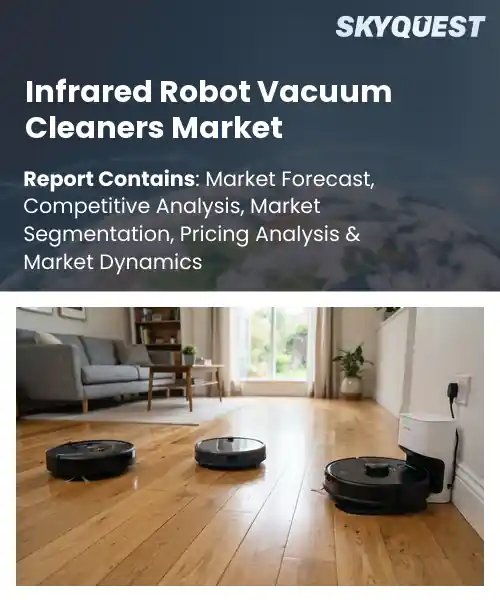
Infrared Robot Vacuum Cleaners Market
Report ID: SQMIG25H2171
Report ID: SQMIG25H2171
[email protected]
USA +1 351-333-4748
Report ID:
SQMIG25H2171 |
Region:
Global |
Published Date: August, 2026
Pages:
157
|Tables:
181
|Figures:
79


Global Infrared Robot Vacuum Cleaners Market size was valued at USD 5.86 Billion in 2024 and is poised to grow from USD 6.6 Billion in 2025 to USD 17.06 Billion by 2033, growing at a CAGR of 12.6% during the forecast period (2026-2033).
The global infrared robot vacuum cleaner market comprises autonomous floor‑cleaning devices that use infrared sensors to map obstacles, detect edges, and navigate efficiently. Its importance stems from rising consumer demand for smart home solutions that combine convenience with energy efficiency. The primary driver has been the maturation of low‑cost infrared components, which shifted the technology from premium prototypes in the early 2010s to mass‑produced units sold by brands such as iRobot and Roborock. Over the past decade, adoption accelerated as households embraced connected ecosystems, and the market expanded from niche North‑American sales to a worldwide $2.4 billion industry in 2023 today. The next catalyst for market expansion is integration with voice ecosystems and AI mapping, turning a cleaning cycle into a service. When a device links to platforms such as Amazon Alexa or Google Assistant, users can trigger cleaning with a command, prompting manufacturers to embed updates that refine obstacle detection and battery management. This synergy lowers entry barriers for renters, as subscription models now offer hardware upgrades without upfront costs, illustrated by Xiaomi’s monthly plan that bundles an infrared robot with analytics. Consequently, residential adoption surges, urging hotels and offices to deploy fleets that cut labor expenses while ensuring hygiene.
How are AI and IoT integration shaping the infrared robot vacuum cleaners market?
AI and IoT are turning infrared robot vacuums into connected assistants that learn and adapt to each home. AI algorithms process infrared scans to map rooms, recognize furniture and adjust cleaning paths without user input. IoT links the vacuums to voice assistants and mobile apps, allowing users to start, pause or schedule cleans from anywhere. The technology also streams performance data to cloud services where updates improve obstacle avoidance and battery management. Brands such as Dyson, iRobot, Ecovacs Deebot and Eufy showcase these features in their latest models, making the market more dynamic and appealing to tech‑savvy consumers.Dyson January 2026, introduced an infrared sensor system that combines AI vision with IoT connectivity, enabling real time obstacle detection and remote optimization, a move that reinforces market growth and efficiency.
Market snapshot - (2026-2033)
Global Market Size
USD 5.86 Billion
Largest Segment
Robotic Vacuum Cleaners
Fastest Growth
Hybrid Floor-Cleaning Robots
Growth Rate
12.6% CAGR
To get more insights on this market click here to Request a Free Sample Report
Global infrared robot vacuum cleaners market is segmented by product type, navigation technology, cleaning function, connectivity, distribution channel, end user and region. Based on product type, the market is segmented into Robotic Vacuum Cleaners, Robotic Vacuum & Mop Cleaners, Robotic Mops, Hybrid Floor-Cleaning Robots and Others. Based on navigation technology, the market is segmented into Infrared Navigation, LiDAR Navigation, Camera-Based Navigation, Infrared & LiDAR Hybrid Navigation and Other Navigation Technologies. Based on cleaning function, the market is segmented into Vacuuming, Mopping, Vacuuming & Mopping and Other Cleaning Functions. Based on connectivity, the market is segmented into Wi-Fi Enabled, Bluetooth Enabled, Smart Home Integrated and Non-Connected. Based on distribution channel, the market is segmented into Online Retail, Supermarkets & Hypermarkets, Specialty Electronics Stores, Department Stores and Others. Based on end user, the market is segmented into Residential, Commercial, Hospitality, Institutional and Others. Based on region, the market is segmented into North America, Europe, Asia Pacific, Latin America and Middle East & Africa.
Infrared navigation segment dominates because it leverages the intrinsic compatibility with infrared sensors, enabling precise obstacle detection and low cost implementation. Manufacturers favor it for its simplicity, energy efficiency, and reliable performance on typical home flooring. This ease of integration accelerates product development cycles and reduces bill of materials, driving widespread adoption across entry level and mid range devices. Consumers appreciate the quiet operation and minimal maintenance, reinforcing brand loyalty and prompting OEMs to prioritize infrared navigation in future models.
However, infrared and LiDAR hybrid navigation is witnessing the strongest growth momentum because it merges the low cost precision of infrared with the high resolution mapping of LiDAR. This combination addresses consumer demand for smarter mapping, multi room cleaning and obstacle avoidance, attracting premium segment buyers. The hybrid approach is spurring new feature development and expanding the market’s technology frontier.
Wi Fi enabled segment dominates because it provides seamless integration with smartphone apps, enabling remote scheduling, firmware updates, and real time performance monitoring. Users value the convenience of controlling devices from any location, which drives brand preference and encourages subscription services for advanced cleaning plans. The ubiquity of home Wi Fi networks reduces barriers to adoption, making Wi Fi connectivity a core selling point across price tiers. Manufacturers also leverage Wi Fi to gather usage analytics, informing product refinements and creating additional revenue streams.
Meanwhile, smart home integrated is emerging as the key high growth area because it embeds robot vacuums within broader home automation ecosystems, enabling voice control, scene based routines, and cross device coordination. Growing consumer interest in unified smart living experiences fuels demand for appliances that communicate with assistants and security systems. This convergence opens new partnership opportunities and drives innovative service models, accelerating market expansion.
To get detailed segments analysis, Request a Free Sample Report
Asia Pacific leads the infrared robot vacuum cleaners market due to a confluence of advanced manufacturing capabilities, strong consumer appetite for home automation, and early adoption of smart home ecosystems. The region benefits from extensive research and development investments by technology firms, which drive continual improvements in sensor accuracy and navigation algorithms. Highly competitive pricing combined with a cultural emphasis on cleanliness and compact living spaces fuels demand across urban households. Robust distribution networks and a supportive regulatory environment further accelerate market penetration, while collaboration between electronics manufacturers and software providers creates integrated solutions that resonate with tech‑savvy consumers. In addition, emerging smart city initiatives encourage the integration of autonomous cleaning devices into residential and commercial infrastructures, reinforcing demand across the region.
Infrared Robot Vacuum Cleaners Market in Japan thrives on a well‑established culture of precision engineering and a consumer base that values high‑tech household solutions. Domestic manufacturers leverage deep expertise in electronics miniaturization to produce compact units with refined navigation capabilities. Retail channels emphasize product demonstrations, fostering trust among early adopters. Integration with popular voice‑assistant platforms further enhances user experience, while ongoing collaborations between robotics firms and academic institutions drive innovation.
Infrared Robot Vacuum Cleaners Market in South Korea is propelled by consumer uptake of connected home devices and aggressive product rollout by leading electronics conglomerates. Strong emphasis on artificial intelligence integration results in devices that adapt to varying floor layouts and user preferences. Local e‑commerce platforms provide extensive visibility, facilitating swift market penetration. Government incentives for smart‑home adoption further encourage households to replace traditional cleaning tools with autonomous infrared‑based solutions.
North America experiences swift expansion of the infrared robot vacuum cleaners market as consumer demand for convenience converges with robust technology ecosystems. Strong disposable income levels empower households to invest in premium automation solutions, while widespread broadband connectivity enables seamless software updates and cloud‑based mapping. Leading manufacturers collaborate with major smart‑home platforms, creating interoperable devices that integrate effortlessly into existing ecosystems. Retail environments emphasize experiential showcases, allowing shoppers to witness real‑time navigation and cleaning efficiency. Additionally, heightened awareness of indoor air quality and hygiene drives preference for devices equipped with advanced infrared sensing, reinforcing confidence in autonomous cleaning performance. Industry analysts also note that growing investment in home‑automation research labs further fuels product differentiation and consumer intrigue. These combined factors accelerate market momentum across the United States and Canada.
Infrared Robot Vacuum Cleaners Market in the United States is characterized by a highly competitive landscape where global brands and innovative startups vie for consumer attention. Emphasis on seamless integration with voice‑assistant ecosystems drives feature‑rich development, while extensive home‑automation showrooms provide hands‑on experiences that reinforce product credibility. Consumers prioritize intelligent navigation and mapping accuracy, encouraging manufacturers to refine infrared sensor arrays for superior obstacle detection and cleaning precision in homes.
Infrared Robot Vacuum Cleaners Market in Canada benefits from a consumer base that values environmental sustainability alongside convenience. Provincial incentives for energy‑efficient appliances encourage adoption of devices that incorporate low‑power infrared sensors. Retail channels stress product reliability and ease of integration with existing smart‑home hubs, reinforcing confidence among buyers. Local tech incubators support startups developing advanced mapping algorithms, fostering a pipeline of differentiated solutions that resonate with eco‑conscious households today.
Europe reinforces its position in the infrared robot vacuum cleaners market through a combination of strong regulatory standards, a mature consumer focus on design aesthetics, and collaborative innovation networks spanning academia and industry. Stringent safety and energy‑efficiency directives compel manufacturers to embed high‑precision infrared sensors and optimized power management, elevating product reliability. Consumers across the region place premium value on sleek form factors that complement contemporary interior décor, prompting designers to blend functionality with style. Cross‑border research partnerships accelerate advancements in artificial intelligence‑driven navigation, while a dense ecosystem of specialized distributors ensures rapid market reach. Together these elements drive a virtuous cycle of quality, innovation, and consumer acceptance that solidifies Europe’s competitive foothold. The region also benefits from strong consumer trust in locally engineered solutions.
Infrared Robot Vacuum Cleaners Market in Germany is driven by a consumer preference for engineering excellence and durable design. Manufacturers prioritize integration of precise infrared detection with energy‑saving modes to meet stringent national efficiency guidelines. Retail experiences emphasize hands‑on testing, allowing buyers to evaluate navigation reliability under varied flooring conditions. Collaborative efforts between automotive sensor specialists and home‑automation firms foster cross‑industry technology transfer, significantly enhancing product robustness and market appeal.
Infrared Robot Vacuum Cleaners Market in the United Kingdom reflects a consumer base that values seamless integration with voice‑controlled ecosystems. Manufacturers respond by embedding advanced infrared mapping capabilities that adapt to intricate floor plans typical of historic homes. Retail formats focus on curated demonstrations, highlighting quiet operation and efficient cleaning cycles. Partnerships with local software developers enable tailored user interfaces, reinforcing brand loyalty and driving broader adoption across residential settings.
Infrared Robot Vacuum Cleaners Market in France benefits from a design culture that blends functionality with aesthetics. Companies prioritize sleek form factors equipped with infrared sensors to navigate narrow corridors and tiled surfaces common in French apartments. Retail experiences emphasize configuration, allowing shoppers to set cleaning zones through smartphone interfaces. Collaborative research initiatives with engineering schools accelerate developments in infrared perception, enhancing performance and reinforcing consumer confidence in cleaning technologies.
To know more about the market opportunities by region and country, click here to
Buy The Complete Report
Rising Adoption of Smart Home
Advancements in Navigation Sensor Technology
High Initial Purchase Cost
Limited Battery Life Under Heavy Use
Request Free Customization of this report to help us to meet your business objectives.
The competitive landscape of the global infrared robot vacuum cleaners market is shaped by intense rivalry among established manufacturers and aggressive innovation from emerging players. Companies such as Dyson, Eufy and iRobot are leveraging advanced infrared navigation and AI‑driven mapping to differentiate their models, while strategic moves like Dyson’s acquisition of a sensor‑technology firm and iRobot’s partnership with a smart‑home ecosystem provider accelerate product integration and market reach. These M&A and partnership activities, combined with rapid tech upgrades, are key drivers of competition in the sector.
Top Player’s Company Profile
Recent Developments
SkyQuest’s ABIRAW (Advanced Business Intelligence, Research & Analysis Wing) is our Business Information Services team that Collects, Collates, Correlates, and Analyses the Data collected by means of Primary Exploratory Research backed by robust Secondary Desk research. As per SkyQuest analysis, the global infrared robot vacuum cleaners market is being propelled primarily by the rising adoption of smart‑home ecosystems, which encourage manufacturers to embed Wi‑Fi and voice‑assistant connectivity for seamless user experiences. A second driver is the rapid advancement in navigation sensor technology, especially AI‑enhanced infrared and hybrid infrared‑LiDAR systems that boost mapping precision and cleaning efficiency. The market is currently led by the Asia Pacific region, where cost‑effective production and strong consumer appetite for automation drive growth, and the infrared navigation segment dominates due to its low‑cost, reliable obstacle detection. However, high initial purchase costs remain a restraint, tempering adoption among price‑sensitive buyers.
| Report Metric | Details |
|---|---|
| Market size value in 2024 | USD 5.86 Billion |
| Market size value in 2033 | USD 17.06 Billion |
| Growth Rate | 12.6% |
| Base year | 2024 |
| Forecast period | (2026-2033) |
| Forecast Unit (Value) | USD Billion |
| Segments covered |
|
| Regions covered | North America (US, Canada), Europe (Germany, France, United Kingdom, Italy, Spain, Rest of Europe), Asia Pacific (China, India, Japan, Rest of Asia-Pacific), Latin America (Brazil, Rest of Latin America), Middle East & Africa (South Africa, GCC Countries, Rest of MEA) |
| Companies covered |
|
| Customization scope | Free report customization with purchase. Customization includes:-
|
To get a free trial access to our platform which is a one stop solution for all your data requirements for quicker decision making. This platform allows you to compare markets, competitors who are prominent in the market, and mega trends that are influencing the dynamics in the market. Also, get access to detailed SkyQuest exclusive matrix.
Table Of Content
Executive Summary
Market overview
Parent Market Analysis
Market overview
Market size
KEY MARKET INSIGHTS
COVID IMPACT
MARKET DYNAMICS & OUTLOOK
Market Size by Region
KEY COMPANY PROFILES
Methodology
For the Infrared Robot Vacuum Cleaners Market, our research methodology involved a mixture of primary and secondary data sources. Key steps involved in the research process are listed below:
1. Information Procurement: This stage involved the procurement of Market data or related information via primary and secondary sources. The various secondary sources used included various company websites, annual reports, trade databases, and paid databases such as Hoover's, Bloomberg Business, Factiva, and Avention. Our team did 45 primary interactions Globally which included several stakeholders such as manufacturers, customers, key opinion leaders, etc. Overall, information procurement was one of the most extensive stages in our research process.
2. Information Analysis: This step involved triangulation of data through bottom-up and top-down approaches to estimate and validate the total size and future estimate of the Infrared Robot Vacuum Cleaners Market.
3. Report Formulation: The final step entailed the placement of data points in appropriate Market spaces in an attempt to deduce viable conclusions.
4. Validation & Publishing: Validation is the most important step in the process. Validation & re-validation via an intricately designed process helped us finalize data points to be used for final calculations. The final Market estimates and forecasts were then aligned and sent to our panel of industry experts for validation of data. Once the validation was done the report was sent to our Quality Assurance team to ensure adherence to style guides, consistency & design.
Analyst Support
Customization Options
With the given market data, our dedicated team of analysts can offer you the following customization options are available for the Infrared Robot Vacuum Cleaners Market:
Product Analysis: Product matrix, which offers a detailed comparison of the product portfolio of companies.
Regional Analysis: Further analysis of the Infrared Robot Vacuum Cleaners Market for additional countries.
Competitive Analysis: Detailed analysis and profiling of additional Market players & comparative analysis of competitive products.
Go to Market Strategy: Find the high-growth channels to invest your marketing efforts and increase your customer base.
Innovation Mapping: Identify racial solutions and innovation, connected to deep ecosystems of innovators, start-ups, academics, and strategic partners.
Category Intelligence: Customized intelligence that is relevant to their supply Markets will enable them to make smarter sourcing decisions and improve their category management.
Public Company Transcript Analysis: To improve the investment performance by generating new alpha and making better-informed decisions.
Social Media Listening: To analyze the conversations and trends happening not just around your brand, but around your industry as a whole, and use those insights to make better Marketing decisions.
REQUEST FOR SAMPLE
 REQUEST FREE CUSTOMIZATION


Want to customize this report? This report can be personalized according to your needs. Our analysts and industry experts will work directly with you to understand your requirements and provide you with customized data in a short amount of time. We offer $1000 worth of FREE customization at the time of purchase.
Feedback From Our Clients


 USA (+1) 351-333-4748

