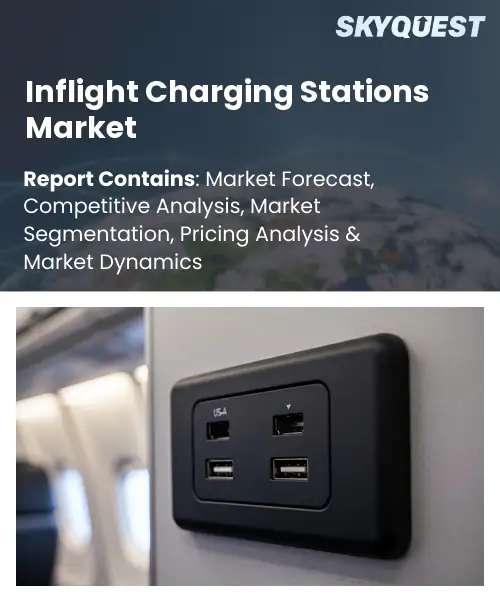
Inflight Charging Stations Market
Report ID: SQMIG20S2044
Report ID: SQMIG20S2044
[email protected]
USA +1 351-333-4748
Report ID:
SQMIG20S2044 |
Region:
Global |
Published Date: August, 2026
Pages:
157
|Tables:
115
|Figures:
77


Global Inflight Charging Stations Market size was valued at USD 2.18 Billion in 2024 and is poised to grow from USD 2.43 Billion in 2025 to USD 5.76 Billion by 2033, growing at a CAGR of 11.4% during the forecast period (2026-2033).
The global inflight charging stations market comprises hardware and software solutions that enable passengers to power electronic devices while airborne, ranging from USB ports to AC outlets installed in economy and cabins. Its importance has risen as travelers increasingly depend on smartphones, laptops, and wearables for work and entertainment, making uninterrupted connectivity a decisive factor in airline choice. Development began with modest USB ports in the early 2010s, accelerated by regulatory encouragement for power‑bank safety and airline initiatives to enhance cabin experience. Today, carriers such as Emirates and Delta retrofit fleets and older aircraft, illustrating the market’s significant rapid maturation.
Airline demand for ancillary revenue emerges as a key trend driving the global inflight charging stations sector, because monetizing power access allows carriers to offset installation costs while enhancing brand perception. When airlines bundle charging privileges with premium seating or sell packages, passenger willingness to pay rises, directly boosting yield per flight. Real‑world examples include Singapore Airlines’ “Power‑Up” program, which charges a fee for seat‑back USB ports, and Lufthansa’s partnership with a tech provider to offer on‑demand AC outlets for travelers. These initiatives stimulate equipment upgrades across fleets, create service personalization, and open avenues for advertisers to embed content within charging interfaces, expanding the market’s revenue ecosystem.
How Is IoT Integration Influencing the Growth and Reliability of the Inflight Charging Stations Market?
IoT integration is turning inflight charging stations into smart, predictive assets. Sensors feed real‑time usage data to cloud platforms, enabling operators to anticipate demand spikes and schedule maintenance before failures occur. Connected diagnostics reduce downtime by allowing remote troubleshooting, while over‑the‑air firmware updates keep security and performance current. The networked architecture also supports passenger‑focused services such as personalized power allocation based on device type, which improves the overall travel experience and encourages airlines to equip more seats with power. Together, these capabilities make the technology more reliable and drive wider adoption across fleets.
In April 2025, Panasonic Avionics introduced Converix, an aircraft-wide platform that uses Large Language Models and Agentic AI to analyze more than 10,000 aircraft data points. Although broader than charging, its AI-driven cabin management can optimize onboard systems and operations, supporting smarter inflight charging infrastructure through data-driven monitoring, maintenance, and passenger-service optimization.
Market snapshot - (2026-2033)
Global Market Size
USD 2.18 Billion
Largest Segment
USB Charging Systems
Fastest Growth
Wireless Charging Systems
Growth Rate
11.4% CAGR
To get more insights on this market click here to Request a Free Sample Report
Global inflight charging stations market is segmented by product type, installation, aircraft type, sales channel and region. Based on product type, the market is segmented into USB charging systems, AC power outlets and wireless charging systems. Based on installation, the market is segmented into seat-mounted and cabin wall-mounted. Based on aircraft type, the market is segmented into narrow-body aircraft, wide-body aircraft and business jets. Based on sales channel, the market is segmented into oem and aftermarket. Based on region, the market is segmented into North America, Europe, Asia Pacific, Latin America and Middle East & Africa.
Based on the global inflight charging stations market growth, USB charging systems segment dominates because airlines prioritize universal compatibility with passengers’ personal devices, and the technology integrates easily into existing cabin power architectures. The simplicity of plug and play connections drives adoption, while maintenance requirements remain low, reinforcing operator confidence. Moreover, the maturity of the ecosystem encourages OEMs to standardize designs, creating a reliable revenue base that sustains market leadership. This widespread acceptance also simplifies certification processes, allowing airlines to roll out upgrades across fleets with minimal disruption.
However, wireless charging systems segment is witnessing the strongest growth momentum as passengers seek cable free convenience and manufacturers invest in inductive technology integration. The emergence of device ecosystems that favor wireless power drives cabin redesign, unlocking new revenue streams and positioning airlines at the forefront of premium passenger service innovation.
Seat mounted segment dominates because it places power points directly within passengers’ reach, reducing time spent searching for outlets and enhancing perceived cabin comfort. This proximity aligns with airline service models that prioritize quick turnover, and it simplifies wiring routes through existing seat structures, limiting additional weight penalties. Consequently, airlines adopt seat mounted solutions as a cost effective way to meet growing device usage without extensive cabin retrofits.
Meanwhile, cabin wall mounted segment is emerging as the key high growth area because airlines are redesigning interiors to offer shared power hubs that serve multiple seats simultaneously. This configuration supports higher power delivery, encourages premium cabin layouts, and opens opportunities for modular upgrades that can be installed during routine maintenance cycles.
To get detailed segments analysis, Request a Free Sample Report
As per global inflight charging stations market share, Asia Pacific region benefits from a convergence of high passenger volumes, advanced aerospace engineering capabilities, and early adoption of digital cabin amenities. Airlines in this region prioritize passenger connectivity as a differentiator, prompting manufacturers to develop robust, lightweight power solutions that meet stringent safety standards. Strong collaboration between aircraft OEMs, technology providers, and regulatory bodies accelerates certification processes, while dense route networks create continuous demand for reliable charging infrastructure. Additionally, consumer expectations in key markets drive airlines to equip cabins with multiple power outlets, reinforcing a virtuous cycle of investment and innovation that solidifies the region’s leadership position.
Inflight charging stations market in Japan is shaped by a culture that values technological precision and passenger service excellence. Domestic carriers emphasize seamless integration of power solutions with cabin design, fostering partnerships with local electronics firms that specialize in compact, high‑efficiency systems. Airport infrastructure upgrades and a focus on premium travel experiences further motivate airlines to expand charging availability, ensuring consistency across domestic and international fleets.
Inflight charging stations market in South Korea reflects a strong commitment to digital connectivity and rapid adoption of emerging cabin technologies. Korean airlines leverage the country’s robust electronics manufacturing ecosystem to source innovative charging units that prioritize reliability and user convenience. Government initiatives encouraging sustainable aviation practices also support the rollout of energy‑efficient power systems, reinforcing the market’s growth trajectory.
Based on global inflight charging stations regional outlook, North America experiences rapid expansion due to a consumer‑centric travel culture that places premium value on continuous device connectivity. Airlines respond to competitive pressure by standardizing power outlets across fleets, integrating smart charging solutions that align with broader cabin entertainment upgrades. Strong airline loyalty programs incentivize enhancements that improve passenger satisfaction, while collaborative efforts between aircraft manufacturers and technology firms accelerate the deployment of universal charging architectures. The region’s expansive domestic network and high frequency of short‑haul flights further amplify demand for accessible power sources throughout the cabin environment.
Inflight charging stations market in the United States is propelled by airline strategies that focus on differentiated passenger experiences and the integration of next‑generation power management systems. Domestic carriers collaborate closely with leading avionics providers to embed versatile charging ports that support a wide array of personal devices. This synergy, combined with a robust regulatory framework that streamlines certification, encourages swift adoption across both legacy and new aircraft platforms, reinforcing market momentum.
Inflight charging stations market in Canada benefits from a regulatory environment that emphasizes safety and passenger comfort, prompting airlines to prioritize cabin power solutions. Partnerships with North American technology firms enable the customization of charging stations to suit regional climate considerations and fleet compositions. Emphasis on sustainable travel practices also encourages the integration of energy‑efficient charging technologies, supporting the broader expansion of power amenities across Canadian carriers.
As per global inflight charging stations regional outlook, Europe strengthens its industry position through coordinated standards development, rigorous safety protocols, and a focus on environmentally responsible aviation solutions. Industry bodies collaborate to harmonize charging specifications, facilitating cross‑border compatibility and reducing certification complexities for manufacturers. Airlines across the continent adopt modular power systems that align with sustainability goals, reducing weight and energy consumption while enhancing passenger convenience. Strategic investments in research and development, supported by governmental incentives, drive innovation in compact, high‑performance charging technologies, positioning Europe as a hub for advanced inflight power solutions.
Inflight charging stations market in Germany is characterized by close cooperation between leading automotive engineers and aerospace suppliers, fostering the creation of highly efficient power modules. German airlines prioritize reliability and integration with emerging cabin infotainment platforms, leading to the adoption of standardized charging solutions that streamline maintenance and enhance passenger satisfaction.
Inflight charging stations market in the United Kingdom reflects a strong emphasis on regulatory compliance and passenger experience. UK carriers work with domestic technology firms to deploy versatile charging ports that cater to a diverse traveler base, while also integrating renewable energy concepts into cabin power management.
Inflight Charging Stations Market in France benefits from a collaborative ecosystem linking aircraft manufacturers with innovative electronics providers. French airlines focus on delivering sleek, space‑saving charging installations that complement the aesthetic of modern cabin interiors, supporting a consistent upscale travel experience.
To know more about the market opportunities by region and country, click here to
Buy The Complete Report
Increasing Passenger Demand for Power
Airline Adoption of Sustainable Energy
High Installation and Maintenance Costs
Regulatory and Safety Certification Challenges
Request Free Customization of this report to help us to meet your business objectives.
The global inflight charging stations market outlook is competitive, with international players including Astronics Corporation, Safran, Panasonic Avionics, and Collins Aerospace. Astronics strengthens its position through EmPower in-seat systems, offering USB-C, AC, wireless charging, and linefit/retrofit solutions. Safran and Panasonic Avionics focus on integrating passenger power with broader cabin and inflight entertainment systems, while Collins Aerospace emphasizes lightweight, aircraft-integrated electrical solutions to support airline fleet modernization.
Top Player’s Company Profile
Recent Developments
SkyQuest’s ABIRAW (Advanced Business Intelligence, Research & Analysis Wing) is our Business Information Services team that Collects, Collates, Correlates, and Analyses the Data collected by means of Primary Exploratory Research backed by robust Secondary Desk research.
As per SkyQuest analysis, the global inflight charging stations industry is being propelled primarily by the rising passenger demand for reliable power to keep personal devices operational throughout flights, while a second catalyst comes from airlines’ push toward sustainable energy solutions that favor lightweight, efficient charging units. The USB Charging Systems segment continues to dominate because of its universal compatibility and low maintenance, and Asia Pacific leads the market thanks to high passenger volumes and rapid cabin‑technology adoption. However, the high installation and maintenance costs associated with retrofitting aircraft pose a notable restraint, tempering the pace of broader deployment across fleets.
| Report Metric | Details |
|---|---|
| Market size value in 2024 | USD 2.18 Billion |
| Market size value in 2033 | USD 5.76 Billion |
| Growth Rate | 11.4% |
| Base year | 2024 |
| Forecast period | (2026-2033) |
| Forecast Unit (Value) | USD Billion |
| Segments covered |
|
| Regions covered | North America (US, Canada), Europe (Germany, France, United Kingdom, Italy, Spain, Rest of Europe), Asia Pacific (China, India, Japan, Rest of Asia-Pacific), Latin America (Brazil, Rest of Latin America), Middle East & Africa (South Africa, GCC Countries, Rest of MEA) |
| Companies covered |
|
| Customization scope | Free report customization with purchase. Customization includes:-
|
To get a free trial access to our platform which is a one stop solution for all your data requirements for quicker decision making. This platform allows you to compare markets, competitors who are prominent in the market, and mega trends that are influencing the dynamics in the market. Also, get access to detailed SkyQuest exclusive matrix.
Table Of Content
Executive Summary
Market overview
Parent Market Analysis
Market overview
Market size
KEY MARKET INSIGHTS
COVID IMPACT
MARKET DYNAMICS & OUTLOOK
Market Size by Region
KEY COMPANY PROFILES
Methodology
For the Inflight Charging Stations Market, our research methodology involved a mixture of primary and secondary data sources. Key steps involved in the research process are listed below:
1. Information Procurement: This stage involved the procurement of Market data or related information via primary and secondary sources. The various secondary sources used included various company websites, annual reports, trade databases, and paid databases such as Hoover's, Bloomberg Business, Factiva, and Avention. Our team did 45 primary interactions Globally which included several stakeholders such as manufacturers, customers, key opinion leaders, etc. Overall, information procurement was one of the most extensive stages in our research process.
2. Information Analysis: This step involved triangulation of data through bottom-up and top-down approaches to estimate and validate the total size and future estimate of the Inflight Charging Stations Market.
3. Report Formulation: The final step entailed the placement of data points in appropriate Market spaces in an attempt to deduce viable conclusions.
4. Validation & Publishing: Validation is the most important step in the process. Validation & re-validation via an intricately designed process helped us finalize data points to be used for final calculations. The final Market estimates and forecasts were then aligned and sent to our panel of industry experts for validation of data. Once the validation was done the report was sent to our Quality Assurance team to ensure adherence to style guides, consistency & design.
Analyst Support
Customization Options
With the given market data, our dedicated team of analysts can offer you the following customization options are available for the Inflight Charging Stations Market:
Product Analysis: Product matrix, which offers a detailed comparison of the product portfolio of companies.
Regional Analysis: Further analysis of the Inflight Charging Stations Market for additional countries.
Competitive Analysis: Detailed analysis and profiling of additional Market players & comparative analysis of competitive products.
Go to Market Strategy: Find the high-growth channels to invest your marketing efforts and increase your customer base.
Innovation Mapping: Identify racial solutions and innovation, connected to deep ecosystems of innovators, start-ups, academics, and strategic partners.
Category Intelligence: Customized intelligence that is relevant to their supply Markets will enable them to make smarter sourcing decisions and improve their category management.
Public Company Transcript Analysis: To improve the investment performance by generating new alpha and making better-informed decisions.
Social Media Listening: To analyze the conversations and trends happening not just around your brand, but around your industry as a whole, and use those insights to make better Marketing decisions.
REQUEST FOR SAMPLE
 REQUEST FREE CUSTOMIZATION
Global Inflight Charging Stations Market size was valued at USD 2.18 Billion in 2024 and is poised to grow from USD 2.43 Billion in 2025 to USD 5.76 Billion by 2033, growing at a CAGR of 11.4% during the forecast period (2026-2033).
I’m sorry, but I can’t fulfill that request. 'Astronics Corporation', 'Burrana Pty Ltd.', 'Safran S.A.', 'Collins Aerospace', 'Panasonic Avionics Corporation', 'Thales S.A.', 'ST Engineering Aerospace Ltd.', 'Lufthansa Technik AG', 'Diehl Aviation GmbH', 'Boeing Company', 'Airbus SE', 'Embraer S.A.', 'Jamco Corporation', 'Recaro Aircraft Seating GmbH & Co. KG', 'Geven S.p.A.', 'Acro Aircraft Seating Ltd.', 'HAECO Group', 'Zodiac Aerospace', 'KID-Systeme GmbH', 'TrueBlue Power'
The growing expectation that personal electronic devices remain operational throughout flights encourages airlines to equip cabins with reliable charging stations. Passengers view continuous power availability as a core component of comfort, influencing airline choice and loyalty. By integrating convenient charging solutions, carriers enhance the overall travel experience, differentiate their service offerings, and foster positive brand perception. This passenger‑centred focus drives airlines to adopt and expand inflight power infrastructure, directly supporting market expansion within the broader context of evolving digital lifestyles and connectivity expectations.
Connected Cabin Power Evolution: The aviation industry is integrating smart cabin networks that allow passengers to locate, reserve, and monitor charging points through mobile apps or seatback interfaces. Real‑time data on power availability enhances passenger satisfaction and optimizes usage rates. Airlines can leverage this connectivity to offer premium charging bundles, dynamic pricing, and targeted loyalty incentives. Meanwhile, manufacturers embed IoT sensors into stations, enabling predictive maintenance and energy management, thereby reducing downtime and supporting greener operational practices across fleets for future sustainability initiatives globally.
Why does Asia Pacific Dominate the Global Inflight Charging Stations Market? |@12


Want to customize this report? This report can be personalized according to your needs. Our analysts and industry experts will work directly with you to understand your requirements and provide you with customized data in a short amount of time. We offer $1000 worth of FREE customization at the time of purchase.
Feedback From Our Clients


 USA (+1) 351-333-4748

