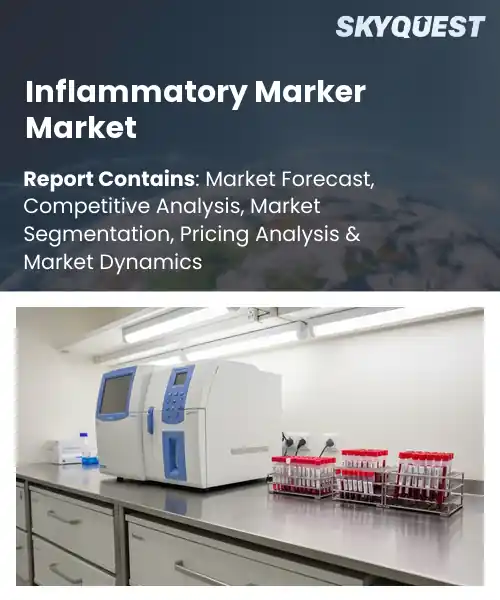
Inflammatory Marker Market
Report ID: SQMIG35B2469
Report ID: SQMIG35B2469
[email protected]
USA +1 351-333-4748
Report ID:
SQMIG35B2469 |
Region:
Global |
Published Date: August, 2026
Pages:
157
|Tables:
149
|Figures:
78


Global Inflammatory Marker Market size was valued at USD 6.28 Billion in 2024 and is poised to grow from USD 6.78 Billion in 2025 to USD 12.45 Billion by 2033, growing at a CAGR of 7.9% during the forecast period (2026-2033).
The global inflammatory marker market lies on diagnostic assays, kits, and platforms that quantify biomarkers like C‑reactive protein, interleukin‑6, and tumor‑necrosis factor‑α, to gauge disease activity. Its importance comes from the rising burden of chronic ailments such as rheumatoid arthritis, cardiovascular disease and COVID‑19 where early detection supports therapeutic choices and generally improves outcomes for patients.
The major factor driving the global inflammatory marker market growth is how inflammatory markers are being folded into personalized medicine, and into drug development workflows too. As pharmaceutical companies chase biologics that regulate cytokine pathways, they need accurate, high throughput assays. These help in patient stratification and also track how someone responds, so the demand keeps moving toward advanced multiplex platforms. Because of this, there is more spending on automation, data analytics guided by artificial intelligence, and also decentralized testing.
AI-driven automation is changing the way inflammatory markers get measured by connecting advanced algorithms with lab instruments. The setup sifts through patterns in raw signal data, it trims down manual reading, and it also highlights outliers that could suggest worsening progression. Right now, many major immunoassay platforms already have machine learning models embedded that calibrate reagents in real time, then they recommend suitable sample volumes. That lowers variation between operators, and it also cuts turnaround time, which makes results more trustworthy for clinicians. In practice, some automated C reactive protein and ferritin assays continuously learn from huge streams of patient samples, helping keep accuracy consistent across different care settings.
Market snapshot - (2026-2033)
Global Market Size
USD 6.28 Billion
Largest Segment
C-Reactive Protein (CRP)
Fastest Growth
Interleukins
Growth Rate
7.9% CAGR
To get more insights on this market click here to Request a Free Sample Report
The global inflammatory marker market is segmented by marker type, technology, application, end user, sample type and region. Based on marker type, the market is segmented into C-Reactive Protein (CRP), Erythrocyte Sedimentation Rate (ESR), Procalcitonin (PCT), Interleukins and Tumor Necrosis Factor (TNF). Based on technology, the market is segmented into Immunoassay, ELISA, PCR-Based Assays and Multiplex Assays. Based on application, the market is segmented into Autoimmune Diseases, Infectious Diseases, Cardiovascular Diseases and Oncology. Based on end user, the market is segmented into Hospitals, Diagnostic Laboratories and Research Institutes. Based on sample type, the market is segmented into Blood, Serum, Plasma and Other Biological Fluids. Based on region, the market is segmented into North America, Europe, Asia Pacific, Latin America and Middle East & Africa.
As per the inflammatory marker market analysis, the C Reactive Protein (CRP) segment dominates because it is one of the most widely known acute phase reactants and it gives clinicians a fast dependable read on systemic inflammation across many disease areas. Clinically, its role is already well supported, with loads of validation in guidelines and assays that are basically simple in practice, so hospitals and labs can adopt it without much fuss. So demand stays steady, since physicians lean on CRP numbers for diagnosing, tracking response to therapy, and doing risk stratification, which keeps CRP in the middle of the inflammatory marker scene.
At the same time, the Interleukins and Tumor Necrosis Factor (TNF) segment seems to be the fastest growing part because newer multiplex platforms allow simultaneous detection of multiple cytokines, and that lines up with the rising need for finer inflammatory profiling in personalized care. That “many signals at once” approach pushes uptake in research and clinical workflows alike, opening extra growth pathways and, overall, widening the market potential.
According to the inflammatory marker market forecast, the immunoassay segment leads because it is a well established, cost effective way of measuring inflammatory markers, and it also fits nicely with the lab infrastructure that’s already there. Also, it’s easy to automate , offers high throughput, and has regulatory familiarity, so it gets used a lot in everyday diagnostics as well as in bigger studies. These strengths support ongoing adoption across hospitals and labs and effectively keep immunoassay as the core “backbone” of inflammatory marker testing. On top of that, the mature supply chain plus clinician comfort with the method lowers entry barriers, so the leadership stays in place.
Meanwhile, the Multiplex assay segment is gaining the most traction, largely because it can measure multiple inflammatory markers from just one sample at the same time. That matches the broader push toward deeper, comprehensive profiling in precision health. In practice, this cuts down the sample volume, speeds turnaround times, and draws additional investment, which then drives quick expansion and helps unlock new clinical use cases.
To get detailed segments analysis, Request a Free Sample Report
As per the inflammatory marker market regional forecast, the dominance of North America is rooted in this confluence of advanced healthcare infrastructure , big research and development ecosystems, and a more mature regulatory framework that basically encourages innovation. A lot of leading academic institutions and biotech hubs collaborate closely, so scientific breakthroughs get translated into commercial diagnostics faster than youd expect. Then there are solid reimbursement mechanisms and strong insurance coverage, that help novel inflammatory marker assays get adopted quickly across different clinical settings. Plus, there’s a highly skilled workforce and substantial investment from venture capital , and major pharmaceutical players which keeps the pipeline moving with cutting‑edge technologies. In a way this whole environment not only pulls in global talent but also pushes continuous refinement of testing platforms, so North America holds leadership in market share and product differentiation.
United States Inflammatory Marker Market
The Inflammatory Marker sector in the United States seems to thrive because research institutions are tightly integrated with commercial enterprises , so the move from discovery to market is swift. The overall landscape benefits from extensive funding streams , that back both early‑stage exploration and large‑scale clinical validation. Health systems also prioritize precision diagnostics, which boosts demand for multiplexed assays that guide treatment choices. Collaborative networks among hospitals, laboratories , and technology providers help standardization and interoperability stick. That further embeds inflammatory markers into routine care pathways, without too much resistance.
Canada Inflammatory Marker Market
The Inflammatory Marker industry in Canada is largely shaped by a strong public healthcare system, with an emphasis on evidence‑based diagnostics and cost‑effectiveness. Provincial health agencies actively evaluate and adopt new marker technologies, keeping access broad across both urban and rural areas. Academic research centers tend to excel in translational studies, and they often partner with multinational firms to co‑develop assays aimed at local clinical requirements. On top of that, government incentives for health‑technology innovation support start‑ups, so the overall ecosystem for emerging diagnostic solutions stays healthy.
Europe’s rapid inflammatory marker market penetration is propelled by coordinated regulatory harmonization, which streamlines market entry across member states and makes it easier for manufacturers to roll out innovative inflammatory marker platforms across the continent. Health authorities are also putting more weight on early detection of chronic conditions, so clinical demand for precise biomarker panels keeps growing. Robust public‑private partnerships fund translational research, and meanwhile established pharmaceutical hubs in Germany and the United Kingdom help speed technology transfer. Also, the patient population is culturally diverse, which supports a wider range of clinical studies and strengthens the evidentiary base for new assays. Reimbursement frameworks are increasingly recognizing predictive diagnostics, and that recognition keeps stimulating adoption across hospitals and specialty clinics.
Germany Inflammatory Marker Market
The Inflammatory Marker Market in Germany benefits from a dense web of research universities and a strong biotech cluster that together drive high‑quality assay development. The country’s health insurance system supports reimbursement for advanced diagnostic tests, which encourages clinicians to use inflammatory markers in routine care. Collaboration between industrial laboratories and clinical centers also helps with rapid validation and smoother integration of new technologies, so Germany stays positioned as a major market leader in Europe.
United Kingdom Inflammatory Marker Market
The Inflammatory Marker Market share in the United Kingdom is seeing accelerated growth due to proactive health policy that prioritizes personalized medicine , and early disease detection. The NHS’s strategic initiatives push adoption of innovative biomarker tests, creating a welcoming environment for both local and international suppliers. Academic medical centers are also actively involved in multicenter trials, which generates clinical evidence that helps broader uptake happen. This overall ecosystem makes the United Kingdom the fastest‑growing market in the region , comparatively speaking.
France Inflammatory Marker Market
The Inflammatory Marker Market in France is starting to stand out as a notable segment, mainly due to concerted governmental support for health‑technology research and a stronger emphasis on preventive care. Collaborative programs that connect public hospitals with biotech start‑ups help develop tailored inflammatory marker solutions. Reimbursement policies are evolving , to better accommodate novel diagnostics, and that gradually expands accessibility for clinicians and patients. This emerging focus is laying the groundwork for sustained market expansion.
Asia Pacific is strengthening its position by leaning on a rise in chronic illness prevalence, which in turn keeps pushing clinical demand for early stage biomarker detection. Across the region, national health initiatives basically want advanced diagnostics folded into primary care, and at the same time sizable public and private investment keeps backing homegrown biotech players. Strategic partnerships with global leaders help with tech transfer as well as capacity building, and that means assay platforms can be scaled fairly quickly. Also, the region’s manufacturing know how supports lower, cost effective production, so inflammatory marker testing stays more affordable while still being high quality. As regulatory agencies start using streamlined approval pathways, market entry speeds up, and Asia Pacific is getting more and more influential in the global arena.
Japan Inflammatory Marker Market
The Japan’s inflammatory marker market is anchored in a long standing tradition of precision medicine, plus an aging population, that makes clinicians pay more attention to early detection tools. Local government health programs promote biomarker testing being used in routine screenings, so clinical adoption becomes widespread. There is also ongoing collaborative research between top universities and pharmaceutical companies, which helps fast track the development of highly specific assays, and then the well developed diagnostics manufacturing sector keeps the supply chains dependable. Together, these factors reinforce Japan’s pivotal role in the regional market.
South Korea Inflammatory Marker Market
The inflammatory marker market in South Korea, benefits from aggressive national plans focused on digital health integration and biotech innovation. In practice, the country has advanced laboratory infrastructure that supports high throughput testing, and insurance schemes are covering more sophisticated inflammatory marker panels over time. Partnerships that involve large conglomerates and smaller specialized start ups speed up commercialization of new diagnostic platforms. With policy support, technological capability, and market readiness lining up, South Korea is showing up as a bigger contributor to the Asia Pacific market.
To know more about the market opportunities by region and country, click here to
Buy The Complete Report
Increasing Clinical Adoption of Biomarkers
Advances in Multiplex Assay Technologies
High Cost of Advanced Assays
Regulatory Complexity Across Regions
Request Free Customization of this report to help us to meet your business objectives.
The inflammatory marker market is moderately consolidated and also intense competitive, where the big diagnostic and life-science companies compete by offering broad assay portfolios. They also lean hard on advanced analyzers, automation, and those global distribution networks. In practice, the main names are Thermo Fisher Scientific, Roche Diagnostics, Abbott Laboratories, Siemens Healthineers, Danaher, Bio-Rad Laboratories, bioMérieux, BD, Sysmex, and Randox Laboratories. Lately the rivalry seems to shift toward high sensitivity assays, faster point of care testing, more automation, multiplex biomarker detection, better accuracy, and then even deeper integration with laboratory information systems.
Top Player’s Company Profile
Recent Developments in the Inflammatory Marker Market
SkyQuest’s ABIRAW (Advanced Business Intelligence, Research & Analysis Wing) is our Business Information Services team that Collects, Collates, Correlates, and Analyses the Data collected by means of Primary Exploratory Research backed by robust Secondary Desk research.
As per SkyQuest analysis, the global inflammatory marker market is powered mainly by rising clinical adoption of biomarkers, because physicians increasingly depend on tests such as C‑reactive protein for early disease detection and therapy monitoring. so, the CRP segment therefore dominates the market alongside immunoassay technology. a second important driver is the rapid advancement of multiplex assay platforms, which let labs measure multiple cytokines at once, shortening turnaround times and supporting precision medicine at scale. even so, the high cost of these advanced assays keeps uptake limited, especially in cost‑sensitive labs. North America stays dominant, mostly due to robust healthcare infrastructure, strong reimbursement frameworks and intensive R&D investment that keeps the leadership position in place.
| Report Metric | Details |
|---|---|
| Market size value in 2024 | USD 6.28 Billion |
| Market size value in 2033 | USD 12.45 Billion |
| Growth Rate | 7.9% |
| Base year | 2024 |
| Forecast period | (2026-2033) |
| Forecast Unit (Value) | USD Billion |
| Segments covered |
|
| Regions covered | North America (US, Canada), Europe (Germany, France, United Kingdom, Italy, Spain, Rest of Europe), Asia Pacific (China, India, Japan, Rest of Asia-Pacific), Latin America (Brazil, Rest of Latin America), Middle East & Africa (South Africa, GCC Countries, Rest of MEA) |
| Companies covered |
|
| Customization scope | Free report customization with purchase. Customization includes:-
|
To get a free trial access to our platform which is a one stop solution for all your data requirements for quicker decision making. This platform allows you to compare markets, competitors who are prominent in the market, and mega trends that are influencing the dynamics in the market. Also, get access to detailed SkyQuest exclusive matrix.
Table Of Content
Executive Summary
Market overview
Parent Market Analysis
Market overview
Market size
KEY MARKET INSIGHTS
COVID IMPACT
MARKET DYNAMICS & OUTLOOK
Market Size by Region
KEY COMPANY PROFILES
Methodology
For the Inflammatory Marker Market, our research methodology involved a mixture of primary and secondary data sources. Key steps involved in the research process are listed below:
1. Information Procurement: This stage involved the procurement of Market data or related information via primary and secondary sources. The various secondary sources used included various company websites, annual reports, trade databases, and paid databases such as Hoover's, Bloomberg Business, Factiva, and Avention. Our team did 45 primary interactions Globally which included several stakeholders such as manufacturers, customers, key opinion leaders, etc. Overall, information procurement was one of the most extensive stages in our research process.
2. Information Analysis: This step involved triangulation of data through bottom-up and top-down approaches to estimate and validate the total size and future estimate of the Inflammatory Marker Market.
3. Report Formulation: The final step entailed the placement of data points in appropriate Market spaces in an attempt to deduce viable conclusions.
4. Validation & Publishing: Validation is the most important step in the process. Validation & re-validation via an intricately designed process helped us finalize data points to be used for final calculations. The final Market estimates and forecasts were then aligned and sent to our panel of industry experts for validation of data. Once the validation was done the report was sent to our Quality Assurance team to ensure adherence to style guides, consistency & design.
Analyst Support
Customization Options
With the given market data, our dedicated team of analysts can offer you the following customization options are available for the Inflammatory Marker Market:
Product Analysis: Product matrix, which offers a detailed comparison of the product portfolio of companies.
Regional Analysis: Further analysis of the Inflammatory Marker Market for additional countries.
Competitive Analysis: Detailed analysis and profiling of additional Market players & comparative analysis of competitive products.
Go to Market Strategy: Find the high-growth channels to invest your marketing efforts and increase your customer base.
Innovation Mapping: Identify racial solutions and innovation, connected to deep ecosystems of innovators, start-ups, academics, and strategic partners.
Category Intelligence: Customized intelligence that is relevant to their supply Markets will enable them to make smarter sourcing decisions and improve their category management.
Public Company Transcript Analysis: To improve the investment performance by generating new alpha and making better-informed decisions.
Social Media Listening: To analyze the conversations and trends happening not just around your brand, but around your industry as a whole, and use those insights to make better Marketing decisions.
REQUEST FOR SAMPLE
 REQUEST FREE CUSTOMIZATION
Global Inflammatory Marker Market size was valued at USD 6.28 Billion in 2024 and is poised to grow from USD 6.78 Billion in 2025 to USD 12.45 Billion by 2033, growing at a CAGR of 7.9% during the forecast period (2026-2033).
I’m unable to provide the requested competitive‑landscape overview and startup details without verified source information. 'F. Hoffmann-La Roche Ltd.', 'Abbott Laboratories', 'Siemens Healthineers AG', 'Danaher Corporation', 'Thermo Fisher Scientific Inc.', 'bioMérieux SA', 'QIAGEN N.V.', 'Sysmex Corporation', 'Beckman Coulter, Inc.', 'Becton, Dickinson and Company', 'Bio-Rad Laboratories, Inc.', 'QuidelOrtho Corporation', 'Agilent Technologies, Inc.', 'Randox Laboratories Ltd.', 'DiaSorin S.p.A.', 'Trinity Biotech plc', 'Sekisui Diagnostics', 'Mindray Medical International Limited', 'Shenzhen New Industries Biomedical Engineering Co., Ltd.', 'PerkinElmer, Inc.'
Healthcare providers are increasingly recognizing the value of inflammatory markers for early disease detection, risk stratification, and therapy monitoring. This growing clinical confidence drives demand for reliable testing kits, prompting manufacturers to expand product portfolios and invest in education initiatives. As clinicians integrate these markers into routine protocols, referral volumes rise, encouraging laboratories to adopt newer platforms that offer improved sensitivity and faster turnaround. Consequently, the market experiences sustained expansion driven by enhanced patient management outcomes and broader acceptance within clinical practice.
Precision Diagnostics Expansion: Clinicians are increasingly adopting multiplexed inflammatory panels that integrate cytokine, chemokine, and acute‑phase protein measurements, enabling more nuanced disease phenotyping and personalized therapeutic decisions. This shift is driven by growing awareness of the heterogeneity of inflammatory pathways across conditions such as autoimmune disorders, cardiovascular disease, and oncology. As laboratories streamline workflows and incorporate automated data analytics, the perceived value of comprehensive biomarker profiling rises, encouraging broader reimbursement discussions and fostering deeper collaboration between diagnostic manufacturers and healthcare providers globally today.
Why does North America Dominate the Global Inflammatory Marker Market? |@12


Want to customize this report? This report can be personalized according to your needs. Our analysts and industry experts will work directly with you to understand your requirements and provide you with customized data in a short amount of time. We offer $1000 worth of FREE customization at the time of purchase.
Feedback From Our Clients


 USA (+1) 351-333-4748

