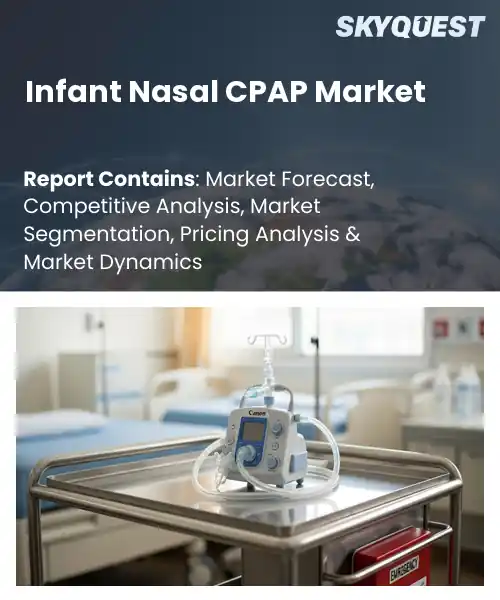
Infant Nasal CPAP Market
Report ID: SQMIG35A3334
Report ID: SQMIG35A3334
[email protected]
USA +1 351-333-4748
Report ID:
SQMIG35A3334 |
Region:
Global |
Published Date: March, 2026
Pages:
157
|Tables:
113
|Figures:
77


Global Infant Nasal CPAP Market size was valued at USD 1.70 Billion in 2024 and is poised to grow from USD 1.82 Billion in 2025 to USD 3.09 Billion by 2033, growing at a CAGR of 6.9% during the forecast period (2026-2033).
Growing incidence of preterm births, increasing survival rates of low-birth-weight infants, rising demand for noninvasive respiratory support, advancements in neonatal care technologies, and emphasis on reducing ventilator-associated complications are driving sales of infant nasal CPAP systems.
The extensive implementation of bubble CPAP in poor countries and heated prongs in tertiary hospitals underscores the significance of customizing breathing aids. Clinically driven acceptance through health policies, procedures, and education has been identified as one of the main drivers of market development, owing to the impact of early CPAP utilization on mortality and reduced stays in intensive care units. In addition, CPAP providers are offering flexible, budget-friendly units with monitoring capabilities. Telemedicine assistance have also facilitated implementation, especially in low-income areas. Growing need for effective and gentle respiratory support for neonates coupled with a shift toward noninvasive treatment approaches is expected to primarily drive infant nasal CPAP market growth.
On the contrary, high costs of advanced CPAP systems, lack of skilled healthcare professionals in developing regions, risk of nasal injury and device-related complications, maintenance challenges, and limited awareness in low-resource settings are anticipated to slow down infant nasal CPAP market penetration in the future.
How is AI Improving Infant Nasal CPAP Device Performance?
Artificial intelligence improves nasal continuous positive airway pressure systems for infants by making their breathing assistance capabilities more adaptable and their operation more standard. The system utilizes intelligent sensors together with machine learning technology to modify pressure and timing settings during actual usage according to how the infant breathes. The market is shifting toward integrated smart respiratory care systems. The solutions decrease the requirement for ongoing manual checks which enables healthcare professionals to spend additional time delivering treatment to their patients. AI technology provides doctors with customized CPAP treatment solutions while creating advanced neonatal monitoring systems that help infants maintain stability and achieve better medical results. AI integration helps reduce mask-related injuries, improve comfort, and detect signs of respiratory distress earlier.
In January 2026, GE HealthCare showcased an edge AI neonatal monitoring concept with NXP. This system detects infant condition and unsafe positioning. When combined with nasal CPAP, it can enable adaptive support, faster leak correction, and reduced workload for clinicians, supporting better efficiency and wider adoption.
Market snapshot - 2026-2033
Global Market Size
USD 1.7 Billion
Largest Segment
CPAP Devices
Fastest Growth
Accessories
Growth Rate
6.9% CAGR
To get more insights on this market click here to Request a Free Sample Report
Global infant nasal CPAP market is segmented by product type, end user, age group, distribution channel, and region. Based on product type, the market is segmented into CPAP devices and accessories. Based on end user, the market is segmented into hospitals and home healthcare. Based on age group, the market is segmented into newborns and infants. Based on distribution channel, the market is segmented into online sales and retail pharmacies. Based on region, the market is segmented into North America, Europe, Asia Pacific, Latin America, and Middle East & Africa.
The CPAP devices segment is forecasted to lead the global infant nasal CPAP market revenue generation in the future. These devices constitute the core therapeutic platform for managing neonatal and infant respiratory distress, which helps cement the dominance of this segment. Rising demand for precise pressure delivery and compatibility with neonatal interfaces also cements the dominance. Reliance on the efficacy of the equipment influences purchasing decisions in both acute care and outpatient settings. With the ongoing technological improvements and monitoring capability, the effectiveness of the devices is reinforced, resulting in greater use and adherence to the device-based treatment path.
However, accessories are emerging as the most rapidly expanding segment as per this infant nasal CPAP industry analysis. Rising demand for improved nasal prongs, masks, and disposable interfaces that enhance comfort and infection control is creating new business scope. Innovations in consumable items, single-use devices, and purchase repetition help to encourage manufacturers in their pursuit of accessories, thereby making revenue flows consistent and allowing the broader use of nasal CPAP treatment.
The hospital segment is predicted to account for the highest global infant nasal CPAP market share in the future. Neonatal intensive care units concentrate the highest acuity cases requiring continuous nasal CPAP therapy, enabling standardized protocols, clinician training, and institutional purchasing. The clinical pathways within hospitals encourage early adoption of proven technology solutions and offer a platform for evaluation and improvement of procedures. Centralized purchasing and dedicated clinical teams speed up the incorporation of CPAP into the healthcare system, thus cementing its market in the healthcare industry through institutional healthcare delivery.
However, home healthcare is witnessing the strongest growth momentum as early discharge programs and caregiver training expand outpatient nasal CPAP use. Improvements in portable devices, telemonitoring, and support services facilitate safe home management, while payor and provider interest in cost effective care and family centered models propels adoption, opening sustained market opportunities beyond hospital walls.
To get detailed segments analysis, Request a Free Sample Report
Strong clinical infrastructure, concentrated expertise in neonatal care, and active participation by major medical device manufacturers help boost infant nasal CPAP demand in North America. The region possesses well-developed neonatal intensive care networks, and clinicians have familiarity with a variety of noninvasive respiratory support modalities used to treat neonates. The collaboration among various stakeholders such as academic institutions, industry, and regulatory bodies has created an environment conducive to product development and evidence generation. Reimbursement frameworks and procurement practices in many healthcare settings promote the adoption of specialized device technologies, while the investment of resources into clinician training and the development of clinical guidelines contribute to ongoing utilization and innovation within the field.
High clinical adoption of infant nasal CPAP driven by leading neonatal centers, robust medical device presence, and strong research activity creates new opportunities in the United States. Academic collaborations and joint studies facilitate clinical validation and educate medical practitioners. The health care system and specialists will favor therapies that have been proved as well as those that are simple to apply, leading to the adoption of more advanced interfaces and systems in nasal CPAP therapy.
Coordinated approach across provincial health systems, with emphasis on evidence-based protocols and equitable access shapes infant nasal CPAP demand in Canada. Stress on training clinicians and leveraging telehealth services contributes to the uniform implementation of the treatment in distant locations. Cooperative efforts by hospitals and manufacturers ensure customization according to local clinical practices without compromising safety and prudent procurement practices. The regional neonatal network, along with central purchase routes, ensures the successful implementation of standardized CPAP treatments in tertiary hospitals and community settings.
Integrated healthcare systems, strong clinical guideline development, and active technology adoption are shaping infant nasal CPAP procurement in European countries. Through harmonized regulatory processes and health technology assessment frameworks provide a predictable pathway to entering new markets and the potential to have smooth discussions regarding reimbursement. Collaboration between neonatal networks, research institutions, and manufacturers will support the dissemination of best practices and use of evidence for improved patient outcomes. An emphasis on a patient-centered approach to design, interoperability with existing neonatal devices and customized service models for hospitals are accelerating the adoption of these solutions across the European region.
Advanced hospital infrastructure and a dense network of specialized neonatal units that demand high quality respiratory support solutions boost market growth in Germany. Procurement driven by doctors along with partnerships with local suppliers enables further development of the product. Focus on clinical data along with compatibility with existing neonatal care systems promotes adoption at academic hospitals and regional facilities.
Coordinated NHS procurement pathways and emphasis on scalable, cost-effective neonatal interventions are shaping infant nasal CPAP adoption in the United Kingdom. Collaboration among hospital trusts and manufacturers enables quick assessment and deployment. Dedication to performance measurement and staff education ensures continued integration in tertiary neonatal units and regional clusters. Clinical guidelines at the national level and pilot projects promote early implementation of user-friendly nasal CPAP devices, which are consistent with organizational improvement objectives.
Clinician-led initiatives and regional investments in neonatal care modernization are supporting consistent demand for infant nasal CPAP in France. Increasing awareness and localized procurement processes facilitate the introduction of customized CPAP devices and monitoring technologies. Cooperation among hospitals, research institutes, and manufacturing firms facilitates the localization of product attributes and training tools.
Expansion of neonatal care, growth of domestic manufacturing, and strategic partnerships with global medical device companies support steady sales of infant nasal CPAP products in this region. Increased investment in building new neonatal unit facilities and training clinicians will lead to improved clinical capabilities and confidence to use these devices. As a result of two initiatives designed to create clearer pathways for the introduction of products through regulatory reform and targeted procurement activities, products will be made available to the market sooner. The local adaptation of devices so that they can better meet the needs of clinical practice in the region, along with active research partnerships and export-driven manufacturing, are also factors that will impact how quickly and how much the region will adopt, and supply, technologies for who provides infant nasal continuous positive airway pressure (CPAP) services.
Emphasis on high-quality, safety-oriented devices, and close cooperation between hospitals and domestic manufacturers are shaping infant nasal CPAP procurement in Japan. Training and integration with existing neonatal procedures guarantee continued clinical uptake of the device. An emphasis on incremental innovations and user-centered design guarantees that the solution perfectly fits the requirements of both users and infants.
Flexible business operations and its regulatory system which enables quick product development are shaping infant nasal CPAP demand in South Korea. The combination of domestic manufacturing facilities and export markets drives the creation of solutions that meet international engineering standards. The integration of clinician education programs and hospital collaborations and connectivity technology will help more tertiary centers and neonatal units to implement the system.
To know more about the market opportunities by region and country, click here to
Buy The Complete Report
Improved Neonatal Survival Rates
Technological Advancements In CPAP Devices
High Cost Of Advanced Systems
Limited Trained Neonatal Personnel
Request Free Customization of this report to help us to meet your business objectives.
Competition in the global infant nasal CPAP market centers on consolidation, distribution alliances, and product differentiation. Examples include Hillroms acquisition of Breathe Technologies, Telesairs US distribution agreement for Bonhawa high flow, and InnAccels SAANS portable neonatal CPAP that targets low resource settings. These corporate moves drive differentiation around device portability, interfaces and bundled service contracts.
Recent Developments in the Infant nasal CPAP Market
SkyQuest’s ABIRAW (Advanced Business Intelligence, Research & Analysis Wing) is our Business Information Services team that Collects, Collates, Correlates, and Analyses the Data collected by means of Primary Exploratory Research backed by robust Secondary Desk research.
As per SkyQuest analysis, rising incidence of preterm births, increasing demand for noninvasive respiratory support, and growing advancements in neonatal care technologies are anticipated to drive the demand for infant nasal CPAP systems going forward. However, high costs of advanced devices, risk of nasal injury and complications, lack of skilled healthcare professionals, and maintenance challenges are slated to slow down the adoption of infant nasal CPAP systems in the future. North America is slated to spearhead the demand for infant nasal CPAP systems owing to the strong presence of advanced neonatal care infrastructure, high healthcare spending, and early adoption of innovative medical technologies. Integration of AI-enabled respiratory support systems, development of cost-effective and modular CPAP devices, and advancements in neonatal monitoring technologies are anticipated to be key trends driving the infant nasal CPAP sector in the long run.
| Report Metric | Details |
|---|---|
| Market size value in 2024 | USD 1.70 Billion |
| Market size value in 2033 | USD 3.09 Billion |
| Growth Rate | 6.9% |
| Base year | 2024 |
| Forecast period | 2026-2033 |
| Forecast Unit (Value) | USD Billion |
| Segments covered |
|
| Regions covered | North America (US, Canada), Europe (Germany, France, United Kingdom, Italy, Spain, Rest of Europe), Asia Pacific (China, India, Japan, Rest of Asia-Pacific), Latin America (Brazil, Rest of Latin America), Middle East & Africa (South Africa, GCC Countries, Rest of MEA) |
| Companies covered |
|
| Customization scope | Free report customization with purchase. Customization includes:-
|
To get a free trial access to our platform which is a one stop solution for all your data requirements for quicker decision making. This platform allows you to compare markets, competitors who are prominent in the market, and mega trends that are influencing the dynamics in the market. Also, get access to detailed SkyQuest exclusive matrix.
Table Of Content
Executive Summary
Market overview
Parent Market Analysis
Market overview
Market size
KEY MARKET INSIGHTS
COVID IMPACT
MARKET DYNAMICS & OUTLOOK
Market Size by Region
KEY COMPANY PROFILES
Methodology
For the Infant Nasal CPAP Market, our research methodology involved a mixture of primary and secondary data sources. Key steps involved in the research process are listed below:
1. Information Procurement: This stage involved the procurement of Market data or related information via primary and secondary sources. The various secondary sources used included various company websites, annual reports, trade databases, and paid databases such as Hoover's, Bloomberg Business, Factiva, and Avention. Our team did 45 primary interactions Globally which included several stakeholders such as manufacturers, customers, key opinion leaders, etc. Overall, information procurement was one of the most extensive stages in our research process.
2. Information Analysis: This step involved triangulation of data through bottom-up and top-down approaches to estimate and validate the total size and future estimate of the Infant Nasal CPAP Market.
3. Report Formulation: The final step entailed the placement of data points in appropriate Market spaces in an attempt to deduce viable conclusions.
4. Validation & Publishing: Validation is the most important step in the process. Validation & re-validation via an intricately designed process helped us finalize data points to be used for final calculations. The final Market estimates and forecasts were then aligned and sent to our panel of industry experts for validation of data. Once the validation was done the report was sent to our Quality Assurance team to ensure adherence to style guides, consistency & design.
Analyst Support
Customization Options
With the given market data, our dedicated team of analysts can offer you the following customization options are available for the Infant Nasal CPAP Market:
Product Analysis: Product matrix, which offers a detailed comparison of the product portfolio of companies.
Regional Analysis: Further analysis of the Infant Nasal CPAP Market for additional countries.
Competitive Analysis: Detailed analysis and profiling of additional Market players & comparative analysis of competitive products.
Go to Market Strategy: Find the high-growth channels to invest your marketing efforts and increase your customer base.
Innovation Mapping: Identify racial solutions and innovation, connected to deep ecosystems of innovators, start-ups, academics, and strategic partners.
Category Intelligence: Customized intelligence that is relevant to their supply Markets will enable them to make smarter sourcing decisions and improve their category management.
Public Company Transcript Analysis: To improve the investment performance by generating new alpha and making better-informed decisions.
Social Media Listening: To analyze the conversations and trends happening not just around your brand, but around your industry as a whole, and use those insights to make better Marketing decisions.
REQUEST FOR SAMPLE
 REQUEST FREE CUSTOMIZATION
Global Infant Nasal Cpap Market size was valued at USD 1.7 Billion in 2024 and is poised to grow from USD 1.82 Billion in 2025 to USD 3.1 Billion by 2033, growing at a CAGR of 6.9% during the forecast period (2026-2033).
Competition in the global infant nasal CPAP market centers on consolidation, distribution alliances, and product differentiation. Examples include Hillroms acquisition of Breathe Technologies, Telesairs US distribution agreement for Bonhawa high flow, and InnAccels SAANS portable neonatal CPAP that targets low resource settings. These corporate moves drive differentiation around device portability, interfaces and bundled service contracts. 'ResMed', 'Philips Healthcare', 'Fisher & Paykel Healthcare', 'Vapotherm', 'Medtronic', 'Breethe', 'ABC Technologies', 'Natus Medical Incorporated', 'NeoMed', 'Dräger', 'Getinge Group', 'Inova Robotics', 'Masimo Corporation', 'GE Healthcare', 'NIPRO Corporation', 'Ambu A/S', 'Vyaire Medical', 'Hummingbird Pediatric', 'Little Nurse', 'Bunnell Inc.'
Improved neonatal survival has increased demand for advanced respiratory support and sustained adaptation of nasal CPAP in neonatal units, prompting hospitals to expand procurement and clinicians to favor noninvasive options for early respiratory distress management. Greater confidence among care teams in CPAP efficacy encourages broader clinical adoption and protocol integration, while manufacturers respond with focused product development to meet clinical needs. This dynamic contributes to market expansion by aligning clinical practice preferences with investment in device availability and supportive care infrastructure.
Expansion Into Homecare Settings: Manufacturers and care providers are shifting focus toward portable, easy to use infant nasal CPAP solutions for use outside the neonatal intensive care unit. This trend is driven by efforts to support transition to care at home, simplify device operation for parents and clinicians, and reduce hospital occupancy pressure. Emphasis is placed on device safety features, streamlined setup, caregiver education resources, and integration with remote monitoring services to ensure continuity of clinical oversight in nonclinical environments.
Why does North America Dominate the Global Infant Nasal CPAP Market? |@12
The Infant Nasal CPAP Market is segmented by product type (CPAP devices, accessories), end user (hospitals, home healthcare), age group (newborns, infants), distribution channel (online sales, retail pharmacies), and region.
AI is enhancing the Infant Nasal CPAP Market by enabling real-time monitoring, predictive analysis, and automated adjustments in respiratory support systems, improving treatment accuracy and patient outcomes in neonatal care.


Want to customize this report? This report can be personalized according to your needs. Our analysts and industry experts will work directly with you to understand your requirements and provide you with customized data in a short amount of time. We offer $1000 worth of FREE customization at the time of purchase.
Feedback From Our Clients


 USA (+1) 351-333-4748

