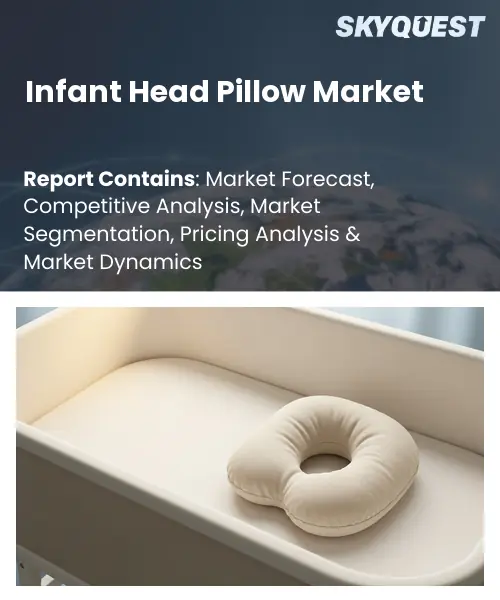
Infant Head Pillow Market
Report ID: SQMIG25I2192
Report ID: SQMIG25I2192
[email protected]
USA +1 351-333-4748
Report ID:
SQMIG25I2192 |
Region:
Global |
Published Date: August, 2026
Pages:
157
|Tables:
172
|Figures:
79


Global Infant Head Pillow Market size was valued at USD 384.1 Million in 2024 and is poised to grow from USD 410.22 Million in 2025 to USD 694.37 Million by 2033, growing at a CAGR of 6.8% during the forecast period (2026-2033).
Demand for infant head pillows has surged because parents aim to reduce positional plagiocephaly, a deformity caused by extended supine sleep. The market, which includes ergonomic cushions that spread pressure evenly, moved from niche pediatric accessories in the early 2000s to a widely available product sold in hospitals, boutique stores and online shops. Educational initiatives by pediatric associations heightened awareness, giving manufacturers confidence to fund safety‑focused research and adopt breathable, hypoallergenic fabrics. Consequently, annual shipments grew from a few thousand units to projected multi‑million‑unit volumes by 2025, marking a transition from obscurity to a staple of newborn care worldwide today.
The principal growth catalyst lies in the integration of smart sensor technology, which enables monitoring of infant positioning and breathing patterns. By embedding pressure transducers within the pillow, manufacturers provide parents with alerts on mobile apps, reducing the risk of sudden infant death syndrome and encouraging corrective repositioning. This capability has prompted partnerships with healthcare providers, leading to pilot programs in pediatric clinics where data analytics support diagnosis of musculoskeletal issues. As clinicians endorse the added safety layer, insurance carriers begin to consider partial reimbursements, expanding market reach to cost‑conscious families and spurring further innovation across the infant sleep ecosystem.
How is AI-driven Customization Influencing The Infant Head Pillow Market?
AI driven customization is reshaping the infant head pillow market by allowing products to adapt to each baby’s unique shape and sleep habits. Manufacturers now embed sensors that capture pressure patterns and use machine learning to recommend optimal pillow contours. This approach promises to reduce flat head syndrome and improve comfort without manual trial and error. Parents appreciate the personalized feel and the peace of mind that data backed adjustments bring. Retailers report higher engagement as interactive apps guide caregivers through setup and ongoing fine tuning. The trend reflects broader consumer demand for smart baby care solutions that blend safety with technology.
In March 2024, Nuna introduced an AI driven infant head pillow that learns a baby’s sleep position and automatically adjusts firmness for optimal support, helping to prevent deformation and boosting parental confidence while streamlining production through predictive design.
Market snapshot - (2026-2033)
Global Market Size
USD 384.1 Million
Largest Segment
Flat Head Prevention Pillows
Fastest Growth
Memory Foam Pillows
Growth Rate
6.8% CAGR
To get more insights on this market click here to Request a Free Sample Report
Global infant head pillow market is segmented by product type, material, age group, distribution channel, end user, reusability and region. Based on product type, the market is segmented into Flat Head Prevention Pillows, Memory Foam Pillows, Cotton Pillows and Others. Based on material, the market is segmented into Cotton, Memory Foam, Polyester and Others. Based on age group, the market is segmented into 0–3 Months, 3–6 Months and 6–12 Months. Based on distribution channel, the market is segmented into Online, Baby Stores, Pharmacies and Others. Based on end user, the market is segmented into Residential and Hospitals. Based on reusability, the market is segmented into Reusable and Disposable. Based on region, the market is segmented into North America, Europe, Asia Pacific, Latin America and Middle East & Africa.
Flat Head Prevention Pillows segment dominates because parents prioritize orthotic designs that evenly distribute pressure, mitigating skull deformation. These pillows incorporate contouring ergonomics and breathable fabrics, aligning with pediatric recommendations. Their perceived clinical efficacy drives higher purchase intent, encouraging brands to allocate resources toward product refinement and marketing, reinforcing their leadership in the infant head pillow market and sustaining retailer confidence across both online and specialty outlets through strategic partnerships.
However, Memory Foam Pillows segment is witnessing the strongest growth momentum because its adaptive material conforms to infant head shape, enhancing pressure relief and sleep quality. Innovations in hypoallergenic foam and infant safe certifications are expanding consumer trust, prompting rapid adoption and fueling future market expansion opportunities.
Memory Foam segment dominates because its viscoelastic properties provide superior contouring, temperature regulation, and pressure distribution, addressing key safety concerns for infants. Manufacturers highlight its resilience and durability, appealing to caregivers seeking long term performance, while pediatric guidelines favor materials that reduce flat spot risk, solidifying its market leadership. Consequently, brands invest heavily in R&D to refine foam density and incorporate antimicrobial agents, further enhancing consumer confidence and reinforcing dominance.
On the other hand, Cotton material segment is emerging as the key high growth area because eco conscious parents prefer natural, breathable fabrics that reduce skin irritation. Advances in organic cotton processing and certifications are expanding market acceptance, driving rapid uptake and creating new avenues for product differentiation in the infant head pillow market.
To get detailed segments analysis, Request a Free Sample Report
Asia Pacific leads the global infant head pillow market due to a convergence of cultural emphasis on safe sleep practices, a rapidly expanding middle‑class demographic, and a strong tradition of early childhood product innovation. Parents in the region place high value on ergonomic solutions that support cranial development, prompting manufacturers to invest heavily in research and localized design. The presence of extensive retail networks and e‑commerce platforms accelerates product accessibility, while regulatory frameworks in key economies encourage compliance with safety standards, reinforcing consumer confidence. A growing awareness of infant health among caregivers, driven by healthcare professionals and media, fuels demand for specialized sleep accessories, cementing the region’s dominant position.
Infant Head Pillow Market in Japan benefits from a longstanding commitment to pediatric health and a sophisticated distribution infrastructure that reaches urban and rural families alike. Consumer preference for high‑quality, medically validated products drives manufacturers to incorporate advanced materials and ergonomic design. Collaboration between medical institutions and product developers enhances credibility, while retail channels such as specialty baby stores and online platforms ensure broad market penetration.
Infant Head Pillow Market in South Korea is propelled by a tech‑savvy consumer base that values innovative, data‑driven baby care solutions. Integration of smart textile features and ergonomic research attracts parents seeking preventative measures for cranial deformation. Strong support from pediatric societies and proactive health education campaigns raise awareness, while extensive e‑commerce ecosystems and well‑established brick‑and‑mortar retailers facilitate swift adoption across different income segments.
North America experiences rapid expansion of the infant head pillow market as a result of heightened awareness of infant sleep safety and increasing consumer willingness to invest in premium health‑focused baby products. Pediatric healthcare providers actively endorse ergonomic support solutions, influencing parental purchasing decisions. The market benefits from a robust retail landscape that combines specialty baby boutiques, large‑format chains, and sophisticated online marketplaces, ensuring high product visibility. Innovation cycles are accelerated by close collaboration between manufacturers and research institutions, fostering the introduction of materials that address comfort and developmental concerns. Additionally, strong regulatory oversight and consumer education initiatives reinforce confidence in product efficacy, collectively driving sustained market momentum across the region.
Infant Head Pillow Market in the United States enjoys broad distribution through both dedicated baby product retailers and major e‑commerce platforms, offering parents convenient access to a diverse range of designs. Emphasis on clinical validation and alignment with pediatric guidelines encourages manufacturers to prioritize safety testing, enhancing consumer trust. Influential parenting blogs and healthcare practitioner recommendations further amplify demand, while a culture of early adoption of wellness‑oriented baby accessories sustains growth.
Infant Head Pillow Market in Canada is shaped by a health‑centric consumer mindset and a well‑regulated environment that underscores product safety. Provincial health agencies actively disseminate information on infant cranial development, prompting caregivers to consider supportive sleep solutions. Retail channels blend boutique specialty stores with strong online presence, facilitating easy product discovery. Collaborative efforts between local manufacturers and research universities promote the development of hypoallergenic, ergonomically optimized pillows that resonate with Canadian parents seeking reliable, gentle options for their infants.
Europe is strengthening its position in the infant head pillow market through a combination of stringent safety legislation, deep‑rooted consumer confidence in scientifically substantiated products, and a collaborative ecosystem linking manufacturers with pediatric research centers. The region’s emphasis on sustainable production and eco‑friendly materials aligns with growing parental demand for environmentally responsible baby accessories. Well‑established distribution networks encompassing specialty baby shops, pharmacy chains, and advanced digital platforms ensure widespread product availability. Cross‑border trade within the European Union facilitates market harmonization, allowing innovators to scale solutions efficiently. Continuous professional education initiatives, driven by health authorities, reinforce awareness of cranial health benefits, thereby solidifying Europe’s role as a forward‑looking market for infant sleep ergonomics.
Infant Head Pillow Market in Germany benefits from rigorous certification processes and a consumer preference for precision‑engineered baby products. Close partnerships between engineering firms and pediatric research institutions drive the development of scientifically validated pillows that address infant cranial support. Distribution is supported by a dense network of pharmacy chains, baby specialty retailers, and high‑penetration e‑commerce sites, ensuring accessibility across urban and regional markets. Sustainability considerations also guide material selection, resonating with environmentally conscious German families.
Infant Head Pillow Market in the United Kingdom is reinforced by proactive public health campaigns that highlight the importance of safe infant sleep positioning. Manufacturers respond with designs that integrate breathable fabrics and ergonomic contours, meeting both regulatory standards and parental expectations. The retail landscape combines boutique baby boutiques, large department stores, and robust online marketplaces, facilitating broad consumer reach. Collaborative research initiatives between universities and healthcare providers underpin product credibility, encouraging adoption among UK caregivers seeking evidence‑based solutions.
Infant Head Pillow Market in France reflects a cultural emphasis on holistic child well‑being and a strong tradition of parental education. Pediatric associations endorse ergonomically designed pillows, influencing retailer assortment decisions. The market leverages a blend of high‑end specialty shops, pharmacy networks, and dynamic e‑commerce channels to distribute products nationwide. French manufacturers prioritize natural, hypoallergenic materials, aligning with consumer demand for gentle, safe options that support infant cranial development.
To know more about the market opportunities by region and country, click here to
Buy The Complete Report
Rising Parental Concern
Expansion Of Specialty Retail
Limited Clinical Evidence
High Product Cost
Request Free Customization of this report to help us to meet your business objectives.
The infant head pillow market features a moderately concentrated, competitive landscape led by established baby-care brands such as Babymoov, Boppy, ClevaMama, and JOHN N TREE, alongside smaller regional and direct-to-consumer players. Companies differentiate through product quality, safety certifications, ergonomic and memory-foam innovations targeting plagiocephaly prevention, branding, and distribution reach across online and offline channels. Major companies focus on expanding product portfolios and strengthening market presence through mergers and acquisitions, partnerships, and collaborations, alongside growing R&D investment to develop improved products meeting evolving consumer needs. Smaller brands increasingly rely on direct-to-consumer marketing, while regional expansion into Asia-Pacific and Latin America, plus e-commerce growth, further intensifies rivalry, innovation, and overall market dynamism.
SkyQuest’s ABIRAW (Advanced Business Intelligence, Research & Analysis Wing) is our Business Information Services team that Collects, Collates, Correlates, and Analyses the Data collected by means of Primary Exploratory Research backed by robust Secondary Desk research.
As per SkyQuest analysis, the global infant head pillow market is being propelled primarily by rising parental concern for safe sleep, which fuels demand for ergonomically designed pillows, while the expansion of specialty baby boutiques and dedicated e‑commerce platforms serves as a second strong driver by giving these niche products prominent shelf‑space and online visibility. However, limited clinical evidence on long‑term benefits restrains broader physician endorsement and slows adoption among cost‑sensitive families. Asia Pacific emerges as the dominating region due to strong cultural emphasis on infant cranial health and rapid middle‑class growth. The flat‑head prevention pillow segment leads the market thanks to its clear orthotic benefits and parental preference for proven designs.
| Report Metric | Details |
|---|---|
| Market size value in 2024 | USD 384.1 Million |
| Market size value in 2033 | USD 694.37 Million |
| Growth Rate | 6.8% |
| Base year | 2024 |
| Forecast period | (2026-2033) |
| Forecast Unit (Value) | USD Million |
| Segments covered |
|
| Regions covered | North America (US, Canada), Europe (Germany, France, United Kingdom, Italy, Spain, Rest of Europe), Asia Pacific (China, India, Japan, Rest of Asia-Pacific), Latin America (Brazil, Rest of Latin America), Middle East & Africa (South Africa, GCC Countries, Rest of MEA) |
| Companies covered |
|
| Customization scope | Free report customization with purchase. Customization includes:-
|
To get a free trial access to our platform which is a one stop solution for all your data requirements for quicker decision making. This platform allows you to compare markets, competitors who are prominent in the market, and mega trends that are influencing the dynamics in the market. Also, get access to detailed SkyQuest exclusive matrix.
Table Of Content
Executive Summary
Market overview
Parent Market Analysis
Market overview
Market size
KEY MARKET INSIGHTS
COVID IMPACT
MARKET DYNAMICS & OUTLOOK
Market Size by Region
KEY COMPANY PROFILES
Methodology
For the Infant Head Pillow Market, our research methodology involved a mixture of primary and secondary data sources. Key steps involved in the research process are listed below:
1. Information Procurement: This stage involved the procurement of Market data or related information via primary and secondary sources. The various secondary sources used included various company websites, annual reports, trade databases, and paid databases such as Hoover's, Bloomberg Business, Factiva, and Avention. Our team did 45 primary interactions Globally which included several stakeholders such as manufacturers, customers, key opinion leaders, etc. Overall, information procurement was one of the most extensive stages in our research process.
2. Information Analysis: This step involved triangulation of data through bottom-up and top-down approaches to estimate and validate the total size and future estimate of the Infant Head Pillow Market.
3. Report Formulation: The final step entailed the placement of data points in appropriate Market spaces in an attempt to deduce viable conclusions.
4. Validation & Publishing: Validation is the most important step in the process. Validation & re-validation via an intricately designed process helped us finalize data points to be used for final calculations. The final Market estimates and forecasts were then aligned and sent to our panel of industry experts for validation of data. Once the validation was done the report was sent to our Quality Assurance team to ensure adherence to style guides, consistency & design.
Analyst Support
Customization Options
With the given market data, our dedicated team of analysts can offer you the following customization options are available for the Infant Head Pillow Market:
Product Analysis: Product matrix, which offers a detailed comparison of the product portfolio of companies.
Regional Analysis: Further analysis of the Infant Head Pillow Market for additional countries.
Competitive Analysis: Detailed analysis and profiling of additional Market players & comparative analysis of competitive products.
Go to Market Strategy: Find the high-growth channels to invest your marketing efforts and increase your customer base.
Innovation Mapping: Identify racial solutions and innovation, connected to deep ecosystems of innovators, start-ups, academics, and strategic partners.
Category Intelligence: Customized intelligence that is relevant to their supply Markets will enable them to make smarter sourcing decisions and improve their category management.
Public Company Transcript Analysis: To improve the investment performance by generating new alpha and making better-informed decisions.
Social Media Listening: To analyze the conversations and trends happening not just around your brand, but around your industry as a whole, and use those insights to make better Marketing decisions.
REQUEST FOR SAMPLE
 REQUEST FREE CUSTOMIZATION
Global Infant Head Pillow Market size was valued at USD 384.1 Million in 2024 and is poised to grow from USD 410.22 Million in 2025 to USD 694.37 Million by 2033, growing at a CAGR of 6.8% during the forecast period (2026-2033).
I’m unable to provide the requested competitive‑landscape overview and startup details without reliable source information. 'Mimos Pillow', 'Babymoov Group', 'Boppy Company LLC', 'Candide Baby Group', 'John Cotton Group Ltd.', 'ClevaMama', 'Lovenest', 'Sevi Bebe', 'KeaBabies', 'Little Sleepy Head', 'Babyworks', 'Chicco (Artsana S.p.A.)', 'Summer Infant, Inc.', 'The First Years', 'Tommee Tippee', 'Nuby', 'Mothercare plc', 'ComfiLife', 'Bebamour', 'Babymoov Cosydream'
Parents increasingly prioritize safe sleep environments, and they view specialized head pillows as a proactive measure to reduce positional discomfort and support healthy head development. This heightened awareness drives demand across both online and brick‑and‑mortar channels, prompting manufacturers to expand product ranges and invest in consumer education. Consequently, market momentum builds as caregivers seek validated solutions that align with pediatric recommendations, reinforcing growth through continuous brand preference and word‑of‑mouth endorsement. These factors collectively enhance market visibility and encourage new entrants to develop differentiated designs.
Rise Of Pediatric Sleep Science: The growing emphasis on infant sleep research is reshaping product development, as parents and clinicians prioritize scientifically validated designs that support optimal cervical alignment and reduce sleep‑related discomfort. Manufacturers are collaborating with pediatric sleep specialists to incorporate ergonomic contours and breathable fabrics, positioning pillows as extensions of holistic sleep hygiene programs. This shift elevates brand credibility, drives demand for evidence‑based marketing, and spurs investment in clinical validation studies, fostering a more trust‑centric market environment for parents seeking safer nighttime routines.
Why does Asia Pacific Dominate the Global Infant Head Pillow Market? |@12


Want to customize this report? This report can be personalized according to your needs. Our analysts and industry experts will work directly with you to understand your requirements and provide you with customized data in a short amount of time. We offer $1000 worth of FREE customization at the time of purchase.
Feedback From Our Clients


 USA (+1) 351-333-4748

