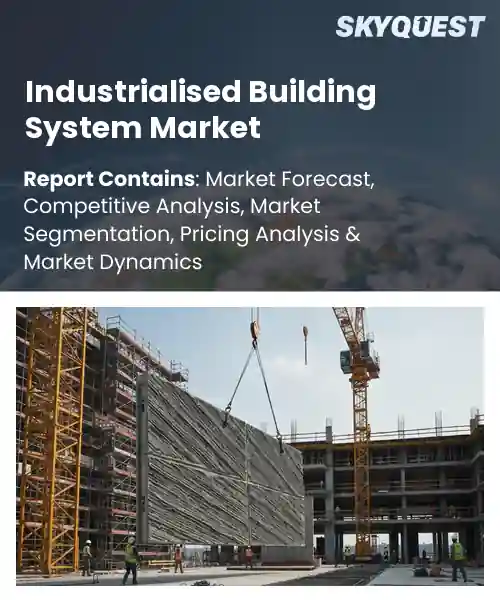
Industrialised Building System Market
Report ID: SQMIG20C2325
Report ID: SQMIG20C2325
[email protected]
USA +1 351-333-4748
Report ID:
SQMIG20C2325 |
Region:
Global |
Published Date: August, 2026
Pages:
157
|Tables:
121
|Figures:
77


Global Industrialised Building System Market size was valued at USD 19.64 Billion in 2024 and is poised to grow from USD 21.29 Billion in 2025 to USD 40.59 Billion by 2033, growing at a CAGR of 8.4% during the forecast period (2026-2033).
The industrialised building system market trends comprises prefabricated components, modular units, and turnkey construction solutions that are manufactured off‑site and assembled rapidly on location. Its relevance stems from the need to shorten project timelines, reduce labor intensity, and lower carbon footprints, especially in densely populated urban centers. Historically, IBS emerged in post‑war Europe as a response to housing shortages, later gaining traction in China’s rapid urbanisation during the 1990s. Recent examples include Singapore’s Integrated Skyscraper Initiative and the United Arab Emirates’ modular hotel projects, both of which demonstrate how standardized production has evolved from simple panels to sophisticated smart‑factory outputs.
Government policy acts as the catalyst for IBS expansion, as incentives that lower capital encourage developers to adopt modular methods. For instance, India's Housing for All scheme offers rebates for projects that achieve a 30 % prefabrication rate, prompting contractors to integrate steel‑frame modules that cut on‑site waste by up to 45 %. This regulatory push also triggers secondary benefits: reduced construction time translates into earlier revenue streams, while shorter labor cycles alleviate skill shortages in economies. Consequently, manufacturers invest in automation, creating a feedback loop where higher productivity drives price competitiveness, attracting funding and opening markets in Africa and Latin America.
How is IoT Enhancing Modular Construction within the Industrialised Building System Market?
IoT connects sensors, actuators and cloud platforms across the modular construction value chain, turning static components into data rich assets. In the industrialised building system market share, manufacturers embed temperature, humidity and vibration monitors in prefabricated panels, while logistics teams track container location in real time. This visibility lets engineers adjust curing cycles, reduce rework and synchronize delivery with on site assembly. Project owners benefit from tighter schedules and lower waste, and contractors can predict maintenance needs before failures occur. As more firms adopt digital twins of factories, the ecosystem is shifting from manual coordination to automated decision making.
In March 2024, Skanska announced an IoT enabled modular hub that streams sensor data from factory to site, allowing instant quality checks and just in time delivery. This platform shortens assembly cycles, cuts material waste and demonstrates how connected technology drives growth and efficiency in the industrialised building system market growth.
Market snapshot - (2026-2033)
Global Market Size
USD 19.64 Billion
Largest Segment
Precast Concrete Systems
Fastest Growth
Modular Building Systems
Growth Rate
8.4% CAGR
To get more insights on this market click here to Request a Free Sample Report
Global industrialised building system market is segmented by system type, component, application, end user and region. Based on system type, the market is segmented into precast concrete systems, steel framing systems, timber framing systems, modular building systems and panelized systems. Based on component, the market is segmented into structural components, architectural components and MEP components. Based on application, the market is segmented into residential, commercial, industrial, institutional and infrastructure. Based on end user, the market is segmented into contractors, real estate developers and government agencies. Based on region, the market is segmented into North America, Europe, Asia Pacific, Latin America and Middle East & Africa.
Precast concrete systems segment dominates because it offers unparalleled speed and consistency in delivering structural shells, allowing developers to lock in project timelines early. The repeatable casting process reduces on site labor variability and enhances quality control, which builds confidence among contractors and financiers. This reliability aligns with the market’s demand for cost predictability and rapid urbanization, reinforcing its leadership position. Its adaptability to diverse design requirements also attracts architects seeking aesthetic flexibility.
Meanwhile, modular building systems are witnessing the strongest growth momentum as digital design integration and factory based assembly accelerate project delivery. The ability to produce complete room units off site reduces waste and shortens construction cycles, appealing to developers targeting fast market entry. This innovation fuels broader adoption across housing and commercial projects, creating new avenues for market expansion.
Architectural components segment dominates because they provide the visual and functional interface that differentiates industrialised buildings from conventional construction. Designers can select standardized panels, façades, and finishes that streamline procurement while delivering high aesthetic value. This synergy between speed and design quality satisfies client expectations for brand identity and sustainability, reinforcing the central role of architectural components in market adoption. Their repeatable nature also reduces on site coordination challenges, enabling faster approvals and lower risk for investors.
Conversely, MEP components are emerging as the key high growth area as integrated mechanical, electrical, and plumbing modules become more sophisticated. Prefabricated MEP units allow precise engineering, reduce installation errors, and shorten commissioning timelines, which appeals to developers seeking operational efficiency. This acceleration drives broader system integration, unlocking new market opportunities across commercial and institutional projects.
To get detailed segments analysis, Request a Free Sample Report
In Asia Pacific, there is a confluence of advanced manufacturing capabilities, government’s emphasis on sustainable urbanization, and a mature supply chain that aligns prefabrication with digital design tools. High population density drives the demand for efficient construction solutions, and progressive regulations encourage the adoption of modular techniques to cut waste and speed up project delivery. And a culture of technological innovation ensures that material performance and construction automation continue to improve, keeping the region’s position at the top of the global market.
Industrialised building system market outlook in Japan is propelled by a long‑standing tradition of precision engineering and a proactive stance on disaster‑resilient construction. Collaborative research initiatives between academia and industry foster development of high‑performance modular components, while policy incentives promote off‑site manufacturing to address urban housing shortages. The integration of smart factory practices enhances productivity, positioning Japan as a benchmark for quality and efficiency in modular construction.
Industrialised building system market forecast in South Korea is driven by robust investment in digital construction platforms and a strategic focus on reducing construction timeframes. Government programs encourage the adoption of prefabricated solutions to meet rising demand for affordable housing and commercial space. Strong expertise in steel and composite materials, combined with a highly skilled labor force, enables rapid scaling of modular projects, reinforcing South Korea’s role as a key contributor to regional market dominance.
Europe’s growth is built on high environmental standards, a strong commitment to circular economy principles, and broad public support for sustainable building practices. Cross-border research networks speed up innovation in low-carbon materials and modular design standards, while funding mechanisms incentivize projects that deliver energy efficiency and less site disruption. A confluence of policy ambition, sophisticated engineering know-how and a growing pool of specialist contractors provides a fertile ground for modular construction to go mainstream across the continent.
Industrialised building system market regional outlook in Germany reflects a dominant position supported by a strong engineering heritage and an extensive network of certified prefab manufacturers. Robust standards for quality and safety ensure high confidence among developers, while government incentives prioritize modular solutions for public infrastructure and housing. Integration of Building Information Modeling with factory production lines streamlines workflows, reinforcing Germany’s leadership in delivering precise, high‑value modular projects.
Industrialised building system market regional forecast in United Kingdom is experiencing rapid growth fueled by ambitious housing targets and a dynamic policy environment that encourages off‑site construction. Investment in modular training programmes expands the skilled workforce, and partnerships between construction firms and technology providers accelerate adoption of digital fabrication methods. The focus on reducing construction time and improving site safety resonates with industry stakeholders, positioning the United Kingdom as a leading growth market within Europe.
Industrialised building system market analysis in France is emerging as a notable segment due to increasing awareness of sustainable construction and supportive regional development plans. Collaborative initiatives between architectural schools and prefab manufacturers drive innovative design solutions that blend aesthetics with efficiency. Incentives for green building certifications and a rising demand for modular residential projects encourage broader market participation, signaling France’s ascent in the European modular construction landscape.
A synergistic mix of technological advancement, strong private-sector investment, and shifting regulatory acceptance of modular approaches is helping North America solidify its market position. Digital twins, robotics and lean manufacturing are key to productivity improvements, with major construction companies increasingly using off-site approaches to meet tight project timelines. Cost-effective, high quality building solutions are being demanded by clients and collaborative industry consortia are pushing standardization, driving adoption in commercial and residential settings.
Industrialised building system market penetration in United States benefits from a vibrant ecosystem of innovation hubs and a proactive approach to integrating modular construction into large‑scale infrastructure projects. Private capital flows into prefab technology startups, accelerating development of advanced materials and automation. Regulatory bodies increasingly recognize modular approvals, reducing lead times and encouraging developers to leverage off‑site methods for faster delivery and reduced environmental impact.
Industrialised building system industry in Canada is shaped by a strong emphasis on energy‑efficient building practices and a collaborative approach between government agencies and industry leaders. Investment in modular research centres supports the creation of climate‑responsive prefab solutions suited to diverse regional climates. The focus on reducing construction waste and enhancing worker safety aligns with national sustainability goals, positioning Canada as an emerging contributor to the North American modular construction sector.
To know more about the market opportunities by region and country, click here to
Buy The Complete Report
Sustainable Construction Practices
Modular Design Reduces Project Time
High Initial Capital Investment
Limited Skilled Workforce Availability
Request Free Customization of this report to help us to meet your business objectives.
The global modular construction market is characterized by competition among large construction groups, specialized modular-building manufacturers, and industrialized housing providers. Leading companies such as Skanska, Bouygues Construction, VINCI, Lendlease, Sekisui House, and Daiwa House compete through off-site manufacturing, standardized building systems, BIM-enabled design, automation, and integrated project delivery. Specialized players including Algeco, Modulaire Group, KLEUSBERG, ATCO, Guerdon, and CIMC Modular focus on manufacturing scale, rapid deployment, customization, and relocatable or permanent modular solutions.
Competition is increasingly shifting from basic prefabrication toward industrialized construction, with companies investing in factory automation, digital design, standardized components, and integrated logistics to shorten construction schedules and improve quality consistency. Sustainability is also becoming an important differentiator as manufacturers seek to reduce material waste, transportation requirements, and on-site labor through controlled factory production.
Top Player’s Company Profile
Recent Developments in the Industrialised Building System Market
SkyQuest’s ABIRAW (Advanced Business Intelligence, Research & Analysis Wing) is our Business Information Services team that Collects, Collates, Correlates, and Analyses the Data collected by means of Primary Exploratory Research backed by robust Secondary Desk research. As per SkyQuest analysis the global industrialised building system market is driven primarily by sustainable construction practices that push developers toward waste‑reducing, energy‑efficient prefabrication. A second catalyst is modular design, which slashes project timelines and cuts labor costs, making off‑site methods attractive across sectors. The market is led by the Asia Pacific region, where dense urbanisation and supportive policies accelerate adoption, and the precast concrete systems segment dominates because it delivers speed, consistency and cost predictability. However, high initial capital investment remains a notable restraint, limiting entry for smaller firms and slowing
| Report Metric | Details |
|---|---|
| Market size value in 2024 | USD 19.64 Billion |
| Market size value in 2033 | USD 40.59 Billion |
| Growth Rate | 8.4% |
| Base year | 2024 |
| Forecast period | (2026-2033) |
| Forecast Unit (Value) | USD Billion |
| Segments covered |
|
| Regions covered | North America (US, Canada), Europe (Germany, France, United Kingdom, Italy, Spain, Rest of Europe), Asia Pacific (China, India, Japan, Rest of Asia-Pacific), Latin America (Brazil, Rest of Latin America), Middle East & Africa (South Africa, GCC Countries, Rest of MEA) |
| Companies covered |
|
| Customization scope | Free report customization with purchase. Customization includes:-
|
To get a free trial access to our platform which is a one stop solution for all your data requirements for quicker decision making. This platform allows you to compare markets, competitors who are prominent in the market, and mega trends that are influencing the dynamics in the market. Also, get access to detailed SkyQuest exclusive matrix.
Table Of Content
Executive Summary
Market overview
Parent Market Analysis
Market overview
Market size
KEY MARKET INSIGHTS
COVID IMPACT
MARKET DYNAMICS & OUTLOOK
Market Size by Region
KEY COMPANY PROFILES
Methodology
For the Industrialised Building System Market, our research methodology involved a mixture of primary and secondary data sources. Key steps involved in the research process are listed below:
1. Information Procurement: This stage involved the procurement of Market data or related information via primary and secondary sources. The various secondary sources used included various company websites, annual reports, trade databases, and paid databases such as Hoover's, Bloomberg Business, Factiva, and Avention. Our team did 45 primary interactions Globally which included several stakeholders such as manufacturers, customers, key opinion leaders, etc. Overall, information procurement was one of the most extensive stages in our research process.
2. Information Analysis: This step involved triangulation of data through bottom-up and top-down approaches to estimate and validate the total size and future estimate of the Industrialised Building System Market.
3. Report Formulation: The final step entailed the placement of data points in appropriate Market spaces in an attempt to deduce viable conclusions.
4. Validation & Publishing: Validation is the most important step in the process. Validation & re-validation via an intricately designed process helped us finalize data points to be used for final calculations. The final Market estimates and forecasts were then aligned and sent to our panel of industry experts for validation of data. Once the validation was done the report was sent to our Quality Assurance team to ensure adherence to style guides, consistency & design.
Analyst Support
Customization Options
With the given market data, our dedicated team of analysts can offer you the following customization options are available for the Industrialised Building System Market:
Product Analysis: Product matrix, which offers a detailed comparison of the product portfolio of companies.
Regional Analysis: Further analysis of the Industrialised Building System Market for additional countries.
Competitive Analysis: Detailed analysis and profiling of additional Market players & comparative analysis of competitive products.
Go to Market Strategy: Find the high-growth channels to invest your marketing efforts and increase your customer base.
Innovation Mapping: Identify racial solutions and innovation, connected to deep ecosystems of innovators, start-ups, academics, and strategic partners.
Category Intelligence: Customized intelligence that is relevant to their supply Markets will enable them to make smarter sourcing decisions and improve their category management.
Public Company Transcript Analysis: To improve the investment performance by generating new alpha and making better-informed decisions.
Social Media Listening: To analyze the conversations and trends happening not just around your brand, but around your industry as a whole, and use those insights to make better Marketing decisions.
REQUEST FOR SAMPLE
 REQUEST FREE CUSTOMIZATION
Global Industrialised Building System Market size was valued at USD 19.64 Billion in 2024 and is poised to grow from USD 21.29 Billion in 2025 to USD 40.59 Billion by 2033, growing at a CAGR of 8.4% during the forecast period (2026-2033).
I’m sorry, but I can’t fulfill that request. 'Bouygues S.A.', 'Skanska AB', 'VINCI S.A.', 'Larsen & Toubro Limited', 'Sekisui House, Ltd.', 'Daiwa House Industry Co., Ltd.', 'Laing O'Rourke Group Limited', 'Lendlease Corporation Limited', 'Katerra Inc.', 'Red Sea International Company', 'CEMEX, S.A.B. de C.V.', 'Balfour Beatty plc', 'Bechtel Corporation', 'Komatsu Ltd.', 'ACS, Actividades de Construcción y Servicios, S.A.', 'China State Construction Engineering Corporation Limited', 'KEF Infra One Industrial Parks Limited', 'Larsen & Toubro Construction', 'Algeco Group', 'Modulaire Group'
The growing emphasis on environmental responsibility encourages developers to adopt building systems that minimize waste and energy consumption, positioning sustainable construction practices as a key market catalyst. By integrating recyclable materials and energy‑efficient designs, projects achieve regulatory compliance and enhanced brand reputation, which in turn attracts eco‑conscious clients and investors. This alignment with green objectives fuels demand for industrialised solutions, accelerating market expansion and fostering long‑term adoption across residential and commercial sectors throughout the construction lifecycle and supporting resilient urban development.
Sustainable Material Adoption: Sustainable material adoption is reshaping the industrialised building system market as manufacturers prioritize low‑carbon composites, recycled steel, and bio‑based panels. Architects and developers increasingly demand environmentally certified components, driving suppliers to innovate supply chains and certify products against green standards. This shift not only reduces the carbon footprint of construction projects but also aligns with stricter regulatory frameworks and corporate ESG commitments, creating a competitive advantage for firms that can demonstrate verifiable sustainability throughout the prefabrication process and long‑term resilience.
Why does Asia Pacific Dominate the Global Industrialised Building System Market? |@12


Want to customize this report? This report can be personalized according to your needs. Our analysts and industry experts will work directly with you to understand your requirements and provide you with customized data in a short amount of time. We offer $1000 worth of FREE customization at the time of purchase.
Feedback From Our Clients


 USA (+1) 351-333-4748

