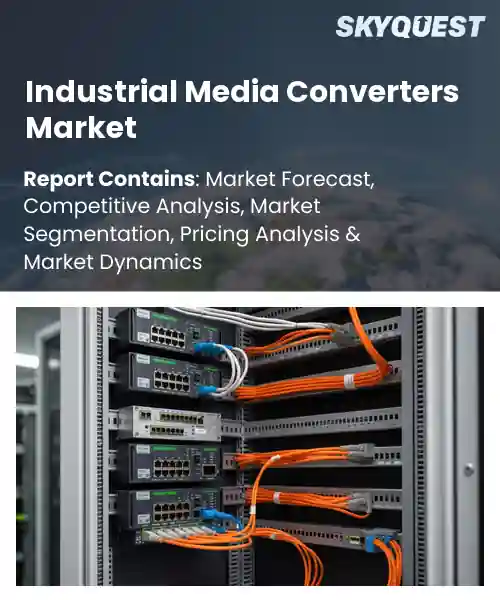
Industrial Media Converters Market
Report ID: SQMIG45J2390
Report ID: SQMIG45J2390
[email protected]
USA +1 351-333-4748
Report ID:
SQMIG45J2390 |
Region:
Global |
Published Date: February, 2026
Pages:
157
|Tables:
117
|Figures:
77


Global Industrial Media Converters Market size was valued at USD 70.4 Million in 2024 and is poised to grow from USD 73.78 Million in 2025 to USD 107.36 Million by 2033, growing at a CAGR of 4.8% during the forecast period (2026-2033).
Growing industrial automation, rising demand for secure and uninterrupted data transmission, expanding smart grid deployments, and rapid adoption of Industry 4.0 technologies are driving sales of industrial media converters.
High demand for reliable long-distance data transmission in industrial environments coupled with increasing integration of fiber-based networking solutions are expected to primarily drive industrial media converters market growth. Utilities upgrading substations to fiber to reduce outages and petrochemical plants deploying converters to isolate critical control loops are further strengthening demand. Industry 4.0 and IIoT adoption is also promoting the multiplication of edge devices, sensors, cameras, PLCs, and AGVs that require long-reach connectivity in noisy settings. This drives demand for managed converters with embedded cybersecurity, deterministic latency, and modular, standards-compliant designs that simplify deployment, support private 5G backhaul, enable smart grid modernization.
On the contrary, high initial costs of ruggedized and managed industrial media converters, integration complexity with legacy industrial networks, lack of standardization across vendors, cybersecurity vulnerabilities, and maintenance challenges in harsh environments are expected to negatively impact industrial media converters market penetration through 2033.
How is IoT Integration Impacting Deployment and Reliability of Industrial Media Converters?
Industrial IoT (IIoT) integration is transforming how industrial media converters are deployed and managed by improving visibility, reliability, and remote control. The market is shifting toward managed converters and chassis-based solutions that support hot-swappable modules and remote power cycling. These capabilities reduce the need for on-site maintenance and speed up network restoration. In response, vendors are introducing rugged and modular products with cloud-compatible APIs, allowing seamless integration between legacy copper networks and modern fiber infrastructure with minimal disruption.
In March 2025, AMG Systems launched the AMG260B blade media converter card and the AMG2036 chassis. When combined with IoT-enabled monitoring, this high-density, hot-swappable platform enhances deployment speed and reliability.
Market snapshot - 2026-2033
Global Market Size
USD 70.4 Million
Largest Segment
Ethernet Converters
Fastest Growth
Ethernet Converters
Growth Rate
4.8% CAGR
To get more insights on this market click here to Request a Free Sample Report
Global industrial media converters market is segmented by product type, application, end user, sales channel, and region. Based on product type, the market is segmented into ethernet converters, fiber optic converters, and serial converters. Based on application, the market is segmented into industrial automation, telecommunication networks, and transportation systems. Based on end user, the market is segmented into manufacturing, energy & utilities, and IT & telecom. Based on sales channel, the market is segmented into direct sales, distributors, and online retailers. Based on region, the market is segmented into North America, Europe, Asia Pacific, Latin America, and Middle East & Africa.
The ethernet converters segment is estimated to account for a prominent chunk of the global industrial media converters market share in the future. Extensive use of these converters in factory automation, smart manufacturing, and transportation systems is reinforcing the dominance of this segment. Launch of new Industry 4.0 and IIoT architectures are also expected to further bolster the high share of this segment.
Meanwhile, the demand for fiber optic converters is slated to rise at a robust pace as per this industrial media converters industry analysis. High demand for long-distance and interference-free communication across industries is slated to generate new business scope for companies focused on this segment.
The manufacturing segment is slated to lead the global industrial media converters market revenue generation in the future. Growing reliance of industrial facilities on Industry 4.0, factory automation, and IIoT-enabled production systems is expected to help this segment bolster its dominant stance. Continuous investments in smart factories, predictive maintenance systems, and real-time monitoring solutions further helps this end user bring in more business than any other segment.
The energy & utilities segment is slated to exhibit high CAGR across the study period. Rising investments in grid modernization initiatives and growing renewable energy integration are slated to help this segment generate new business scope in the long run.
To get detailed segments analysis, Request a Free Sample Report
The Asia Pacific region leads the global industrial media converters market by the fusion of high manufacturing intensity, a strong electronics and telecommunication industry, and active initiatives for the digitalization of industry. Regional players in the technology supply chain have developed specific solutions to meet the requirements of the tough environment in which these products are used. The large existing base of applications in factory automation, transportation, and energy infrastructure ensures a stable market for reliable media conversion and network robustness. The region enjoys a strong innovation base and a competent workforce that collectively maintains its leadership position in industrial connectivity solutions and ensures continuous improvements in performance and functionality.
Growing demand for advanced solutions that support factory automation and transportation networks is augmenting industrial media converters adoption in the country. Collaborative innovation between equipment suppliers and users enables incremental innovation and customization. Safety and continuity, as reinforced by standards and regulations, promote the preference for established technologies and supply relationships.
Presence of a developed electronics manufacturing ecosystem and investments in smart infrastructure development are primarily influencing sales of industrial media converters in South Korea. Local companies work in close collaboration with global equipment suppliers to co-optimize solutions for high-density and high-throughput applications. Prototyping and integration enable customized solutions for complex industrial applications. Connectivity and technology commercialization support government further expands business scope.
Growing emphasis on infrastructure modernization and quick adoption of advanced industrial technologies are estimated to help boost the sales of industrial media converters in North America. Demand for industrial media converters that have better interoperability features and bridge the gap between legacy serial and modern Ethernet systems is expected to be high in the region. With increased focus on the security of the network and the use of managed services, there is an increase in demand for converters that provide secure and monitored connectivity. Presence of stringent regulatory compliance frameworks and strict qualification processes are also expected to boost the adoption of certified converters in the long run.
Surge in demand for interoperable and secure connectivity solutions across the industrial landscape of the United States is boosting sales of industrial media converters. Cybersecurity and regulatory requirements are driving up the demand for hardened converters with better management capabilities. Strong service infrastructure and certification programs support reliability and field service expectations through 2033.
High emphasis on adoption of rugged connectivity solutions suited to remote and cold climate operations is influencing market growth in Canada. Energy, mining, and transportation industries are forecasted to spearhead sales of industrial media converters going forward. Joint efforts between local integrators and suppliers enable the integration of existing systems with modern networks. Industrial media converters companies offering ruggedized enclosures, life cycle support, and easy maintenance are slated to be popular in the country.
High emphasis on standards harmonization and growing modernization of industrial frameworks as per sustainability expectations are shaping industrial media converters demand in this region. Manufacturers and systems integrators throughout the EU place high importance on interoperability and modularity, which is why modular industrial media converters are expected to witness a rise in demand. Investments in validation laboratories and conformity assessment increase confidence in buyers. Cross border collaboration among equipment makers, utilities, and industrial end users is also opening up new avenues of business that enable customization. Research centers and industrial clusters in each country provide application specific research and pilot projects, especially related to rail signaling and energy distribution applications.
Demand for industrial media converters in Germany is expected to be centered around precision engineering and production solutions that demand reliable and certified connectivity components. A strong collaborative environment among OEMs, system integrators, and research and development organizations also helps boost innovation potential of the country. Preference of industrial media converters with globally recognized compliance credentials is high among German end users.
Growing demand for secure and resilient network conversion solutions across multiple sectors is shaping industrial media converters adoption in the United Kingdom. Focus on interoperability with telecom infrastructure and compliance with tough safety regulations encourages suppliers to offer certified and serviceable solutions. System integrators prefer solutions that are modular and easy to upgrade with minimal downtime.
High investments in modernization across energy distribution, industrial manufacturing, and transportation networks are shaping demand for industrial media converters in France. Certification and compliance policies influence the supply chain and inspire confidence in the market among risk-averse buyers. Collaboration between manufacturers and research institutions facilitates validation and enables use in safety-critical environments.
To know more about the market opportunities by region and country, click here to
Buy The Complete Report
Growing Industrial Ethernet Adoption
Rise in use of industrial ethernet across manufacturing and process industries is expected to bolster the sales of industrial media converters in the future. Media converters play an important role in helping industries migrate to Ethernet-based architectures without having to replace the existing cabling infrastructure. The use of media converters in extending the reach of networks, fault isolation, and increasing the flexibility of networks encourages their use in automation and control networks.
Demand For Remote Monitoring Solutions
Surge in demand for remote monitoring and IIoT initiatives in industrial settings is also expected to boost the adoption of industrial media converters. Industrial media converters enable electrical isolation and immunity to electromagnetic interference, which helps ensure better connectivity in harsh or distributed sites. The converter’s capacity to link legacy equipment with new network protocols and enable secure, continuous telemetry access encourages investment in converter solutions in monitoring upgrade projects.
Compatibility Challenges With Legacy Systems
Persistent compatibility challenges between legacy devices and modern media converters can slow down their adoption. Perceived risk and engineering complexity of modifying the existing infrastructure deter immediate replacement or upgradation of certain components in industrial settings. Hence, these issues of compatibility require extensive validation of investments thereby slowing down the global industrial media converters market outlook in the long run.
High Initial Integration Complexity
High costs of initial integration of industrial media converters with industrial ecosystems can also restraint their demand in the long run. The need for sophisticated network design and implementation may increase the perceived risk of deployment. Companies that lack internal knowledge and skills may be reluctant to invest in the market or opt for alternative solutions that do not require the purchase of individual media converter units.
Request Free Customization of this report to help us to meet your business objectives.
Competitive landscape is defined by consolidation and targeted alliances as incumbent and specialist vendors execute M&A, join industry consortia and introduce ruggedized and single pair Ethernet media converters to win industrial accounts; examples include Moog acquiring a rugged optical supplier, DriveNets joining an Ethernet consortium to advance high performance fabrics, and suppliers launching SPE and rugged fiber converter lines to differentiate on integration and reliability.
FOSSA Systems: The Spanish company focuses on delivering global IoT connectivity for remote industrial assets by building and operating nanosatellite connectivity platforms that reduce reliance on terrestrial connectivity in underserved locations. The 2020-founded startup has progressed its constellation and commercial program, closed follow on funding rounds and announced satellite launches and partner integrations to commercialize space based IoT services for logistics utilities and agriculture.
SkyQuest’s ABIRAW (Advanced Business Intelligence, Research & Analysis Wing) is our Business Information Services team that Collects, Collates, Correlates, and Analyses the Data collected by means of Primary Exploratory Research backed by robust Secondary Desk research.
As per SkyQuest analysis, accelerating industrial automation and rising demand for reliable long-distance data transmission in harsh environments are anticipated to drive the demand for industrial media converters through 2033. On the flip side, high initial costs of ruggedized and managed converters, integration complexities with legacy systems, and cybersecurity vulnerabilities are slated to slow down the adoption of industrial media converters in the future. North America is slated to spearhead the demand for industrial media converters owing to rapid Industry 4.0 implementation, extensive smart grid modernization initiatives, and the presence of advanced industrial infrastructure. Development of Gigabit and PoE-enabled rugged converters, integration of embedded cybersecurity features, and remote monitoring applications are anticipated to be key trends driving the industrial media converters sector over the coming years.
| Report Metric | Details |
|---|---|
| Market size value in 2024 | USD 70.4 Million |
| Market size value in 2033 | USD 107.36 Million |
| Growth Rate | 4.8% |
| Base year | 2024 |
| Forecast period | 2026-2033 |
| Forecast Unit (Value) | USD Million |
| Segments covered |
|
| Regions covered | North America (US, Canada), Europe (Germany, France, United Kingdom, Italy, Spain, Rest of Europe), Asia Pacific (China, India, Japan, Rest of Asia-Pacific), Latin America (Brazil, Rest of Latin America), Middle East & Africa (South Africa, GCC Countries, Rest of MEA) |
| Companies covered |
|
| Customization scope | Free report customization with purchase. Customization includes:-
|
To get a free trial access to our platform which is a one stop solution for all your data requirements for quicker decision making. This platform allows you to compare markets, competitors who are prominent in the market, and mega trends that are influencing the dynamics in the market. Also, get access to detailed SkyQuest exclusive matrix.
Table Of Content
Executive Summary
Market overview
Parent Market Analysis
Market overview
Market size
KEY MARKET INSIGHTS
COVID IMPACT
MARKET DYNAMICS & OUTLOOK
Market Size by Region
KEY COMPANY PROFILES
Methodology
For the Industrial Media Converters Market, our research methodology involved a mixture of primary and secondary data sources. Key steps involved in the research process are listed below:
1. Information Procurement: This stage involved the procurement of Market data or related information via primary and secondary sources. The various secondary sources used included various company websites, annual reports, trade databases, and paid databases such as Hoover's, Bloomberg Business, Factiva, and Avention. Our team did 45 primary interactions Globally which included several stakeholders such as manufacturers, customers, key opinion leaders, etc. Overall, information procurement was one of the most extensive stages in our research process.
2. Information Analysis: This step involved triangulation of data through bottom-up and top-down approaches to estimate and validate the total size and future estimate of the Industrial Media Converters Market.
3. Report Formulation: The final step entailed the placement of data points in appropriate Market spaces in an attempt to deduce viable conclusions.
4. Validation & Publishing: Validation is the most important step in the process. Validation & re-validation via an intricately designed process helped us finalize data points to be used for final calculations. The final Market estimates and forecasts were then aligned and sent to our panel of industry experts for validation of data. Once the validation was done the report was sent to our Quality Assurance team to ensure adherence to style guides, consistency & design.
Analyst Support
Customization Options
With the given market data, our dedicated team of analysts can offer you the following customization options are available for the Industrial Media Converters Market:
Product Analysis: Product matrix, which offers a detailed comparison of the product portfolio of companies.
Regional Analysis: Further analysis of the Industrial Media Converters Market for additional countries.
Competitive Analysis: Detailed analysis and profiling of additional Market players & comparative analysis of competitive products.
Go to Market Strategy: Find the high-growth channels to invest your marketing efforts and increase your customer base.
Innovation Mapping: Identify racial solutions and innovation, connected to deep ecosystems of innovators, start-ups, academics, and strategic partners.
Category Intelligence: Customized intelligence that is relevant to their supply Markets will enable them to make smarter sourcing decisions and improve their category management.
Public Company Transcript Analysis: To improve the investment performance by generating new alpha and making better-informed decisions.
Social Media Listening: To analyze the conversations and trends happening not just around your brand, but around your industry as a whole, and use those insights to make better Marketing decisions.
REQUEST FOR SAMPLE
 REQUEST FREE CUSTOMIZATION
Global Industrial Media Converters Market size was valued at USD 70.4 Million in 2024 and is poised to grow from USD 73.78 Million in 2025 to USD 107.36 Million by 2033, growing at a CAGR of 4.8% during the forecast period (2026-2033).
Competitive landscape is defined by consolidation and targeted alliances as incumbent and specialist vendors execute M&A, join industry consortia and introduce ruggedized and single pair Ethernet media converters to win industrial accounts; examples include Moog acquiring a rugged optical supplier, DriveNets joining an Ethernet consortium to advance high performance fabrics, and suppliers launching SPE and rugged fiber converter lines to differentiate on integration and reliability. 'Advantech', 'Moxa', 'N-Tron', 'Red Lion Controls', 'EtherWAN Systems', 'Intellinet Network Solutions', 'Siemens', 'Schneider Electric', 'Belden', 'Phoenix Contact', 'Westermo', 'Axiomtek', 'Netgear', 'Hirschmann Automation', 'Antaira Technologies', 'L-Com Global Connectivity', 'D-Link', 'StarTech.com', 'COMMSCOPE', 'Pulse Electronics'
Industrial Ethernet adoption is expanding across manufacturing and process industries, increasing demand for media converters that bridge legacy copper and modern fiber networks. By enabling reliable, deterministic communication and simplified integration, converters support seamless migration to Ethernet-based architectures without replacing existing cabling infrastructure. Their role in extending reach, isolating faults, and improving network flexibility encourages deployment in automation and control systems. As engineers prioritize interoperability and continuous operation, media converters become practical tools for modernizing networks while minimizing disruption and maintaining industrial reliability.
Asia Pacific Dominate the Global Industrial Media Converters Market.


Want to customize this report? This report can be personalized according to your needs. Our analysts and industry experts will work directly with you to understand your requirements and provide you with customized data in a short amount of time. We offer $1000 worth of FREE customization at the time of purchase.
Feedback From Our Clients


 USA (+1) 351-333-4748

