Industrial IoT Display Market
Report ID: SQMIG45J2389
Report ID: SQMIG45J2389
[email protected]
USA +1 351-333-4748
Report ID:
SQMIG45J2389 |
Region:
Global |
Published Date: February, 2026
Pages:
157
|Tables:
155
|Figures:
78


Global Industrial IoT Display Market size was valued at USD 1.02 Billion in 2024 and is poised to grow from USD 1.15 Billion in 2025 to USD 2.9 Billion by 2033, growing at a CAGR of 12.3% during the forecast period (2026-2033).
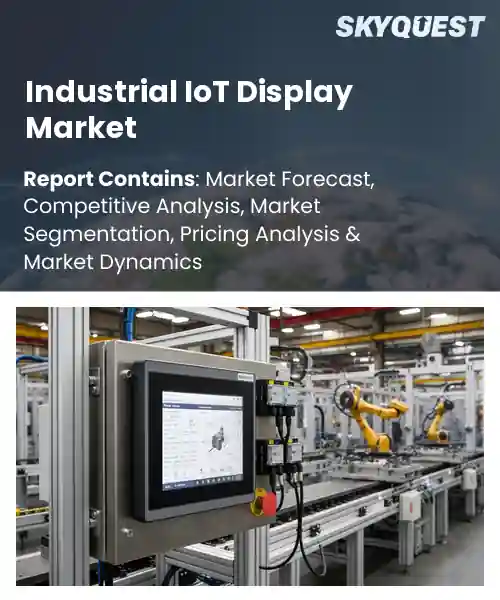
The main catalyst behind overall growth in the industrial IoT display market is the increasing need for real-time visibility of operations in both manufacturing facilities with automated processes and critical infrastructure facilities. Industrial IoT displays are specialized human-machine interfaces and visualization panels that connect sensors, controllers, and analytics to present actionable information to operators. This market matters because clear, timely visualization affects safety, throughput, and cost efficiency, and it has evolved from simple status LEDs and monochrome screens to high-resolution, touch-enabled, and intrinsically safe displays. Examples include factory-floor HMIs integrated with SCADA for automotive assembly lines and explosion-proof panels used in oil and gas, illustrating technological progression and adaptation.
Building on that adaptation, the most influential key trend driving the global industrial IoT display market trends are convergence of robust connectivity and edge computing, because local processing reduces latency and enables contextual visualizations at the point of use. Edge-enabled displays which allow analytical processes to be performed near sensors allow factories to determine when there is abnormal wear on bearings and proactively schedule maintenance thus reducing unplanned downtime and the number of spare parts that are needed. Therefore, OEMs (original equipment manufacturers) that provide modular, software-updatable display systems with the accompanying cloud service can benefit monetarily through the ability to sell upgrades and capitalize on retrofit opportunities within the automotive, logistics, and energy industries.
How is AI Improving Functionality in the Industrial IoT Display Market?
AI is improving industrial IoT displays by turning them into intelligent decision points that do more than show data. Key aspects include edge-based analytics that process sensor streams locally, adaptive interfaces that surface the most relevant controls for specific tasks, and computer vision that automates visual quality checks. The current state is a shift from passive panels to smart endpoints that support predictive maintenance and streamlined operator workflows. In the market context vendors focus on ruggedness and integration with plant systems so displays deliver actionable insights on the shop floor. Real world examples show displays prioritizing alerts and guiding technicians with contextual visual instructions.
Market snapshot - 2026-2033
Global Market Size
USD 1.02 Billion
Largest Segment
Manufacturing
Fastest Growth
Smart Buildings
Growth Rate
12.3% CAGR
To get more insights on this market click here to Request a Free Sample Report
Global industrial IoT display market is segmented by end use, application, connectivity, display type, panel size and region. Based on end use, the market is segmented into industrial automation, smart buildings, logistics and supply chain, oil and gas, agriculture, manufacturing, energy management, transportation, healthcare and others. Based on application, the market is segmented into human machine interface, remote monitoring, interactive display, electronic shelf labels and others. Based on connectivity, the market is segmented into wired and wireless. Based on display type, the market is segmented into LED, LCD, OLED, touchscreen, E-paper display and others. Based on panel size, the market is segmented into less than 10 inches, between 10 and 20 inches and more than 20 inches. Based on region, the market is segmented into North America, Europe, Asia Pacific, Latin America and Middle East & Africa.
Based on the global Industrial IoT display market growth, human machine interface segment dominates because it serves as the primary touchpoint between operators and industrial IoT systems, enabling intuitive control, visualization, and command of complex processes. The choice of the GUI as the primary interface for making real-time decisions is influenced by the strength of software ecosystems for building HMIs, as well as the integration of the HMI with sensor technology and control networks. The ability to customize workflows and rugged hardware, in conjunction with these design elements, eliminates sources of operational friction and tend to bias purchasing patterns towards integrated display solutions in industrial applications.
Electronic shelf labels are projected to be the fastest-growing application in the global industrial IoT display market due to retail automation, dynamic pricing needs, and real-time inventory visibility. E-paper's low energy requirement also greatly reduces costs of operation and allows for updates from a central point in the cloud. Expansion of smart warehouses and omnichannel retail ecosystems accelerates adoption.
Touchscreen segment leads because it offers natural multi touch interaction and flexibility required for operator centric tasks in industrial IoT displays. Its compatibility with gesture control and glove modes improves usability in harsh conditions, while available ruggedized designs and integrated sensors ensure durability. Strong developer toolchains and firmware support enable rapid customization, causing manufacturers and integrators to favour touchscreen displays for diverse industrial deployments.
E-paper display type is expected to be the fastest growing in the global industrial IoT display market forecast, due to ultra-low power consumption, superior readability in bright environments, and long operational lifespan. Because it can be utilized in battery-operated devices for electronic shelf labels, smart logistics tags, and internet of things (IoT) Sensors, the technology is well-suited to allow configuration at scale for retail, warehousing, and industrial automation.
To get detailed segments analysis, Request a Free Sample Report
As per the global Industrial IoT display market analysis, Asia Pacific dominates the industry due to a confluence of deep manufacturing ecosystems, established display component suppliers, and accelerated adoption of factory automation across heavy industry and advanced electronics sectors. Rapid development, prototyping and deployment of rugged human/computer interface devices that are appropriate for industrial use require strong integration between original equipment manufacturers (OEM's) and local system integrators. As a result, OEMs will have a strong supply chain for panels and other electronic pieces to quickly deliver "to market" and minimize costs to scale. Additionally, because there is widespread investment in the industrial digital transformation, coupled with broad service/maintenance networks and a highly skilled base of engineers, there is also a higher degree of leadership amongst OEMs related to Industrial IoT (Internet of Things) displays.
Industrial IoT display market in Japan benefits from a mature electronics manufacturing base and deep expertise in precision displays and industrial controls. Collaboration between display manufacturers, automation equipment makers, and system integrators yields reliable human machine interfaces for demanding industrial environments. Emphasis on quality and continuous improvement drives testing and certification. Established local service networks and focus on interoperability with legacy systems facilitate deployment across automotive and factory automation applications.
Industrial IoT display industry trends in South Korea benefits from proximity to leading semiconductor, and advanced display manufacturers and a strong focus on high performance component integration. Collaboration among technology conglomerates, specialized OEMs, and system integrators yields compact, connectivity-oriented interfaces suited to smart factories. Industry-specific solutions in telecommunications, automobile manufacturing and electronics manufacturing are enabled by close relationships between research institutions and industries with their established local service ecosystems supporting and providing aftermarket support services.
Rapid expansion in North America is driven by a combination of strong enterprise demand for industrial digital transformation, close integration of display hardware with advanced IIoT platforms, and an ecosystem of software developers and system integrators focused on operational intelligence. Across industries, ranging from manufacturing to energy and logistics, there is a growing trend towards rugged, secure, and interoperable interfaces that allow for the connection between older equipment (or legacy equipment) and modern analytics. The growth of this market is also fuelled by the proximity of industrial vendors and service-oriented economies that require both rapid deployment timeframes as well as aftermarket support. Collaborative standards efforts, combined with a dynamic startup community, are driving innovation in the areas of touch, connectivity, and edge computing functionality to create customized solutions that meet both demanding reliability expectations and security requirements for industrial environments.
Industrial IoT display market outlook in United States reflects strong enterprise adoption of IIoT platforms combined with deep software and cloud partnerships and an active systems integration sector. Demand from energy, defense, and advanced manufacturing requires secure, rugged interfaces with reliable connectivity. Cybersecurity, asset management interoperability, and user-centred design are all important factors in developing scalable, modular solutions. These factors also assist with the implementation of these types of solutions by establishing a wide network of service and OEM partnerships which can provide both short- and long-term support, including ongoing training.
Industrial IoT display market regional analysis in Canada emphasizes ruggedization and reliability for harsh operating conditions, with demand driven by energy, mining, and manufacturing sectors. Local system integrators and their advances in customization, plus their proximity to technology partners across North America has created a network of very capable modular systems at all levels. Interoperability with asset management systems and compliance with safety standards will stimulate the adoption of modular, manageable connectors between the various devices. Government support for industrial innovation and research collaboration enhances research and deployment nationally.
Europe is strengthening its position through a strategic combination of industrial modernization initiatives, collaborative standards development, and active alliances between display manufacturers, automation vendors, and software platform providers. A strong presence in the automotive and precision engineering sectors boosts demand for durable, safe compliant interfaces that integrate with established industrial control systems. Sustainability and long-term serviceability are key factors in product design and life cycle management. Cross-border collaborative research and robust system integrator networks enable customized multilingual solutions across varying industrial markets. Additionally, the various regulatory frameworks and industry consortia are developing data interoperability, cybersecurity best practices, and harmonized certification pathways that facilitate multinational deployments and reduce time to market for new products. Strong aftermarket service models, along with targeted production resources for small- and medium-sized manufacturers, help expand into fragmented industrial sectors by encouraging the use of standardised, upgradable displays that are aligned with evolving automation strategies.
Industrial IoT display market share in Germany is anchored by a strong industrial base, leadership in automotive manufacturing, and focus on Industry Four point Zero. Collaboration between equipment OEMs, software platform providers, and display manufacturers produces standardized, reliable interfaces tailored to industrial automation environments. The long-term sustainability of your products, combined with safety certification, ensures that you can deploy your products into complex production systems if they are designed to be used that way.
Industrial IoT display market regional outlook in United Kingdom benefits from a strong software and services ecosystem, with demand from aerospace, maritime, and manufacturing sectors. Industrial display screens are selected based on the following three criteria, User focused design; Cybersecurity best practices; and Enterprise interoperability. System Integrators and Technology Consultant firms work as a collaborative community to design and implement solutions that meet the needs of the end user. The ability to "retrofit" existing industrial display screens into existing equipment as well as offering ongoing technical service through service contracts helps accelerate user adoption across all types of industrial users.
Industrial IoT display market regional forecast in France benefits from strong capabilities in industrial automation, energy, and aerospace sectors, with emphasis on engineering and user experience. Collaboration between display manufacturers, integrators, and industrial software providers enables localized, multilingual interfaces that meet complex regulatory and safety requirements. Our existing service programs and research partnerships provide the basis for customizing and continuing to support long-term maintenance of all forms of Industrial deployments.
To know more about the market opportunities by region and country, click here to
Buy The Complete Report
Connectivity Improvements Accelerate Deployment
Demand For Real Time Insights
Integration Challenges with Legacy Systems
Security and Data Privacy Concerns
Request Free Customization of this report to help us to meet your business objectives.
Competitive intensity in the global industrial IoT display market outlook is rising as automation incumbents and display specialists pursue system-level plays through acquisitions, platform partnerships and targeted product innovation to lock in HMI and edge solutions. Recent consolidation and integrations, for example Rockwell’s acquisition of Plex and Emerson’s purchase of Progea, show consolidation toward cloud, SCADA and HMI convergence while vendors expand cloud partnerships and rugged panel lines to secure integrated contracts.
SkyQuest’s ABIRAW (Advanced Business Intelligence, Research & Analysis Wing) is our Business Information Services team that Collects, Collates, Correlates, and Analyses the Data collected by means of Primary Exploratory Research backed by robust Secondary Desk research.
As per SkyQuest analysis, the global industrial IoT display industry is propelled by growing demand for real-time operational visibility as a key driver, while integration challenges with legacy systems act as a primary restraint that slows large-scale rollouts. Asia Pacific dominates the market, due to deep manufacturing ecosystems, local component supply chains and rapid automation adoption, and the Human Machine Interface segment leads by providing the primary operator touchpoint for control and visualization. A second driver is the convergence of edge intelligence and improved connectivity, which enables on-device analytics, contextual visualizations and predictive maintenance, creating retrofit and software-driven revenue opportunities for modular, rugged display suppliers.
| Report Metric | Details |
|---|---|
| Market size value in 2024 | USD 1.02 Billion |
| Market size value in 2033 | USD 2.9 Billion |
| Growth Rate | 12.3% |
| Base year | 2024 |
| Forecast period | 2026-2033 |
| Forecast Unit (Value) | USD Billion |
| Segments covered |
|
| Regions covered | North America (US, Canada), Europe (Germany, France, United Kingdom, Italy, Spain, Rest of Europe), Asia Pacific (China, India, Japan, Rest of Asia-Pacific), Latin America (Brazil, Rest of Latin America), Middle East & Africa (South Africa, GCC Countries, Rest of MEA) |
| Companies covered |
|
| Customization scope | Free report customization with purchase. Customization includes:-
|
To get a free trial access to our platform which is a one stop solution for all your data requirements for quicker decision making. This platform allows you to compare markets, competitors who are prominent in the market, and mega trends that are influencing the dynamics in the market. Also, get access to detailed SkyQuest exclusive matrix.
Table Of Content
Executive Summary
Market overview
Parent Market Analysis
Market overview
Market size
KEY MARKET INSIGHTS
COVID IMPACT
MARKET DYNAMICS & OUTLOOK
Market Size by Region
KEY COMPANY PROFILES
Methodology
For the Industrial IoT Display Market, our research methodology involved a mixture of primary and secondary data sources. Key steps involved in the research process are listed below:
1. Information Procurement: This stage involved the procurement of Market data or related information via primary and secondary sources. The various secondary sources used included various company websites, annual reports, trade databases, and paid databases such as Hoover's, Bloomberg Business, Factiva, and Avention. Our team did 45 primary interactions Globally which included several stakeholders such as manufacturers, customers, key opinion leaders, etc. Overall, information procurement was one of the most extensive stages in our research process.
2. Information Analysis: This step involved triangulation of data through bottom-up and top-down approaches to estimate and validate the total size and future estimate of the Industrial IoT Display Market.
3. Report Formulation: The final step entailed the placement of data points in appropriate Market spaces in an attempt to deduce viable conclusions.
4. Validation & Publishing: Validation is the most important step in the process. Validation & re-validation via an intricately designed process helped us finalize data points to be used for final calculations. The final Market estimates and forecasts were then aligned and sent to our panel of industry experts for validation of data. Once the validation was done the report was sent to our Quality Assurance team to ensure adherence to style guides, consistency & design.
Analyst Support
Customization Options
With the given market data, our dedicated team of analysts can offer you the following customization options are available for the Industrial IoT Display Market:
Product Analysis: Product matrix, which offers a detailed comparison of the product portfolio of companies.
Regional Analysis: Further analysis of the Industrial IoT Display Market for additional countries.
Competitive Analysis: Detailed analysis and profiling of additional Market players & comparative analysis of competitive products.
Go to Market Strategy: Find the high-growth channels to invest your marketing efforts and increase your customer base.
Innovation Mapping: Identify racial solutions and innovation, connected to deep ecosystems of innovators, start-ups, academics, and strategic partners.
Category Intelligence: Customized intelligence that is relevant to their supply Markets will enable them to make smarter sourcing decisions and improve their category management.
Public Company Transcript Analysis: To improve the investment performance by generating new alpha and making better-informed decisions.
Social Media Listening: To analyze the conversations and trends happening not just around your brand, but around your industry as a whole, and use those insights to make better Marketing decisions.
REQUEST FOR SAMPLE
 REQUEST FREE CUSTOMIZATION
Global Industrial Iot Display Market size was valued at USD 1.02 Billion in 2024 and is poised to grow from USD 1.15 Billion in 2025 to USD 2.9 Billion by 2033, growing at a CAGR of 12.3% during the forecast period (2026-2033).
Competitive intensity in the global industrial IoT display market is rising as automation incumbents and display specialists pursue system-level plays through acquisitions, platform partnerships and targeted product innovation to lock in HMI and edge solutions. Recent consolidation and integrations, for example Rockwell’s acquisition of Plex and Emerson’s purchase of Progea, show consolidation toward cloud, SCADA and HMI convergence while vendors expand cloud partnerships and rugged panel lines to secure integrated contracts. 'Siemens', 'Honeywell', 'Rockwell Automation', 'Schneider Electric', 'General Electric', 'ABB', 'Emerson Electric', 'Mitsubishi Electric', 'Panasonic', 'Advantech Co., Ltd', 'Beckhoff Automation', 'Digi International', 'E Ink Holdings Inc.', 'Fujitsu Ltd.', 'Keyence Corporation', 'Texas Instruments', 'Samsung Display', 'Omron Corporation', 'LG Display', 'Sharp Corporation'
Enhanced wireless protocols, broader network coverage, and standardized industrial communication stacks reduce barriers to field deployment and enable more reliable, continuous connectivity for sensors and displays. This improved link reliability supports real time visualization of operational parameters, allowing operators to respond quickly and coordinate processes across distributed sites. As connectivity becomes more predictable and accessible, manufacturers prioritize retrofitting and new installations with advanced displays that can exploit persistent links for centralized monitoring and remote control, thereby fostering investment and accelerating uptake across industrial segments.
Asia Pacific Dominates the Global Industrial IoT Display Market


Want to customize this report? This report can be personalized according to your needs. Our analysts and industry experts will work directly with you to understand your requirements and provide you with customized data in a short amount of time. We offer $1000 worth of FREE customization at the time of purchase.
Feedback From Our Clients


 USA (+1) 351-333-4748

