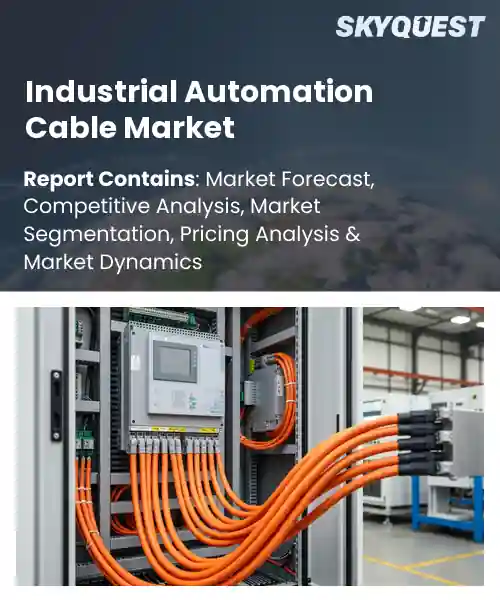
Industrial Automation Cable Market
Report ID: SQMIG20D2476
Report ID: SQMIG20D2476
[email protected]
USA +1 351-333-4748
Report ID:
SQMIG20D2476 |
Region:
Global |
Published Date: February, 2026
Pages:
157
|Tables:
153
|Figures:
78


Global Industrial Automation Cable Market size was valued at USD 6.4 Billion in 2024 and is poised to grow from USD 6.9 Billion in 2025 to USD 12.58 Billion by 2033, growing at a CAGR of 7.8% during the forecast period (2026-2033).
The main reason for the growth in the value of the industrial automation cable market is the growing prevalence of digitally linked, highly automated manufacturing workplaces and therefore the reliance on reliable cable systems to provide both data and power. Types of industrial automation cables can be power cables, control cables, instrumentation cables, Ethernet cables and fiber optic cables, and these industrial automation cables create connections between sensors, actuators, drives, and their associated control systems. Over decades, the market moved from basic power wiring in assembly lines to specialized high speed and high flex cable designs for robotics and real-time control in automotive and semiconductor plants, and demand for ruggedized, shielded, standards-compliant cabling reflects technological advancement and reliability expectations.
Building on factory automation growth, a key trend driving the global industrial automation cable sector is the proliferation of robotics and IIoT devices that produce real-time data and require durable cabling for continuous motion in harsh environments. As robotics deployment rises, demand for high-speed Ethernet, fiber optics, and torsion-resistant cables increases, prompting manufacturers to invest in materials and shielding to reduce electromagnetic interference. The effect is expanded opportunities for custom cable assemblies, predictive monitoring enabled by embedded sensors, and retrofit projects in aging plants; practical use cases include automotive robot lines, automated warehouses with guided vehicles, and wind turbines needing long life low maintenance cabling.
How is IoT Driving Demand For Advanced Industrial Automation Cables In Smart Manufacturing?
IoT is increasing sensor density and real-time data exchange across production lines, which directly raises the need for advanced industrial automation cables. Key aspects include robust signal integrity, immunity to electromagnetic interference, flexible construction for frequent motion, and support for higher bandwidth industrial Ethernet and fiber networks. Many factories are adding edge devices and wireless bridges while still relying on wired backbones for reliable connectivity, so demand focuses on cables built for harsh environments and integrated power and data delivery. Suppliers are responding with tailored jacket materials and connector solutions that simplify installation and extend uptime.
LAPP Group, February 2025, launched a line of halogen-free high-flex cables optimized for collaborative robots, which helps route dense sensor and actuator networks in confined spaces while preserving signal quality and reducing maintenance. That IoT-focused innovation supports smarter manufacturing by enabling continuous data collection for condition monitoring and faster automated responses.
Market snapshot - (2026-2033)
Global Market Size
USD 6.4 Billion
Largest Segment
Control Cables
Fastest Growth
Data Cables
Growth Rate
7.8% CAGR
To get more insights on this market click here to Request a Free Sample Report
Global industrial automation cable market is segmented by type of cable, material, application, industry end-use, cable configuration, and region. Based on type of cable, the market is segmented into control cables, data cables, power cables, instrumentation cables and flexible cables. Based on material, the market is segmented into copper, aluminum, fiber optics, and polymer. Based on application, the market is segmented into manufacturing, energy, process automation, building automation and transportation. Based on industry end-use, the market is segmented into oil and gas, automotive, food and beverage, pharmaceutical and electronics. Based on cable configuration, the market is segmented into single-core cables, multi-core cables, twisted pair cables, shielded cables and flat cables. Based on region, the market is segmented into North America, Europe, Asia Pacific, Latin America, and the Middle East & Africa.
What Role Do Control Cables Play in Transforming the Industrial Automation Cable Market?
Based on the global industrial automation cable market forecast, power cables are witnessing continuous innovation through improved insulation materials, high-temperature resistance, flame-retardant coatings, and enhanced durability for harsh industrial environments. They are being used increasingly on automated manufacturing production lines, in robotics, and in heavy equipment, which requires continual and consistent energy transmission. Power cables dominate the industrial automation cable market because every automated system fundamentally depends on a reliable power supply, making them indispensable for operational continuity, large-scale electrification, and increasing factory automation worldwide.
Data cables are expected to be the fastest-growing segment in the global industrial automation cable market due to the rapid adoption of Industrial IoT, smart factories, and real-time data-driven operations. The growing usage of industrial Ethernet technology and the use of connected sensors as well as the growth of machine-to-machine communications, are creating a need for high-speed, reliable data transmission infrastructures throughout today’s automated manufacturing environments.
How are Shielded Cables Addressing Key Interference Challenges in the Industrial Automation Cable Market?
Multi-core cables are evolving with advanced shielding, flexible insulation, and compact designs to support complex automation systems requiring simultaneous power, control, and data transmission. They are used for a lot of different applications beyond just those for PLCs. Use them in robotics, process automation and anywhere that has a concern for having neatly organized wiring and space utilization. Multi-core cables dominate the market because they reduce installation complexity, enhance system reliability, and streamline connectivity across increasingly integrated and high-density industrial automation infrastructures.
Twisted pair cables are projected to be the fastest-growing configuration due to rising adoption of Industrial Ethernet, IIoT devices, and real-time communication networks in smart factories. Because of their excellent noise immunity, low crosstalk, and high-speed, reliable data transfer, they are a critical component of interconnected automation systems, leading to faster deployment of digitally integrated industrial environments with higher operating speeds.
To get detailed segments analysis, Request a Free Sample Report
As per the global industrial automation cable market analysis, Asia Pacific dominance is driven by a dense concentration of manufacturing clusters, strong electronics and automotive ecosystems, and a culture of rapid technology adoption. The area has an integrated supplier base, which provides support for customized cable designs, large scale production, rapid prototyping, etc. Manufacturing facilities are heavily invested in factory automation, and advanced robotic and control systems are pushing up demand for specialized cables with demanding performance and reliability specifications. Manufacturers are located close to each other which leads to shorter lead times and also makes all OEMs and cable manufacturers able to work collaboratively. With a strong emphasis placed on regulatory compliance and industrial standards, there is a considerable quantity of skilled engineering professionals supporting the growth of the area as an innovator and provider of high-quality industrial automation cabling solutions.
Industrial automation cable market in Japan is characterized by demand for precision engineered solutions that support advanced robotics, semiconductor fabrication, and automotive electrification. Miniaturization, high reliability and the ability to interface with very complex control architectures – these are the three primary contributions of any one supplier. Therefore, many times the focus of product development is placed on building to last and operate effectively over a long period of time, while meeting defined quality assurance guidelines and requirements for product certification.
Industrial automation cable market in South Korea is shaped by strong electronics, shipbuilding, and semiconductor manufacturing sectors requiring high performance cabling. Customization, fast iterations, and smart factory initiative integration are top priorities for today's marketplace. OEMs and local suppliers are collaborating closely to deliver cables that meet the stringent demands of high-speed data transfer, high levels of electromagnetic resistance, and the ability to perform in harsh industrial environments. Export-focused production and technology collaboration are helping to drive ongoing advances in the design of cable materials and connectors that support both domestic automation projects and international supply agreements.
Expansion in North America is propelled by a combination of modernization efforts across diverse industries, strategic reshoring of manufacturing, and heightened emphasis on industrial resilience. Cables that facilitate high-speed communications, ensure signal integrity and provide robust distribution of power are in demand as a result of the growth in digital transformation and investment in the industrial Internet of Things (IoT). Additionally, the growth of the cable market has been further supported by strong aftermarket service environments and a growing preference for local supply chains to mitigate risk and enhance the responsiveness of service. The cross-sectoral demand for cables from industries such as energy, automotive, aerospace and food processing will drive the increased use of specialised cabling that meets the rigorous safety, environmental and interoperability criteria established by the respective industries.
Industrial automation cable market in United States is driven by modernization programs across manufacturing, energy, and defense sectors that require rugged, high performance cabling. Suppliers concentrate on adhering to stringent safety requirements, being built to last in very difficult settings (e.g., on boats at sea or in remote fields), and being compatible with advanced control networks. Domestic sourcing and supply chain resiliency also add to create a healthy ecosystem of manufacturers and suppliers. Custom-engineering, integration support, and lifecycle services are provided as the first priority for meeting the complex needs of projects and reducing the amount of time that critical industrial facilities cannot operate because of downtime related to equipment failure.
Industrial automation cable market in Canada reflects strong demand from natural resources, processing, and infrastructure sectors that require durable and weather resistant cabling. Projects focus on delivering a reliable experience over many years while being built to withstand damage caused by climate-related events, meeting state/federal law requirements for the services being provided, and supporting sustainable practices. Suppliers work collaboratively with integrators providing appropriate solutions for remote projects in difficult climates with an emphasis on being easily maintained as well as providing durable performance.
Europe is reinforcing its market position through coordinated emphasis on standardization, sustainability, and advanced manufacturing capabilities. Manufacturers at the regional level have a great deal of expertise, particularly in machine tools, the automotive sector and also in the process sectors. They use this expertise to engineer cables that will work well together, be safe and last very long. There is also a push regarding the use of recyclable materials and modular designs by many regulators who are looking to improve both energy efficiency and the circular economy. In addition to being able to develop new and improved technologies, the harmonization of regulatory frameworks as well as certification processes, support cross-border trade and helps assure consistency in quality.
Industrial automation cable market in Germany centers on precision engineering and high reliability to serve automotive, machinery, and industrial equipment sectors. Engineers expect strict adherence to engineering and mechanical performance specifications, as well as the ability to incorporate into highly sophisticated control systems. Continued collaboration between manufacturers and integrators creates specialized cabling that meets the demands of modern production facilities. Design emphasis on extending service life, energy conservation and compatibility with modular automation solutions strengthens the preference for high-end engineered cable for industrial uses.
Industrial automation cable market in United Kingdom emphasizes adaptability to diverse industries including aerospace, process manufacturing, and infrastructure modernization. In response to this increase in demand, providers now offer engineering expertise as well as a variety of field services and customized products to achieve specific compliance and operational resilience goals. Leading-edge innovation hubs and service oriented supply chains are creating new markets for the development of application-specific cables that achieve the right combination of performance, easy maintenance, and regulatory compliance for many different types of industrial estate facilities.
Industrial automation cable market in France is shaped by requirements from aerospace, rail, and energy sectors that demand high reliability and stringent performance characteristics. Providers will also furnish engineering support, in-field services, and provide customised solutions to help their customers meet compliance requirements and operational resilience goals. Additionally, the innovative hubs and service-centric supply chain created will stimulate the development of application-specific cables meeting the needs for performance, maintenance, and regulatory compliance for highly complex industrial facilities.
To know more about the market opportunities by region and country, click here to
Buy The Complete Report
Growing Industrial Connectivity Demand
The strong demand for seamless connectivity in factories drives the use of specialized industrial cables that provide reliable signal transmission and are physically robust enough to withstand harsh environments, and subsequently lead to the growth of the market. Manufacturers are increasingly prioritizing real-time monitoring, equipment synchronization, and long-term installations; therefore, a shift toward purchasing cables that have been designed for electromagnetic immunity, flexible routing, and the ability to tolerate extreme temperatures has taken place. Thus, the redefinition of purchasing and engineering specifications results in an increased preference for purpose-built industrial automation cables, an acceleration of product development and an extension of the procurement cycles.
Advances In Cable Materials
Cable performance and lifecycle improvements are achieved with advancements to insulation materials like cable jackets and improved shielding techniques, resulting in increased use of higher grade components by end user specifications for industrial cable use. Improved flame retardance, chemical resistance and flexibility provide better reliability and less downtime for maintenance, therefore reducing operational risks and total ownership costs as designers and asset owners see the value of these modern materials in automating systems for reliability and safety. As resulting procurement practices favour modernized cable products, manufacturers' opportunities for new product differentiation and the global industrial automation cable market share will be expanded.
High Installation And Maintenance Costs
Installation, routing, and periodic maintenance of specialty industrial cable have high upfront costs that may delay a quick implementation of new solutions. If a facility needs to upgrade existing capabilities with new cable, purchasing decisions can be delayed because buyers are often weighing upfront costs and possible downtime against perceived benefits. Resource allocation toward labor, specialty connectors, and compliance increases project complexity; therefore, procurement teams focus on keeping costs down. This indecisiveness leads to slower adoption rates of new cabling solutions and decreases the speed of capital investment both currently and in the future into these new cabling solutions.
Standardization And Compatibility Challenges
Lack of universal standards and compatibility issues among legacy equipment, protocols, and connector types create barriers that limit large scale cable replacements and slow specification changes, thereby restraining market growth. Integration complexities force system designers to prefer bespoke or familiar solutions to avoid interoperability risks, which reduces demand for newer standardized cable offerings. Because many different control systems must be supported and that older systems need to continue to be compatible with newer designs, there are added design efforts and hesitations to buy the necessary equipment. This slows down the process of how quickly suppliers can bring innovative new cabling products to market and roll them out to various global industrial sectors.
Request Free Customization of this report to help us to meet your business objectives.
Competition in the global industrial automation cable market outlook is shaped by consolidation, supplier alliances and technology differentiation, with incumbents using acquisitions, recycling and SPE rollouts to defend share and add services. M&A, supplier partnerships and sensor connectivity innovation have demonstrated themselves through several concrete moves such as Prysmian’s acquisition of General Cable; Nexans’ industrial recycling and supply partnerships; LAPP’s productization of Single Pair Ethernet; and DNV’s Smart Cable Guard monitoring platform.
SkyQuest’s ABIRAW (Advanced Business Intelligence, Research & Analysis Wing) is our Business Information Services team that Collects, Collates, Correlates, and Analyses the Data collected by means of Primary Exploratory Research backed by robust Secondary Desk research.
As per SkyQuest analysis, the global industrial automation cable industry is being driven primarily by the shift to digitally connected, highly automated production environments requiring reliable power and data transmission, and is further supported by advances in cable materials that increase durability, flexibility and EMI resistance. Control cables remain the dominant segment because they provide essential, low loss signal paths for PLCs and motor drives, while Asia Pacific leads the regional market due to dense manufacturing clusters and rapid technology adoption. However, high installation and maintenance costs restrain faster deployment, particularly in brownfield retrofits and cost-sensitive facilities, slowing overall replacement cycles despite strong technological momentum.
| Report Metric | Details |
|---|---|
| Market size value in 2024 | USD 6.4 Billion |
| Market size value in 2033 | USD 12.58 Billion |
| Growth Rate | 7.8% |
| Base year | 2024 |
| Forecast period | (2026-2033) |
| Forecast Unit (Value) | USD Billion |
| Segments covered |
|
| Regions covered | North America (US, Canada), Europe (Germany, France, United Kingdom, Italy, Spain, Rest of Europe), Asia Pacific (China, India, Japan, Rest of Asia-Pacific), Latin America (Brazil, Rest of Latin America), Middle East & Africa (South Africa, GCC Countries, Rest of MEA) |
| Companies covered |
|
| Customization scope | Free report customization with purchase. Customization includes:-
|
To get a free trial access to our platform which is a one stop solution for all your data requirements for quicker decision making. This platform allows you to compare markets, competitors who are prominent in the market, and mega trends that are influencing the dynamics in the market. Also, get access to detailed SkyQuest exclusive matrix.
Table Of Content
Executive Summary
Market overview
Parent Market Analysis
Market overview
Market size
KEY MARKET INSIGHTS
COVID IMPACT
MARKET DYNAMICS & OUTLOOK
Market Size by Region
KEY COMPANY PROFILES
Methodology
For the Industrial Automation Cable Market, our research methodology involved a mixture of primary and secondary data sources. Key steps involved in the research process are listed below:
1. Information Procurement: This stage involved the procurement of Market data or related information via primary and secondary sources. The various secondary sources used included various company websites, annual reports, trade databases, and paid databases such as Hoover's, Bloomberg Business, Factiva, and Avention. Our team did 45 primary interactions Globally which included several stakeholders such as manufacturers, customers, key opinion leaders, etc. Overall, information procurement was one of the most extensive stages in our research process.
2. Information Analysis: This step involved triangulation of data through bottom-up and top-down approaches to estimate and validate the total size and future estimate of the Industrial Automation Cable Market.
3. Report Formulation: The final step entailed the placement of data points in appropriate Market spaces in an attempt to deduce viable conclusions.
4. Validation & Publishing: Validation is the most important step in the process. Validation & re-validation via an intricately designed process helped us finalize data points to be used for final calculations. The final Market estimates and forecasts were then aligned and sent to our panel of industry experts for validation of data. Once the validation was done the report was sent to our Quality Assurance team to ensure adherence to style guides, consistency & design.
Analyst Support
Customization Options
With the given market data, our dedicated team of analysts can offer you the following customization options are available for the Industrial Automation Cable Market:
Product Analysis: Product matrix, which offers a detailed comparison of the product portfolio of companies.
Regional Analysis: Further analysis of the Industrial Automation Cable Market for additional countries.
Competitive Analysis: Detailed analysis and profiling of additional Market players & comparative analysis of competitive products.
Go to Market Strategy: Find the high-growth channels to invest your marketing efforts and increase your customer base.
Innovation Mapping: Identify racial solutions and innovation, connected to deep ecosystems of innovators, start-ups, academics, and strategic partners.
Category Intelligence: Customized intelligence that is relevant to their supply Markets will enable them to make smarter sourcing decisions and improve their category management.
Public Company Transcript Analysis: To improve the investment performance by generating new alpha and making better-informed decisions.
Social Media Listening: To analyze the conversations and trends happening not just around your brand, but around your industry as a whole, and use those insights to make better Marketing decisions.
REQUEST FOR SAMPLE
 REQUEST FREE CUSTOMIZATION
Global Industrial Automation Cable Market size was valued at USD 6.4 Billion in 2024 and is poised to grow from USD 6.9 Billion in 2025 to USD 12.58 Billion by 2033, growing at a CAGR of 7.8% during the forecast period (2026-2033).
Competition in the global industrial automation cable market is shaped by consolidation, supplier alliances and technology differentiation, with incumbents using acquisitions, recycling and SPE rollouts to defend share and add services. Concrete moves include Prysmian’s General Cable acquisition, Nexans’ industrial recycling and supply partnerships, LAPP’s Single Pair Ethernet productization and DNV’s Smart Cable Guard monitoring platform, showing M&A, supplier partnerships and sensor connectivity innovation. 'Belden Inc.', 'TE Connectivity Ltd.', 'Schneider Electric', 'Siemens AG', 'Rockwell Automation', 'Molex LLC', 'ABB Ltd.', 'Amphenol Corporation', 'Phoenix Contact', 'Lapp Group', 'Southwire Company', 'General Cable', 'Cable Solutions', 'Panduit Corporation', 'Huber + Suhner AG', 'Nexans S.A.', 'Leviton Manufacturing Co., Inc.', 'Optimum Cable', 'Eisele Pneumatics LLC', 'Sumitomo Electric Industries, Ltd.'
Robust demand for seamless connectivity across factories compels adoption of specialized industrial cables that ensure reliable signal transmission and physical resilience in harsh environments, directly supporting market expansion. As manufacturers prioritize real-time monitoring, equipment synchronization, and longevity of installations, procurement shifts toward cables designed for electromagnetic immunity, flexible routing, and temperature tolerance. This reorientation of purchasing and engineering specifications increases preference for purpose-built industrial automation cables, stimulates product development and broadens procurement cycles, thereby creating sustained growth opportunities for suppliers and incentivizing investment in cable technologies.
As per the global industrial automation cable market analysis, Asia Pacific dominance is driven by a dense concentration of manufacturing clusters, strong electronics and automotive ecosystems, and a culture of rapid technology adoption.


Want to customize this report? This report can be personalized according to your needs. Our analysts and industry experts will work directly with you to understand your requirements and provide you with customized data in a short amount of time. We offer $1000 worth of FREE customization at the time of purchase.
Feedback From Our Clients


 USA (+1) 351-333-4748

