
In Vitro Diagnostics and Cell Culture Medias Market
Report ID: SQMIG35D2405
Report ID: SQMIG35D2405
[email protected]
USA +1 351-333-4748
Report ID:
SQMIG35D2405 |
Region:
Global |
Published Date: February, 2026
Pages:
157
|Tables:
62
|Figures:
75


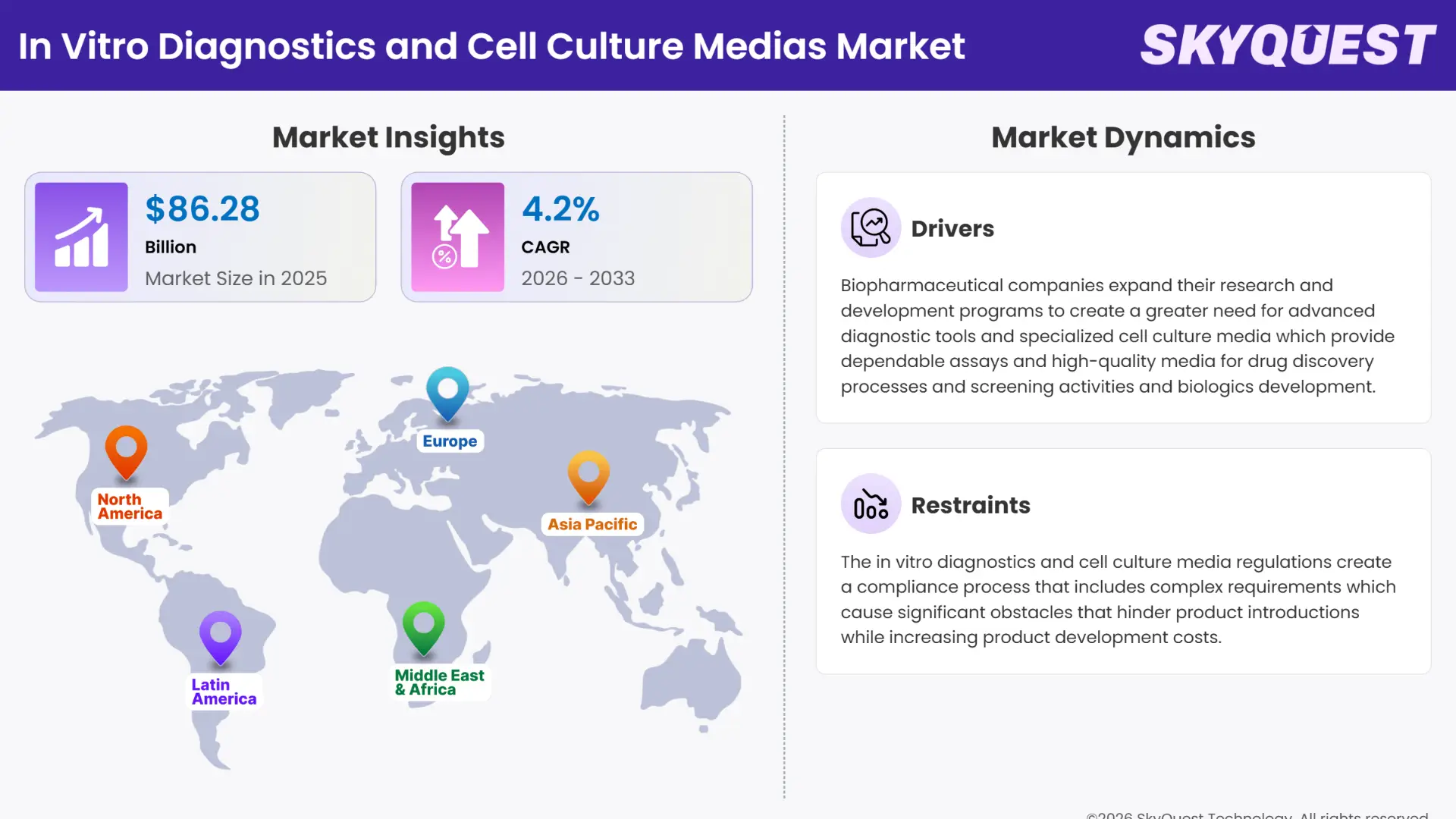
Global In Vitro Diagnostics and Cell Culture Medias Market size was valued at USD 82.8 Billion in 2024 and is poised to grow from USD 86.28 Billion in 2025 to USD 119.91 Billion by 2033, growing at a CAGR of 4.2% during the forecast period (2026-2033).
Key Takeaways: Market Trends & Insights
The growing requirement for precise and swift biological data, which supports clinical choices and speeds up biopharmaceutical research, drives the global in vitro diagnostics and cell culture medias market growth. The market includes products that detect disease biomarkers through assays and instruments and reagents together with defined media which researchers and manufacturers use for cell growth. The diagnostic process gains importance through its ability to decrease treatment ambiguity while high-quality media resources permit dependable biologics production which became evident during the PCR-based COVID-19 testing boom and the rising need for monoclonal antibody production.
Moreover, the global in vitro diagnostics and cell culture medias market outlook transformed throughout the years from basic immunoassays which used serum-containing culture to molecular platforms that operated through automated systems and used chemically defined GMP-grade media. The main growth driver for the market stems from the combination of precision medicine and cell therapy and rising biologics manufacturing which establishes new paths for diagnostic testing and media supply chain operations. The development of molecular assays and point-of-care platforms continues through the demand for companion diagnostics which oncology and rare disease biomarkers create while they increase clinical lab reagent consumption and replacement rates for reagents.
The production of monoclonal antibodies and vaccines and CAR-T therapies require chemically defined GMP-grade serum-free media which drives suppliers to create unique media solutions and single-use product designs. The new developments help manufacturers and CDMOs to improve product launch speed while decreasing contamination threats which leads to new business opportunities.
How is AI Improving Diagnostic Accuracy in the In Vitro Diagnostics and Cell Culture Media Market?
AI technology enhances diagnostic precision for the in vitro diagnostics and cell culture media market through its ability to detect signals better while minimizing process variations. The essential components include machine learning which interprets image and assay data and develops predictive models for assay results and implements automated media production quality control. The current state shows labs and manufacturers adopting validated algorithms to flag subtle biomarkers, standardize readings across operators, and accelerate assay development. The market environment consists of diagnostics companies establishing partnerships with AI developers and regulatory bodies increasing their assessment of clinically validated software. The two real-world applications that implement digital pathology systems together with AI-based assay optimization tools streamline operational processes while delivering consistent experimental outcomes.
To get more insights on this market click here to Request a Free Sample Report
The global in vitro diagnostics and cell culture medias market is segmented into product type, application, and end use, and region. By product type, the market includes reagents, instruments, software, and others. In terms of application, it is categorized into clinical diagnostics, drug discovery, research and development, and other applications. Based on end use, the market is segmented into hospitals, diagnostic laboratories, research institutions, and other end users. Regionally, it is analyzed across North America, Europe, Latin America, Middle East & Africa, and Asia-Pacific.
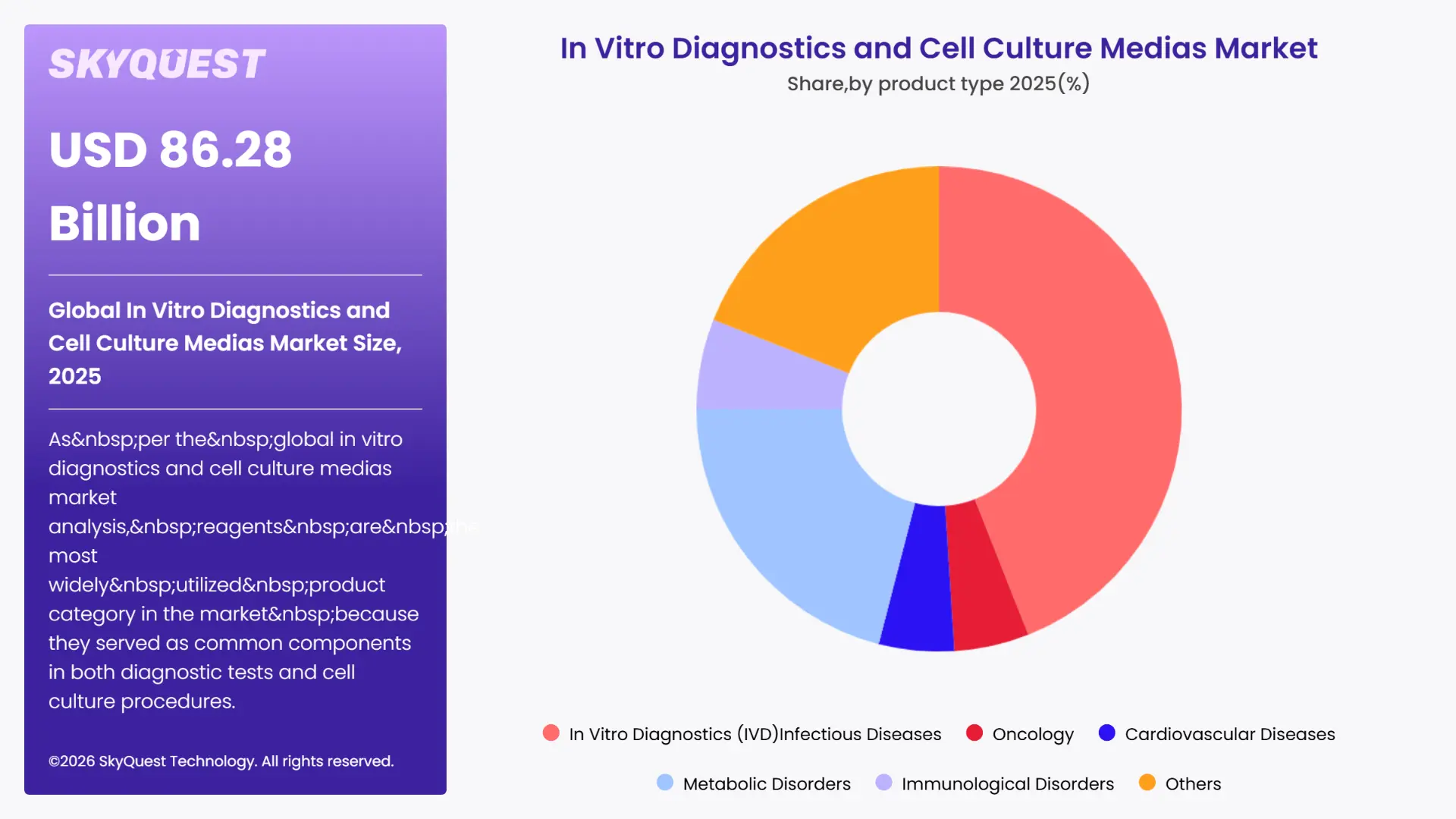
As per the global in vitro diagnostics and cell culture medias market analysis, reagents are the most widely utilized product category in the market because they served as common components in both diagnostic tests and cell culture procedures. Reagents play an essential role as the main element for laboratories that conduct assays and sample preparation together with media production. Hospitals maintain a constant need for reagents because diagnostic labs depend on 24-hour replenishment of reagents for routine blood tests and PCR-based detection.
However, laboratories will experience their fastest software development growth because automation and digital transformation become more present in these environments. Advanced laboratory information management systems (LIMS), data analytics platforms, and AI-based diagnostic tools are being used by an increasing number of people. Research and diagnostic facilities in modern times rely heavily on software solutions because these tools enhance data processing capabilities while boosting operational efficiency and maintaining high accuracy levels.
According to the global in vitro diagnostics and cell culture medias market forecast, the healthcare industry used clinical diagnostic tests to assess and monitor medical conditions which resulted in clinical diagnostics becoming the most important application segment of the market. Hospitals and diagnostic laboratories conduct various tests every day which include chronic disease management and infectious disease screening. IVD products and cell culture media form the fundamental basis for direct diagnostic tests like molecular diagnostics and blood panel tests which illustrate the essential role of this market segment.
Whereas the drug discovery is anticipated to have the maximum global in vitro diagnostics and cell culture medias market share. The requirement for advanced cell culture media and diagnostic products increases because the biotechnology and pharmaceutical sectors expand their drug development operations. The drug development process has accelerated through the rising popularity of biologics and vaccines and personalized medicine technologies.
To get detailed segments analysis, Request a Free Sample Report
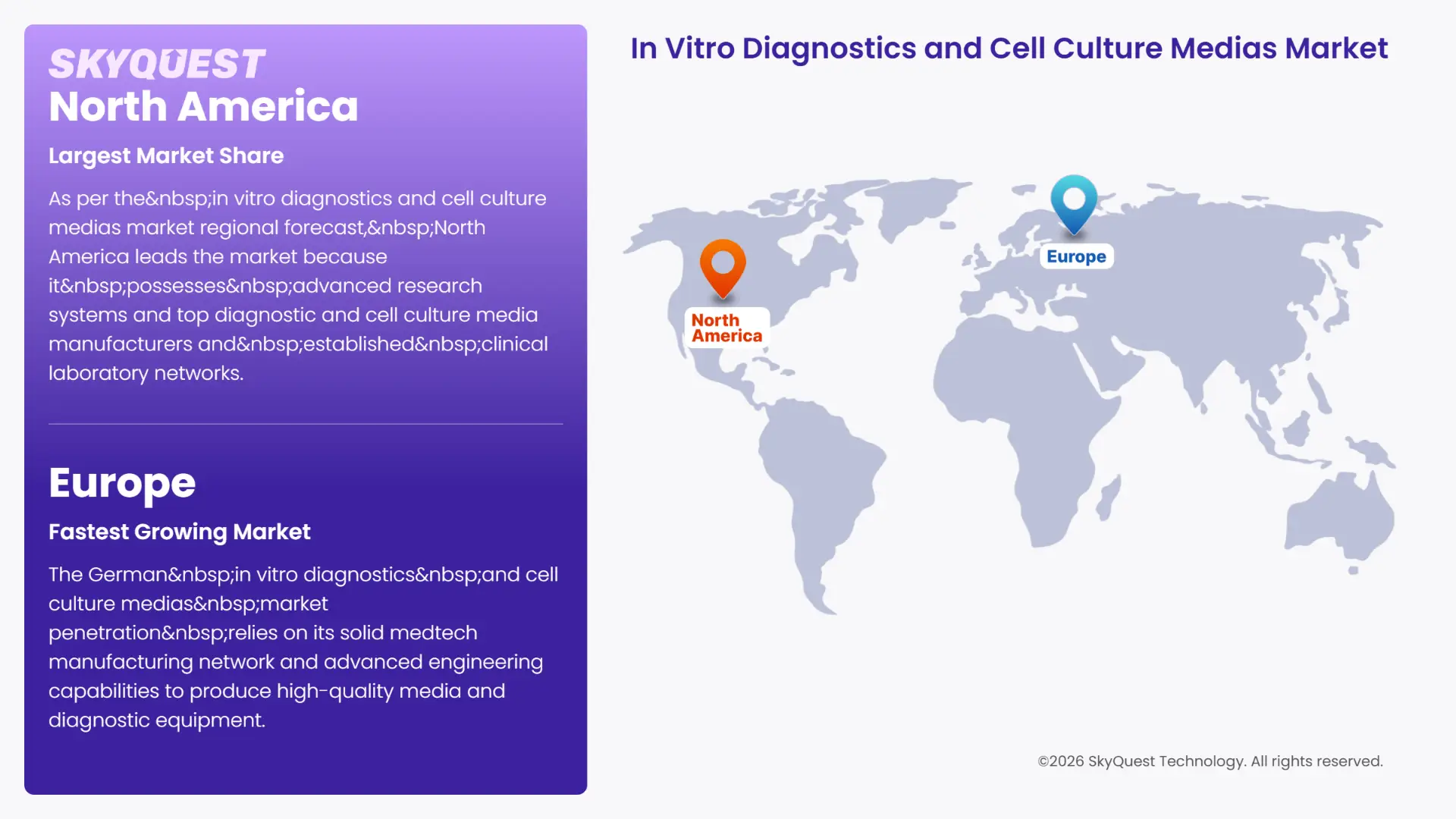
As per the in vitro diagnostics and cell culture medias market regional forecast, North America leads the market because it possesses advanced research systems and top diagnostic and cell culture media manufacturers and established clinical laboratory networks. The development of clinical assays occurs more quickly because academic medical centers and major biopharma companies and instrument designers work together to develop medical assays. The existing regulatory and reimbursement framework enables healthcare providers to use new diagnostic tests while facilitating the manufacturing process for commercial products. The combination of strong private funding and active mergers and acquisitions enables businesses to achieve rapid product launch and distribution.
The United States in vitro diagnostics and cell culture medias sector operates through a dense network of instrument makers and reagent suppliers and clinical laboratories which enables faster adoption of cutting-edge diagnostic testing. The rapid development of new media formulations and diagnostics receives support from private funding and close academic-industry partnerships and existing regulatory frameworks. The ability to produce products through contract manufacturing and the availability of laboratory facilities lets researchers and clinicians use the product across all settings.
The Canadian in vitro diagnostics and cell culture medias industry operate through two main systems which include public health laboratories and specialized industry programs and the development of biotech clusters. Collaborative networks link universities, regional hospitals, and manufacturers to advance validation and scale production. Domestic product development operates through the establishment of regulatory frameworks which help clinical research organizations implement new products into their research and development operations.
The European market expands at a fast pace because member countries establish unified regulatory systems and maintain strong public research infrastructures and build cross-border partnerships with the private sector. National health systems and reimbursement mechanisms support adoption of clinically validated diagnostics while established medtech clusters supply sophisticated instruments and media. Cross-country funding and translational research grants support the development of commercial products based on academic research results. The laboratory market expansion results from investments in precision medicine and cell therapy and companion diagnostics while laboratory consolidation leads to standardized supply requirements. European organizations face strict requirements for clinical validation, which creates challenges for local manufacturers to access export markets and maintain their domestic manufacturing abilities.
The German in vitro diagnostics and cell culture medias market penetration relies on its solid medtech manufacturing network and advanced engineering capabilities to produce high-quality media and diagnostic equipment. The research organizations and clinical facilities and industry partners work together to validate and implement new technologies for healthcare delivery. Hospitals use their extensive networks to acquire standard products, while businesses use their export-ready products and specialized suppliers to build their manufacturing and distribution capacities. European leaders maintain their market position through their understanding of regulatory requirements and their technical expertise.
The United Kingdom In Vitro Diagnostics and Cell Culture Medias market operates through research hubs and active life science hubs which create a business environment that fosters innovation-based product development. The academic centers and industry sectors and clinical network partners work together to accelerate the development of new media and diagnostic products. The combination of venture capital investment and public support and focused cell therapy initiatives lead to manufacturing expansion while creating operational advantages for both domestic companies and international partners.
The In Vitro Diagnostics and Cell Culture Medias Market in France experiences growth through biotech cluster expansion and dedicated industry programs which support market development. The validation process and local production process receive acceleration through cooperation between universities and clinical centers and manufacturers. Research funding and manufacturing support help domestic suppliers develop products for clinical and research applications. France establishes itself as an emerging regional supplier through its export-oriented quality systems.
Asia Pacific strengthens its position through dedicated domestic manufacturing investments together with targeted research projects and worldwide industrial alliances. The combined efforts of government entities and private sector investors enable them to enhance production capabilities for culture media and diagnostic components while they establish innovation centers that turn academic scientific discoveries into market-ready products. The market benefits from better regulatory frameworks and the establishment of regional standards which help businesses enter markets and conduct export operations. The laboratory automation boom together with digital diagnostics growth and precision medicine development drives higher product demand for superior media and assay testing solutions. AsiaPacific reduces its need for remote suppliers through strategic partnerships and technology transfer functions and localized supply chain development activities which enable quick response to clinical and research requirements while developing into a key global market player.
The In Vitro Diagnostics and Cell Culture Medias Market in Japan thrives because diagnostic manufacturers produce high-quality products which provide essential media for clinical and research purposes. The adoption of validated products receives support from hospital systems because their medical products undergo conservative regulatory procedures which allow product validation through hospital system integration. The country develops its domestic manufacturing capacity through precision diagnostic platform and automation system investments while its export activities and international partnerships create market opportunities and technology sharing.
The In Vitro Diagnostics and Cell Culture Medias Market in South Korea benefits from two main factors which are biotech innovation and government support and manufacturing agility that creates fast media and reagent development. Industry teams work together with universities to develop and test products through their technology transfer partnership with research centers. The public programs and regulatory frameworks create market access pathways which enable South Korea to establish itself as a global manufacturing partner and regional supplier through its digital manufacturing and quality production capabilities.
To know more about the market opportunities by region and country, click here to
Buy The Complete Report
Expansion of Biopharmaceutical Research
Biopharmaceutical companies expand their research and development programs to create a greater need for advanced diagnostic tools and specialized cell culture media which provide dependable assays and high-quality media for drug discovery processes and screening activities and biologics development. The expansion encourages suppliers to create new formulations while they increase manufacturing capacity, which results in improved product distribution and additional product choices that enable laboratories and manufacturers to access more products. The close alignment between R&D needs and product development leads to stronger collaborative relationships throughout the entire value chain, which drives market growth through ongoing product procurement and technology sharing.
Rising Focus on Personalized Medicine
The rising demand for personalized medicine needs precise and reliable in vitro diagnostic tests which must be combined with specific cell culture media that support the identification of biomarkers and the creation of targeted treatments for individual patients. Clinicians and researchers who prefer individual-based methods create a demand for media and diagnostic tools that can produce reproducible results while enabling personalization through multiple sample testing and intricate assay development. The demand in the market for established solutions leads manufacturers to create special products which aid in market expansion through increased product variety and better clinical integration of diagnostics and culture systems in research and clinical laboratories.
Stringent Regulatory Requirements
The in vitro diagnostics and cell culture media regulations create a compliance process that includes complex requirements which cause significant obstacles that hinder product introductions while increasing product development costs. Manufacturers need to handle multiple regional standards and safety demonstration requirements together with performance benchmarks and quality assessment standards which creates obstacles that stop smaller companies from entering the market while slowing down their product development process. The regulatory requirements for worldwide product distribution need manufacturers to deliver comprehensive documentation together with technical validation proof, which leads to longer technology adoption delays while scientific developments push new technology to laboratories.
Raw Material Supply Constraints
The manufacturing process for cell culture media and diagnostic kits depends on specific raw materials and essential reagents, which creates supply chain risks that arise from sudden material shortages and fluctuating product quality and supplier distribution across few geographical areas. The production process faces difficulties because sourcing problems lead to production interruption which forces manufacturing revision and limits production capability to meet increasing product demand. The product supply constraints create difficulties for producers who need to manage multiple operational processes and laboratories face procurement challenges that lead to production delays which prevent the market from growing despite rising research demand and clinical requirements.
Request Free Customization of this report to help us to meet your business objectives.
The market competition develops through existing companies and specialized companies which compete in three key areas, namely media expenses and operational risk management, and diagnostic effectiveness. Companies use M&A activities to bridge capability deficiencies, which includes Merck's acquisition of the MAST sampling platform, and companies such as Sartorius who expand their supplier capacity. Startups use product development and production partnerships to compel established companies into making licensing agreements and shared production contracts.
AI-enabled Diagnostic Acceleration: Laboratories now use AI-driven algorithms and machine learning frameworks for designing assays and interpreting images and conducting laboratory work which allows them to quickly develop diagnostics that can be repeated. Biological signals and clinical context combine to create tools which support predictive biomarkers and adaptive testing strategies that enhance their clinical relevance. Automated analytical pipelines together with intelligent data curation enable organizations to validate their processes and make decisions more efficiently while their software capabilities allow them to conduct more diagnostic tests in decentralized medical settings.
Modular Serum Free Media: Scientists now use serum free media to create standardized cell culture environments which help them achieve consistent results during their research and testing activities. The organizations use specialized cell type formulations together with their research needs to create therapeutic products and research materials which meet their production requirements and regulatory standards. The system enables flexible manufacturing operations while enabling smooth technology transfer because it operates with both single-use platforms and automated bioprocessing systems. The media solutions create supplier-user partnerships which users use to develop tailored solutions that accelerate translational research while establishing standard research practices for laboratories and supporting the development of cell and gene therapies.
SkyQuest’s ABIRAW (Advanced Business Intelligence, Research & Analysis Wing) is our Business Information Services team that Collects, Collates, Correlates, and Analyses the Data collected by means ofPrimary Exploratory Research backed by robust Secondary Desk research.
As per SkyQuest analysis, the global in vitro diagnostics and cell culture medias market is growing steadily. The increasing demand for precise disease detection combined with the rising incidence of both chronic and infectious diseases and the expanding scope of research activities drives this market growth. The market depends on standard testing and laboratory operations because reagents and clinical diagnostics function as essential components of medical testing. The market experiences rapid expansion due to three factors, including automation, digital solutions, and personalized medicine. The demand for cell culture media is rising because researchers are increasing their funding for biotechnology and pharmaceutical research. The market will experience continuous growth because new healthcare innovations and rising global healthcare demands will drive market expansion.
| Report Metric | Details |
|---|---|
| Market size value in 2024 | USD 82.8 Billion |
| Market size value in 2033 | USD 119.91 Billion |
| Growth Rate | 4.2% |
| Base year | 2024 |
| Forecast period | 2026-2033 |
| Forecast Unit (Value) | USD Billion |
| Segments covered |
|
| Regions covered | North America (US, Canada), Europe (Germany, France, United Kingdom, Italy, Spain, Rest of Europe), Asia Pacific (China, India, Japan, Rest of Asia-Pacific), Latin America (Brazil, Rest of Latin America), Middle East & Africa (South Africa, GCC Countries, Rest of MEA) |
| Companies covered |
Recent Developments in the In Vitro Diagnostics and Cell Culture Medias Market
|
| Customization scope | Free report customization with purchase. Customization includes:-
|
To get a free trial access to our platform which is a one stop solution for all your data requirements for quicker decision making. This platform allows you to compare markets, competitors who are prominent in the market, and mega trends that are influencing the dynamics in the market. Also, get access to detailed SkyQuest exclusive matrix.
Table Of Content
Executive Summary
Market overview
Parent Market Analysis
Market overview
Market size
KEY MARKET INSIGHTS
COVID IMPACT
MARKET DYNAMICS & OUTLOOK
Market Size by Region
KEY COMPANY PROFILES
Methodology
For the In Vitro Diagnostics and Cell Culture Medias Market, our research methodology involved a mixture of primary and secondary data sources. Key steps involved in the research process are listed below:
1. Information Procurement: This stage involved the procurement of Market data or related information via primary and secondary sources. The various secondary sources used included various company websites, annual reports, trade databases, and paid databases such as Hoover's, Bloomberg Business, Factiva, and Avention. Our team did 45 primary interactions Globally which included several stakeholders such as manufacturers, customers, key opinion leaders, etc. Overall, information procurement was one of the most extensive stages in our research process.
2. Information Analysis: This step involved triangulation of data through bottom-up and top-down approaches to estimate and validate the total size and future estimate of the In Vitro Diagnostics and Cell Culture Medias Market.
3. Report Formulation: The final step entailed the placement of data points in appropriate Market spaces in an attempt to deduce viable conclusions.
4. Validation & Publishing: Validation is the most important step in the process. Validation & re-validation via an intricately designed process helped us finalize data points to be used for final calculations. The final Market estimates and forecasts were then aligned and sent to our panel of industry experts for validation of data. Once the validation was done the report was sent to our Quality Assurance team to ensure adherence to style guides, consistency & design.
Analyst Support
Customization Options
With the given market data, our dedicated team of analysts can offer you the following customization options are available for the In Vitro Diagnostics and Cell Culture Medias Market:
Product Analysis: Product matrix, which offers a detailed comparison of the product portfolio of companies.
Regional Analysis: Further analysis of the In Vitro Diagnostics and Cell Culture Medias Market for additional countries.
Competitive Analysis: Detailed analysis and profiling of additional Market players & comparative analysis of competitive products.
Go to Market Strategy: Find the high-growth channels to invest your marketing efforts and increase your customer base.
Innovation Mapping: Identify racial solutions and innovation, connected to deep ecosystems of innovators, start-ups, academics, and strategic partners.
Category Intelligence: Customized intelligence that is relevant to their supply Markets will enable them to make smarter sourcing decisions and improve their category management.
Public Company Transcript Analysis: To improve the investment performance by generating new alpha and making better-informed decisions.
Social Media Listening: To analyze the conversations and trends happening not just around your brand, but around your industry as a whole, and use those insights to make better Marketing decisions.
REQUEST FOR SAMPLE
 REQUEST FREE CUSTOMIZATION
Global In Vitro Diagnostics And Cell Culture Medias Market size was valued at USD 82.8 Billion in 2024 and is poised to grow from USD 86.28 Billion in 2025 to USD 119.91 Billion by 2033, growing at a CAGR of 4.2% during the forecast period (2026-2033).
The competitive landscape is shaped by incumbents and agile specialists competing on media cost, supply chain security, and diagnostic speed. Strategic moves include M&A to close capability gaps, for example Merck’s acquisition of the MAST sampling platform, and supplier capacity expansions by firms such as Sartorius. Startups press incumbents through product innovation and manufacturing partnerships, forcing collaborative licensing and co manufacturing deals. 'Thermo Fisher Scientific', 'Abbott Laboratories', 'Roche Diagnostics', 'BD (Becton, Dickinson and Company)', 'Qiagen', 'Agilent Technologies', 'PerkinElmer', 'Bio-Rad Laboratories', 'Merck Group', 'Siemens Healthineers', 'Illumina', 'Genomatix', 'Promega Corporation', 'Cell Signaling Technology', 'Lonza Group', 'Sigma-Aldrich', 'Eppendorf', 'Hologic', '10X Genomics', 'Sartorius AG'
Biopharmaceutical firms expanding research pipelines and development activities increase demand for advanced in vitro diagnostics and specialized cell culture medias by requiring reliable assays and high-quality media for discovery, screening, and biologics production. This expansion encourages suppliers to innovate formulations and scale manufacturing, enhancing product availability and diversity which in turn supports broader adoption by laboratories and manufacturers. The close alignment between R&D needs and product development fosters deeper collaborations across the value chain, reinforcing market growth through sustained procurement and technology integration.
Ai Enabled Diagnostic Acceleration: AI driven algorithms and machine learning frameworks are increasingly embedded into assay design, image interpretation, and laboratory workflows, enabling rapid iteration and reproducibility in diagnostic development. By synthesizing complex biological signals with clinical context, these tools support predictive biomarkers and adaptive testing strategies, enhancing clinical relevance. Automation of analytical pipelines and intelligent data curation streamlines validation processes and decision making, fostering closer collaboration between diagnostics manufacturers, laboratories, and healthcare providers while expanding the range of assays feasible for decentralized care.
North America Dominate the Global In Vitro Diagnostics and Cell Culture Medias Market?
The In Vitro Diagnostics (IVD) and Cell Culture Medias market focuses on technologies and materials used for analyzing biological samples and supporting cell growth in laboratory environments. These solutions are essential for accurate disease diagnosis, clinical decision-making, and biopharmaceutical development, making them a critical part of modern healthcare and life sciences.
The market faces challenges such as high costs associated with advanced cell culture media and limited access to quality infrastructure in developing regions. Additionally, a shortage of skilled professionals and the need for strict quality management systems can hinder adoption and scalability, especially in low- and middle-income countries.
The In Vitro Diagnostics (IVD) and Cell Culture Medias market focuses on technologies and materials used for analyzing biological samples and supporting cell growth in laboratory environments. These solutions are essential for accurate disease diagnosis, clinical decision-making, and biopharmaceutical development, making them a critical part of modern healthcare and life sciences.
The market faces challenges such as high costs associated with advanced cell culture media and limited access to quality infrastructure in developing regions. Additionally, a shortage of skilled professionals and the need for strict quality management systems can hinder adoption and scalability, especially in low- and middle-income countries.


Want to customize this report? This report can be personalized according to your needs. Our analysts and industry experts will work directly with you to understand your requirements and provide you with customized data in a short amount of time. We offer $1000 worth of FREE customization at the time of purchase.
Feedback From Our Clients


 USA (+1) 351-333-4748

