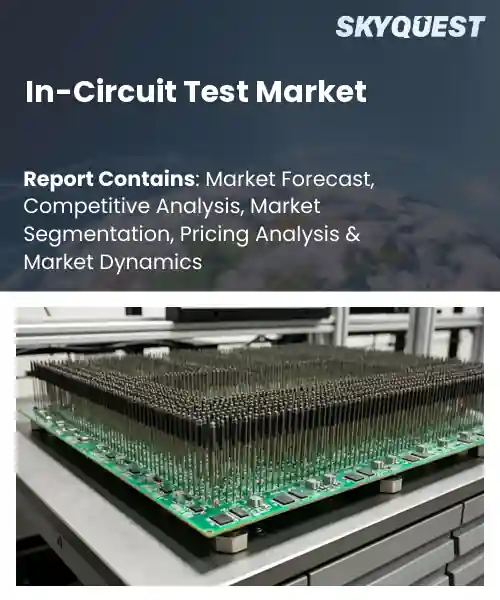
In-Circuit Test Market
Report ID: SQMIG10D2058
Report ID: SQMIG10D2058
[email protected]
USA +1 351-333-4748
Report ID:
SQMIG10D2058 |
Region:
Global |
Published Date: February, 2026
Pages:
157
|Tables:
66
|Figures:
75


Global In-Circuit Test Market size was valued at USD 1.7 Billion in 2024 and is poised to grow from USD 1.8 Billion in 2025 to USD 2.82 Billion by 2033, growing at a CAGR of 5.8% during the forecast period (2026-2033).
The in-circuit test market centers on automated systems that verify assembled printed circuit boards by probing individual components and nets to detect manufacturing defects and it matters because early fault detection reduces costly recalls and improves product yield. Over decades the market evolved from manual beds of nails fixtures to sophisticated flying probe and mixed signal testers as electronics grew denser and diversified, driven by demand for higher reliability in automotive, aerospace and consumer electronics. For example, automotive electronic control units adopted ICT extensively after stringent safety standards emerged, and smartphone producers increased tester throughput to handle high volumes.
One key factor driving global ICT market expansion is relentless electronic complexity that forces manufacturers to invest in adaptive testing solutions; as boards incorporate more layers, fine pitch components and embedded sensors, traditional fixtures become impractical and flying probe systems rise. That causes test vendors to develop faster algorithms, higher pin counts, and integrated diagnostics, creating opportunities for equipment leasing and analytics services that reduce downtime globally. Examples include prototype houses using flying probes to shorten design cycles; automotive suppliers deploying inline ICT arrays for batch validation and aerospace firms specifying mixed signal testers to validate safety critical subsystems.
How is AI Enhancing Fault Detection in the In-circuit Test Market?
AI is improving fault detection in the in-circuit test market by adding data driven detection, smarter diagnostics, and automated test planning. Key aspects include anomaly detection on tester telemetry, model-based root cause analysis and machine learned test vector optimization that focus effort on hard-to-find faults. The current state sees vendors embedding analytics into testers and factory systems, so teams can shorten debug cycles and reduce yield escapes. Market pressure from denser boards and faster interconnects makes traditional static tests less effective and raises demand for adaptive, context aware of fault triage and continuous learning from production data. Examples include log driven fault grouping and graph-based models that infer component level failures.
Market snapshot - 2026-2033
Global Market Size
USD 1.7 Billion
Largest Segment
Mixed Signal
Fastest Growth
Portability
Growth Rate
5.8% CAGR
To get more insights on this market click here to Request a Free Sample Report
The global in-circuit test market is segmented by in-circuit test types, applications, and region. Based on in-circuit test types, the market is segmented into analog, mixed signal,and portability. Based on applications, the market is segmented into Consumer Electronics, Aerospace & Defense, Medical Equipment, Wireless Communication, Automotive and Energy. Based on region, the market is segmented into North America, Europe, Asia Pacific, Latin America and Middle East & Africa.
Mixed Signal segment dominates because modern boards combine analog and digital functions that require integrated measurement and complex stimulus and response analysis. The need to validate interactions across domains forces in circuit test suppliers to offer versatile instruments and advanced software. This drives investment in higher channel density and adaptive test routines, making mixed signal capabilities the default choice for manufacturers seeking comprehensive fault coverage and reduced debug cycles during production.
Analog in-circuit test types are projected to be the fastest growing in the global in-circuit test market due to rising demand for precise validation of power management circuits, sensors, and analog components across automotive, medical, and industrial electronics. As the use of mixed voltage and high reliability analog circuitry in devices continues to increase, manufacturers place greater emphasis on accurate fault detection which will lead to the increased use of Analog ICTs.
Automotive segment leads because vehicles demand high reliability and traceable diagnostics across a growing number of electronic control units, prompting manufacturers to prioritize thorough circuit validation. The need for strict safety requirements combined with the expectation that products will have a long life has driven suppliers to implement strict testing procedures and to make equipment much stronger. Product safety regulations and product long-term durability requirements mean that suppliers invest consistently in testing infrastructure and specialized automotive test strategies for both the manufacturing and service environments.
Consumer electronics applications are expected to be the fastest growing in the global in-circuit test market due to surging production of smartphones, wearables, smart home devices, and connected appliances. The continuous increase in PCB complexity coupled with faster product life cycles and regulation of higher volume production means that there will be increased need for timely and accurate detection of faults in all products.
To get detailed segments analysis, Request a Free Sample Report
The dominance of Asia Pacific is driven by an extensive manufacturing ecosystem that couples large-scale electronics production with deep engineering capabilities. Concentration of OEMs, contract manufacturers, and component suppliers enables rapid alignment between design, fabrication, and test requirements. High local demand for consumer electronics, automotive electronics, and industrial automation fosters continuous refinement of test methodologies and close collaboration with equipment vendors. Because of miniaturization, highly dense assemblies with higher yield from advanced in-circuit techniques, strong local competency allows for customization, iterative development and integrated service offers that all support regional leaders accelerating their growth.
In-circuit test market in Japan is characterized by a concentration of advanced electronics manufacturers, a mature supply chain, and a focus on precision testing for complex assemblies. There has been growing local demand in automotive manufacturing, consumer electronics, and industrial automation industries that require significant collaborative activity between contract manufacturers and major equipment supplying companies. Also, there has been increasing emphasis placed upon both reliability and miniaturization which has led many manufacturers to explore and adopt higher density fixture and boundary-scan hybrid methodologies as well as domestic engineering resources to enhance and customize their testing solutions.
In-circuit test market in South Korea benefits from a robust electronics manufacturing ecosystem, strong OEM and contract manufacturing capabilities, and close integration with semiconductor supply chains. The support of local suppliers through direct collaboration with global vendors has created customized test strategies that accommodate small form factor multilayer PCBs. Continuous optimization of manufacturing processes, as well as continuous support of all aspects of manufacturing, further enhances the reliability of manufacturing in high-volume production environments on a global scale.
The rapid expansion in North America stems from a convergence of strong demand for high-reliability electronics across industries, an established ecosystem of test equipment suppliers, and deep integration with semiconductor and printed circuit board manufacturers. Emphasis on automation, yield improvement, and compliance with rigorous quality standards encourages adoption of advanced in-circuit methodologies and complementary boundary-scan practices. (A lively service sector) along with collaboration (between regulated manufacturers and outsourced manufacturing) could accelerate the development of modular and scalable testing systems. (To facilitate iterative advancements in test algorithms and fixtures would be possible) through strong R&D and collaboration between universities and the industry. (The desire for fast prototyping and the use of vendor-neutral integration will help create configura-tion(s) for complicated assemblies) and (the current stage of the market will encourage) prices to become competitive and provide a sound after-market for calibration and maintenance of test equipment.
In-circuit test market in United States reflects a diverse industrial base with significant activity in aerospace, medical devices, and advanced computing. OEMs, contract manufacturers and test equipment suppliers have developed solid relationships that allow for customized solutions and fast integration. The demand for modular in-circuit systems, with associated software-driven diagnostic capabilities, is driven by the increasing trends towards automation and scalable test platforms. The continued growth of adoption in a diverse range of domestic manufacturing environments can be attributed to the focus on service, product after-sales calibration, and the sharing of cross-industry knowledge.
In-circuit test market in Canada is driven by a combination of advanced manufacturing, emphasis on quality standards, close ties to North American supply chains. The telecommunications, automotive electronics, and clean technology industries are driving demand for flexible testing platforms and remote diagnostic support. Local integrator/vendor collaboration is also a significant factor in developing localized service & training solutions; whereas reliability, responsiveness to suppliers have contributed significantly to the use of in-circuit testing methods across various types of manufacturing facilities.
A blend of specialization, industrial policies and testing infrastructure and skill development creates an enhanced position for Europe as it focuses on high-reliability sectors. The implementation of rigorous safety and interoperability standards by manufacturers and systems integrators has facilitated the increased use of complex in-circuit and hybrid testing methods in the automotive electrification, industrial automation and medical device industry. Knowledge transfer is further supported by collaboration across borders between many contract manufacturers. Modular test architecture, energy efficient testing processes, and locally offered services are helping to increase competitiveness among the region's manufacturers, as they create better alignment between designing for testability and production engineering. The collaboration between public/private companies also creates excellence centres that promote validation of testing methodologies and their implementation at small and mid-sized businesses.
In-circuit test market in Germany is anchored by a strong industrial engineering tradition and engagement in automotive and industrial automation sectors. Effectively using advanced in-circuit test systems and integrated diagnostic software is due to improved accuracy, quality and the need for compliance with strict quality specifications. The collaboration of system integrators, equipment manufacturers, and component providers allows for the development of scalable and energy-conscious testing methodologies. Implementation and continual improvement are aided by using local service networks and training resources through the course of the whole production line.
In-circuit test market in United Kingdom benefits from a strong mix of defense, aerospace, and medical device manufacturing that prioritizes traceability and reliability. Innovative testing equipment manufacturers and universities work closely together to promote the use of advanced diagnostic techniques as well as fixture design. For example, using a flexible and adaptable type of test equipment allows manufacturers to easily produce small batch quantities and specialty products. In addition, manufacturers can provide high-quality calibration and maintenance services to their customers, allowing them to maintain a consistent level performance across multiple manufacturing/production environments while remaining compliant with government regulations.
In-circuit test market in France is influenced by strong electronics design capabilities, in transport, energy, and industrial control applications. The focus on interoperability as well as compliance with European quality standards means that mixed functional/in-circuit testing strategies will become more common. Collaboration between designers and contract manufacturers allows for the creation of custom test flows for small, multi-technology devices. Continued commitment to training operators and providing service support to operators will improve the reliability of test processes and help to continually improve the processes used in test.
To know more about the market opportunities by region and country, click here to
Buy The Complete Report
Growing Adoption of Automated Testing
The increasing shift by electronics manufacturers toward automated test processes has expanded demand for in-circuit test solutions that deliver faster throughput and consistent fault detection across complex assemblies. Automated workflows reduce reliance on manual inspection, enable standardized test coverage, and facilitate integration with production line systems, which encourages investment in ICT equipment and software. Suppliers benefit from clear value propositions around efficiency and quality, prompting broader adoption and deployment of ICT across diverse manufacturing segments, thereby sustaining steady market expansion and supplier innovation.
Advancements in Test Probe Technology
By improving the design of probes, the types of contacts used and building new fixtures that have lower risk of breaking, there has been a continuous focus on having a reliable system that reduces interruptions during the testing cycle and thus creating a reason for the manufacturer to install newer in-circuit test systems. Longer life probes and lower maintenance of the probes result in less downtime for the manufacturer and better perceptions of first pass yields which provide a greater incentive to implement ICT. Manufacturers are utilizing these advancements in technology to provide modular/serviceable solutions that meet the changing needs of production.
High Initial Equipment Costs
Small manufacturers usually avoid implementing comprehensive in-circuit test solutions because of the significant upfront expense related to advance in-circuit test equipment and fixtures. In addition, when other production investments are prioritized in capital expenditures, decision-makers tend to delay or reduce their decision to purchase in-circuit test (ICT) systems, thus extending replacement cycles for existing equipment and negatively impacting sales of higher-end ICT systems. Consequently, vendors of ICT equipment face longer sales cycles and requests for financing as well as lower-cost alternatives to their ICT systems. Thus, the practical difficulties associated with accommodating the wide range of legacy portfolios have caused a moderating effect on the demand for new ICT installations.
Complexity of Legacy Board Designs
The design of effective in-circuit test fixtures becomes more challenging and expensive because of legacy boards with dense routing, mixed technologies, and nonstandard test points. Therefore, many manufacturers do not invest in ICT for older product lines due to these factors. The engineering time associated with developing customized fixture requirements also diminishes the attractiveness of standardized test solutions. Manufacturers are currently continuing to rely on manual or alternative testing methods, which further decreases the appeal of ICT for older product lines.
Request Free Customization of this report to help us to meet your business objectives.
The global in-circuit test market is moderately consolidated, led by Teradyne, Inc., Keysight Technologies, SPEA S.p.A., Seica S.p.A., and Takaya Corporation. Technological advancements, the integration of automated systems, and fast, mixed-signal capabilities are how businesses compete. Teradyne emphasizes scalable automated platforms - Keysight enhances software-driven diagnostics; SPEA and Seica focus on small, high-performance flying probe systems as they seek to grow their global relationships with OEM partners and after-market service providers.
Smart Factory Test Integration: In circuit test systems are increasingly embedded within smart manufacturing workflows, enabling inline diagnostics, closed loop feedback and coordinated yield improvement across production stages. To allow rapid product changeover and mixed-model production, OEMs are looking for modular and interoperable testers that integrate with MES and provisioning systems. The ability to configure test sequences via software, have remote access for fault finding, and allow for robotic handling will also reduce downtime and improve traceability. In addition, suppliers are moving to providing unified hardware and software solutions with greater lifecycle services to allow for improved process refinement.
Iot and Next Generation Testing: The proliferation of connected devices and advanced wireless modules requires circuit test strategies that handle mixed signal verification, RF sensitivity checks, and complex power management validation. Test vendors are prioritizing flexible fixturing, modular instruments, and scalable workflows to address diverse form factors and mixed production. Cloud enabled test orchestration and remote diagnostics support rapid firmware validation and field feedback loops. Collaboration between test equipment suppliers, EMS providers and component makers is central to delivering tailored, complete validation solutions globally.
SkyQuest’s ABIRAW (Advanced Business Intelligence, Research & Analysis Wing) is our Business Information Services team that Collects, Collates, Correlates, and Analyses the Data collected by means of Primary Exploratory Research backed by robust Secondary Desk research.
As per SkyQuest analysis, the global in-circuit test market is positioned for steady expansion with a key driver being relentless electronic complexity that compels manufacturers to invest in adaptive testing solutions, and a second driver coming from smart factory integration and AI-enabled diagnostics that shorten debug cycles and enable predictive maintenance. A significant restraint remains at high initial equipment costs, which can delay adoption among smaller manufacturers. Asia Pacific is the leading market for mixed signal testing because of the enormous electronics manufacturing ecosystem in this area, coupled with the high local demand for electronics. Furthermore, there is an increasing trend for electronic boards to include both analogue and digital components. Therefore, integrated measurements require more versatile test routines than traditional tests performed individually on either an analogue or a digital device separately.
| Report Metric | Details |
|---|---|
| Market size value in 2024 | USD 1.7 Billion |
| Market size value in 2033 | USD 2.82 Billion |
| Growth Rate | 5.8% |
| Base year | 2024 |
| Forecast period | 2026-2033 |
| Forecast Unit (Value) | USD Billion |
| Segments covered |
|
| Regions covered | North America (US, Canada), Europe (Germany, France, United Kingdom, Italy, Spain, Rest of Europe), Asia Pacific (China, India, Japan, Rest of Asia-Pacific), Latin America (Brazil, Rest of Latin America), Middle East & Africa (South Africa, GCC Countries, Rest of MEA) |
| Companies covered |
|
| Customization scope | Free report customization with purchase. Customization includes:-
|
To get a free trial access to our platform which is a one stop solution for all your data requirements for quicker decision making. This platform allows you to compare markets, competitors who are prominent in the market, and mega trends that are influencing the dynamics in the market. Also, get access to detailed SkyQuest exclusive matrix.
Table Of Content
Executive Summary
Market overview
Parent Market Analysis
Market overview
Market size
KEY MARKET INSIGHTS
COVID IMPACT
MARKET DYNAMICS & OUTLOOK
Market Size by Region
KEY COMPANY PROFILES
Methodology
For the In-Circuit Test Market, our research methodology involved a mixture of primary and secondary data sources. Key steps involved in the research process are listed below:
1. Information Procurement: This stage involved the procurement of Market data or related information via primary and secondary sources. The various secondary sources used included various company websites, annual reports, trade databases, and paid databases such as Hoover's, Bloomberg Business, Factiva, and Avention. Our team did 45 primary interactions Globally which included several stakeholders such as manufacturers, customers, key opinion leaders, etc. Overall, information procurement was one of the most extensive stages in our research process.
2. Information Analysis: This step involved triangulation of data through bottom-up and top-down approaches to estimate and validate the total size and future estimate of the In-Circuit Test Market.
3. Report Formulation: The final step entailed the placement of data points in appropriate Market spaces in an attempt to deduce viable conclusions.
4. Validation & Publishing: Validation is the most important step in the process. Validation & re-validation via an intricately designed process helped us finalize data points to be used for final calculations. The final Market estimates and forecasts were then aligned and sent to our panel of industry experts for validation of data. Once the validation was done the report was sent to our Quality Assurance team to ensure adherence to style guides, consistency & design.
Analyst Support
Customization Options
With the given market data, our dedicated team of analysts can offer you the following customization options are available for the In-Circuit Test Market:
Product Analysis: Product matrix, which offers a detailed comparison of the product portfolio of companies.
Regional Analysis: Further analysis of the In-Circuit Test Market for additional countries.
Competitive Analysis: Detailed analysis and profiling of additional Market players & comparative analysis of competitive products.
Go to Market Strategy: Find the high-growth channels to invest your marketing efforts and increase your customer base.
Innovation Mapping: Identify racial solutions and innovation, connected to deep ecosystems of innovators, start-ups, academics, and strategic partners.
Category Intelligence: Customized intelligence that is relevant to their supply Markets will enable them to make smarter sourcing decisions and improve their category management.
Public Company Transcript Analysis: To improve the investment performance by generating new alpha and making better-informed decisions.
Social Media Listening: To analyze the conversations and trends happening not just around your brand, but around your industry as a whole, and use those insights to make better Marketing decisions.
REQUEST FOR SAMPLE
 REQUEST FREE CUSTOMIZATION
Global In-Circuit Test Market size was valued at USD 1.7 Billion in 2024 and is poised to grow from USD 1.8 Billion in 2025 to USD 2.82 Billion by 2033, growing at a CAGR of 5.8% during the forecast period (2026-2033).
I cannot verify two real startups founded in 2019 or later that specifically offer in-circuit test solutions. Do you want me to choose one of the following options? Reply with 1, 2, or 3. 1) Include verified, relevant companies even if founded before 2019. 2) Include verified startups founded 2019 or later in adjacent PCB test and inspection segments (not strictly in-circuit test). 3) Proceed with a best-effort list of the most relevant companies and note any uncertainty about founding dates. 'TERADYNE INC.', 'KEYSIGHT TECHNOLOGIES', 'TEST RESEARCH, INC.', 'HIOKI E.E. CORPORATION', 'DIGITALTEST GMBH', 'SPEA S.P.A.', 'CHECKSUM', 'ACCULOGIC', 'KYORITSU ELECTRIC CORPORATION', 'REINHARDT SYSTEM- UND MESSELECTRONIC GMBH', 'TESTRONICS', 'Kyoritsu Electric India Pvt Ltd', 'KONRAD GMBH', 'EVBEX', 'PROTEK TESTING', 'MTS SYSTEMS CORPORATION', 'ASSET InterTech', 'S.E.I.C.A. S.P.A.', 'TESSEN', 'OKANO ELECTRIC CO., LTD'
The increasing shift by electronics manufacturers toward automated test processes has expanded demand for in-circuit test solutions that deliver faster throughput and consistent fault detection across complex assemblies. Automated workflows reduce reliance on manual inspection, enable standardized test coverage, and facilitate integration with production line systems, which encourages investment in ICT equipment and software. Suppliers benefit from clear value propositions around efficiency and quality, prompting broader adoption and deployment of ICT across diverse manufacturing segments, thereby sustaining steady market expansion and supplier innovation.
Asia Pacific Dominates the Global In-Circuit Test Market


Want to customize this report? This report can be personalized according to your needs. Our analysts and industry experts will work directly with you to understand your requirements and provide you with customized data in a short amount of time. We offer $1000 worth of FREE customization at the time of purchase.
Feedback From Our Clients


 USA (+1) 351-333-4748

