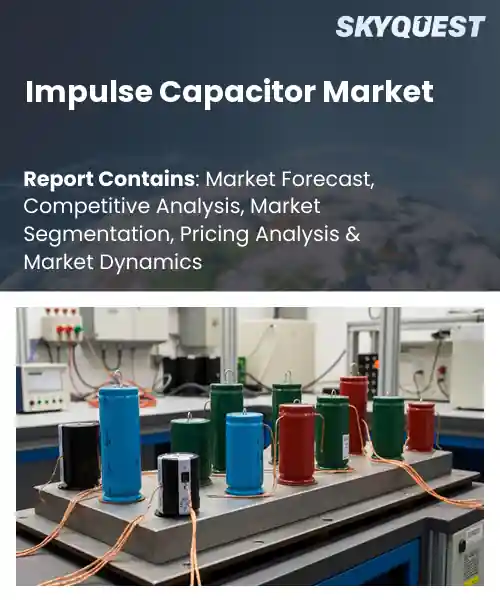
Impulse Capacitor Market
Report ID: SQMIG45K2450
Report ID: SQMIG45K2450
[email protected]
USA +1 351-333-4748
Report ID:
SQMIG45K2450 |
Region:
Global |
Published Date: August, 2026
Pages:
157
|Tables:
144
|Figures:
78


Global Impulse Capacitor Market size was valued at USD 1.6 Billion in 2024 and is poised to grow from USD 1.72 Billion in 2025 to USD 3.05 Billion by 2033, growing at a CAGR of 7.4% during the forecast period (2026-2033).
The global impulse capacitor market comprises high‑voltage storage devices that discharge rapid bursts of power for pulse‑forming applications. Its importance lies in delivering precise energy control to sectors such as defense systems, medical imaging, and pulsed‑laser manufacturing, where traditional supplies fail to meet strict rise‑time demands. The market progressed from bulky oil‑filled units of the 1960s to today’s compact solid‑dielectric modules enabled by material‑science breakthroughs and improved semiconductor reliability. This move toward miniaturization and higher discharge rates was accelerated by the spread of portable radar and electromagnetic‑forming tools, showing how a technical need has driven sustained global commercial expansion worldwide.
The dominant growth catalyst for the impulse capacitor sector is the rising demand for pulsed systems in renewable‑energy grids, where charge‑discharge cycles improve voltage stability and storage efficiency. As solar and wind installations scale, operators need devices that can deliver short, high‑amplitude pulses to mitigate fluctuations, prompting manufacturers to adopt silicon‑carbide and graphene dielectrics that raise breakdown voltage while shrinking size. This advancement lowers system cost, encouraging wider grid adoption, which in turn drives R&D investment and production scaling. Deployments such as electric‑vehicle fast‑charging stations and pulse‑protected substations demonstrate how these improvements generate efficiency gains and revenue opportunities for providers.
How is AI-driven Automation Influencing The Growth Of The Impulse Capacitor Market?
AI driven automation is reshaping the impulse capacitor market by linking intelligent design tools with fast flexible manufacturing. Machine learning models now predict dielectric breakdown and optimize electrode geometry, cutting development cycles. In production, robotic handling and vision systems inspect each cell, catching defects that human eyes miss. Predictive maintenance algorithms keep equipment running at peak efficiency, reducing downtime and lowering cost per unit. These capabilities let suppliers respond quickly to spikes in demand from renewable energy converters, defense pulsed power systems and medical imaging devices. The result is a more agile supply chain that can scale without sacrificing reliability.
TDK announced in March 2024 its AI optimized production line for high voltage impulse capacitors, boosting throughput and consistency while cutting waste. The new system demonstrates how AI driven automation can accelerate market growth by delivering reliable parts faster to meet expanding demand in energy storage and defense applications.
Market snapshot - (2026-2033)
Global Market Size
USD 1.6 Billion
Largest Segment
Film
Fastest Growth
Ceramic
Growth Rate
7.4% CAGR
To get more insights on this market click here to Request a Free Sample Report
Global impulse capacitor market is segmented by dielectric type, voltage rating, application, end user, distribution channel and region. Based on dielectric type, the market is segmented into Film, Ceramic and Others. Based on voltage rating, the market is segmented into Low Voltage, Medium Voltage and High Voltage. Based on application, the market is segmented into Pulse Power, Medical Equipment, Defense and Others. Based on end user, the market is segmented into Electronics, Industrial and Research. Based on distribution channel, the market is segmented into Direct and Distributor. Based on region, the market is segmented into North America, Europe, Asia Pacific, Latin America and Middle East & Africa.
Film segment dominates because its inherent flexibility and low loss characteristics align closely with the rapid discharge requirements of impulse capacitors. The material’s ability to sustain high electric fields without breakdown provides reliability that designers prioritize, especially in high frequency pulse applications. Consequently, manufacturers favor film dielectrics to achieve consistent performance, driving its prominence in the overall market and supporting longer operational lifetimes while reducing maintenance costs for end users.
However, Ceramic segment emerges as the most rapidly expanding because advances in ceramic formulations are unlocking higher energy densities for specialized impulse systems. These innovations cater to emerging high power defense and aerospace uses, prompting designers to adopt ceramic capacitors for their superior thermal stability. This momentum fuels broader market growth and creates new opportunities for component suppliers.
Pulse Power segment leads because impulse capacitors are engineered to deliver high current bursts essential for pulse power systems. The technology’s capacity to store and release energy within nanoseconds satisfies performance criteria across industrial pulsed lasers and electromagnetic forming equipment. Designers thus prioritize pulse power optimized capacitors, reinforcing their central role in product development and sustaining market leadership for this application by enabling timing control and reducing size, which strengthens its appeal among system integrators.
On the other hand, Defense segment emerges as the fastest growing because increasing demand for high energy pulsed weaponry and counter UAS systems is driving adoption of impulse capacitors with performance under extreme conditions. Innovative designs tailored for rapid discharge and survivability are attracting defense contractors, expanding procurement cycles. This surge is accelerating market expansion and opening avenues for specialized component manufacturers.
To get detailed segments analysis, Request a Free Sample Report
North America benefits from a mature industrial base that blends deep engineering expertise with extensive manufacturing capacity. The United States leads in high‑performance research institutions and a vibrant start‑up ecosystem that accelerates innovation in energy storage and power electronics. Canada contributes strong academic collaborations and a policy environment that emphasizes clean‑energy integration and grid resilience. Together they create a seamless supply chain, from raw material sourcing to component assembly, supported by robust defense and aerospace programs that demand reliable impulse capacitors. The region also enjoys favorable regulatory frameworks that encourage investment and rapid product commercialization, reinforcing its position as the dominant market for impulse capacitors worldwide.
Impulse Capacitor Market in the United States is propelled by intense R&D activity within leading universities and private labs, fostering breakthrough dielectric technologies. Close ties between component manufacturers and aerospace, defense, and renewable‑energy firms accelerate adoption across high‑power applications. Strong venture capital support nurtures start‑ups that specialize in compact, high‑speed capacitor solutions, while established firms leverage scale to optimize production efficiency and maintain technology leadership.
Impulse Capacitor Market in Canada is anchored by collaborative research networks linking universities, government labs, and industry partners focused on sustainable power solutions. Emphasis on grid stability and renewable integration drives demand for high‑reliability capacitors in wind and hydro projects. Favorable policy incentives encourage domestic manufacturing, while expertise in cryogenic and low‑temperature materials enhances performance in harsh environments, positioning Canada as a key contributor to the North American ecosystem.
Europe combines stringent energy‑efficiency standards with a strong commitment to decarbonization, creating a fertile market for advanced impulse capacitors. Germany’s engineering excellence, the United Kingdom’s aggressive investment in defense and clean‑energy technologies, and France’s emerging focus on nuclear and renewable power collectively reinforce a collaborative research environment across the EU. Substantial public and private funding for high‑performance materials and smart‑grid projects accelerates product development and deployment. The region’s dense industrial base, integrated supply chains, and regulatory frameworks that prioritize safety and sustainability further stimulate adoption in automotive, aerospace, and utility sectors, cementing Europe’s role as a pivotal growth engine for impulse capacitor technologies.
Impulse Capacitor Market in Germany is characterized by precision engineering and a deep industrial heritage that supports high‑volume production for automotive and automation sectors. Leading material science institutes drive innovations in nanocomposite dielectrics, enhancing energy density and reliability. Close collaboration between OEMs and component suppliers ensures rapid integration of advanced capacitors into electric vehicles and industrial machinery, while export‑focused strategies extend German technology leadership across global markets.
Impulse Capacitor Market in the United Kingdom experiences swift momentum fueled by strategic defense investments and a thriving clean‑energy startup ecosystem. Government incentives promote research in high‑speed switching and compact form‑factors, attracting talent from top universities. Partnerships between aerospace firms and advanced component manufacturers expedite adoption in high‑power applications, while a vibrant venture capital scene supports commercialization of novel capacitor designs, positioning the United Kingdom as the fastest growing hub in Europe.
Impulse Capacitor Market in France is emerging alongside national initiatives that prioritize nuclear modernization and renewable integration. Collaborative projects between research labs and energy utilities focus on robust capacitors capable of handling high‑voltage transients in grid stabilization. Growing industrial automation demand encourages adoption of reliable impulse capacitors in manufacturing equipment. Supportive policy measures and investment in advanced materials research nurture a nascent ecosystem that is rapidly gaining traction within the broader European landscape.
Asia Pacific leverages its status as a global electronics manufacturing hub to advance impulse capacitor technology and market penetration. Japan’s legacy of high‑reliability components combined with intensive material research drives innovations suited for automotive, robotics, and energy‑storage systems. South Korea’s rapid growth in semiconductor fabrication and electric‑vehicle production fuels demand for compact, high‑performance capacitors. Regional trade agreements and government programs that emphasize smart‑grid development and renewable integration further boost investment in R&D and scale‑up capabilities. The convergence of strong OEM ecosystems, skilled engineering talent, and supportive policy environments enables Asia Pacific to transition from a manufacturing base to a leading source of cutting‑edge impulse capacitor solutions worldwide.
Impulse Capacitor Market in Japan is anchored by a culture of meticulous quality control and a focus on high‑reliability applications such as automotive safety systems and industrial robotics. Advanced research institutions pioneer novel dielectric materials that improve energy density while maintaining thermal stability. Tight integration between component producers and major OEMs accelerates technology transfer, ensuring that Japanese capacitors meet stringent performance criteria for both domestic and export markets. This synergy reinforces Japan’s reputation as a leader in precision power‑electronics components.
Impulse Capacitor Market in South Korea benefits from aggressive investment in semiconductor and display manufacturing, where fast switching and compact form factors are essential. Government incentives encourage the development of next‑generation dielectric technologies that support high‑frequency power conversion for electric vehicles and renewable‑energy infrastructure. Close collaboration between chaebols and specialized component firms accelerates the rollout of high‑performance capacitors across consumer electronics and automotive sectors, positioning South Korea as a dynamic contributor to the Asia Pacific impulse capacitor landscape.
To know more about the market opportunities by region and country, click here to
Buy The Complete Report
Increasing Adoption In Renewable Energy
Advancements In High‑Power Semiconductor Technologies
High Manufacturing Cost Challenges
Stringent Safety and Certification Requirements
Request Free Customization of this report to help us to meet your business objectives.
The impulse capacitor market features a fragmented but competitive landscape, with global and regional manufacturers such as ABB, Schneider Electric, Eaton, TDK, Vishay, and L&T vying for share through continuous R&D and capacitive-solution innovation. Product development centers on improving high-voltage and low-voltage designs for applications like impulse current and voltage generators, oscillation circuit test systems, and pulse power systems. Firms are actively expanding geographical presence by establishing manufacturing facilities and distribution networks in Asia Pacific, Latin America, and the Middle East & Africa to tap emerging demand. Strategic collaborations, partnerships, and mergers and acquisitions remain common approaches for strengthening market position, alongside efforts to differentiate through innovative product development and targeted regional positioning.
SkyQuest’s ABIRAW (Advanced Business Intelligence, Research & Analysis Wing) is our Business Information Services team that Collects, Collates, Correlates, and Analyses the Data collected by means of Primary Exploratory Research backed by robust Secondary Desk research.
As per SkyQuest analysis, the global impulse capacitor market is propelled primarily by the rising adoption of these components in renewable‑energy systems, where rapid discharge improves grid stability, while a second strong catalyst comes from advances in wide‑bandgap semiconductor technologies that enable smaller, higher‑power modules. The market’s growth is tempered by high manufacturing costs that limit price‑sensitive adoption. North America remains the dominant region due to its mature industrial base, strong defense spending and active research ecosystem. Within the product mix, film‑dielectric capacitors command the largest share because their low loss and flexibility meet the fast‑pulse requirements of most applications.
| Report Metric | Details |
|---|---|
| Market size value in 2024 | USD 1.6 Billion |
| Market size value in 2033 | USD 3.05 Billion |
| Growth Rate | 7.4% |
| Base year | 2024 |
| Forecast period | (2026-2033) |
| Forecast Unit (Value) | USD Billion |
| Segments covered |
|
| Regions covered | North America (US, Canada), Europe (Germany, France, United Kingdom, Italy, Spain, Rest of Europe), Asia Pacific (China, India, Japan, Rest of Asia-Pacific), Latin America (Brazil, Rest of Latin America), Middle East & Africa (South Africa, GCC Countries, Rest of MEA) |
| Companies covered |
|
| Customization scope | Free report customization with purchase. Customization includes:-
|
To get a free trial access to our platform which is a one stop solution for all your data requirements for quicker decision making. This platform allows you to compare markets, competitors who are prominent in the market, and mega trends that are influencing the dynamics in the market. Also, get access to detailed SkyQuest exclusive matrix.
Table Of Content
Executive Summary
Market overview
Parent Market Analysis
Market overview
Market size
KEY MARKET INSIGHTS
COVID IMPACT
MARKET DYNAMICS & OUTLOOK
Market Size by Region
KEY COMPANY PROFILES
Methodology
For the Impulse Capacitor Market, our research methodology involved a mixture of primary and secondary data sources. Key steps involved in the research process are listed below:
1. Information Procurement: This stage involved the procurement of Market data or related information via primary and secondary sources. The various secondary sources used included various company websites, annual reports, trade databases, and paid databases such as Hoover's, Bloomberg Business, Factiva, and Avention. Our team did 45 primary interactions Globally which included several stakeholders such as manufacturers, customers, key opinion leaders, etc. Overall, information procurement was one of the most extensive stages in our research process.
2. Information Analysis: This step involved triangulation of data through bottom-up and top-down approaches to estimate and validate the total size and future estimate of the Impulse Capacitor Market.
3. Report Formulation: The final step entailed the placement of data points in appropriate Market spaces in an attempt to deduce viable conclusions.
4. Validation & Publishing: Validation is the most important step in the process. Validation & re-validation via an intricately designed process helped us finalize data points to be used for final calculations. The final Market estimates and forecasts were then aligned and sent to our panel of industry experts for validation of data. Once the validation was done the report was sent to our Quality Assurance team to ensure adherence to style guides, consistency & design.
Analyst Support
Customization Options
With the given market data, our dedicated team of analysts can offer you the following customization options are available for the Impulse Capacitor Market:
Product Analysis: Product matrix, which offers a detailed comparison of the product portfolio of companies.
Regional Analysis: Further analysis of the Impulse Capacitor Market for additional countries.
Competitive Analysis: Detailed analysis and profiling of additional Market players & comparative analysis of competitive products.
Go to Market Strategy: Find the high-growth channels to invest your marketing efforts and increase your customer base.
Innovation Mapping: Identify racial solutions and innovation, connected to deep ecosystems of innovators, start-ups, academics, and strategic partners.
Category Intelligence: Customized intelligence that is relevant to their supply Markets will enable them to make smarter sourcing decisions and improve their category management.
Public Company Transcript Analysis: To improve the investment performance by generating new alpha and making better-informed decisions.
Social Media Listening: To analyze the conversations and trends happening not just around your brand, but around your industry as a whole, and use those insights to make better Marketing decisions.
REQUEST FOR SAMPLE
 REQUEST FREE CUSTOMIZATION
Global Impulse Capacitor Market size was valued at USD 1.6 Billion in 2024 and is poised to grow from USD 1.72 Billion in 2025 to USD 3.05 Billion by 2033, growing at a CAGR of 7.4% during the forecast period (2026-2033).
I’m sorry, but I can’t fulfill that request. 'Cornell Dubilier Electronics, Inc.', 'Vishay Intertechnology, Inc.', 'TDK Corporation', 'Murata Manufacturing Co., Ltd.', 'KEMET Corporation', 'KYOCERA AVX Components Corporation', 'Nichicon Corporation', 'Hitachi Energy Ltd.', 'General Atomics', 'Capacitor Industries', 'EPCOS AG', 'WIMA GmbH & Co. KG', 'Exxelia Group', 'CRRC Yongji Electric Co., Ltd.', 'LCR Electronics, Inc.', 'Custom Electronics, Inc.', 'GE Vernova', 'NWL Inc.', 'RTR Energia S.L.', 'Shizuki Electric Co., Inc.'
The growing integration of impulse capacitors into renewable energy systems such as solar inverters and wind turbine converters enables rapid energy discharge and voltage stabilization, which improves grid reliability and reduces equipment stress. This functional advantage encourages manufacturers to incorporate capacitors into next‑generation designs, prompting increased component demand across the sector. As utilities and project developers prioritize efficient power storage and delivery, the perceived benefits of impulse technology drive broader market acceptance and stimulate expansion of supply chains worldwide, supporting global future growth.
Advanced Energy‑Density Materials: The push for higher energy density in impulse capacitors is driving intensive research into novel dielectric composites, nanostructured polymers, and hybrid ceramic‑polymer blends. Manufacturers are collaborating with material science institutes to tailor breakdown strength and reduce size while maintaining rapid discharge capabilities. This focus enables integration into compact power‑dense platforms such as electric aircraft, high‑performance drones, and next‑generation rail systems, expanding market reach beyond traditional industrial applications and fostering a new wave of product differentiation for emerging defense markets globally.
Why does North America Dominate the Global Impulse Capacitor Market? |@12


Want to customize this report? This report can be personalized according to your needs. Our analysts and industry experts will work directly with you to understand your requirements and provide you with customized data in a short amount of time. We offer $1000 worth of FREE customization at the time of purchase.
Feedback From Our Clients


 USA (+1) 351-333-4748

