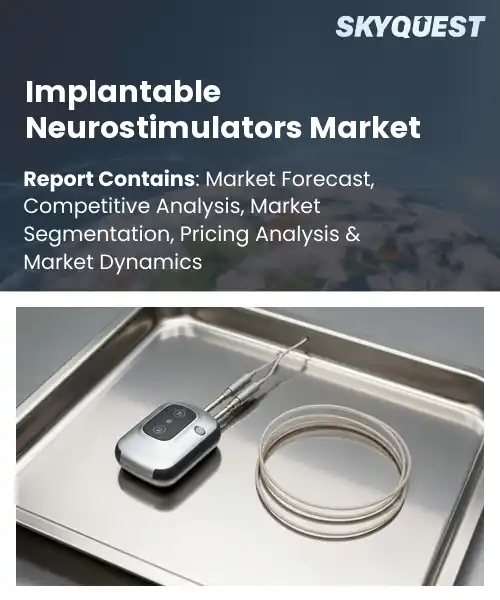
Implantable Neurostimulators Market
Report ID: SQMIG35B2329
Report ID: SQMIG35B2329
[email protected]
USA +1 351-333-4748
Report ID:
SQMIG35B2329 |
Region:
Global |
Published Date: June, 2026
Pages:
157
|Tables:
184
|Figures:
79


Global Implantable Neurostimulators Market size was valued at USD 8.1 Billion in 2024 and is poised to grow from USD 9.08 Billion in 2025 to USD 22.64 Billion by 2033, growing at a CAGR of 12.1% during the forecast period (2026-2033).
The implantable neurostimulators market centers on devices that deliver modulated electrical pulses to targeted neural structures to treat chronic pain, movement disorders and autonomic dysfunction, and its primary driver is the growing clinical burden of neurological and chronic pain conditions that resist pharmacotherapy. This market matters because such devices offer durable symptom control, can reduce opioid dependency and enable functional restoration, as seen in deep brain stimulation for Parkinson's disease and spinal cord stimulation for refractory back pain. Over decades the sector evolved from bulky, hardwired systems to compact, rechargeable and MRI conditional implants, expanding indications and attracting industry investment.
Technological innovation is the growth amplifier because improvements in sensing, closed loop control, battery life and miniaturization increase clinical efficacy and broaden patient pools, which stimulates market expansion. For example, adaptive deep brain stimulation which adjusts stimulation based on neural biomarkers reduces side effects and prolongs battery longevity, encouraging clinician adoption and payer coverage. Similarly, next generation spinal cord stimulators with paresthesia free waveforms and rechargeability improve patient adherence, which lowers complication rates and follow up costs, producing favorable health economics that unlock new reimbursement pathways and create opportunities for companies to pursue indications beyond pain, such as psychiatric disorders.
How is AI enhancing clinical outcomes in the implantable neurostimulators market?
AI is improving clinical outcomes in implantable neurostimulators by enabling adaptive personalization, real time detection, and predictive analytics. Key aspects include data driven signal analysis, closed loop responsive stimulation, clinician decision support, and remote monitoring. The field is shifting from lengthy manual programming to algorithm assisted tuning that matches stimulation to patient specific neural signatures. That shift leads to better symptom control and fewer side effects while reducing clinician review time. Market momentum reflects wider adoption as devices integrate analytics and cloud based tools and as research validates AI driven forecasting and therapy adaptation.
NeuroPace May 2026, announced FDA clearance of ECoG Assistant an AI enabled tool that automates long term intracranial EEG review and highlights clinician relevant trends. This innovation supports market growth by cutting clinician workload and accelerating therapy optimization so more patients can benefit from responsive neurostimulation.
Market snapshot - (2026-2033)
Global Market Size
USD 8.1 Billion
Largest Segment
Spinal Cord Stimulators
Fastest Growth
Peripheral Nerve Stimulators
Growth Rate
12.1% CAGR
To get more insights on this market click here to Request a Free Sample Report
Global implantable neurostimulators market is segmented by product type, application, technology, end user, route of implantation, patient type and region. Based on product type, the market is segmented into Spinal Cord Stimulators, Deep Brain Stimulators, Sacral Nerve Stimulators, Vagus Nerve Stimulators, Gastric Electrical Stimulators, Peripheral Nerve Stimulators and Others. Based on application, the market is segmented into Chronic Pain Management, Parkinson’s Disease, Epilepsy, Urinary & Fecal Incontinence, Gastroparesis, Depression, Migraine Management and Others. Based on technology, the market is segmented into Rechargeable Neurostimulators, Non-rechargeable Neurostimulators, MRI-compatible Neurostimulators, Closed-loop Neurostimulators and Others. Based on end user, the market is segmented into Hospitals, Neurology Clinics, Ambulatory Surgical Centers, Specialty Pain Clinics and Others. Based on route of implantation, the market is segmented into Epidural Implantation, Cranial Implantation and Peripheral Implantation. Based on patient type, the market is segmented into Adult, Pediatric and Geriatric. Based on region, the market is segmented into North America, Europe, Asia Pacific, Latin America and Middle East & Africa.
Spinal Cord Stimulators segment dominates because these devices address a broad spectrum of refractory chronic pain conditions and benefit from established clinical evidence that drives clinician confidence and prescribing patterns. Improved device architectures and programming flexibility enable tailored pain modulation, leading to sustained patient outcomes and reduced reliance on systemic therapies. Clear reimbursement pathways and widespread training among implanting physicians further reinforce adoption, making this technology the backbone of neurostimulation therapy strategies.
However, Peripheral Nerve Stimulators are emerging as the fastest growing area, propelled by targeted therapies for localized neuropathic conditions and refined minimally invasive implantation techniques that expand patient candidacy. Innovations in electrode design and sensing, together with growing outpatient adoption and broadened clinical indications, are rapidly generating new treatment opportunities and commercial momentum.
Rechargeable Neurostimulators segment leads because rechargeable systems reduce the frequency of device replacements and associated revision procedures, improving patient experience and lowering long term care burdens for providers. The capability to deliver higher energy therapies in a compact form supports broader clinical applications while technological refinements in recharge interfaces and battery safety increase clinician and patient acceptance, driving adoption across both chronic pain and neurologic disorder treatment pathways.
Meanwhile, Closed-loop Neurostimulators are emerging as the fastest growing area, enabled by real-time sensing and adaptive stimulation algorithms that tailor therapy and boost efficacy. Progress in biosensing, algorithm development, and miniaturized electronics, together with regulatory support for adaptive interventions, is expanding indications, attracting investment, and accelerating clinical adoption and commercial innovation.
To get detailed segments analysis, Request a Free Sample Report
North America dominates the global implantable neurostimulators market due to a confluence of clinical, technological and commercial advantages. A mature healthcare infrastructure with specialized neurology and pain management centers accelerates clinical adoption, while concentrated presence of leading manufacturers drives product innovation and scale. Strong intellectual property protection and a supportive regulatory environment facilitate rapid commercialization of novel devices. Collaborative ecosystems linking academic research centers, clinical trial networks and industry enable iterative refinement of therapy and evidence generation. Reimbursement frameworks and payer engagement in major markets reduce barriers to clinician uptake. Skilled clinician base and established referral pathways further reinforce market leadership, enabling swift integration of advanced neuromodulation solutions into clinical practice. Market participants invest in education and training initiatives to sustain procedural proficiency and support long term therapy management.
Implantable Neurostimulators Market in United States is characterized by concentrated innovation hubs, dense clinical research infrastructure and broad specialist networks that drive early adoption. Leading device manufacturers and referral centers collaborate on clinical development and real world evidence generation. Payer engagement and established procedural pathways support commercialization of complex therapies. Ongoing clinician education and multidisciplinary care models sustain advanced neuromodulation use across neurology, pain and rehabilitation settings in routine practice.
Implantable Neurostimulators Market in Canada reflects close collaboration between academic hospitals and specialized clinics that foster clinical adoption and evidence generation. Policy frameworks and provincial reimbursement pathways influence access and deployment of advanced neuromodulation therapies. Local clinical expertise and training programs support procedural proficiency, while partnerships with device manufacturers promote technology transfer and implementations. Patient referral networks and interdisciplinary care approaches underpin integration of implantable neurostimulation into chronic disease management.
Rapid expansion in Europe is driven by a combination of evolving clinical practice, policy alignment and strengthening commercial ecosystems. Well established hospital networks and specialized neuromodulation centers facilitate adoption through concentrated expertise and shared best practices. Incremental harmonization of regulatory pathways and increased payer dialogue in key markets reduce barriers to market entry and support reimbursement for complex therapies. Growing emphasis on real world evidence, health technology assessment and cost effectiveness encourages adoption of neurostimulation for chronic conditions. Cross border clinical collaborations, rising investment in domestic manufacturing capacity and integration of digital health tools for remote programming and monitoring further accelerate market growth and enable more patient centric deployment across diverse healthcare systems. Active engagement by clinical societies and patient advocacy groups is strengthening guideline development and therapy awareness.
Implantable Neurostimulators Market in Germany benefits from deep clinical expertise, robust medtech manufacturing and integrated hospital networks that support broad adoption. Regulatory and reimbursement mechanisms, aligned with active research institutions, foster rigorous evidence generation and device refinement. Collaborative programs between device developers and academic centers enable tailored therapy protocols. Concentration of specialized surgeons and neurologists, together with advanced imaging infrastructure, underpins leadership in complex neuromodulation applications across the wider region.
Implantable Neurostimulators Market in United Kingdom is supported by focused clinical networks, outcome driven health policies and growing industry collaboration that accelerate adoption. Centralized specialist centers and training initiatives improve procedural capacity and aftercare. Strong ties between academic research and commercial developers foster rapid evidence generation and iterative device refinement. Expansion of digital follow up and patient pathways enhances access and supports efficient deployment of neurostimulation therapies across care environments.
Implantable Neurostimulators Market in France is marked by growing clinical interest, expanding specialist centers and a clinical research community exploring neuromodulation indications. Policy discussions and payer engagement are shaping access pathways and reimbursement frameworks, supporting broader deployment. Collaboration between regional hospitals, academic laboratories and device developers promotes piloting and local adaptation of technologies. Emphasis on patient centric care models and multidisciplinary treatment teams strengthens adoption and long term therapy management.
Asia Pacific is strengthening its position by combining advanced engineering expertise, growing domestic medtech capability and targeted clinical initiatives that adapt neurostimulation technologies to regional needs. Japan and South Korea contribute strong device engineering, precision manufacturing and regulatory systems that support high quality product development. Investment in clinical research, adoption of minimally invasive procedures and integration of digital health platforms for monitoring and remote programming enhance therapeutic value. Cross border partnerships with global manufacturers accelerate technology transfer and local production. Expanding training programs for clinicians and focused payer engagement in key markets improve access pathways, while increasing patient awareness and collaborative research networks support sustained uptake and regional competitiveness. Manufacturing scale and export orientation amplify regional influence, while tailored product variants address population specific clinical profiles. Public and private funding mechanisms support translational research and commercialization pipelines.
Implantable Neurostimulators Market in Japan reflects strong device engineering, precision manufacturing and active clinical research networks that support high quality product development. Regulatory rigor and comprehensive clinical evaluation foster robust evidence generation. Collaboration between technology firms and medical centers advances integration of hardware and software for refined therapy delivery. Focused investment in clinician training and post implant monitoring infrastructure enhances patient follow up and supports adoption of tailored neuromodulation therapies.
Implantable Neurostimulators Market in South Korea leverages advanced electronics expertise, manufacturing and strong ties between technology companies and clinical institutions to enable device development. Regulatory bodies and health programs are increasingly aligned with innovation pathways, allowing local firms to iterate rapidly. Emphasis on digital integration and remote monitoring complements procedural adoption. Collaborative initiatives with international partners, clinician training and focused reimbursement engagement support scaling of neuromodulation therapies across specialized centers.
To know more about the market opportunities by region and country, click here to
Buy The Complete Report
Technological Advancements In Devices
Rising Prevalence Of Neurological Disorders
High Procedure and Device Costs
Regulatory Hurdles and Approval Complexity
Request Free Customization of this report to help us to meet your business objectives.
Competitive landscape is shaped by incumbent M&A and product differentiation, while specialized startups drive miniaturized and closed loop technologies. Large medtechs use acquisitions to enter adjacencies, exemplified by Boston Scientific acquiring Axonics. Device innovation favors longer battery life and MRI compatible implants, illustrated by Medtronic's Vanta and Axonics' recharge free systems.
SkyQuest’s ABIRAW (Advanced Business Intelligence, Research & Analysis Wing) is our Business Information Services team that Collects, Collates, Correlates, and Analyses the Data collected by means of Primary Exploratory Research backed by robust Secondary Desk research.
As per SkyQuest analysis, the global implantable neurostimulators market is being propelled primarily by rapid technological advancements in device miniaturization, sensing and closed loop control, while adoption is restrained by high procedure and device costs that limit patient access and payer coverage. North America remains the dominant region driven by concentrated clinical expertise, manufacturer presence and reimbursement pathways, and spinal cord stimulators continue as the leading product segment due to established evidence and broad indications. A second important growth catalyst is the rising prevalence of chronic neurological and pain disorders, which expands addressable patient populations and encourages investment in less invasive, AI enabled and rechargeable solutions.
| Report Metric | Details |
|---|---|
| Market size value in 2024 | USD 8.1 Billion |
| Market size value in 2033 | USD 22.64 Billion |
| Growth Rate | 12.1% |
| Base year | 2024 |
| Forecast period | (2026-2033) |
| Forecast Unit (Value) | USD Billion |
| Segments covered |
|
| Regions covered | North America (US, Canada), Europe (Germany, France, United Kingdom, Italy, Spain, Rest of Europe), Asia Pacific (China, India, Japan, Rest of Asia-Pacific), Latin America (Brazil, Rest of Latin America), Middle East & Africa (South Africa, GCC Countries, Rest of MEA) |
| Companies covered |
|
| Customization scope | Free report customization with purchase. Customization includes:-
|
To get a free trial access to our platform which is a one stop solution for all your data requirements for quicker decision making. This platform allows you to compare markets, competitors who are prominent in the market, and mega trends that are influencing the dynamics in the market. Also, get access to detailed SkyQuest exclusive matrix.
Table Of Content
Executive Summary
Market overview
Parent Market Analysis
Market overview
Market size
KEY MARKET INSIGHTS
COVID IMPACT
MARKET DYNAMICS & OUTLOOK
Market Size by Region
KEY COMPANY PROFILES
Methodology
For the Implantable Neurostimulators Market, our research methodology involved a mixture of primary and secondary data sources. Key steps involved in the research process are listed below:
1. Information Procurement: This stage involved the procurement of Market data or related information via primary and secondary sources. The various secondary sources used included various company websites, annual reports, trade databases, and paid databases such as Hoover's, Bloomberg Business, Factiva, and Avention. Our team did 45 primary interactions Globally which included several stakeholders such as manufacturers, customers, key opinion leaders, etc. Overall, information procurement was one of the most extensive stages in our research process.
2. Information Analysis: This step involved triangulation of data through bottom-up and top-down approaches to estimate and validate the total size and future estimate of the Implantable Neurostimulators Market.
3. Report Formulation: The final step entailed the placement of data points in appropriate Market spaces in an attempt to deduce viable conclusions.
4. Validation & Publishing: Validation is the most important step in the process. Validation & re-validation via an intricately designed process helped us finalize data points to be used for final calculations. The final Market estimates and forecasts were then aligned and sent to our panel of industry experts for validation of data. Once the validation was done the report was sent to our Quality Assurance team to ensure adherence to style guides, consistency & design.
Analyst Support
Customization Options
With the given market data, our dedicated team of analysts can offer you the following customization options are available for the Implantable Neurostimulators Market:
Product Analysis: Product matrix, which offers a detailed comparison of the product portfolio of companies.
Regional Analysis: Further analysis of the Implantable Neurostimulators Market for additional countries.
Competitive Analysis: Detailed analysis and profiling of additional Market players & comparative analysis of competitive products.
Go to Market Strategy: Find the high-growth channels to invest your marketing efforts and increase your customer base.
Innovation Mapping: Identify racial solutions and innovation, connected to deep ecosystems of innovators, start-ups, academics, and strategic partners.
Category Intelligence: Customized intelligence that is relevant to their supply Markets will enable them to make smarter sourcing decisions and improve their category management.
Public Company Transcript Analysis: To improve the investment performance by generating new alpha and making better-informed decisions.
Social Media Listening: To analyze the conversations and trends happening not just around your brand, but around your industry as a whole, and use those insights to make better Marketing decisions.
REQUEST FOR SAMPLE
 REQUEST FREE CUSTOMIZATION
Global Implantable Neurostimulators Market size was valued at USD 8.1 Billion in 2024 and is poised to grow from USD 9.08 Billion in 2025 to USD 22.64 Billion by 2033, growing at a CAGR of 12.1% during the forecast period (2026-2033).
Competitive landscape is shaped by incumbent M&A and product differentiation, while specialized startups drive miniaturized and closed loop technologies. Large medtechs use acquisitions to enter adjacencies, exemplified by Boston Scientific acquiring Axonics. Device innovation favors longer battery life and MRI compatible implants, illustrated by Medtronic's Vanta and Axonics' recharge free systems. 'Medtronic', 'Abbott Laboratories', 'Boston Scientific', 'Nevro', 'LivaNova', 'Inspire Medical Systems', 'Mainstay Medical', 'NeuroPace', 'Biotronik', 'Synapse Biomedical', 'Nalu Medical', 'Aleva Neurotherapeutics', 'MicroTransponder', 'Cala Health', 'Saluda Medical', 'SceneRay', 'Soterix Medical', 'Neuspera Medical', 'Stimwave Technologies', 'electroCore'
Technological advancements in implantable neurostimulator design have improved device precision, miniaturization, battery longevity, and programmability, enabling more targeted stimulation and fewer complications. These improvements enhance clinical outcomes and patient satisfaction, encouraging physicians to recommend neurostimulation therapies and hospitals to invest in associated programs. Manufacturers leveraging advanced materials and software provide differentiated offerings that expand clinical indications and enable personalized therapy adjustments, which in turn supports market expansion through broader adoption, longer device lifecycles, and increased confidence among clinicians and patients.
Minimally Invasive Delivery Advances: Manufacturers and clinicians are prioritizing less invasive implantation techniques that reduce patient discomfort and accelerate recovery, enabling wider acceptance among providers and patients. Innovations in lead design, delivery sheaths, and percutaneous approaches facilitate outpatient procedures and lower clinical complexity. These advances support expansion into earlier stages of disease management and make neurostimulation more accessible in community care settings. The focus on minimizing tissue trauma and simplifying surgical workflows enhances procedural predictability, strengthens adoption pathways, and creates opportunities for device differentiation.
Why does North America Dominate the Global Implantable Neurostimulators Market? |@12


Want to customize this report? This report can be personalized according to your needs. Our analysts and industry experts will work directly with you to understand your requirements and provide you with customized data in a short amount of time. We offer $1000 worth of FREE customization at the time of purchase.
Feedback From Our Clients


 USA (+1) 351-333-4748

