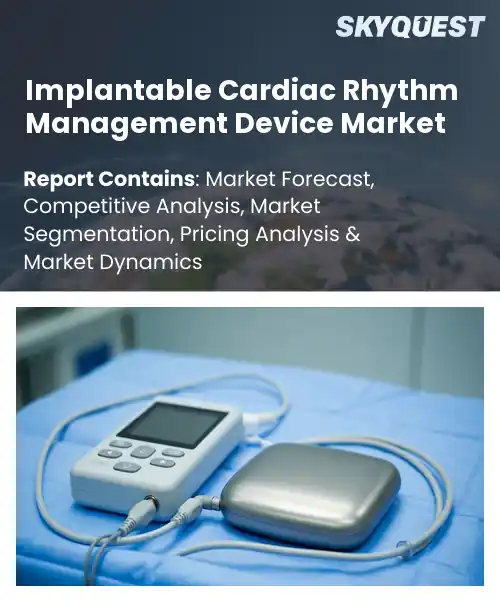
Implantable Cardiac Rhythm Management Device Market
Report ID: SQMIG35A3981
Report ID: SQMIG35A3981
[email protected]
USA +1 351-333-4748
Report ID:
SQMIG35A3981 |
Region:
Global |
Published Date: May, 2026
Pages:
157
|Tables:
89
|Figures:
76


Global Implantable Cardiac Rhythm Management Device Market size was valued at USD 22.52 Billion in 2024 and is poised to grow from USD 23.92 Billion in 2025 to USD 38.85 Billion by 2033, growing at a CAGR of 6.22% during the forecast period (2026-2033).
The primary driver of the implantable cardiac rhythm management device market is an aging population and a rising burden of cardiac arrhythmias and heart failure that together have created sustained clinical need. These devices range from basic pacemakers to implantable cardioverter defibrillators and resynchronization systems that maintain hemodynamic stability and prevent sudden cardiac death, which explains why the market is central to cardiology practice. Over decades the sector progressed from bulky single chamber implants to MRI compatible dual chamber units and leadless platforms with embedded diagnostics, and major firms such as Medtronic and Abbott accelerated change through acquisitions and partnerships.
Building on this trajectory the dominant growth factor in the global implantable cardiac rhythm management device market is technological convergence that improves clinical outcomes and reduces cost of care, prompting payers and providers to expand access. When devices offer remote monitoring with predictive analytics and longer battery life clinicians intervene earlier to prevent readmissions which generates world evidence of value and supports broader reimbursement. In practice remote follow up can detect atrial fibrillation before stroke risk rises and cardiac resynchronization therapy improves ejection fraction in heart failure patients, thereby creating commercial opportunity for leadless systems and digital partnerships internationally today.
How is AI improving patient monitoring and therapy optimization in the implantable cardiac rhythm management device market?
AI advances implantable cardiac rhythm management with continuous remote monitoring, intelligent alerting and personalized therapy recommendation. Key features include automated rhythm detection, trend analytics that flag early deterioration, and cloud-based models that help clinicians adjust device settings. The trend in the market is toward integrated device and platform solutions that streamline clinician workflow and are focused on actionable data. Vendors are using AI in implantable monitors as well as backend services to lighten the load on clinicians and target interventions where they’re needed. Real world analyses show improved alert prioritization, but also point to the need for clinician oversight to manage non actionable alerts.
May 2026, BIOTRONIK announced a research collaboration to progress digital cardiology, with AI driven tools for remote monitoring and device based therapy guidance. This development promotes market efficiency by enhancing alert triage, allowing more accurate device programming and speeding clinical validation that supports adoption of implantable therapies.
Market snapshot - (2026-2033)
Global Market Size
USD 22.52 Billion
Largest Segment
Pacemakers
Fastest Growth
Subcutaneous ICD
Growth Rate
6.22% CAGR
To get more insights on this market click here to Request a Free Sample Report
Global implantable cardiac rhythm management device market is segmented by device type, application, end-user and region. Based on device type, the market is segmented into Pacemakers, Implantable Cardioverter Defibrillators (ICDs) and Subcutaneous ICD. Based on application, the market is segmented into Bradycardia, Tachycardia and Heart Failure. Based on end-user, the market is segmented into Hospitals and Cardiac Centers. Based on region, the market is segmented into North America, Europe, Asia Pacific, Latin America and Middle East & Africa.
Pacemakers segment dominates because their long standing clinical role as the primary therapy for slow heart rhythms creates continuous procedural demand and a large installed base that reinforces clinician preference. The technology’s proven reliability, lower implantation complexity, and established reimbursement pathways reduce adoption friction and drive standardization in care. That clinical trust encourages incremental product refinements focused on longevity and connectivity, which sustain routine utilization and ongoing replacement cycles.
However, implantable cardioverter defibrillators are witnessing the strongest growth momentum as improved detection algorithms and integrated therapies widen clinical use. Growing emphasis on sudden cardiac death prevention and expanding device capabilities for combined pacing and defibrillation accelerate clinician adoption and open avenues for higher value devices and novel service offerings.
Device therapies are a crucial component in the management of ventricular dyssynchrony and progressive pump dysfunction, thus placing cardiac resynchronization and combined therapy devices at the core of clinical pathways, and leading the Heart Failure segment. Physicians prefer and invest capital in devices that have strong clinical evidence of improving symptoms and reducing hospitalizations. This leads manufacturers to concentrate on heart failure focused design, integrated diagnostics and long term remote monitoring in order to maintain market leadership.
But the fastest growing use is for tachycardia, as improved detection of arrhythmias and adaptive therapies broaden the utility of the devices. The increasing preference for minimally invasive and subcutaneous approaches, combined with algorithm driven management, is accelerating product innovation and expanding clinical use cases, and creating new commercial opportunities for device makers and care networks.
To get detailed segments analysis, Request a Free Sample Report
North America is the largest regional market for implantable cardiac rhythm management devices, due to presence of advanced clinical infrastructure, high adoption rate of cutting edge technologies and high investment in research and development. The collaboration between medical centers, industry, and academia is strong and accelerates clinical validation and device iteration. Strong reimbursement and regulatory pathways that allow timely market access are of great help to innovative devices. Demand for sophisticated solutions is driven by patient awareness and clinician expertise, and existing supply chain capabilities ensure wide availability of devices in both acute and ambulatory care settings. Strategic presence of leading device manufacturers and focused post market surveillance programs further cement market leadership, maintain quality, foster clinicians confidence and enable rapid diffusion of next generation therapies. The long term demand for specialized pacemakers and defibrillators continues to be driven by the collective focus on patient outcomes and cost effective care models.
The United States Implantable Cardiac Rhythm Management Device market is characterized by a mature ecosystem with a high concentration of clinical expertise, a large number of device developers and rapid technology adoption. High levels of clinical trial activity and close academic industry partnerships help to support iterative innovation. Comprehensive care networks support patient referral and follow up. Reimbursement structures and current regulatory engagement provide predictable avenues for new therapies, further supporting leadership in the application of advanced pacemakers and defibrillators.
In Canada Implantable Cardiac Rhythm Management Device Market, integrated health systems, clinician familiarity with advanced device therapy and coordinated provincial procurements are affecting the adoption. Academic hospitals and specialized cardiac centers concentrate expertise. Industry-supported collaborative initiatives enable local clinical evaluation. Policy-driven care models and equity-focused access drive the implementation of implantable solutions across urban and regional settings, with clinical pathways a work in progress.
The European market for implantable cardiac rhythm management devices is growing rapidly, driven by changing clinical guidelines, greater regulatory harmonisation and an increasing focus on integrated cardiac care pathways. Growing focus on early diagnosis and intervention coupled with strong hospital networks and collaborative reimbursement schemes are anticipated to drive patient access, fueled by increasing demand for advanced pacemakers and defibrillators. A strong medtech manufacturing ecosystem plus leadership in multinational clinical trials means iterative innovation and refinement of devices in the region. Collaboration across borders between healthcare providers, payers and industry accelerates the spread of best practices, and targeted efforts to reduce variation in treatment help adoption in both longstanding and new markets throughout the continent. Investment in training of electrophysiologists and development of expanded outpatient management models supports adoption. National strategies for the optimisation of cardiac care pathways create an environment for market diversification and long-term resilience.
Germany Implantable Cardiac Rhythm Management Device market is supported by advanced specialized cardiac centers, hospital capacity and early adoption culture for electrophysiology innovation. Collaboration between clinical research units and in-country device manufacturers facilitates real-world assessment and proven reimbursement pathways promote wide availability across care settings. Deep clinician expertise and organized training programs foster the high procedural experience and refinement of device therapy protocols in the leader Germany.
In the United Kingdom, the implantable cardiac rhythm management device market is developing via improved electrophysiology services, referral networks and training that facilitate device adoption. The health system’s focus on rapid cardiac intervention and integrated care pathways is driving the use of advanced pacemaker and defibrillator technologies. Academic centers work with industry to drive evaluation and the United Kingdom is becoming a center of leadership in rhythm innovation with an emphasis on device management in the outpatient setting and remote monitoring.
The Implantable Cardiac Rhythm Management Device Market in France is driven by access-improving initiatives, the growth of electrophysiology centers and collaboration between clinicians and device developers. Reimbursement and investment in outpatient care models will allow widespread use of pacemakers and defibrillators. Remote monitoring and specialist training growth speeds up deployment. France is a growing market with increased clinician and patient engagement in rhythm management.
Asia Pacific is cementing its position in the implantable cardiac rhythm management device market through targeted investment in clinical capacity, growing local manufacturing capability and strategic partnerships with global device developers. Electrophysiology is a growing sub-specialty, tertiary cardiac centers are expanding, rhythm disorders are diagnosed and managed more quickly with better access to diagnostic pathways. Governments and health systems are looking for regulatory clarity and reimbursement mechanisms that support adoption and pilot programs for remote monitoring and integrated care models are showing the real-world value of device-enabled chronic management. As clinicians continue to develop experience and as technology is used in the region to better monitor patients and coordinate care through software, clinical need should translate into continued use of devices and more innovation. Established markets with strong research ecosystems and emerging hubs with nimble regulatory approaches together form a complementary landscape to support cross border clinical studies, knowledge transfer and scale up of manufacturing capacity across the Asia Pacific region.
Implantable cardiac rhythm management devices Japan’s market is characterized by sophisticated clinical infrastructure, a strong domestic device manufacturing base and clinician expertise in electrophysiology. The strong collaboration between the academic centers and industry provides an avenue for evaluation of novel pacemakers and defibrillators and the regulatory processes ensure both access and safety. The widespread adoption of remote monitoring and integrated care paths will enhance the continuity of patient management and cement Japan position as a hub of clinical excellence and device development.
South Korea Implantable Cardiac Rhythm Management Device Market is characterized by rapid technology adoption, strong hospital networks and domestic device development accelerating maturation. Strong clinician training in electrophysiology and collaboration between medical centers and industry help the clinical evaluation and uptake of novel pacemaker and defibrillator technologies. Integration of digital health tools and remote monitoring in cardiac care pathways improves follow up and supports a competitive innovation oriented environment.
To know more about the market opportunities by region and country, click here to
Buy The Complete Report
Aging Population driven Demand
Advancements In Device Technology
High Procedure Costs Limit Uptake
Complex Regulatory Pathways Slow Adoption
Request Free Customization of this report to help us to meet your business objectives.
The leadless and modular pacing regulatory approvals are igniting direct product rivalries and strategic maneuvers, fueling the competitive landscape. Major OEMs boost their internal R&D and pursue M&A and targeted partnerships. Examples of device feature differentiation and alliance activity driving the space are Abbott’s Aveir leadless approvals, Medtronic’s next generation Micra CE mark and Boston Scientific’s modular mCRM clinical program.
| Report Metric | Details |
|---|---|
| Market size value in 2024 | USD 22.52 Billion |
| Market size value in 2033 | USD 38.85 Billion |
| Growth Rate | 6.22% |
| Base year | 2024 |
| Forecast period | (2026-2033) |
| Forecast Unit (Value) | USD Billion |
| Segments covered |
|
| Regions covered | North America (US, Canada), Europe (Germany, France, United Kingdom, Italy, Spain, Rest of Europe), Asia Pacific (China, India, Japan, Rest of Asia-Pacific), Latin America (Brazil, Rest of Latin America), Middle East & Africa (South Africa, GCC Countries, Rest of MEA) |
| Companies covered |
|
| Customization scope | Free report customization with purchase. Customization includes:-
|
To get a free trial access to our platform which is a one stop solution for all your data requirements for quicker decision making. This platform allows you to compare markets, competitors who are prominent in the market, and mega trends that are influencing the dynamics in the market. Also, get access to detailed SkyQuest exclusive matrix.
Table Of Content
Executive Summary
Market overview
Parent Market Analysis
Market overview
Market size
KEY MARKET INSIGHTS
COVID IMPACT
MARKET DYNAMICS & OUTLOOK
Market Size by Region
KEY COMPANY PROFILES
Methodology
For the Implantable Cardiac Rhythm Management Device Market, our research methodology involved a mixture of primary and secondary data sources. Key steps involved in the research process are listed below:
1. Information Procurement: This stage involved the procurement of Market data or related information via primary and secondary sources. The various secondary sources used included various company websites, annual reports, trade databases, and paid databases such as Hoover's, Bloomberg Business, Factiva, and Avention. Our team did 45 primary interactions Globally which included several stakeholders such as manufacturers, customers, key opinion leaders, etc. Overall, information procurement was one of the most extensive stages in our research process.
2. Information Analysis: This step involved triangulation of data through bottom-up and top-down approaches to estimate and validate the total size and future estimate of the Implantable Cardiac Rhythm Management Device Market.
3. Report Formulation: The final step entailed the placement of data points in appropriate Market spaces in an attempt to deduce viable conclusions.
4. Validation & Publishing: Validation is the most important step in the process. Validation & re-validation via an intricately designed process helped us finalize data points to be used for final calculations. The final Market estimates and forecasts were then aligned and sent to our panel of industry experts for validation of data. Once the validation was done the report was sent to our Quality Assurance team to ensure adherence to style guides, consistency & design.
Analyst Support
Customization Options
With the given market data, our dedicated team of analysts can offer you the following customization options are available for the Implantable Cardiac Rhythm Management Device Market:
Product Analysis: Product matrix, which offers a detailed comparison of the product portfolio of companies.
Regional Analysis: Further analysis of the Implantable Cardiac Rhythm Management Device Market for additional countries.
Competitive Analysis: Detailed analysis and profiling of additional Market players & comparative analysis of competitive products.
Go to Market Strategy: Find the high-growth channels to invest your marketing efforts and increase your customer base.
Innovation Mapping: Identify racial solutions and innovation, connected to deep ecosystems of innovators, start-ups, academics, and strategic partners.
Category Intelligence: Customized intelligence that is relevant to their supply Markets will enable them to make smarter sourcing decisions and improve their category management.
Public Company Transcript Analysis: To improve the investment performance by generating new alpha and making better-informed decisions.
Social Media Listening: To analyze the conversations and trends happening not just around your brand, but around your industry as a whole, and use those insights to make better Marketing decisions.
REQUEST FOR SAMPLE
 REQUEST FREE CUSTOMIZATION
Global Implantable Cardiac Rhythm Management Device Market size was valued at USD 22.52 Billion in 2024 and is poised to grow from USD 23.92 Billion in 2025 to USD 38.85 Billion by 2033, growing at a CAGR of 6.22% during the forecast period (2026-2033).
The competitive landscape is intensifying as regulatory approvals for leadless and modular pacing spark direct product competition and strategic moves. Major OEMs pursue M&A and targeted partnerships while accelerating internal R&D. Examples include Abbott’s Aveir leadless approvals, Medtronic’s next generation Micra CE mark, and Boston Scientific’s modular mCRM clinical program, all driving device feature differentiation and alliance activity. 'Medtronic plc', 'Abbott Laboratories (St. Jude Medical)', 'Boston Scientific', 'Biotronik SE', 'LivaNova plc', 'MicroPort Scientific', 'Lepu Medical Technology', 'Oscor Inc.', 'Sorin Group (LivaNova)', 'Cardiac Science', 'ZOLL Medical (Asahi Kasei)', 'Cameron Health (Boston Scientific)', 'Imricor Medical Systems', 'EBR Systems', 'Nevro Corp.', 'Nalu Medical', 'Stimwave Technologies', 'Backbeat Medical', 'BioElectronics', 'AtaCor Medical'
A growing elderly population increases prevalence of arrhythmias and conduction disorders, expanding the pool of patients who may require long-term rhythm management therapies. As clinicians prioritize quality of life and longevity, demand for implantable cardiac devices rises because they offer durable symptom control and reduced hospital admissions. This demographic shift prompts healthcare systems and device manufacturers to focus on tailored device designs and post-implant care pathways, incentivizing investment in device availability, clinician training, and patient monitoring programs that collectively support sustained market expansion.
Leadless And Miniaturized Devices: Miniaturization and leadless technology are reshaping clinical choices by enabling less invasive implantation, reduced infection risk, and improved patient comfort. Device makers prioritize compact form factors, novel fixation methods, and energy-efficient electronics to extend longevity without sacrificing performance. This trend broadens candidacy to frailer patients and ambulatory care pathways, prompting collaboration among medtech firms, implant specialists, and component suppliers. Design emphasis on biocompatible materials, modularity, and simplified delivery systems supports differentiated value propositions that accelerate adoption and stimulate reimbursement conversations.
Why does North America Dominate the Global Implantable Cardiac Rhythm Management Device Market? |@12


Want to customize this report? This report can be personalized according to your needs. Our analysts and industry experts will work directly with you to understand your requirements and provide you with customized data in a short amount of time. We offer $1000 worth of FREE customization at the time of purchase.
Feedback From Our Clients


 USA (+1) 351-333-4748

