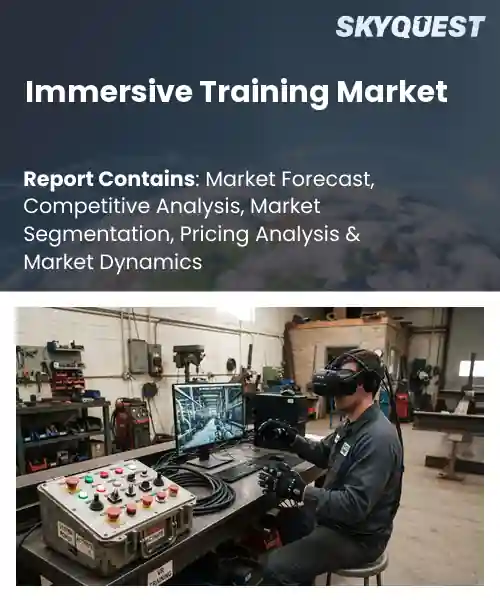
Immersive Training Market
Report ID: SQMIG45E3361
Report ID: SQMIG45E3361
[email protected]
USA +1 351-333-4748
Report ID:
SQMIG45E3361 |
Region:
Global |
Published Date: November, 2026
Pages:
157
|Tables:
123
|Figures:
77


Global Immersive Training Market size was valued at USD 5.6 Billion in 2024 and is poised to grow from USD 6.85 Billion in 2025 to USD 34.54 Billion by 2033, growing at a CAGR of 22.4% during the forecast period (2026-2033).
The immersive training market comprises virtual‑reality, augmented‑reality and mixed‑reality platforms that replicate real‑world tasks for skill acquisition. Its primary driver is the escalating demand for risk‑free, cost‑efficient learning in high‑stakes industries such as aerospace, healthcare and defense. Historically, training relied on physical mock‑ups and classroom lectures, which limited scalability and exposed trainees to safety hazards. The advent of consumer‑grade headsets in the early 2010s reduced hardware costs, while cloud‑based content distribution accelerated adoption across global enterprises. Today, firms cite faster competency development, measurable performance metrics and reduced travel expenses as compelling reasons to transition to immersive solutions for modern organizations. The integration of artificial‑intelligence analytics is a pivotal factor driving immersive training growth, because AI personalizes learning pathways and delivers feedback. By interpreting biometric signals such as eye‑tracking and heart‑rate, the system adjusts scenario difficulty instantly, which accelerates skill retention and cuts dropout rates. Boeing, for example, uses AI‑enhanced VR simulators to certify wiring technicians, reducing certification time by 40 percent. Corporate L&D teams deploy immersive modules for soft‑skill development, seeing measurable gains in communication scores. This AI‑immersive synergy opens revenue streams for software providers, attracts venture capital, and expands market penetration into regions with limited conventional training infrastructure significantly.
How is AI and IoT integration improving engagement in the immersive training market?
AI and IoT are reshaping immersive training by creating environments that react in real time to learner behavior. AI analyzes performance data, adjusts difficulty, and offers personalized feedback, while IoT sensors capture physical actions, biometric signals, and spatial positioning. Together they enable simulations that feel alive, fostering deeper engagement and faster skill acquisition. Trainers can monitor progress remotely, fine‑tune scenarios on the fly, and deliver context‑aware guidance, turning static modules into adaptive experiences. This synergy is driving broader adoption across sectors such as manufacturing, healthcare, and defense, where realistic practice reduces risk and improves readiness.A recent development in June 2024 saw Strivr launch an AI‑driven, IoT‑enabled VR training platform that automatically tailors scenarios based on sensor inputs, boosting learner immersion and operational efficiency.
Market snapshot - (2026-2033)
Global Market Size
USD 5.6 Billion
Largest Segment
Virtual Reality
Fastest Growth
Mixed Reality
Growth Rate
22.4% CAGR
To get more insights on this market click here to Request a Free Sample Report
Global immersive training market is segmented by technology, offering, training type, end user and region. Based on technology, the market is segmented into Virtual Reality, Augmented Reality and Mixed Reality. Based on offering, the market is segmented into Hardware, Software & Platforms and Services. Based on training type, the market is segmented into Technical & Operational Training, Safety & Compliance Training, Soft Skills Training, Medical & Healthcare Training and Other Training Types. Based on end user, the market is segmented into Manufacturing, Healthcare, Aerospace & Defense, Automotive, Education, Corporate Enterprises and Other End Users. Based on region, the market is segmented into North America, Europe, Asia Pacific, Latin America and Middle East & Africa.
Virtual reality hardware dominates because it delivers fully immersive environments that replicate real‑world scenarios with high fidelity, allowing trainees to practice complex procedures without physical risk. Its tactile feedback and precise motion tracking create a sense of presence that boosts knowledge retention and confidence. Manufacturers prioritize VR rigs for their proven ability to shorten learning curves, reduce material waste, and support scalable curriculum deployment across dispersed workforces globally and effectively in today’s.
However, mixed reality hardware is witnessing the strongest growth momentum as it overlays digital information onto physical surroundings, letting users manipulate virtual objects while handling real equipment. This hybrid interaction broadens applications to maintenance assistance and real‑time procedural guidance, drawing firms eager to merge simulation with on‑site work and fuel market expansion.
Safety and compliance training solutions dominate because they address regulatory mandates and risk‑mitigation imperatives that compel organizations to ensure workforce preparedness without exposing personnel to hazardous conditions. immersive simulations recreate high‑risk environments, enabling learners to rehearse emergency responses and procedural adherence, which builds confidence and reduces incident rates. This focus on protecting lives and assets drives sustained investment and integration across regulated industries.
Meanwhile, soft skills training is emerging as the key high‑growth area, leveraging immersive storytelling and scenario‑based interactions to develop communication, leadership, and teamwork capabilities. Advancements in avatar realism and AI‑driven feedback enhance learner engagement, prompting companies to expand immersive curricula beyond technical domains and opening new revenue streams for providers.
To get detailed segments analysis, Request a Free Sample Report
North America maintains its leadership through a combination of advanced technology ecosystems, robust corporate investment, and a highly skilled workforce. The region benefits from a mature digital infrastructure that supports seamless integration of virtual, augmented, and mixed reality solutions across sectors such as aerospace, defense, healthcare, and manufacturing. Strong collaboration between industry leaders, academic institutions, and venture capital fuels continuous innovation, while a regulatory environment that encourages experimentation accelerates adoption. Moreover, a culture of performance‑driven learning and a focus on safety and efficiency reinforce the preference for immersive training as a strategic priority, cementing the region’s pre‑eminence.
United States Immersive Training Market
Immersive Training Market in the United States thrives on the convergence of cutting‑edge research labs, defense contracts, and a vibrant startup scene. Corporations leverage immersive platforms to shorten skill acquisition cycles, and the integration of artificial intelligence enhances realism and adaptive feedback. Partnerships between universities and technology providers generate a pipeline of talent equipped to develop and deploy next‑generation training solutions, reinforcing the market’s depth and breadth.
Canada Immersive Training Market
Immersive Training Market in Canada is propelled by strong government support for digital innovation and a collaborative ecosystem linking research institutions with industry. Emphasis on safety‑critical sectors such as oil and gas, as well as healthcare, drives demand for realistic simulation environments. Indigenous expertise in motion capture and haptic technologies enriches the offering, while multicultural talent pools ensure diverse perspectives in solution design, fostering sustainable growth.
Europe’s rapid expansion is anchored by a strategic focus on workforce upskilling, sustainability, and cross‑border collaboration. The region’s regulatory frameworks promote standardisation of immersive content, facilitating wider adoption across diverse industries. Significant public‑private partnerships fund research into immersive pedagogies, while a strong emphasis on vocational training creates a receptive market for experiential learning tools. Cultural openness to innovation and a well‑established network of digital hubs further accelerate the diffusion of immersive training technologies throughout the continent.
Germany Immersive Training Market
Immersive Training Market in Germany benefits from a deep engineering heritage and a robust industrial base that prioritises precision and efficiency. Leading manufacturers adopt immersive simulations to optimise complex assembly processes and reduce downtime. Close ties between technical universities and corporates generate bespoke training modules that reflect real‑world challenges, while governmental incentives encourage integration of immersive solutions within apprenticeship programmes.
United Kingdom Immersive Training Market
Immersive Training Market in the United Kingdom is characterised by a dynamic blend of fintech, creative industries, and defence enterprises seeking accelerated skill development. The country’s strong emphasis on digital transformation drives investment in immersive platforms that support remote and hybrid learning models. Collaboration between leading research councils and private innovators yields highly customised content, reinforcing the market’s position as the fastest growing in Europe.
France Immersive Training Market
Immersive Training Market in France is emerging through strategic initiatives that link cultural institutions with technology providers. The focus on aerospace, automotive, and health sectors creates niche opportunities for high‑fidelity simulations. Government funding for digital education and a vibrant startup ecosystem accelerate the rollout of immersive curricula, while partnerships with elite engineering schools nurture a pipeline of specialists capable of scaling market adoption.
Asia Pacific is strengthening its position by leveraging rapid digital adoption, strong manufacturing bases, and proactive government policies that champion technology‑enabled education. The region’s emphasis on real‑time data integration and mobile‑first solutions expands access to immersive training across both urban and remote settings. Collaborative ventures between Asian tech giants and multinational corporations foster the development of culturally relevant content, while investments in R&D accelerate the creation of low‑latency, high‑resolution platforms that meet the demanding needs of fast‑moving industries.
Japan Immersive Training Market
Immersive Training Market in Japan capitalises on the nation’s reputation for precision engineering and robotics. Leading manufacturers employ immersive environments to streamline complex assembly lines and enhance worker safety. Integration of advanced haptic feedback and real‑time analytics supports continuous improvement, while academic‑industry consortia develop specialised curricula for sectors such as automotive and electronics, reinforcing the market’s depth.
South Korea Immersive Training Market
Immersive Training Market in South Korea is driven by a strong gaming and entertainment heritage that translates into sophisticated virtual reality capabilities. Major conglomerates adopt immersive solutions to upskill personnel in semiconductor fabrication and shipbuilding, where accuracy and speed are paramount. Government incentives for smart manufacturing and a highly connected infrastructure enable rapid deployment of immersive training across diverse industrial clusters.
To know more about the market opportunities by region and country, click here to
Buy The Complete Report
Increasing Adoption of Immersive Technologies
Growing Demand for Safe Training
High Initial Investment Costs
Limited Content Development Expertise
Request Free Customization of this report to help us to meet your business objectives.
The competitive landscape of the global immersive training market is shaped by rapid technology adoption and strategic alliances, with major players leveraging M&A, partnerships, and innovation to capture enterprise clients; for example, Accenture’s joint venture with Microsoft to embed Mesh in corporate learning, Walmart’s partnership with Motive.io to roll out VR safety modules, and Shell’s deployment of Immerse’s platform for offshore training, all driving heightened competition and accelerated product development.
Top Player’s Company Profile
Recent Developments
SkyQuest’s ABIRAW (Advanced Business Intelligence, Research & Analysis Wing) is our Business Information Services team that Collects, Collates, Correlates, and Analyses the Data collected by means of Primary Exploratory Research backed by robust Secondary Desk research. As per SkyQuest analysis, the global immersive training market is being propelled primarily by the rapid adoption of immersive technologies that replace traditional classrooms with risk‑free, repeatable simulations, while a secondary boost comes from the heightened demand for safe training environments in high‑risk sectors such as aerospace and healthcare. The market is still constrained by the high upfront investment required for hardware, software and content creation, which slows uptake among smaller firms. North America remains the dominant region, benefitting from a robust tech ecosystem and strong corporate spending, and the Virtual Reality technology segment leads the market thanks to its mature hardware ecosystem and proven training outcomes.
| Report Metric | Details |
|---|---|
| Market size value in 2024 | USD 5.6 Billion |
| Market size value in 2033 | USD 34.54 Billion |
| Growth Rate | 22.4% |
| Base year | 2024 |
| Forecast period | (2026-2033) |
| Forecast Unit (Value) | USD Billion |
| Segments covered |
|
| Regions covered | North America (US, Canada), Europe (Germany, France, United Kingdom, Italy, Spain, Rest of Europe), Asia Pacific (China, India, Japan, Rest of Asia-Pacific), Latin America (Brazil, Rest of Latin America), Middle East & Africa (South Africa, GCC Countries, Rest of MEA) |
| Companies covered |
|
| Customization scope | Free report customization with purchase. Customization includes:-
|
To get a free trial access to our platform which is a one stop solution for all your data requirements for quicker decision making. This platform allows you to compare markets, competitors who are prominent in the market, and mega trends that are influencing the dynamics in the market. Also, get access to detailed SkyQuest exclusive matrix.
Table Of Content
Executive Summary
Market overview
Parent Market Analysis
Market overview
Market size
KEY MARKET INSIGHTS
COVID IMPACT
MARKET DYNAMICS & OUTLOOK
Market Size by Region
KEY COMPANY PROFILES
Methodology
For the Immersive Training Market, our research methodology involved a mixture of primary and secondary data sources. Key steps involved in the research process are listed below:
1. Information Procurement: This stage involved the procurement of Market data or related information via primary and secondary sources. The various secondary sources used included various company websites, annual reports, trade databases, and paid databases such as Hoover's, Bloomberg Business, Factiva, and Avention. Our team did 45 primary interactions Globally which included several stakeholders such as manufacturers, customers, key opinion leaders, etc. Overall, information procurement was one of the most extensive stages in our research process.
2. Information Analysis: This step involved triangulation of data through bottom-up and top-down approaches to estimate and validate the total size and future estimate of the Immersive Training Market.
3. Report Formulation: The final step entailed the placement of data points in appropriate Market spaces in an attempt to deduce viable conclusions.
4. Validation & Publishing: Validation is the most important step in the process. Validation & re-validation via an intricately designed process helped us finalize data points to be used for final calculations. The final Market estimates and forecasts were then aligned and sent to our panel of industry experts for validation of data. Once the validation was done the report was sent to our Quality Assurance team to ensure adherence to style guides, consistency & design.
Analyst Support
Customization Options
With the given market data, our dedicated team of analysts can offer you the following customization options are available for the Immersive Training Market:
Product Analysis: Product matrix, which offers a detailed comparison of the product portfolio of companies.
Regional Analysis: Further analysis of the Immersive Training Market for additional countries.
Competitive Analysis: Detailed analysis and profiling of additional Market players & comparative analysis of competitive products.
Go to Market Strategy: Find the high-growth channels to invest your marketing efforts and increase your customer base.
Innovation Mapping: Identify racial solutions and innovation, connected to deep ecosystems of innovators, start-ups, academics, and strategic partners.
Category Intelligence: Customized intelligence that is relevant to their supply Markets will enable them to make smarter sourcing decisions and improve their category management.
Public Company Transcript Analysis: To improve the investment performance by generating new alpha and making better-informed decisions.
Social Media Listening: To analyze the conversations and trends happening not just around your brand, but around your industry as a whole, and use those insights to make better Marketing decisions.
REQUEST FOR SAMPLE
 REQUEST FREE CUSTOMIZATION


Want to customize this report? This report can be personalized according to your needs. Our analysts and industry experts will work directly with you to understand your requirements and provide you with customized data in a short amount of time. We offer $1000 worth of FREE customization at the time of purchase.
Feedback From Our Clients


 USA (+1) 351-333-4748

