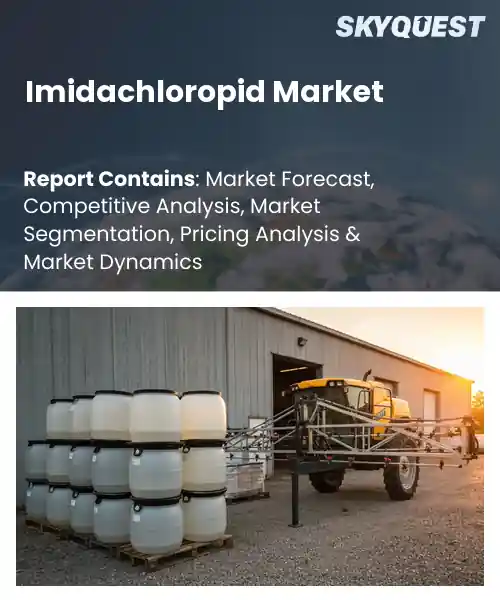
Imidachloropid Market
Report ID: SQMIG15C2157
Report ID: SQMIG15C2157
[email protected]
USA +1 351-333-4748
Report ID:
SQMIG15C2157 |
Region:
Global |
Published Date: March, 2026
Pages:
157
|Tables:
121
|Figures:
77


Global Imidachloropid Market size was valued at USD 1.4 Billion in 2024 and is poised to grow from USD 1.48 Billion in 2025 to USD 2.29 Billion by 2033, growing at a CAGR of 5.6% during the forecast period (2026-2033).
Key Takeaways : Market Trends & Insights
Growing demand for effective crop protection solutions, increasing incidence of pest infestations, rising need to improve agricultural productivity, widespread adoption of seed treatment practices, and advancements in agrochemical formulations are driving sales of imidacloprid.
Regulatory compliance and stewardship obligations are prompting Imidachloropid companies to move towards low dose seed treatment, use of integrated pest management strategies, and developing new formulas. Companies are adopting micro-encapsulation technology, using precise application techniques, and making combination products to minimize off-target effects and optimize efficiency. In all, this promotes sustainability within agriculture and allows for greater efficiency in crop utilization with rice and corn among others, and opens up new opportunities in places where compliant seed treatment products can continue to be utilized. Growing pressure on farmers to enhance crop yields and protect high-value crops from pest damage, coupled with increasing global food demand, is expected to primarily drive imidacloprid market growth.
On the contrary, stringent regulations on neonicotinoids, environmental concerns related to pollinator health, development of pest resistance, and increasing preference for bio-based alternatives are forecasted to hamper imidacloprid market penetration over the coming years.
How is AI Optimizing Imidachloropid Supply Chain Efficiency?
AI technology is boosting the efficiency of the supply chain within the imidacloprid industry through improved forecasting and minimized wastage from sourcing to manufacturing and delivery. AI also enables route optimization for efficient delivery services. Utilizing satellite imagery and drone footage combined with analysis of the crop provides insights specific to each field. AI enables demand forecasts based on the seasonal planting schedule, effective inventory management according to regions and products, and predictive maintenance during manufacturing. The growing preference for digital agriculture and precision spraying techniques also drives the utilization of AI technology in the Imidachloropid industry.
Market snapshot - 2026-2033
Global Market Size
USD 1.4 Billion
Largest Segment
Liquid Formulation
Fastest Growth
Granular Formulation
Growth Rate
5.6% CAGR
To get more insights on this market click here to Request a Free Sample Report
Global imidachloropid market is segmented by formulation type, distribution channel, application, end user, and region. Based on formulation type, the market is segmented into Liquid Formulation, Granular Formulation, Emulsifiable Concentrates, and Wettable Powders. Based on distribution channel, the market is segmented into Online Retail, Offline Retail, Distributors, and Wholesalers and Direct Sales. Based on application, the market is segmented into Agricultural Use, Residential Use, Commercial Use, and Veterinary Use. Based on end user, the market is segmented into Agricultural Producers, Homeowners, Pest Control Services, and Institutions. Based on region, the market is segmented into North America, Europe, Asia Pacific, Latin America, and Middle East & Africa.
The liquid formulation segment is forecasted to spearhead the global Imidachloropid market revenue generation going forward. Formulators and applicators prefer liquids for imidachloropid due to easy integration with standard spray equipment thereby helping this segment hold sway over others. Demand forconsistent active dispersion and rapid foliar uptake is also helping cement the high share of this segment. This tendency makes manufacturers invest their resources in the development of liquid production lines while the distributors store enough products to provide a broad spectrum of usage for both professional farmers and pest controllers.
However, granular formulation is emerging as the most rapidly expanding segment as per this Imidachloropid industry analysis. Growers want soil applied and seed treatment forms that reduce drift and provide longer residual control, which drives interest in this segment. The introduction of new granular carriers and applicability through mechanized application is what will be behind their uptake by large scale and specialty growers, thus providing opportunities for niche applications and innovations in formulations.
The distributors and wholesalers segment is estimated to account for the largest global Imidachloropid market share in the future. Essential role of wholesales as the logistical backbone and commercial reach for imidachloropid distribution is helping this segment hold sway over others. With their purchasing capacity and inventory management, they are able to balance out supply and help in grouping portfolios and feedback mechanisms to manufacturers; this ultimately improvesproduct positioning, instills trust in big buyers, and helps in market penetration.
On the other hand, online retail is becoming the most rapidly expanding mode of distribution in the imidachloropid industry, as the internet gives direct reach to individual consumers who want quick and easy purchases. Product information, special offers, and smaller pack sizes encourage sampling and repurchase, which introduces new consumer segments and facilitates data-driven marketing efforts for innovation.
To get detailed segments analysis, Request a Free Sample Report
Favourable agronomic conditions, diversified crop portfolios, and concentrated production and distribution capabilities are shaping Imidachloropid adoption in Asia Pacific region. Favorable regulatory frameworks, investment in application technologies, extension services, and collaboration between academia and industry help improve product usage. The depth of the market is further supported by infrastructure that connects agricultural operations, the size of agricultural operations, and increased commercial procurement of agricultural inputs creating a strong foundation for future market leadership. Additionally, integrating value chains and responsiveness to the perspectives of the farmer creates continued adoption rates and competitive advantage within several agricultural production systems.
Agricultural extension networks and adoption of precision application techniques are expected to boost sales of Imidachloropid in Japan. Effective interaction between formulators and research facilities promotes local formulation, while high standards of quality and regulations ensure timely delivery and proper handling. Focus of the industry on integration with integrated pest management system contributes to stability in the market.
Rise in adoption of modern agronomy and sector engagement in crop protection solutions helps govern Imidachloropid demand in South Korea. Regulatory compliance and adherence to the principles of good stewardship along with investment in distributors networks have made the products more accessible. Partnership between suppliers and growers has ensured consistent usage. Formulations offer great flexibility to meet different crop cycles and green house cultivation requirements. Integrated methods for managing pests are encouraged by the extension agencies
Intensive crop protection needs, expansive distribution networks, and active engagement by agricultural input providers create new business scope for Imidachloropid providers in this region. Manufacturers are also focusing on the development of formulation innovations that support a wider range of application environments. Private sector extension services to farmers and retail outreach programs from retailers are helping increase farmers' awareness regardingadoption of integrated pest management (IPM) by providing access to new pest control options. In addition, partnerships between private-sector agricultural input manufacturers and local research organizations are allowing for product development that is tailored to meet the specific pest pressures in a region. The presence of clear regulatory guidelines and stewardship programs, which provide incentives for both efficacy and responsible use, instill confidence in stakeholders. The presence of resilient supply chains and channel partnerships is essential to ensure that products are available in all major agricultural production regions, which reinforce market momentum. All market actors are investing in extension services and technical support as a means of facilitating farmer adoption of IPM; however, private research and contract research trials will allow private-sector agricultural input manufacturers to accelerate local validation and increase farmers’ acceptance.
Broad row crop and specialty crop demand, with robust distribution channels are shaping consumption of Imidachloropid across the United States. Investments in formulation and packaging by the industry make the product more user-friendly. Imidachloropid suppliers concentrate on stewardship and application guidelines via the retailers and agronomy advisors. Through joint testing and guidance from the experts, it becomes easier to tailor formulations to the specific pests that exist within the environment.
Expansive distributor networks and agronomic advisory services that focus on regional pest management shape Imidachloropid procurement in Canada. The suppliers partner with the commodities and local researchers to formulate products that will fit in varied production situations. Focus on stewardship, management practices, and proper training of applicators instill trust among producers, while packaging and logistic solutions help overcome access problems faced during production in production zones. Collaboration between suppliers and retailers boosts product access.
Integration of research, regulatory oversight, and industry-led stewardship initiatives are creating a new business scope for Imidachloropid vendors in Europe. The focus on compatibility with Integrated Pest Management (IPM), traceability and supply chain transparency provides greater credibility for growers and buyers to each other. Support of best practices through both cross-border trade facilitation and professional advisory networks increases the ability of growers and buyers to rapidly adapt to pest pressure from region to region and provides the basis for maintaining a continuous presence in the marketplace across critical European markets. The coordinated nature of stakeholder involvement and supply strategies will minimize fragmentation in markets, and specific technical support and education programs will improve confidence among growers about the integrated use of imidachloropid.
Collaboration between research institutes and industry to adapt products to local crop protection frameworks are shaping Imidachloropid demand in Germany. Manufacturers develop formulations suited to temperate climates, and effective logistical support aids in training growers. A focus on compatibility and good stewardship provides reassurance to growers, while companies formulate products suited to temperate agriculture systems. Good distribution channels and technical advice ensure training and guidance are provided.
Efficient advisory networks and the adoption of an integrated approach in managing crops is aiding in increasing the sales of Imidachloropid in the United Kingdom. The flexibility in the supply chains coupled with technical knowledge from the applicators is essential for achieving effective adoption in horticulture and intensive agricultural production where precision in pest control is paramount. Partnership between the manufacturers, extension officers, and agronomists plays a role in ensuring the adoption methods and formulations are evaluated to suit the local crop needs.
Imidachloropid demandin France is influenced by vast research networks and involvement of suppliers that deal with different pests issues. Imidachloropidproduction is mainly driven by requirements from vineyards, horticulture, and other agricultural farms. Cooperation between producers and various advisory services promotes IPM and responsible use. Formulations of Imidachloropid are developed for both greenhouses and open field conditions, while sales agents provide appropriate recommendations and packaging materials for farmers. Traceability and quality are crucial factors for client satisfaction.
To know more about the market opportunities by region and country, click here to
Buy The Complete Report
Expansion of Crop Protection Uses
Increased uses of imidacloprid in various crop protection schemes will improve its penetration since the chemical is quite versatile in providing solutions for sap-sucking insects. Compatibility with integrated pest management techniques and flexibility in terms of application procedures will promote the uptake of imidacloprid in areas that need effective pest management strategies. Agronomic advice is provided for products which will save crops from destruction and ensure ease in their use. This explains why imidacloprid continues to receive favorable acceptance and grows steadily in demand.
Regulatory Clearance and Support
Positive registration results and positive interactions with the relevant agencies can help to foster growth through increasing lawful usage of imidacloprid-based products through proper labelling. Positive legislative environments that consider the efficacy of the product, as well as stewardship programs, will lead to increased investments in production and distribution channels. If regulatory agencies adopt predictable and transparent policies for product approval and compliance, companies will be motivated to develop imidacloprid formulations and enter new markets.
Environmental Concerns and Public Scrutiny
Increased understanding of the dangers that neonicotinoids pose to the environment raises questions from interested parties who might affect the market growth by making potential customers cautious. The problems caused by off-target effects and adverse impact on the ecosystems create a greater need for alternative substances and proper product management, making it possible for certain purchasing agencies to cut back on the utilization of neonicotinoids. This is because companies' decisions about procurement depend on their reputation, and recommendations provided to farmers also take it into account.
Supply Chain and Raw Material Constraints
Inability to access precursor substances and inconsistency in the quality of the raw materials used might limit production capacity. It would mean that the manufacturer would be more concerned about servicing his core market rather than developing new products. There are a number of challenges associated with logistics and sourcing that might deter production capacity expansion. In situations where manufacturers are faced with limited inputs, longer lead times will be observed, which is slated to hurt Imidachloropid market outlook in the long run.
Request Free Customization of this report to help us to meet your business objectives.
Competitive dynamics in the global imidacloprid market are driven by formulation differentiation, regulatory constraints and displacement pressure from biological alternatives. Imidachloropid companies defend share through seed treatment product portfolios and strategic partnerships such as UPL’s STartUPIMIDA and recent formulation initiatives by major formulators. Venture backed innovators pursue tech disruption via peptide and RNA delivery platforms, exemplified by SOLASTA’s investor backing and CDotBio’s carbon nanodot delivery spinout.
Regulatory Harmonization Driving Adoption:Pesticide registration standards and clearer guidelines across key jurisdictions is allowing Imidachloropidcompanies to expand their business scope by reducing duplication of compliance work. Companies can take advantage of simplified processes to plan launches and post-registration stewardship activities, while distributors can look forward to improved predictability regarding market access opportunities. Regulatory convergence can encourage investments in the development of sustainable products to further amplify the prominence of this Imidachloropidmarket trend.
Formulation Innovation Expanding Application: Formulation technology advancements enable imidachloropid to be delivered in more targeted, crop-friendly formats. This helps reduce the risk of off-target exposure and improve efficacy. New carriers and release mechanisms make it easier to combine with other pest management strategies, including biological agents, which widens its application range across different geographic regions and growth stages of crops. This Imidachloropid industry trend creates opportunities for product differentiation and enhances value propositions for farmers.
SkyQuest’s ABIRAW (Advanced Business Intelligence, Research & Analysis Wing) is our Business Information Services team that Collects, Collates, Correlates, and Analyses the Data collected by means of Primary Exploratory Research backed by robust Secondary Desk research.
As per SkyQuest analysis, increasing need for effective crop protection and rising demand for higher agricultural productivity are anticipated to drive the demand for imidacloprid going forward. However, stringent regulations on neonicotinoids, environmental concerns related to pollinator health, and growing adoption of bio-based alternatives are slated to slow down the adoption of imidacloprid in the future. Asia Pacific is slated to spearhead the global demand for imidacloprid owing to the rise in adoption of advanced farming practices and presence of major agrochemical companies. Integration of AI in supply chain management, development of low-dose and precision application formulations, and increasing focus on sustainable and compliant crop protection solutions are anticipated to be key trends driving the imidacloprid industry going forward.
| Report Metric | Details |
|---|---|
| Market size value in 2024 | USD 1.4 Billion |
| Market size value in 2033 | USD 2.29 Billion |
| Growth Rate | 5.6% |
| Base year | 2024 |
| Forecast period | 2026-2033 |
| Forecast Unit (Value) | USD Billion |
| Segments covered |
|
| Regions covered | North America (US, Canada), Europe (Germany, France, United Kingdom, Italy, Spain, Rest of Europe), Asia Pacific (China, India, Japan, Rest of Asia-Pacific), Latin America (Brazil, Rest of Latin America), Middle East & Africa (South Africa, GCC Countries, Rest of MEA) |
| Companies covered |
|
| Customization scope | Free report customization with purchase. Customization includes:-
|
To get a free trial access to our platform which is a one stop solution for all your data requirements for quicker decision making. This platform allows you to compare markets, competitors who are prominent in the market, and mega trends that are influencing the dynamics in the market. Also, get access to detailed SkyQuest exclusive matrix.
Table Of Content
Executive Summary
Market overview
Parent Market Analysis
Market overview
Market size
KEY MARKET INSIGHTS
COVID IMPACT
MARKET DYNAMICS & OUTLOOK
Market Size by Region
KEY COMPANY PROFILES
Methodology
For the Imidachloropid Market, our research methodology involved a mixture of primary and secondary data sources. Key steps involved in the research process are listed below:
1. Information Procurement: This stage involved the procurement of Market data or related information via primary and secondary sources. The various secondary sources used included various company websites, annual reports, trade databases, and paid databases such as Hoover's, Bloomberg Business, Factiva, and Avention. Our team did 45 primary interactions Globally which included several stakeholders such as manufacturers, customers, key opinion leaders, etc. Overall, information procurement was one of the most extensive stages in our research process.
2. Information Analysis: This step involved triangulation of data through bottom-up and top-down approaches to estimate and validate the total size and future estimate of the Imidachloropid Market.
3. Report Formulation: The final step entailed the placement of data points in appropriate Market spaces in an attempt to deduce viable conclusions.
4. Validation & Publishing: Validation is the most important step in the process. Validation & re-validation via an intricately designed process helped us finalize data points to be used for final calculations. The final Market estimates and forecasts were then aligned and sent to our panel of industry experts for validation of data. Once the validation was done the report was sent to our Quality Assurance team to ensure adherence to style guides, consistency & design.
Analyst Support
Customization Options
With the given market data, our dedicated team of analysts can offer you the following customization options are available for the Imidachloropid Market:
Product Analysis: Product matrix, which offers a detailed comparison of the product portfolio of companies.
Regional Analysis: Further analysis of the Imidachloropid Market for additional countries.
Competitive Analysis: Detailed analysis and profiling of additional Market players & comparative analysis of competitive products.
Go to Market Strategy: Find the high-growth channels to invest your marketing efforts and increase your customer base.
Innovation Mapping: Identify racial solutions and innovation, connected to deep ecosystems of innovators, start-ups, academics, and strategic partners.
Category Intelligence: Customized intelligence that is relevant to their supply Markets will enable them to make smarter sourcing decisions and improve their category management.
Public Company Transcript Analysis: To improve the investment performance by generating new alpha and making better-informed decisions.
Social Media Listening: To analyze the conversations and trends happening not just around your brand, but around your industry as a whole, and use those insights to make better Marketing decisions.
REQUEST FOR SAMPLE
 REQUEST FREE CUSTOMIZATION
Global Imidachloropid Market size was valued at USD 1.4 Billion in 2024 and is poised to grow from USD 1.48 Billion in 2025 to USD 2.29 Billion by 2033, growing at a CAGR of 5.6% during the forecast period (2026-2033).
Competitive dynamics in the global imidacloprid market are driven by formulation differentiation, regulatory constraints and displacement pressure from biological alternatives. Incumbents defend share through seed treatment product portfolios and strategic partnerships such as UPL’s STartUP IMIDA and recent formulation initiatives by major formulators. Venture backed innovators pursue tech disruption via peptide and RNA delivery platforms, exemplified by SOLASTA’s investor backing and CDotBio’s carbon nanodot delivery spinout. 'Bayer', 'Nufarm', 'Rallis India', 'Atul Ltd', 'Excel Crop Care', 'Sanonda', 'Jiangsu Yangnong Chemical', 'Nanjing Red Sun', 'Jiangsu Changqing Agrochemical', 'Punjab Chemicals & Crop Protection', 'Anhui Huaxing Chemical', 'Shandong Sino-Agri United Biotechnology', 'Jiangsu Henglong Crop Protection', 'Jiangsu Luye Agrochemicals', 'Hailir Pesticides and Chemicals', 'Hebei Brilliant Chemical', 'Zhejiang Hisun Chemical', 'Jiangsu Fengshan Group', 'Jiangsu Huangma Agrochemicals', 'Jiangsu Changlong Chemicals'
Imidacloprid’s expanded application across diverse crop protection programs increases market penetration by offering versatile control of sap-feeding pests, improving perceived value among growers and agronomists. Its compatibility with integrated pest management practices and adaptability to different application methods encourages broader adoption in regions seeking reliable pest control. As agronomic advisors recommend products that reduce crop losses and simplify treatment regimens, imidacloprid becomes a preferred option, supporting steady demand growth through enhanced acceptance in both commercial and smallholder farming systems globally.
Regulatory Harmonization Driving Adoption: Greater alignment of pesticide registration standards and clearer guidelines across key jurisdictions is lowering barriers to market entry and reducing duplication of compliance work. Manufacturers can leverage streamlined approvals to coordinate launches and post-approval stewardship, while distributors benefit from more predictable market access. Harmonized regulation also encourages investment in sustainable product development and broader farmer outreach programs, enabling imidachloropid portfolios to reach diverse cropping systems with consistent safety and usage frameworks that support long-term commercial expansion and responsible market growth.
Favourable agronomic conditions, diversified crop portfolios, and concentrated production and distribution capabilities are shaping Imidachloropid adoption in Asia Pacific region
The liquid formulation segment holds the largest market share due to its ease of application, compatibility with spraying equipment, and effective dispersion for crop protection.
Distributors and wholesalers dominate the market as they act as the primary supply chain backbone, ensuring efficient product availability, inventory management, and wide market reach.
Opportunities are emerging through formulation innovations (e.g., micro-encapsulation), low-dose seed treatments, and integration with sustainable farming practices, which enhance efficiency while reducing environmental impact.


Want to customize this report? This report can be personalized according to your needs. Our analysts and industry experts will work directly with you to understand your requirements and provide you with customized data in a short amount of time. We offer $1000 worth of FREE customization at the time of purchase.
Feedback From Our Clients


 USA (+1) 351-333-4748

