Icotinib Market
Report ID: SQMIG35F2027
Report ID: SQMIG35F2027
[email protected]
USA +1 351-333-4748
Report ID:
SQMIG35F2027 |
Region:
Global |
Published Date: March, 2026
Pages:
157
|Tables:
169
|Figures:
79


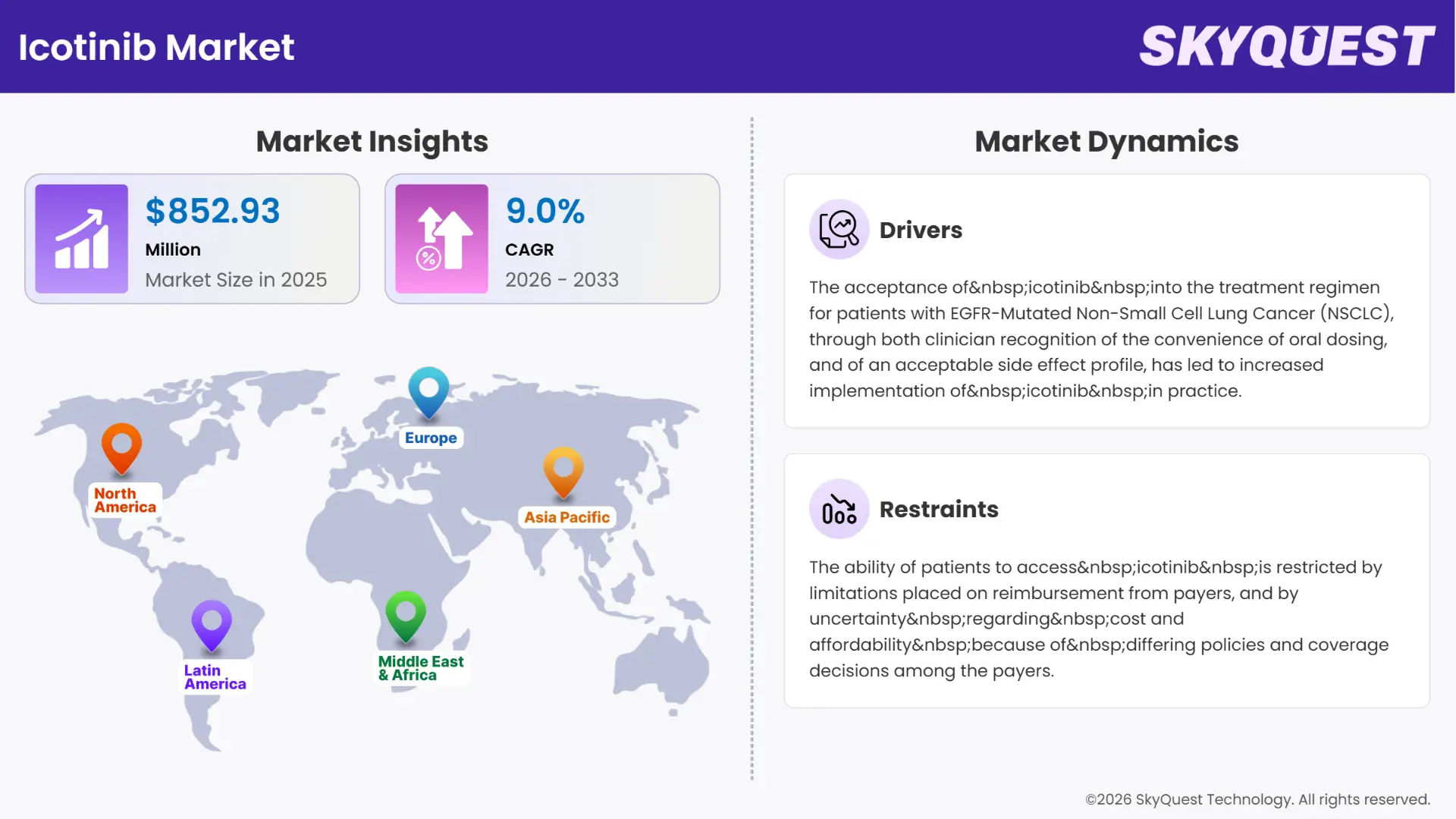
Global Icotinib Market size was valued at USD 782.5 Million in 2024 and is poised to grow from USD 852.93 Million in 2025 to USD 1699.51 Million by 2033, growing at a CAGR of 9.0% during the forecast period (2026-2033).
Key Takeaways: Market Trends & Insights
The icotinib industry is mostly being driven by icotinib's ability to be used as a targeted EGFR inhibitor and its ability to achieve a price that is more competitive than other drugs; and therefore, there is rapid acceptance of icotinib throughout Asia, particularly in China. Icotinib is an oral inhibitor of the human epidermal growth factor receptor tyrosine kinases (EGFR) for patients who have non-small cell lung cancer with EGFR mutations. The icotinib market is comprised of branded and generic products, included in clinical guidelines, available through regulatory approval and via distribution channels.
The icotinib market has transformed from an isolated domestic niche to a recognized component of the oncology market as clinical trial results demonstrated that icotinib is effective and that manufacturers were able to produce it on a mass scale. In addition, the rapid global icotinib market growth has been spurred by an expanding number of molecular diagnostic assays that increase the ability to detect EGFR mutations, which expands the number of patients who are eligible for treatment with icotinib and increases the volume of prescriptions written for icotinib.
The increasing implementation of reimbursement policies by governments and the addition of icotinib to hospital formularies and outpatient prescription programs has further enhanced the ability of patients in urban and rural areas to have access to icotinib. As patents expire and generic formulations of icotinib become available, the average price per unit will decrease due to the increased volume generated from emerging markets, and margin compression will occur for the manufacturers of the original brand-name products.
Artificial intelligence (AI) is changing the way patients are selected for icotinib treatment through better imaging, pathology and genomic data analysis, which leads to earlier and more accurate identification of EGFR driven tumours. Improved capabilities include noninvasive prediction of EGFR mutation status via CT scans and traditional pathology slides; improved triaging of specimens for molecular testing; and integration of circulating tumor DNA (ctDNA) into study workflows. This growing validation of development projects and pilot implementations within hospitals results in reduced time to targeted therapy. In markets where there is insufficient rapid molecular profiling, these tools assist physicians in prioritizing patients for icotinib treatment and improving outcomes in the real world.
To get more insights on this market click here to Request a Free Sample Report
Global icotinib market is segmented into product type, indication, dosage form, treatment line, end-user, distribution channel and region. Based on product type, the market is segmented into branded icotinib and generic icotinib. Based on indication, the market is segmented into non-small cell lung cancer (NSCLC) and other oncology indications. Based on dosage form, the market is segmented into oral tablets and other formulations. Based on treatment line, the market is segmented into first-line therapy and second-line / later-line therapy. Based on end-user, the market is segmented into hospitals, oncology clinics, retail pharmacies, online pharmacies and diagnostic & research centers. Based on distribution channel, the market is segmented into direct manufacturer sales, distributors & dealers and online pharmacies. Based on region, the market is segmented into North America, Europe, Asia Pacific, Latin America and Middle East & Africa.
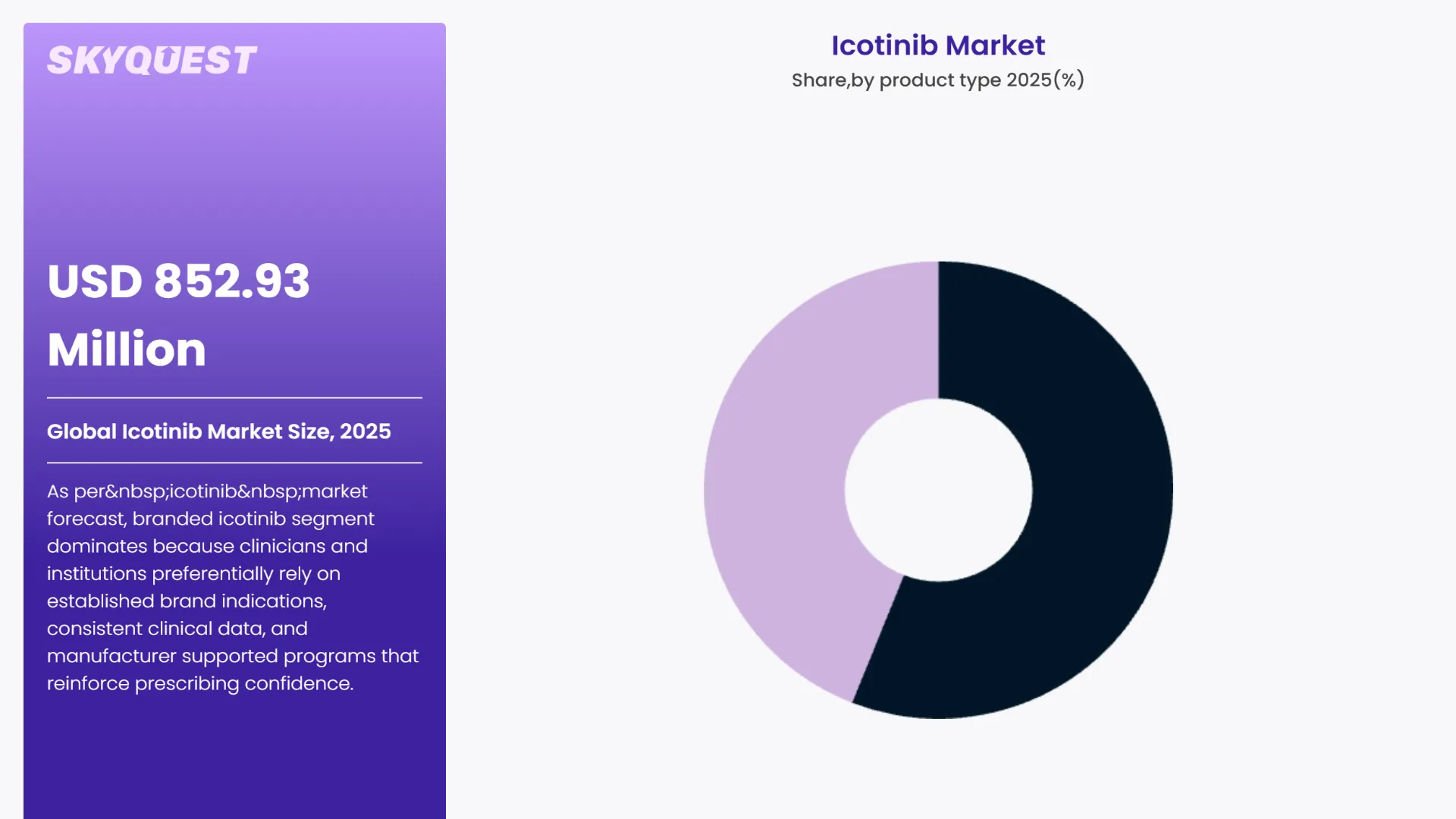
As per icotinib market forecast, branded icotinib segment dominates because clinicians and institutions preferentially rely on established brand indications, consistent clinical data, and manufacturer supported programs that reinforce prescribing confidence. Strong physician familiarity, organized postmarketing surveillance, and promotional support create predictable supply and adherence pathways, reducing perceived risk in therapeutic decision making. This will contribute to the development of sustained formulary placement and integrated treatment pathways that lead to purchasing momentum and continuing demand for this product among healthcare practitioners and institutions.
As per icotinib market outlook, generic icotinib's rapid growth can be attributed to broader acceptance by prescribers, lower acquisition costs and more efficient manufacturing scalability. Expanded access to bioequivalent alternatives and lower pricing will spur use of generics by different types of prescribers and payers across many therapy lines, resulting in higher penetration of generics into a growing number of therapy areas and providing momentum for the market.
How are Online Pharmacies Transforming Patient Access to Icotinib Therapies?
The online pharmacies segment leads with large market share, due to the availability of direct access to patients through digital means, ease of access, and consistent availability of long-term oral oncology treatments such as icotinib. Telemedicine, home delivery, and patient support tools that integrate into telemedicine reduce interruptions to therapy and support compliance with treatments. Simplified ordering processes make it easy for patients to continue to order repetitive prescriptions and manage their inventory. These capabilities reduce logistical disruptions for both patients and payers, making continual use through online channels a primary touchpoint for icotinib distributions.
As per icotinibmarket analysis, distributors & dealers are increasing their momentum, as wholesalers continue to expand logistics and channel partnerships to serve institutional customers. The increase in specialization within supply chains and consolidating procurement result in hospitals and clinics having a reliable source of bulk availability, enabling easier access to drugs within formularies and easier contracting process. This creates additional distribution resiliency upstream and grows the reach of icotinib manufacturers commercially.
To get detailed segments analysis, Request a Free Sample Report
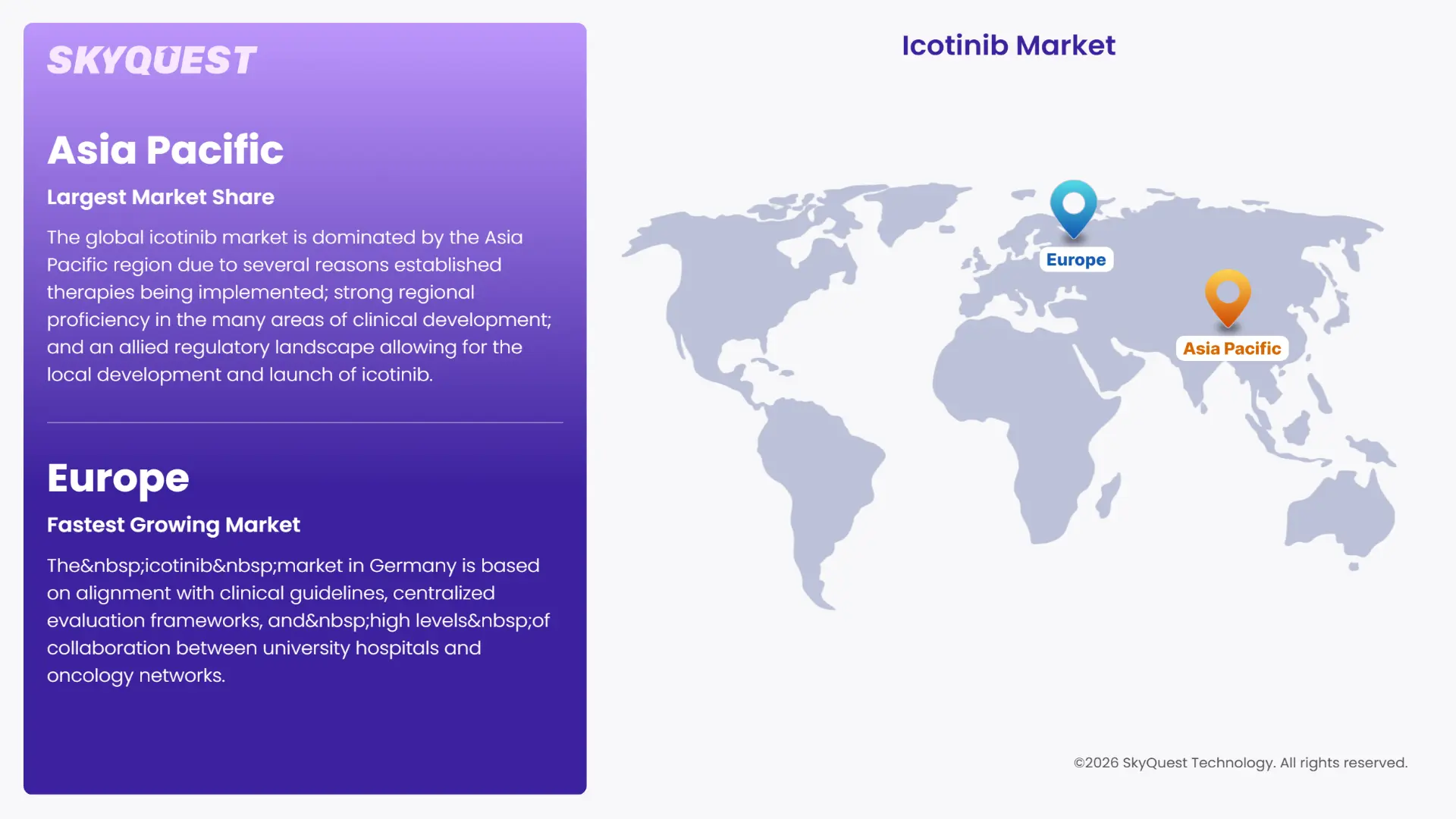
The global icotinib market is dominated by the Asia Pacific region due to several reasons established therapies being implemented; strong regional proficiency in the many areas of clinical development; and an allied regulatory landscape allowing for the local development and launch of icotinib. Providers’ knowledge of targeted therapies and integrated care pathways has further supported provider-consistent prescribing patterns. Robust local production capabilities and alliances between local developers and multinational biopharmaceutical companies have enhanced supply chain integration and market entry.
The icotinib market exists within Japan’s mature clinical environment that encompasses well-established oncology healthcare organization networks and substantial prescriber experience with targeted therapies and focus on post-marketing verification studies. Research organizations and industry collaborators work together to support translation/dissemination of clinical and real-world research, as well as integrated reimbursement and patient support programs that facilitate accessibility.
As per icotinib industry analysis, South Korea market is fostered through a concentrated academic research environment, active clinical trial activity, and well-established referral centers for the treatment of lung cancer with targeted therapies. Partnerships among hospitals, biopharmaceutical developers, and payors enhance the speed of information transfer and execution of patient access initiatives. There is a strong focus on guideline compliance and the collection of post-marketing evidence to instill prescriber confidence.
As per icotinib market regional outlook, Europe is supported by integrating clinical use throughout healthcare systems across Europe, as well as strong partnerships between academia and industry, and evolving treatment guidelines that increasingly include targeted therapies as treatment options. Centralized payer deliberations and structured health technology assessment processes assist in generating extensive data, as well as showing value that can help providers accept more. Cross-border collaborative clinical studies and the establishment of real-world data projects provide additional post-marketing confidence, while partnerships with manufacturers enable stable regional supply chains. Countries that employ market entry strategies involving localized patient support programs, physician education programs, and outreach to specialist referral networks have seen a more rapid adoption of icotinib.
The icotinib market in Germany is based on alignment with clinical guidelines, centralized evaluation frameworks, and high levels of collaboration between university hospitals and oncology networks. The decision-making process is driven by requiring high-quality evidence and conducting comparative value analyses will result in manufacturers producing real-world data to substantiate their products. The establishment of specialist referral pathways and the progress in discussions with payers surrounding reimbursement for icotinibcreate predictable routes of access to icotinib. Continued collaboration between clinicians, payers, and research institutions will continue to support the ongoing adoption of therapeutic use of icotinib and ongoing clinical trials and evaluations.
There is a growing Icotinib market in the United Kingdom. Adoption is taking place at specialist oncology centers, with more focus being put on clinical engagement and payer dialogues that emphasize value-based integration. Icotinib stakeholders are prioritizing the generation of real-world evidence and the incorporation of this evidence into clinical guidelines as tools to help guide clinicians' decisions. Collaborative efforts between academic hospitals and industry provide prescriber education that is targeted appropriately while improving patient adherence through support programs. Consequently, the emphasis on the generation of evidence, outreach to clinicians, and the establishment of structured access pathways will help promote the uptake of Icotinib therapy.
There is rapid growth in the icotinib market in France due to proactive clinical uptake from specialist oncology centers, extensive engagement from research organizations, and initiatives developed to create better patient access. The emphasis placed on real-world evidence generation, and adaptive reimbursement dialogues will result in broader clinical uptake. Industry partnerships to provide education and align clinical guidelines will help facilitate an efficient flow of patients through treatment hubs, thus enhancing the continuity of care. Collectively, these contributing factors will create continued momentum for the overall integration of Icotinib therapy into the marketplace.
As per icotinib market regional forecast, the North America market is solidifying its position through targeted clinical evaluations, regulatory collaborations, and partnerships that connect innovation and commercial infrastructure. The focus on robust clinical trials, investigator-initiated studies, and real-world evidence initiatives promotes the development of comprehensive characterization of therapeutic profiles for local clinical use. Collaborations between biotech innovators, contract manufacturers, and healthcare delivery systems strengthen the supply chain’s resiliency and operational readiness.
The icotinib market in the U.S. focuses on rigorous clinical evaluation, payer evidence synchronization, and connections between research centers and manufacturers. Real-world evidence initiatives will help guide reimbursement and adoption of clinical guidelines. Partnerships with contract manufacturers and distribution networks will enable scalable supply, while focused physician education will build familiarity among specialists.
The icotinib market in Canada will benefit from a strong focus on concentrated networks for oncology research, co-operative research initiatives and engagement with payers focus on generation of evidence and demonstration of value. Provincial treatment framework and referral systems improve access for specialists while partnerships between biopharma companies and clinical sites facilitate educational activities and translational research studies. The combined efforts focused on patient support systems and continuity of care will promote adherence to patients on Icotinib. The combination of co-ordinated research, engagement with stakeholders, and co-ordinated access pathways will enhance regional integration of therapeutic options.
To know more about the market opportunities by region and country, click here to
Buy The Complete Report
Favorable Clinical Profile
The acceptance of icotinib into the treatment regimen for patients with EGFR-Mutated Non-Small Cell Lung Cancer (NSCLC), through both clinician recognition of the convenience of oral dosing, and of an acceptable side effect profile, has led to increased implementation of icotinib in practice. Clinicians’ confidence in predicted tolerability to icotinib has prompted increased use of granted supply for long-term therapy and has encouraged clinicians to explore use of this agent more rapidly in pre-Approved Lines of Therapy for their patients with NSCLC. The clinical acceptability of icotinib has driven use within hospital formularies, out-patient clinics, and driven manufacturers to increase both supply and awareness of this therapy, supporting an overall increase in market growth through provider endorsements and routine prescription writing.
Expanded Regional Availability
Strategic distribution initiatives and partnerships between manufacturers and hospitals have increased access to icotinib by a much larger population of patients and providers, through hospital networks and through specialty pharmacies, beyond its initial launch areas. Coordinated supply chain manufacturing and distribution efforts associated with focused entry into underserved geographic areas, have lowered barriers for prescribing icotinib by clinicians and have created opportunities for clinicians to consider the use of icotinib as an effective treatment option. As icotinib availability grows geographically, so does the presence of icotinib on oncology practices' treatment protocols, and therefore demand by oncology practices have encouraged continuing investment in, and support for, the areas of distribution, educating clinicians, and providing patient support services that will enable continued growth of the icotinib market.
Limited Reimbursement Coverage
The ability of patients to access icotinib is restricted by limitations placed on reimbursement from payers, and by uncertainty regarding cost and affordability because of differing policies and coverage decisions among the payers. Those requirements create added administrative burden for clinicians, and when coverage is limited or requires prior authorization, they may choose to prescribe an alternative treatment that has a more defined and smooth reimbursement process than icotinib. Therefore, this decreases the rate of prescribers and disincentives of healthcare institutions to maintain an adequate supply level of the drug. In addition, the variety in access to icotinib will provide difficulties for the manufacturer to create an effective and reliable market penetration strategy, as well as predicting the type of demand for a new product to expand its market.
Clinical Safety Signals in Specific Populations
There are increasing reports of adverse events resulting from use of icotinib and uncertainty regarding long-term safety in specific patient populations. This creates hesitancy by prescribers and regulatory authorities in using icotinib to treat patients in certain circumstances. Tolerability concerns for use in patients that have multiple medical issues and/or significant organ dysfunction result in a tendency of prescribers to use well established products to treat those patients, as those products have been characterized as having safe use. These safety concern result in an increased need for close monitoring and specialist consultation, both of which increase the complexity of prescribing, thereby slowing the rate at which icotinib can be adopted as a therapy and preventing the ability of prescribers to regularly prescribe icotinib on a routine basis.
Request Free Customization of this report to help us to meet your business objectives.
The competitive landscape for the global icotinib market is largely driven by Betta Pharmaceuticals developing license and distribution partnerships acquisitions as well as research and development enhancements to grow Conmana. The primary competitive factors driving market growth are strategic partnerships for combination regimens development of distribution channels via mergers and acquisitions to achieve regional distribution as well as investment into artificial intelligence enabled formulation development. Examples include Betta's licensing partnership collaborations and recent partnerships to enhance combination studies and establish an international presence.
Shift toward Targeted Therapies: The demand for icotinib has increased because of an emphasis on molecularly defined patient segments, prompting developers to focus on precision dosing, the integration of companion diagnostics, and personalized treatment pathways. As a result, market participants are highlighting differentiated profiles with supportive narratives of targeted safety and efficacy; payers and physicians are evaluating clearly defined value propositions tied to real-world outcomes. This icotinib markettrend reinforces lifecycle strategies that connect clinical positioning and diagnostic partnerships to enable predicted adoption within defined indications and support placement within therapeutic algorithms via evidence-based positioning and stakeholder engagement.
Strategic Partnerships Accelerating Access: The formation of cooperative alliances by originators, generic developers, and distributors is transforming how icotinib is commercialized; these alliances enable the expansion of product reach, streamlining of supply systems and harmonizing of regulatory strategies. Licensing and co-development agreements enable technology transfer between parties; the local manufacturing of the technology can help improve affordability and timely entry into the market. Relationships between stakeholders include academic medical centers and patient advocacy organizations who are working together to build real-world evidence and awareness of the product. The development of these networked models reduces the fragmentation of the marketplace and allows for coordinated access programs that support increased engagement of physicians and the utilization of icotinib by patients in the diverse healthcare settings.
SkyQuest’s ABIRAW (Advanced Business Intelligence, Research & Analysis Wing) is our Business Information Services team that Collects, Collates, Correlates, and Analyses the Data collected by means of Primary Exploratory Research backed by robust Secondary Desk research.
As per SkyQuest analysis, icotinib market growth is driven by its targeted EGFR inhibition and competitive pricing, while a key restraint is limited reimbursement coverage that constrains access. Asia Pacific is the dominating region, and branded icotinib is the dominating segment. A second driver is expanding molecular diagnostics that increase identification of EGFR mutations and enlarge the treatable patient pool. Together these dynamics, alongside online distribution and generics pressure, shape adoption, access and pricing, recommending focused diagnostic integration, targeted clinician education and payer engagement to support formulary inclusion and real-world evidence generation across regions to sustain long term market expansion.
| Report Metric | Details |
|---|---|
| Market size value in 2024 | USD 782.5 Million |
| Market size value in 2033 | USD 1699.51 Million |
| Growth Rate | 9.0% |
| Base year | 2024 |
| Forecast period | 2026-2033 |
| Forecast Unit (Value) | USD Million |
| Segments covered |
|
| Regions covered | North America (US, Canada), Europe (Germany, France, United Kingdom, Italy, Spain, Rest of Europe), Asia Pacific (China, India, Japan, Rest of Asia-Pacific), Latin America (Brazil, Rest of Latin America), Middle East & Africa (South Africa, GCC Countries, Rest of MEA) |
| Companies covered |
|
| Customization scope | Free report customization with purchase. Customization includes:-
|
To get a free trial access to our platform which is a one stop solution for all your data requirements for quicker decision making. This platform allows you to compare markets, competitors who are prominent in the market, and mega trends that are influencing the dynamics in the market. Also, get access to detailed SkyQuest exclusive matrix.
Table Of Content
Executive Summary
Market overview
Parent Market Analysis
Market overview
Market size
KEY MARKET INSIGHTS
COVID IMPACT
MARKET DYNAMICS & OUTLOOK
Market Size by Region
KEY COMPANY PROFILES
Methodology
For the Icotinib Market, our research methodology involved a mixture of primary and secondary data sources. Key steps involved in the research process are listed below:
1. Information Procurement: This stage involved the procurement of Market data or related information via primary and secondary sources. The various secondary sources used included various company websites, annual reports, trade databases, and paid databases such as Hoover's, Bloomberg Business, Factiva, and Avention. Our team did 45 primary interactions Globally which included several stakeholders such as manufacturers, customers, key opinion leaders, etc. Overall, information procurement was one of the most extensive stages in our research process.
2. Information Analysis: This step involved triangulation of data through bottom-up and top-down approaches to estimate and validate the total size and future estimate of the Icotinib Market.
3. Report Formulation: The final step entailed the placement of data points in appropriate Market spaces in an attempt to deduce viable conclusions.
4. Validation & Publishing: Validation is the most important step in the process. Validation & re-validation via an intricately designed process helped us finalize data points to be used for final calculations. The final Market estimates and forecasts were then aligned and sent to our panel of industry experts for validation of data. Once the validation was done the report was sent to our Quality Assurance team to ensure adherence to style guides, consistency & design.
Analyst Support
Customization Options
With the given market data, our dedicated team of analysts can offer you the following customization options are available for the Icotinib Market:
Product Analysis: Product matrix, which offers a detailed comparison of the product portfolio of companies.
Regional Analysis: Further analysis of the Icotinib Market for additional countries.
Competitive Analysis: Detailed analysis and profiling of additional Market players & comparative analysis of competitive products.
Go to Market Strategy: Find the high-growth channels to invest your marketing efforts and increase your customer base.
Innovation Mapping: Identify racial solutions and innovation, connected to deep ecosystems of innovators, start-ups, academics, and strategic partners.
Category Intelligence: Customized intelligence that is relevant to their supply Markets will enable them to make smarter sourcing decisions and improve their category management.
Public Company Transcript Analysis: To improve the investment performance by generating new alpha and making better-informed decisions.
Social Media Listening: To analyze the conversations and trends happening not just around your brand, but around your industry as a whole, and use those insights to make better Marketing decisions.
REQUEST FOR SAMPLE
 REQUEST FREE CUSTOMIZATION
Global Icotinib Market size was valued at USD 782.5 Million in 2024 and is poised to grow from USD 852.93 Million in 2025 to USD 1699.51 Million by 2033, growing at a CAGR of 9.0% during the forecast period (2026-2033).
Competition in the global icotinib market is shaped by Betta Pharmaceuticals executing licensing partnerships distribution acquisitions and R D upgrades to extend Conmana. Key market drivers tied to competition include strategic collaborations for combination regimens targeted distributor M A to secure regional access and investment in AI driven formulation work. Examples include Betta’s licensing collaborations and recent tie ups to advance combination studies and international reach. 'Jiangsu Hengrui Medicine Co., Ltd.', 'Zhejiang Haiyuan Pharmaceutical Co., Ltd.', 'BeiGene, Ltd.', 'Sinopharm Group Co., Ltd.', 'Shanghai Fosun Pharmaceutical Group Co., Ltd.', 'Chugai Pharmaceutical Co., Ltd.', 'Novartis AG', 'AstraZeneca PLC', 'Eli Lilly and Company', 'Merck & Co., Inc.', 'Pfizer Inc.', 'Roche Holding AG', 'Amgen Inc.', 'Takeda Pharmaceutical Company Limited', 'AbbVie Inc.', 'Celgene Corporation', 'GSK plc', 'Boehringer Ingelheim GmbH', 'Sanofi S.A.', 'Bayer AG'
The inclusion of icotinib in treatment pathways for EGFR-mutated non-small cell lung cancer and recognition by clinicians for its oral administration and manageable adverse event profile drives adoption across oncology practices. Confidence in predictable tolerability encourages long-term therapy and facilitates patient adherence, prompting prescribers to consider icotinib earlier in therapy lines. This clinical acceptability supports uptake by hospital formularies and outpatient clinics, stimulates manufacturer efforts to expand supply and awareness, and underpins broader market growth through provider endorsement and routine prescribing.
Shift Toward Targeted Therapies: Demand for icotinib is increasingly driven by focus on molecularly defined patient segments, prompting developers to prioritize precision dosing, companion diagnostics integration, and personalized treatment pathways. Market players emphasize differentiated profiles supported by targeted safety and efficacy narratives, while payers and clinicians seek clear value propositions tied to real-world outcomes. This trend supports lifecycle strategies that link clinical positioning with diagnostic partnerships, enabling predictable adoption in defined indications and facilitating placements within therapeutic algorithms through evidence-led positioning and stakeholder engagement.
The global icotinib market is dominated by the Asia Pacific region due to several reasons established therapies being implemented; strong regional proficiency in the many areas of clinical development; and an allied regulatory landscape allowing for the local development and launch of icotinib.
Artificial intelligence is enhancing patient selection by analyzing imaging, pathology, and genomic data to identify EGFR-driven tumors more accurately. It enables faster diagnosis, prioritization for targeted therapy, and improved treatment outcomes through earlier intervention.
The market is segmented by product type (branded and generic icotinib), indication (non-small cell lung cancer and other oncology uses), dosage form, treatment line, end-user, and distribution channel, reflecting its diverse clinical and commercial applications.


Want to customize this report? This report can be personalized according to your needs. Our analysts and industry experts will work directly with you to understand your requirements and provide you with customized data in a short amount of time. We offer $1000 worth of FREE customization at the time of purchase.
Feedback From Our Clients


 USA (+1) 351-333-4748

