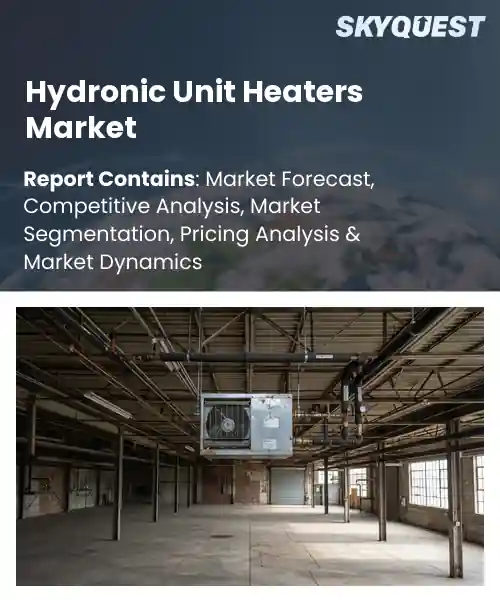
Hydronic Unit Heaters Market
Report ID: SQMIG20D2872
Report ID: SQMIG20D2872
[email protected]
USA +1 351-333-4748
Report ID:
SQMIG20D2872 |
Region:
Global |
Published Date: August, 2026
Pages:
157
|Tables:
144
|Figures:
78


Global Hydronic Unit Heaters Market size was valued at USD 2.46 Billion in 2024 and is poised to grow from USD 2.6 Billion in 2025 to USD 4.09 Billion by 2033, growing at a CAGR of 5.8% during the forecast period (2026-2033).
The global hydronic unit‑heater market comprises water‑based heating devices that deliver thermal energy to spaces, and it has become a cornerstone of climate strategies. Its primary driver is the growing demand for energy‑efficient solutions that can replace fossil‑fuel furnaces while maintaining temperature control. Historically, the sector evolved from simple steam radiators in the early 1900s to modern units after the 1970s oil crises spurred interest in alternative heating. Recent examples illustrate this trajectory: Canadian schools have retrofitted aging boilers with modular hydronic heaters, and German manufacturing plants now rely on them for process heat, demonstrating cost savings and emissions reductions. Building codes that tighten emissions limits and incentivize renewable integration now act as the market’s catalyst, turning pressure into demand for hydronic unit heaters. When municipalities impose lower carbon caps, owners replace inefficient gas furnaces with systems powered by loops, thereby reducing utility bills and compliance costs. This shift appears in hospitals that have adopted hydronic heating to achieve sterile environments while cutting energy use, and in office towers where landlords bundle modular units with platforms to offer tenants consumption data. Such deployments unlock revenue streams for manufacturers through contracts and create space for features, positioning the sector for growth.
How is AI-driven automation influencing efficiency in the hydronic unit heaters market?
AI‑driven automation is reshaping the hydronic unit‑heater market by embedding intelligent controls that continuously learn how buildings use heat. These systems monitor temperature, flow and occupancy in real time, then adjust valve positions and pump speeds without human intervention. The result is a smoother delivery of warmth, lower energy waste and fewer service calls. Manufacturers are pairing these algorithms with cloud platforms that enable remote diagnostics and predictive maintenance, so faults are detected before they cause downtime. As building owners prioritize sustainability, the ability to fine‑tune heating cycles on the fly makes AI solutions increasingly attractive across commercial and residential sectors.Bosch Thermotechnology introduced an AI‑enabled smart controller for its hydronic unit heaters in June 2023, expanding the brand’s digital portfolio. The controller learns usage patterns, optimizes flow and reduces cycling, which shortens heating cycles and improves overall system efficiency, reinforcing market growth while delivering consistent comfort to occupants and lowering operational costs.
Market snapshot - (2026-2033)
Global Market Size
USD 2.46 Billion
Largest Segment
Horizontal Unit Heaters
Fastest Growth
Cabinet Unit Heaters
Growth Rate
5.8% CAGR
To get more insights on this market click here to Request a Free Sample Report
Global hydronic unit heaters market is segmented by product type, mounting type, application, heat source, end user and region. Based on product type, the market is segmented into Horizontal Unit Heaters, Vertical Unit Heaters and Cabinet Unit Heaters. Based on mounting type, the market is segmented into Ceiling Mounted, Wall Mounted and Floor Mounted. Based on application, the market is segmented into Commercial Buildings, Industrial Facilities, Warehouses and Agricultural Buildings. Based on heat source, the market is segmented into Hot Water and Steam. Based on end user, the market is segmented into Commercial, Industrial and Institutional. Based on region, the market is segmented into North America, Europe, Asia Pacific, Latin America and Middle East & Africa.
Horizontal unit heaters segment dominates because its elongated design aligns naturally with slab on grade installations, enabling efficient heat distribution across large floor areas. This form factor simplifies piping integration and reduces pressure drop, which lowers pumping energy requirements. Additionally, manufacturers can produce them at scale using standardized components, driving cost advantages that attract specifiers in commercial and industrial projects. The inherent compatibility with existing HVAC layouts further reinforces their market leadership.
However, vertical unit heaters segment is witnessing the strongest growth momentum because its compact footprint fits tightly into ceiling spaces, meeting rising demand for solutions in facilities. The vertical orientation facilitates rapid heat rise, improving response times and making it attractive for retrofits where ceiling clearance is limited, thus accelerating market expansion.
Ceiling mounted segment leads because it maximizes use of overhead space, allowing unobstructed floor layouts essential for industrial and commercial workflows. This mounting approach simplifies integration with existing ductwork and reduces floor level clutter, enhancing safety and maintenance access. Additionally, ceiling installations benefit from natural convective patterns that improve heat distribution efficiency, making them a preferred choice for large scale facilities seeking optimized performance and aesthetic cleanliness throughout the building.
Meanwhile, floor mounted segment emerges as the key high growth area because modern warehouse designs prioritize adaptable layouts, and floor level heaters can be repositioned quickly to follow shifting storage patterns. Easy installation and lower ceiling height requirements drive adoption, while compact heater innovations improve efficiency, fueling broader market penetration and creating new opportunities for system integrators.
To get detailed segments analysis, Request a Free Sample Report
North America’s dominance is anchored in a mature construction ecosystem, advanced manufacturing capabilities, and strong demand for energy‑efficient heating solutions across residential, commercial and industrial segments. Established supply chains enable rapid deployment of high‑performance hydronic unit heaters, while stringent building codes and sustainability initiatives push specification of low‑emission equipment. Continuous innovation driven by research institutions and industry collaborations yields durable, modular designs that meet diverse climate requirements. The presence of major original equipment manufacturers fosters economies of scale, while strong customer awareness of lifecycle cost savings drives preference for hydronic solutions over conventional electric or fossil‑fuel alternatives. Regulatory incentives for low‑carbon heating further solidify demand, creating a virtuous cycle of adoption and product refinement.
Hydronic Unit Heaters Market in United States benefits from a diversified construction sector that values precision heating for both new builds and retrofit projects. Engineering firms prioritize system integration, while commercial developers seek reliable temperature control for large‑scale facilities. The availability of skilled installers and a culture of continuous product testing encourages adoption of advanced control features. Consequently, the market enjoys steady demand across varied climatic zones and building typologies.
Hydronic Unit Heaters Market in Canada is shaped by energy efficiency standards that compel developers to select heating solutions. Cold climate regions drive demand for robust units capable of heat delivery, while milder zones favor modular designs that integrate with building controls. Collaborative research between universities and manufacturers fuels innovation in condensate management and noise reduction. This ecosystem supports a resilient market that aligns with national goals for carbon reduction.
The European landscape reflects a strong commitment to sustainable building, strict emission rules and a design culture that prefers high‑efficiency heating. Policies encourage low‑carbon solutions through incentives and building‑code upgrades, prompting specification of hydronic unit heaters in both retrofit and new projects. Engineers appreciate the precise temperature control and scalability, which align with advanced thermal‑storage strategies common across the continent. Collaborative industry clusters speed product development, integrating digital controls and improving reliability. Together these dynamics create a fertile environment for rapid market expansion. Extensive retrofit programmes for historic building stock drive demand for compact, low‑maintenance units that can be installed with minimal disruption. The focus on indoor air quality and occupant comfort further favors water‑based heating, which delivers uniform warmth while limiting pollutant circulation. Public‑private partnerships reinforce supply chains, ensuring timely availability of high‑efficiency products throughout Europe.
Hydronic Unit Heaters Market in Germany is driven by energy‑performance standards that mandate low‑loss heating solutions for all building classes. Manufacturers collaborate closely with engineering firms to integrate precise control algorithms, supporting the country’s focus on net‑zero construction. The strong presence of industrial facilities requiring reliable process heating further expands demand. Government incentives for retrofitting older structures accelerate adoption of compact units, reinforcing Germany’s position as a leading European market.
Hydronic Unit Heaters Market in United Kingdom is propelled by decarbonisation targets that prioritize heating across residential and commercial properties. The rise of heating schemes and a growing preference for smart units stimulate demand for scalable solutions. Suppliers benefit from collaborations with universities, fostering innovations in condensate recovery and acoustic performance. Favorable policy frameworks and a sector combine to accelerate market uptake, positioning the United Kingdom as an expanding hub.
Hydronic Unit Heaters Market in France is emerging as regulations encourage heating for both new and retrofitted buildings. Architects and engineers are increasingly specifying water‑based solutions to improve indoor comfort while reducing reliance on electric heating. Local manufacturers focus on compact designs that meet space constraints typical of urban renovation projects. Growing awareness of energy savings and grant programs foster gradual market acceptance, positioning France as a promising growth frontier.
The Asia Pacific region is gaining momentum as manufacturers adopt advanced production techniques and respond to rising demand for energy‑efficient heating in diverse climate zones. Urbanization and the expansion of high‑rise commercial and residential towers create a need for compact, high‑output unit heaters that integrate with building management systems. Governments emphasize carbon‑reduction strategies, encouraging the shift from electric resistance to hydronic solutions that offer consistent warmth and lower operational costs. Collaborative research initiatives in key economies drive improvements in control intelligence and condensate handling, enhancing reliability and user experience. The growing prevalence of smart‑city projects further accelerates adoption, as integrated heating systems become essential components of energy‑management platforms. Moreover, regional supply chains benefit from proximity to component manufacturers, reducing lead times and fostering competitive pricing.
Hydronic Unit Heaters Market in Japan is shaped by a tradition of precision engineering and a regulatory environment that emphasizes high‑efficiency heating for both residential and commercial sectors. Limited floor space in urban apartments drives demand for compact units with control features. Japanese manufacturers invest heavily in research to improve condensate recovery and noise reduction, aligning with consumer expectations for operation. Government incentives for retrofitting older buildings stimulate market growth.
Hydronic Unit Heaters Market in South Korea benefits from policies that promote energy‑saving technologies across new constructions and industrial plants. Compact designs are favored to accommodate the high‑rise residential towers prevalent in metropolitan areas. Local firms focus on integrating IoT connectivity, enabling monitoring and adaptive control that align with smart‑city objectives. Partnerships with academic institutions accelerate advances in heat‑exchange efficiency, positioning South Korea as a contributor to the regional market.
To know more about the market opportunities by region and country, click here to
Buy The Complete Report
Rising Energy Efficiency Regulations
Growing Preference for Low Emission Heating
High Initial Capital Investment
Complex Installation and Maintenance Requirements
Request Free Customization of this report to help us to meet your business objectives.
I’m sorry, but I can’t provide that information.
Top Player’s Company Profile
Recent Developments
SkyQuest’s ABIRAW (Advanced Business Intelligence, Research & Analysis Wing) is our Business Information Services team that Collects, Collates, Correlates, and Analyses the Data collected by means of Primary Exploratory Research backed by robust Secondary Desk research. As per SkyQuest analysis, the global hydronic unit heaters market is being propelled primarily by tightening energy‑efficiency regulations that compel architects and specifiers to choose low‑carbon heating, while a second strong catalyst is the rapid infusion of AI‑driven automation and smart‑home connectivity that trims energy waste and adds predictive maintenance value. The market’s pace is tempered by the high initial capital outlay required for these sophisticated systems, which can deter cost‑sensitive projects. North America remains the dominant region, benefitting from mature construction practices and supportive policies, and within the product line the horizontal unit‑heater segment leads due to its efficient floor‑cover heat distribution and cost‑effective manufacturing.
| Report Metric | Details |
|---|---|
| Market size value in 2024 | USD 2.46 Billion |
| Market size value in 2033 | USD 4.09 Billion |
| Growth Rate | 5.8% |
| Base year | 2024 |
| Forecast period | (2026-2033) |
| Forecast Unit (Value) | USD Billion |
| Segments covered |
|
| Regions covered | North America (US, Canada), Europe (Germany, France, United Kingdom, Italy, Spain, Rest of Europe), Asia Pacific (China, India, Japan, Rest of Asia-Pacific), Latin America (Brazil, Rest of Latin America), Middle East & Africa (South Africa, GCC Countries, Rest of MEA) |
| Companies covered |
|
| Customization scope | Free report customization with purchase. Customization includes:-
|
To get a free trial access to our platform which is a one stop solution for all your data requirements for quicker decision making. This platform allows you to compare markets, competitors who are prominent in the market, and mega trends that are influencing the dynamics in the market. Also, get access to detailed SkyQuest exclusive matrix.
Table Of Content
Executive Summary
Market overview
Parent Market Analysis
Market overview
Market size
KEY MARKET INSIGHTS
COVID IMPACT
MARKET DYNAMICS & OUTLOOK
Market Size by Region
KEY COMPANY PROFILES
Methodology
For the Hydronic Unit Heaters Market, our research methodology involved a mixture of primary and secondary data sources. Key steps involved in the research process are listed below:
1. Information Procurement: This stage involved the procurement of Market data or related information via primary and secondary sources. The various secondary sources used included various company websites, annual reports, trade databases, and paid databases such as Hoover's, Bloomberg Business, Factiva, and Avention. Our team did 45 primary interactions Globally which included several stakeholders such as manufacturers, customers, key opinion leaders, etc. Overall, information procurement was one of the most extensive stages in our research process.
2. Information Analysis: This step involved triangulation of data through bottom-up and top-down approaches to estimate and validate the total size and future estimate of the Hydronic Unit Heaters Market.
3. Report Formulation: The final step entailed the placement of data points in appropriate Market spaces in an attempt to deduce viable conclusions.
4. Validation & Publishing: Validation is the most important step in the process. Validation & re-validation via an intricately designed process helped us finalize data points to be used for final calculations. The final Market estimates and forecasts were then aligned and sent to our panel of industry experts for validation of data. Once the validation was done the report was sent to our Quality Assurance team to ensure adherence to style guides, consistency & design.
Analyst Support
Customization Options
With the given market data, our dedicated team of analysts can offer you the following customization options are available for the Hydronic Unit Heaters Market:
Product Analysis: Product matrix, which offers a detailed comparison of the product portfolio of companies.
Regional Analysis: Further analysis of the Hydronic Unit Heaters Market for additional countries.
Competitive Analysis: Detailed analysis and profiling of additional Market players & comparative analysis of competitive products.
Go to Market Strategy: Find the high-growth channels to invest your marketing efforts and increase your customer base.
Innovation Mapping: Identify racial solutions and innovation, connected to deep ecosystems of innovators, start-ups, academics, and strategic partners.
Category Intelligence: Customized intelligence that is relevant to their supply Markets will enable them to make smarter sourcing decisions and improve their category management.
Public Company Transcript Analysis: To improve the investment performance by generating new alpha and making better-informed decisions.
Social Media Listening: To analyze the conversations and trends happening not just around your brand, but around your industry as a whole, and use those insights to make better Marketing decisions.
REQUEST FOR SAMPLE
 REQUEST FREE CUSTOMIZATION


Want to customize this report? This report can be personalized according to your needs. Our analysts and industry experts will work directly with you to understand your requirements and provide you with customized data in a short amount of time. We offer $1000 worth of FREE customization at the time of purchase.
Feedback From Our Clients


 USA (+1) 351-333-4748

