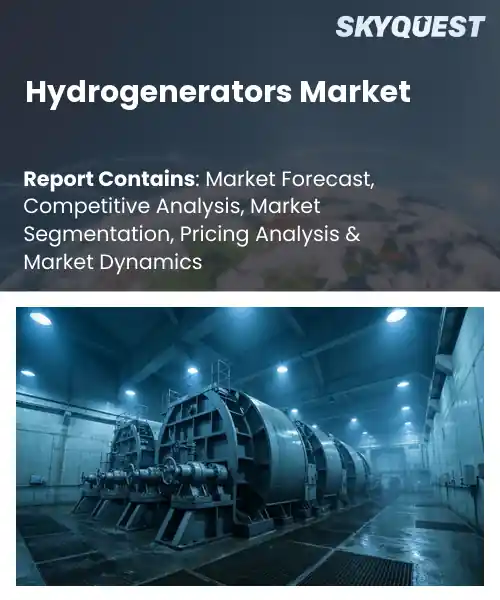
Hydrogenerators Market
Report ID: SQMIG20I2752
Report ID: SQMIG20I2752
[email protected]
USA +1 351-333-4748
Report ID:
SQMIG20I2752 |
Region:
Global |
Published Date: February, 2026
Pages:
157
|Tables:
142
|Figures:
78


Global Hydrogenerators Market size was valued at USD 556.40 Million in 2024 and is poised to grow from USD 599.24 Million in 2025 to USD 1084.75 Million by 2033, growing at a CAGR of 7.7% during the forecast period (2026-2033).
High emphasis on decarbonization, advancements in hydropower generation technologies, and rising global shift toward renewable electricity generation, and expansion of large-scale hydropower capacity are supporting demand for hydrogenerators in the long run.
The rising level of integration of variable renewable energy sources such as solar and wind power is supporting steady sales of hydrogenerators across the world. As the level of integration of renewable energy sources is rising, the level of demand for energy balancing is also rising, making hydropower an essential part of the modern energy system. This is leading to rising investments in pumped storage and variable speed generators, which are helping to reduce renewable energy curtailment and strengthen grid reliability, particularly in regions with variable energy demand and water supply. Moreover, it is helping equipment suppliers develop retrofitting opportunities and long-term service contracts. Growing demand for reliable and sustainable power generation is expected to primarily drive hydrogenerators market growth.
Historically, the market was driven by large-scale dam projects in countries such as Brazil and China, but recent trends have shifted toward modernization, digital control systems, and smaller, environmentally sustainable hydro projects that extend asset life and reduce ecological impact.
On the contrary, high installation and maintenance costs, environmental and social concerns, regulatory hurdles, and risks associated with climate variability and water availability are anticipated to slow down hydrogenerators market penetration through 2033.
IoT is facilitating predictive maintenance in hydrogenerators through the use of sensors installed on critical equipment, including bearings, shafts, and stators. This enables the early detection of problems through the sensors' ability to track vibrations, temperature, and moisture levels. Edge computing is utilized to process the data, and critical alerts are transmitted to secure cloud environments where machine learning and anomaly detection solutions are applied to track early warning signs of problems. Increased demand for digital twins, vendor-based condition monitoring solutions, and retrofit sensor solutions enable operators to focus on critical equipment and address problems before they cause equipment failure.
In July 2025, Voith introduced AI-driven turbine optimization along with broader digital solutions. By combining improved turbine design with real-time data monitoring, this approach enables earlier fault detection and more accurate maintenance planning, improving efficiency across hydrogenerator operations.
Market snapshot - (2026-2033)
Global Market Size
USD 556.4 Million
Largest Segment
Synchronous Hydrogenerators
Fastest Growth
Asynchronous Hydrogenerators
Growth Rate
7.7% CAGR
To get more insights on this market click here to Request a Free Sample Report
Global hydrogenerators market is segmented by type, application, power/capacity, installation, end-user, and region. Based on type, the market is segmented into synchronous hydrogenerators and asynchronous hydrogenerators. Based on application, the market is segmented into vertical hydro turbine generators and horizontal hydro turbine generators. Based on power/capacity, the market is segmented into Less than 1000 KVA, 1000–10000 KVA, and above 10000 KVA. Based on installation, the market is segmented into large-scale hydropower plants, small & micro-hydropower systems, and portable hydrogenerators. Based on end-user, the market is segmented into utility power generation, industrial power supply and commercial & residential backup. Based on region, the market is segmented into North America, Europe, Asia Pacific, Latin America, and Middle East & Africa.
The synchronous hydrogenerators segment is projected to spearhead the global hydrogenerators market revenue generation in the future. The inherent ability of these devices to provide synchronous speed operation, consistent reactive power support, and predictable inertia helps cement their dominance across multiple applications. Their ease of use with existing grid control schemes and well-established integration methodologies also helps to minimize the complexity of large projects, which in turn focuses procurement preference, engineering, and maintenance methodologies on well-established synchronous technologies.
However, asynchronous hydrogenerators are the most rapidly expanding segment as per this hydrogenerators market forecast. The ease of integration with existing grid control schemes and the well-established methodologies for integration also serve to reduce the complexity of the project, which in turn serves to focus procurement preferences, engineering, and maintenance methodologies around well-established synchronous solutions.
The portable hydrogenerators segment is expected to account for the highest global hydrogenerators market share in the future. Rapid deployment and modular capacity of these devices help address service interruptions and emergency power needs across diverse operational environments, which cements their dominance. The plug and play attributes minimize the installation time and the associated hurdles. This helps the operators to restore the loads in the most effective way. The small footprint and permitting needs of these systems minimize the deployment hurdles and facilitate the maintenance strategies.
However, small and micro-hydropower plants are technologies that have the strongest growth momentum. This is because developers are looking at decentralized renewable energy sources that can be used to power small grids. In this regard, innovations in small turbine designs and financing and permitting procedures are making it easier to roll out small power plants.
To get detailed segments analysis, Request a Free Sample Report
Abundant hydropower resources, concentrated manufacturing capabilities, and policy commitments that favor renewable generation helps this region lead the sales of hydrogenerators in the future. Dense supply chains throughout the region and specialized component suppliers enable cost effective production and deployment. The integrated planning between utilities and governments within the regional project pipeline benefits modernization of existing hydro assets and new capacity creation. Active export orientation from the advanced manufacturing areas of the region expands regional influence, while continued investment in digital controls and materials science improves performance and reliability for both domestic and international use.
A skilled engineering workforce within the region, along with the close collaboration of research institutes and manufacturers, accelerates towards the industry-based solution of increased usage of advanced materials and control architecture and the use of project financing mechanisms and public/private partnerships to mitigate large scale investment risk and encourage long-term availability.
Advanced engineering, precision manufacturing, and retrofitting programs that enhance efficiency of existing hydro assets support constant sales of hydrogenerators in Japan. Local energy firms are focused on the reliability and maintenance of their hydro assets, which creates demand for these solutions. Export-focused manufacturers use their high standards to compete globally, but they are also focused on maintenance, monitoring, and bespoke solutions. Effective collaboration between technology companies and research centers helps in the creation of efficient and small-scale designs, as well as complex control systems.
Emphasis on technological integration and modular manufacturing helps boost hydrogenerators deployment in South Korea. The government is also promoting local manufacturing, with export competitiveness driving the service market for refurbishment, spares, and integration to improve availability and reliability. Industry conglomerates, as well as specific suppliers, work together to meet the requirements of various hydro environments, with digitalization and maintenance capabilities also being integrated into the product offerings.
Decarbonization priorities, regulatory frameworks favoring renewable flexibility, and a focus on modernization of aging hydro infrastructure are driving consistent sales of hydrogenerators in Europe. Cross border grid integration, increasing levels of variable renewable generation and consequently, need for balanced generation increase the attractiveness of flexible hydro assets, thereby increasing demand for new technologies and controls related to generators. Utilities and generators working together, with support from research institutions, are innovating and deploying more efficient designs and predictive maintenance practices that extend the life and optimize the performance of hydro assets across all hydropower plants.
Enhanced regional supply chains incorporating small and medium-sized enterprises that are specialized facilitate customization and rapid engineering response; efforts on harmonizing technical standards and certifications support project execution and potential for exports. Engineering capability and established equipment supply aides for retrofitting and upgrading, while policy incentives and availability of green finance contribute significantly to making rehabilitation feasible from a financial perspective.
Robust engineering expertise, established equipment manufacturers, and a dense network of suppliers are supporting steady sales of hydrogenerators across Germany. Joint research activities are helping to speed up innovation in materials and diagnostics for hydro assets in Europe and supporting industry partnerships for complex project delivery in Germany. The focus of utilities and service providers on improving efficiencies, as well as integrating grid balancing mechanisms, fuels the demand for strong design and control system solutions.
Dynamic private sector engagement, growing interest in modernization projects, and strong deployment of digital monitoring solutions shapes hydrogenerators adoption in the United Kingdom. Market innovators and niche producers are focusing on hydrogenerators that are light and flexible to meet a range of site conditions, whereas the industry is focusing on flexible generations to match a range of renewable sources. Supportive policies for refurbishment and export strategies are also creating new opportunities in the long run.
Renewed attention to small and medium scale hydro projects and refurbishment of existing plants supports high demand for hydrogenerators in France. Local players are providing customized solutions to sites with limited space, while pilot projects are being implemented to prove the minimal environmental impact of low-impact turbine solutions. Procurement support is also available, along with cooperation with nearby market players to support export readiness of the domestic industry.
Concentrated efforts to modernize existing hydro assets, bolster domestic manufacturing capacity, and enhance integration with broader grid modernization support steady adoption of hydrogenerators in North America. Evolution of regulations and compliance with environmental requirements are also ensuring upgrade initiatives that balance these requirements with performance and ecological considerations. High emphasis on flexible generation and ancillary service requirements, which are being addressed through upgrades in the design of such generators.
Partnerships with indigenous populations are also being pursued to align these initiatives with local requirements. Various financing models are in place to upgrade existing hydro generators, and research initiatives are being undertaken to improve materials used in such upgrades, to increase efficiencies, and to ensure digitalization of such upgrades. Diversification of supply chains, as well as investments in local talent, are ensuring robust manufacturing capabilities, which can meet both local and international market requirements.
Launch of new modernization initiatives, emphasis on grid services, and the presence of diversified original equipment manufacturers ensure consistent demand for hydrogenerators in the country. Research institutions in the region assist the industry in materials and digitalization. The presence of the supply chain in the region and the services provided after the sale facilitate the ability to sustain the maintenance and upgrades are also creating new business scope in the United States.
Provincial modernization efforts, rehabilitation of remote and small-scale hydro installations, and strong collaboration with indigenous communities are driving steady demand for hydrogenerators in Canada. Local companies have developed expertise in cold climate work and remote sites, providing reliable solutions with good logistics. Modernization efforts include provincial funding opportunities for capacity upgrades, as well as aftermarket solutions. Cross-border cooperation also provides opportunities for Canadian businesses.
To know more about the market opportunities by region and country, click here to
Buy The Complete Report
Expansion Of Renewable Energy Targets
Advancements In Turbine Technology
Environmental and Social Approval Challenges
High Capital Expenditure Requirements
Request Free Customization of this report to help us to meet your business objectives.
Competition in the global hydrogenerators market is intensifying as incumbents pursue consolidation through targeted acquisitions such as Andritz’s takeover of GE hydro assets, while OEMs and utilities form retrofit and service partnerships to lock in long term pipelines. Competitive pressure is driven by demand for low head and pipe solutions and by field pilots. Firms now execute acquisitions, strategic partnerships, and pilot deployments to secure project contracts.
SkyQuest’s ABIRAW (Advanced Business Intelligence, Research & Analysis Wing) is our Business Information Services team that Collects, Collates, Correlates, and Analyses the Data collected by means of Primary Exploratory Research backed by robust Secondary Desk research.
As per SkyQuest analysis, increasing focus on renewable energy generation and rising demand for grid stability solutions are anticipated to drive the demand for hydrogenerators going forward. However, high capital costs, environmental concerns, and regulatory challenges are slated to slow down the adoption of hydrogenerators in the future. Asia Pacific is slated to spearhead the demand for hydrogenerators owing to large hydropower capacity, ongoing infrastructure modernization, and strong government support for clean energy. Development of IoT-enabled predictive maintenance solutions and integration of AI-driven condition monitoring systems are anticipated to be key trends driving the hydrogenerators sector across the study period.
| Report Metric | Details |
|---|---|
| Market size value in 2024 | USD 556.4 Million |
| Market size value in 2033 | USD 1084.75 Million |
| Growth Rate | 7.7% |
| Base year | 2024 |
| Forecast period | (2026-2033) |
| Forecast Unit (Value) | USD Million |
| Segments covered |
|
| Regions covered | North America (US, Canada), Europe (Germany, France, United Kingdom, Italy, Spain, Rest of Europe), Asia Pacific (China, India, Japan, Rest of Asia-Pacific), Latin America (Brazil, Rest of Latin America), Middle East & Africa (South Africa, GCC Countries, Rest of MEA) |
| Companies covered |
|
| Customization scope | Free report customization with purchase. Customization includes:-
|
To get a free trial access to our platform which is a one stop solution for all your data requirements for quicker decision making. This platform allows you to compare markets, competitors who are prominent in the market, and mega trends that are influencing the dynamics in the market. Also, get access to detailed SkyQuest exclusive matrix.
Table Of Content
Executive Summary
Market overview
Parent Market Analysis
Market overview
Market size
KEY MARKET INSIGHTS
COVID IMPACT
MARKET DYNAMICS & OUTLOOK
Market Size by Region
KEY COMPANY PROFILES
Methodology
For the Hydrogenerators Market, our research methodology involved a mixture of primary and secondary data sources. Key steps involved in the research process are listed below:
1. Information Procurement: This stage involved the procurement of Market data or related information via primary and secondary sources. The various secondary sources used included various company websites, annual reports, trade databases, and paid databases such as Hoover's, Bloomberg Business, Factiva, and Avention. Our team did 45 primary interactions Globally which included several stakeholders such as manufacturers, customers, key opinion leaders, etc. Overall, information procurement was one of the most extensive stages in our research process.
2. Information Analysis: This step involved triangulation of data through bottom-up and top-down approaches to estimate and validate the total size and future estimate of the Hydrogenerators Market.
3. Report Formulation: The final step entailed the placement of data points in appropriate Market spaces in an attempt to deduce viable conclusions.
4. Validation & Publishing: Validation is the most important step in the process. Validation & re-validation via an intricately designed process helped us finalize data points to be used for final calculations. The final Market estimates and forecasts were then aligned and sent to our panel of industry experts for validation of data. Once the validation was done the report was sent to our Quality Assurance team to ensure adherence to style guides, consistency & design.
Analyst Support
Customization Options
With the given market data, our dedicated team of analysts can offer you the following customization options are available for the Hydrogenerators Market:
Product Analysis: Product matrix, which offers a detailed comparison of the product portfolio of companies.
Regional Analysis: Further analysis of the Hydrogenerators Market for additional countries.
Competitive Analysis: Detailed analysis and profiling of additional Market players & comparative analysis of competitive products.
Go to Market Strategy: Find the high-growth channels to invest your marketing efforts and increase your customer base.
Innovation Mapping: Identify racial solutions and innovation, connected to deep ecosystems of innovators, start-ups, academics, and strategic partners.
Category Intelligence: Customized intelligence that is relevant to their supply Markets will enable them to make smarter sourcing decisions and improve their category management.
Public Company Transcript Analysis: To improve the investment performance by generating new alpha and making better-informed decisions.
Social Media Listening: To analyze the conversations and trends happening not just around your brand, but around your industry as a whole, and use those insights to make better Marketing decisions.
REQUEST FOR SAMPLE
 REQUEST FREE CUSTOMIZATION
Global Hydrogenerators Market size was valued at USD 556.4 Million in 2024 and is poised to grow from USD 599.24 Million in 2025 to USD 1084.75 Million by 2033, growing at a CAGR of 7.7% during the forecast period (2026-2033).
Competition in the global hydrogenerators market is intensifying as incumbents pursue consolidation through targeted acquisitions such as Andritz’s takeover of GE hydro assets, while OEMs and utilities form retrofit and service partnerships to lock in long term pipelines. Competitive pressure is driven by demand for low head and in pipe solutions and by field pilots. Firms now execute acquisitions, strategic partnerships, and pilot deployments to secure project contracts. 'Andritz Hydro', 'General Electric', 'Siemens', 'Voith Hydro', 'Alstom', 'Toshiba Energy Systems', 'Schneider Electric', 'Hydro-Québec', 'SMC Hydroelectric', 'Itaipu Binacional', 'Nova Scotia Power', 'ABB', 'WEG Industries', 'Northland Power', 'Frenos de Hielo', 'Wärtsilä', 'Hydropower Solutions GmbH', 'Edison International', 'Kansai Electric Power', 'Enel Green Power'
Governmental commitments and national renewable energy targets drive investment in hydrogeneration by creating stable long-term procurement signals, incentivizing utilities and developers to include hydropower solutions in generation portfolios. Policy frameworks reduce perceived policy risk and encourage planning for associated grid and storage capacity, improving financing prospects. Clear targets stimulate supply chain expansion, technology adoption, and project development pipelines, enabling manufacturers and integrators to scale production and lower unit costs through experience, which in turn supports accelerated market growth and broaden investor confidence across regions.
Digitalization And Predictive Maintenance: Adoption of advanced sensors, condition monitoring platforms, and remote diagnostics is transforming hydrogenerator operations. Shift from scheduled to condition-based maintenance improves asset availability and extends equipment life, while enabling data-driven procurement and spare-parts planning. Vendors and operators collaborate on digital service offerings that reduce unplanned outages and improve operational transparency. This trend fosters service-based business models, encourages aftermarket innovation, and supports faster decision making across asset managers and grid operators through continuous performance insights and predictive alerts and regulatory compliance.
Asia-Pacific is dominating the hydrogenerators market. Abundant hydropower resources, concentrated manufacturing capabilities, and policy commitments that favor renewable generation help this region lead the sales of hydrogenerators in the future.


Want to customize this report? This report can be personalized according to your needs. Our analysts and industry experts will work directly with you to understand your requirements and provide you with customized data in a short amount of time. We offer $1000 worth of FREE customization at the time of purchase.
Feedback From Our Clients


 USA (+1) 351-333-4748

