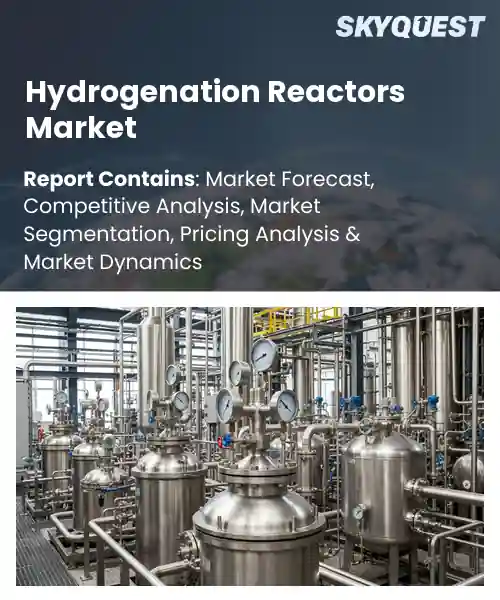
Hydrogenation Reactors Market
Report ID: SQMIG20I2668
Report ID: SQMIG20I2668
[email protected]
USA +1 351-333-4748
Report ID:
SQMIG20I2668 |
Region:
Global |
Published Date: February, 2026
Pages:
157
|Tables:
147
|Figures:
78


Global Hydrogenation Reactors Market size was valued at USD 1.4 Billion in 2024 and is poised to grow from USD 1.64 Billion in 2025 to USD 5.71 Billion by 2033, growing at a CAGR of 16.9% during the forecast period (2026-2033).
The primary driver of the hydrogenation reactors market is expanding demand for refined fuels and specialty chemicals, which compels producers to adopt selective hydrogenation processes. Hydrogenation reactors are vessels that enable catalytic addition of hydrogen across unsaturated bonds, and they matter because they underpin critical value chains from petrochemical desulfurization to pharmaceutical intermediate synthesis. Over decades the market moved from large, low-selectivity slurry systems used in edible oil hydrogenation toward smaller, controlled fixed-bed and trickle-bed reactors suited to fine chemicals and API manufacture. Examples include refinery hydrotreaters for sulfur removal and continuous-flow hydrogenation units in contract pharma, illustrating technological evolution.Building on that technological evolution, a key factor shaping the global hydrogenation reactors market is convergence of advanced catalyst formulations and continuous-flow reactor designs, which drive higher selectivity and safety. As catalysts lower activation energy and suppress side reactions, reactors can operate at milder conditions, causing energy consumption and costs to fall and making hydrogenation viable for specialty and pharmaceutical producers. Real-world adoption is visible where contract manufacturers install continuous-flow hydrogenation modules to shorten development timelines and reduce inventories of hazardous intermediates. Simultaneously, broader access to low-carbon hydrogen creates opportunities for decarbonized chemical production, prompting investment and new business models.
How is AI enhancing operational efficiency in the hydrogenation reactors market?
AI is improving operational efficiency in the hydrogenation reactors market by converting hidden reactor physics into real time, actionable control. Key aspects are advanced sensing, physics informed models and machine learning driven digital twins that predict unstable flow regimes and guide parameter adjustments. The current state features pilot scale deployments and algorithmic assistance for process stability, predictive maintenance and yield consistency. Market drivers include cost pressure and sustainability goals that make energy and feedstock efficiency top priorities. Practical instances range from ML guided catalytic optimization to spatial sensing that reveals gas holdup and mixing quality inside reactors.A clear recent development is Aduro and Siemens May 2025, when Siemens agreed to provide advanced control systems and digital twin capability for Aduro’s pilot plant. That project shows how AI enabled automation can optimize reactor conditions, reduce energy per run and accelerate reliable scale up.
Market snapshot - (2026-2033)
Global Market Size
USD 1.4 Billion
Largest Segment
Fixed-Bed Reactors
Fastest Growth
Slurry Reactors
Growth Rate
16.9% CAGR
To get more insights on this market click here to Request a Free Sample Report
Global hydrogenation reactors market is segmented by type of reactor, catalyst type, scale of operation, operating conditions, application and region. Based on type of reactor, the market is segmented into Fixed-Bed Reactors, Slurry Reactors, Fluidized-Bed Reactors and Batch Reactors. Based on catalyst type, the market is segmented into Homogeneous Catalysts, Heterogeneous Catalysts and Biocatalysts. Based on scale of operation, the market is segmented into Small Scale, Medium Scale and Large Scale. Based on operating conditions, the market is segmented into Low Pressure, Medium Pressure and High Pressure. Based on application, the market is segmented into Petrochemical Production, Pharmaceuticals, Food & Beverage, Fine Chemicals and Polymer Production. Based on region, the market is segmented into North America, Europe, Asia Pacific, Latin America and Middle East & Africa.
Fixed-Bed Reactors segment dominates because their continuous, packed-bed architecture ensures stable contact between hydrogen, feedstock, and solid catalysts, facilitating straightforward catalyst containment and predictable deactivation profiles. That reliability reduces unplanned downtime and simplifies maintenance, encouraging their use in high-throughput petrochemical and polymer processes. Mature engineering practices and compatibility with robust heterogeneous catalysts further lower operational complexity and lifecycle costs, reinforcing preference within the Hydrogenation Reactors Market.
However, slurry reactors are emerging as the fastest growing option due to superior heat and mass transfer and flexible catalyst handling for fine chemical and pharmaceutical hydrogenations. Advances in catalyst recovery and reactor internals enable selective chemistries under milder conditions, creating new application spaces and driving future investment and market expansion.
Heterogeneous Catalysts segment dominates because their solid form allows easy separation from products and robust performance across a wide range of temperatures and pressures, aligning with continuous reactor configurations widely used in industry. Their recyclability and resistance to contamination reduce downstream purification burdens, encouraging integration with fixed-bed and fluidized-bed reactors for large scale petrochemical, polymer and fine chemical operations, thereby shaping capital and process design decisions in the Hydrogenation Reactors Market.
However, homogeneous catalysts are witnessing the strongest growth momentum as superior selectivity and enantioselective performance address pharmaceutical and fine chemical quality demands. Improvements in recovery and immobilization reduce catalyst loss while milder operating conditions lower impurity risks, encouraging adoption in specialty transformations and enabling new reactor-catalyst integration that expands market opportunities.
To get detailed segments analysis, Request a Free Sample Report
Asia Pacific leads due to a dense concentration of downstream chemical and refining capacity, proactive industrial investment, and strong OEM and engineering presence that together accelerate deployment of advanced hydrogenation technology. Large domestic manufacturing bases in specialty chemicals, petrochemicals, and pharmaceuticals create sustained demand for reactors, while regional supply chains and component manufacturing lower lead times and costs. Supportive policy frameworks promoting industrial modernization and collaborations between local firms and international technology providers enhance technology transfer and customization. Skilled engineering talent and a competitive vendor landscape enable rapid scaling and aftermarket support. Integration with regional hydrogen production initiatives and investments in catalyst development further bolster capabilities, positioning the region as an innovation and production hub for hydrogenation reactors. Close collaboration with academic research centers sustains iterative innovation and process optimization.
Hydrogenation Reactors Market in Japan benefits from a deep engineering supply base, strong OEM capabilities, and focused catalyst research that supports high-efficiency reactor design. Demand is driven by advanced chemical synthesis and precision pharmaceutical manufacturing, while local integration with hydrogen infrastructure and industrial automation enables reliable operation and rapid commissioning. Close partnerships between manufacturers, research institutes, and component suppliers foster tailored solutions and robust aftermarket services that suit complex requirements.
Hydrogenation Reactors Market in South Korea is supported by a strong industrial fabrication sector, advanced catalytic research, and close collaboration between conglomerates and specialized engineering firms. Focus on high-throughput chemical production and refined fuel processing drives demand for modular and high-efficiency reactor solutions. Local manufacturing excellence and a responsive supply chain enable customization and shorter delivery times, while service networks and technical training programs ensure reliable installation and performance optimization.
North America is experiencing rapid expansion driven by a convergence of factors that elevate demand for hydrogenation reactors across refining, petrochemical, and specialty chemical segments. Policy and market emphasis on cleaner fuel pathways and renewable feedstocks has increased retrofit activity and incentivized deployment of modern reactor technologies. Strong capital availability and active partnerships between technology providers, engineering firms, and end users accelerate project execution and scale-up. Intensive research and development from industrial laboratories and universities yields improved catalysts and process intensification techniques, enhancing reactor throughput and selectivity. A mature service ecosystem and broad aftermarket capabilities support reliable operation and lifecycle management. Availability of skilled process engineers and integrated North America supply chains reduces implementation risk and shortens project cycles, reinforcing market momentum.
Hydrogenation Reactors Market in United States is characterized by active retrofit demand, strong industrial research and development, and base of engineering and construction firms capable of executing complex projects. Focus on renewable fuel production, specialty chemical synthesis, and advanced pharmaceuticals drives specifications for high-performance reactors. Deep service networks, catalyst development expertise, and close collaboration between technology vendors and end users enable rapid adoption of optimized reactor designs and lifecycle support.
Hydrogenation Reactors Market in Canada benefits from a strong energy and chemical processing base, proximity to regional projects, and a focus on fuels and specialty chemicals requiring modern hydrogenation solutions. Local engineering firms and fabricators support bespoke reactor builds and retrofits, while collaborations with universities drive catalyst and process improvements. Emphasis on operational reliability, safety standards, and long-term service agreements ensures sustained demand for advanced reactor technologies and aftermarket support.
Europe is strengthening its position through coordinated industrial strategies that prioritize decarbonization, advanced catalyst development, and integration of renewable feedstocks into conventional processes. Emphasis on stringent safety and technical standards drives higher-quality engineering and fosters trust in complex reactor projects. National and cross-border collaborations among OEMs, research institutions, and end users accelerate technology maturation and commercialization. Significant retrofit activity in legacy plants, combined with a focus on modular and energy-efficient reactor designs, enhances competitiveness. Robust aftermarket services and skilled technical workforces ensure operational reliability. By aligning regulatory incentives with industrial innovation and supply chain localization, the region is reinforcing capabilities across design, fabrication, and long-term support for hydrogenation reactors. Investment in pilot facilities and standardized testing centers, alongside workforce upskilling initiatives, strengthens confidence among industrial adopters and supports wider deployment across diverse chemical, refining, and pharmaceutical applications.
Hydrogenation Reactors Market in Germany is anchored by advanced engineering firms, strong catalyst research, and concentrated chemical industry clusters that demand precision reactor systems. High manufacturing standards and close collaboration with technical institutes accelerate commercialization of improved reactor designs. A comprehensive supply chain and experienced service providers support customization, rigorous testing, and reliable maintenance, enabling industrial operators to implement complex hydrogenation processes with confidence and optimize performance through ongoing collaboration.
Hydrogenation Reactors Market in United Kingdom is driven by a vibrant mix of academic research, specialty chemical production, and engineering contractors able to deliver modular reactor solutions. Emphasis on safety, process optimization, and catalyst innovation supports adoption in pharmaceutical and fine chemical sectors. Collaborative projects and consultancy expertise enable tailored reactor designs and efficient commissioning. Aftermarket service and training programs further ensure operational continuity and knowledge transfer to industrial operators.
Hydrogenation Reactors Market in France benefits from a strong chemical industry heritage, catalyst developers, and diversified manufacturing capabilities that support bespoke and standardized reactor solutions. National research centers collaborate with industrial partners to refine process technologies and improve catalyst performance. Emphasis on energy efficiency and regulatory compliance encourages retrofits and modern designs. Local engineering firms provide integrated project management and aftercare services, helping operators achieve reliable production and operational improvement.
To know more about the market opportunities by region and country, click here to
Buy The Complete Report
Growing Demand For Low Carbon Hydrogen
Technological Advancements In Reactors
High Capital Expenditure Requirements
Stringent Safety And Regulatory Requirements
Request Free Customization of this report to help us to meet your business objectives.
Competitive landscape in the global hydrogenation reactors market is being reshaped by continuous-flow and heat-exchanger reactor innovations that shorten scale-up time and reduce plant footprint, driving direct competition among OEMs and deeptech entrants. Strategic moves include targeted financing and industrial partnerships to secure project pipelines. Examples include KHIMOD’s HER commercialization, Elyse Energy’s institutional financing and project partnerships, and spin-outs commercializing ATJ hydrogenation technology.
Top Player’s Company Profile
Recent Developments
SkyQuest’s ABIRAW (Advanced Business Intelligence, Research & Analysis Wing) is our Business Information Services team that Collects, Collates, Correlates, and Analyses the Data collected by means of Primary Exploratory Research backed by robust Secondary Desk research. As per SkyQuest analysis, the global hydrogenation reactors market is being driven primarily by rising demand for refined fuels and specialty chemicals that require selective hydrogenation, and further accelerated by advances in catalyst formulations and continuous-flow reactor designs which boost selectivity and safety. Growth is restrained by high capital expenditure and complex regulatory and safety requirements for hydrogen handling that slow project timelines. Asia Pacific leads the market thanks to concentrated chemical and refining capacity and strong OEM ecosystems, while fixed-bed reactors remain the dominant segment due to their operational reliability and compatibility with heterogeneous catalysts. Suppliers that couple modular designs with digital optimization are best positioned to capture growth.
| Report Metric | Details |
|---|---|
| Market size value in 2024 | USD 1.4 Billion |
| Market size value in 2033 | USD 5.71 Billion |
| Growth Rate | 16.9% |
| Base year | 2024 |
| Forecast period | (2026-2033) |
| Forecast Unit (Value) | USD Billion |
| Segments covered |
|
| Regions covered | North America (US, Canada), Europe (Germany, France, United Kingdom, Italy, Spain, Rest of Europe), Asia Pacific (China, India, Japan, Rest of Asia-Pacific), Latin America (Brazil, Rest of Latin America), Middle East & Africa (South Africa, GCC Countries, Rest of MEA) |
| Companies covered |
|
| Customization scope | Free report customization with purchase. Customization includes:-
|
To get a free trial access to our platform which is a one stop solution for all your data requirements for quicker decision making. This platform allows you to compare markets, competitors who are prominent in the market, and mega trends that are influencing the dynamics in the market. Also, get access to detailed SkyQuest exclusive matrix.
Table Of Content
Executive Summary
Market overview
Parent Market Analysis
Market overview
Market size
KEY MARKET INSIGHTS
COVID IMPACT
MARKET DYNAMICS & OUTLOOK
Market Size by Region
KEY COMPANY PROFILES
Methodology
For the Hydrogenation Reactors Market, our research methodology involved a mixture of primary and secondary data sources. Key steps involved in the research process are listed below:
1. Information Procurement: This stage involved the procurement of Market data or related information via primary and secondary sources. The various secondary sources used included various company websites, annual reports, trade databases, and paid databases such as Hoover's, Bloomberg Business, Factiva, and Avention. Our team did 45 primary interactions Globally which included several stakeholders such as manufacturers, customers, key opinion leaders, etc. Overall, information procurement was one of the most extensive stages in our research process.
2. Information Analysis: This step involved triangulation of data through bottom-up and top-down approaches to estimate and validate the total size and future estimate of the Hydrogenation Reactors Market.
3. Report Formulation: The final step entailed the placement of data points in appropriate Market spaces in an attempt to deduce viable conclusions.
4. Validation & Publishing: Validation is the most important step in the process. Validation & re-validation via an intricately designed process helped us finalize data points to be used for final calculations. The final Market estimates and forecasts were then aligned and sent to our panel of industry experts for validation of data. Once the validation was done the report was sent to our Quality Assurance team to ensure adherence to style guides, consistency & design.
Analyst Support
Customization Options
With the given market data, our dedicated team of analysts can offer you the following customization options are available for the Hydrogenation Reactors Market:
Product Analysis: Product matrix, which offers a detailed comparison of the product portfolio of companies.
Regional Analysis: Further analysis of the Hydrogenation Reactors Market for additional countries.
Competitive Analysis: Detailed analysis and profiling of additional Market players & comparative analysis of competitive products.
Go to Market Strategy: Find the high-growth channels to invest your marketing efforts and increase your customer base.
Innovation Mapping: Identify racial solutions and innovation, connected to deep ecosystems of innovators, start-ups, academics, and strategic partners.
Category Intelligence: Customized intelligence that is relevant to their supply Markets will enable them to make smarter sourcing decisions and improve their category management.
Public Company Transcript Analysis: To improve the investment performance by generating new alpha and making better-informed decisions.
Social Media Listening: To analyze the conversations and trends happening not just around your brand, but around your industry as a whole, and use those insights to make better Marketing decisions.
REQUEST FOR SAMPLE
 REQUEST FREE CUSTOMIZATION


Want to customize this report? This report can be personalized according to your needs. Our analysts and industry experts will work directly with you to understand your requirements and provide you with customized data in a short amount of time. We offer $1000 worth of FREE customization at the time of purchase.
Feedback From Our Clients


 USA (+1) 351-333-4748

