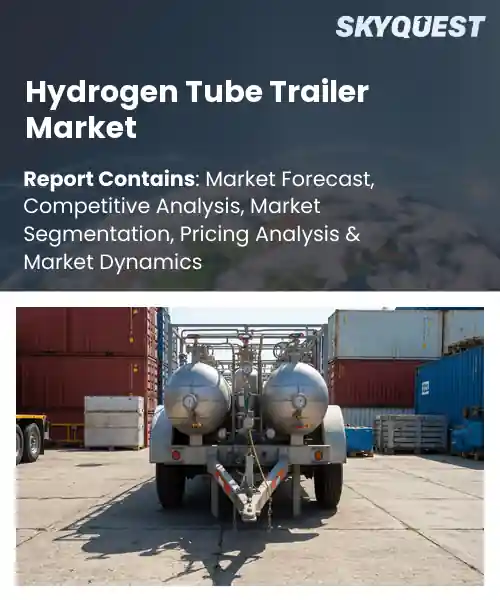
Hydrogen Tube Trailer Market
Report ID: SQMIG20F2055
Report ID: SQMIG20F2055
[email protected]
USA +1 351-333-4748
Report ID:
SQMIG20F2055 |
Region:
Global |
Published Date: May, 2026
Pages:
157
|Tables:
208
|Figures:
80


Global Hydrogen Tube Trailer Market size was valued at USD 634.20 Million in 2024 and is poised to grow from USD 681.13 Million in 2025 to USD 1205.77 Million by 2033, growing at a CAGR of 7.4% during the forecast period (2026-2033).
One key factor driving the hydrogen tube trailer market growth is the increasing worldwide demand for logistics solutions which will support decarbonization and hard-to-abate industrial applications. This market includes trucks that have been outfitted with high-pressure cylinders (tubes) to transport hydrogen from large central plants or local electrolyzers to end users in a rapid manner (via trailer rather than pipeline) when pipelines do not exist. The development of this sector can be traced to the historical use of tubes in transporting other industrial gases (such as CO2 and other gases) for welding and as feedstock (raw material used in manufacturing) in the chemical industry before it became a strategic bridge for not only hydrogen fueling stations but also for the early stages of development of green hydrogen projects (e.g. Germany and California), where effective government policy coupled with advancements in technology helped to transform logistics and facilitate the maturation rate of the market.
A crucial factor currently influencing the global hydrogen tube trailer market trends is the rate and geography at which hydrogen production capacity is growing. Specifically, hydrogen production capacity from an electrolyzer or SMR (steam methane reformer), without being connected to an existing pipeline distribution network, will drive the need for mobile cylinder transportation as a means of bridging the supply gap. As a result, companies will be incentivized to purchase larger-capacity tube trailers in order to reduce their cost per delivered unit and to facilitate the faster rollout of hydrogen refueling stations. For example, operators of fleets supplying hydrogen buses throughout various cities in Europe and companies supplying hydrogen to industrial customers near locations with short-term intermittent renewable generation sources use tube trailers to help them match their demand for hydrogen to the variability of hydrogen production and, as they achieve economies of scale, the supply of hydrogen will become more affordable and the potential for commercial opportunities will be greater than just their current market segments (e.g. long-distance trucking, maritime bunkering).
How is IoT Improving Safety and Monitoring in the Hydrogen Tube Trailer Market?
Through the use of IoT technologies in the hydrogen tube trailer industry, the safety and monitoring of these containers will be enhanced through a sensor network, control systems and analytical functions that provide operators with continuous visibility of their assets and allow for automating responses. The three main focus areas of this technology includes: remote sensing of pressure, temperature and flow; Real-time alarms for automatic isolation actions in order to reduce the possibility of human error; and finally, along with providing security telemetry, these connected trailers will provide a method for tracking route and condition to create a safer experience when handling hydrogen. The industry is expected to transition from pilot programs to widespread distribution, with increasing oversight of safety regulations in order to demonstrate compliance. This will positively impact operational risk by providing ways to lower the risk of accident by enabling faster repairs through remote diagnostics and reducing time spent on delivery inspections through the use of live inspection logs.
Powertech Labs, in May 2026, introduced to the Industry an innovative smart hydrogen tube trailer featuring integrated onboard IoT sensing device capabilities, providing full Functional Safety for automating isolation valves and enabling live telemetry. The result of Powertech's innovation is to support the further development of the hydrogen tube trailer market through reduced operational risk, increased delivery uptime and increased confidence from operators of their fleets.
Market snapshot - (2026-2033)
Global Market Size
USD 634.2 Million
Largest Segment
Intermediate Tube Trailer
Fastest Growth
Modular Tube Trailer
Growth Rate
7.4% CAGR
To get more insights on this market click here to Request a Free Sample Report
Global hydrogen tube trailer market is segmented by trailer type, material type, pressure rating, storage capacity, tube type, application, end user and region. Based on trailer type, the market is segmented into modular tube trailer, intermediate tube trailer, jumbo tube trailer and others. Based on material type, the market is segmented into steel, composite and aluminum. Based on pressure rating, the market is segmented into below 250 bar, 250–500 bar and above 500 bar. Based on storage capacity, the market is segmented into below 500 kg, 500–1,000 kg and above 1,000 kg. Based on tube type, the market is segmented into type I, type II, type III and type IV. Based on application, the market is segmented into hydrogen fuel stations, industrial use, hydrogen mobility & transportation, energy storage & power applications, chemical & petrochemical processing and others. Based on end user, the market is segmented into Industrial gas companies, hydrogen producers & suppliers, refueling infrastructure operators, chemical manufacturers, energy & utility companies and others. Based on region, the market is segmented into North America, Europe, Asia Pacific, Latin America, and Middle East & Africa.
The modular tube trailer segment is leading the way due to its modular design that allows for incremental increases in capacity and quick adaptability to different hydrogen distribution networks. Operators are able to add and remove modular banks to meet their demand which helps maintain little idle capacity and streamlines utility maintenance which will reduce operational friction. This flexibility is encouraging adoption for both refueling and industrial applications by enabling assets to be repurposed, reducing deployment time frames, and improving logistics efficiencies through standardized interfaces and simplified handling.
The intermediate tube trailer segment is the fastest growing segment of all modular tube trailer segments because it has transportable capacity and is highly maneuverable which makes it ideal for medium-range distribution demands, providing easy fleet integration opportunities. Improvements in manufacturing processes and ability to be used with standard handling systems are facilitating fleet upgrades and creating opportunities for operators to increase both their delivery frequency as well as their service coverage area.
The composite segment offers improved operational range and payload efficiency due to its lower tare weights and superior corrosion resistance, both of which directly translate into lower transport costs and improved handling as trailers can carry more hydrogen each trip. In addition, reduced structural mass lowers maintenance and inspires operators’ interest in lifecycle-cost efficiency as a result of superior fatigue performance and the ability to tailor material layups.
Aluminium is continuing to see the strongest growth as a result of moderate weight savings but with the benefit of an established manufacturing supply chain, resulting in lower purchase costs and easier regulatory approvals. Advances in aluminium alloys and joining techniques have improved the performance of aluminium under pressure, enabling faster sourcing and broader use by operators who want to spend less money up front for their equipment.
To get detailed segments analysis, Request a Free Sample Report
The Asia-Pacific region plays a leading role in the global hydrogen tube logistics market because of its integrated industrial strategies; concentrated manufacturing capabilities; and, coordinated supply chain improvements. In addition to a strong legacy of leadership in fuel-cell technology, heavy industry activity in this region has produced a consistent market demand for reliable hydrogen logistics. In addition, Asian countries have hydrogen production plants adjacent to their main cities, reducing the logistical complexity connected with transporting hydrogen. Equipment makers, energy producers and end-users frequently work collaboratively to expedite the adoption of hydrogen tube trailers that meet their specific operational conditions. Since Asia-Pacific countries have efficient trade networks and port facilities to accommodate the movement of large-sized vessels or special components, they also have a highly developed service and maintenance network for hydrogen tube trailers. Thus, with the regional policy emphasis on decarbonisation working in tandem with market forces to provide financing for the development and deployment of refuelling and distribution infrastructure, the Asia Pacific region will continue to be the conduit for technical innovation and scalable development in hydrogen. These networks of developers and training programs for end-users also strengthen the operational resilience and maturity of this market.
Hydrogen tube trailer market share in Japan benefits from strong industrial demand, close integration with fuel cell vehicle programs, and established precision manufacturing capability. Domestic suppliers focus on high quality fabrication, system reliability, and stringent safety processes, enabling operator confidence in long haul and point to point delivery. Collaborative pilot initiatives between energy companies and transport providers refine logistics practices, while dense service networks support maintenance and deployment across industrial clusters.
Hydrogen tube trailer market penetration in South Korea will experience significant growth via development of a strong refueling infrastructure, integrated supply chains, and active investments within the marketplace by industries looking for alternative mobility solutions. To meet the needs of many different customer operator profiles, local manufacturers are placing an emphasis on developing modular designs that create trailer versatility while ensuring safety and serviceability. Infrastructure partnerships between energy suppliers and logistics providers are critical to achieving high frequency of delivery to urban customers. Workforce development and training, as well as creation of specialty service centers, will help improve system uptime and create an environment conducive to encouraging greater mobility across all transportation modes.
Europe rapid expansion of the hydrogen tube trailer market is driven by integrated decarbonization agendas, strong refueling infrastructure development, and cohesive industry alliances that link equipment makers, energy suppliers, and transport operators. Strategic investments in modular logistics solutions respond to diversified demand across industrial hydrogen users and mobility segments. Cross border connectivity and a dense network of service providers facilitate flexible distribution models, while rigorous safety and certification frameworks build operator confidence. Market momentum is further supported by collaborative pilot deployments that refine standards and operational best practices, enabling manufacturers to adapt designs for varied terrains and regulatory environments and positioning the region as a dynamic arena for specialized trailer innovation. Robust financing mechanisms and coordinated public private initiatives create a favorable environment for scaling fleets and enhancing after sales support across national markets.
Hydrogen tube trailer market regional outlook in Germany is underpinned by solid industrial hydrogen activity, existing transportation systems to provide dependable transportation of hydrogen, and established engineering and production capacities. Manufacturers are producing rugged, compliant trailers that are well suited to an industrial (and heavy-duty) delivery profile. The close collaboration between manufacturers of equipment and service providers ensures that maintenance service providers have access to their customers' equipment in order to maintain it and provide parts when needed. Centralized procurement by major customers facilitates customization, while regional hubs provide the infrastructure for an efficient route network and distribution support across the geographic clusters.
Hydrogen tube trailer market regional forecast in United Kingdom is characterized by active private sector engagement, expanding refueling networks, and policies that encourage fleet trials. Suppliers adapt lightweight modular designs to meet urban and interregional delivery needs, while service providers broaden maintenance capabilities along key corridors. Collaboration among technology providers, transport operators, and energy companies accelerates operational learning. Pilot initiatives and flexible procurement enable iteration of trailer designs for diverse use cases.
Hydrogen tube trailer industry in France is developing out of regional hydrogen schemes, adaptable transport testing lanes and an expanding number of suppliers who are focused on ensuring their products meet safety and regulatory requirements. Manufacturers and integrators are producing trailers that have been optimized for operating in mixed duty cycles and provide rural/urban distribution patterns. There are energy cluster organisations collaborating with transport operators to test and refine operational protocols and support local service centres and training initiatives for operators to deploy and grow their operations within regions.
North America is strengthening its position in the hydrogen tube trailer market through a combination of private sector investment, coordinated infrastructure planning, and collaboration between technology developers and logistics providers. Industrial demand centers and growing mobility initiatives create varied use cases that encourage flexible trailer configurations and advanced safety systems. Manufacturers focus on modular designs and serviceability to meet diverse regional requirements, while transport operators refine routing and scheduling models to optimize fill cycles. Public private partnerships and targeted pilot programs foster knowledge exchange and standards alignment, enabling a maturing aftermarket network and improved operator support across cross country distribution corridors. Enhanced focus on workforce training, localized maintenance hubs, and supplier consolidation contributes to operational resilience and scalability, while proximity between production sites and consumption centers shortens logistics pathways and supports rapid response capabilities.
Hydrogen tube trailer market analysis in United States, several factors drive its growth, including varying industrial demands; the supplier ecosystem; and transport/logistics planning between the regional "hub" facilities. Most manufacturers of hydrogen tube trailers are focused on designing modular transportable trailers that will facilitate a variety of duty cycles and meet different levels of safety requirements. Improved fuel economy and lower emissions are examples of how collaboration between energy companies and fleet operators leads to better refinement of operational processes and expanding the maintenance network. Developing the hydrogen workforce and developing local service centers will maximize uptime, while private sector pilot programs provide real-world examples that improve scalability.
Hydrogen tube trailer market outlook in Canada is greatly affected by energy-related activity in specific regions, logistics involved with traveling long distances, and a collaborative working relationship between suppliers and end-users. To accommodate remote delivery routes due to geographic constraints (e.g., rough terrain or long distances between locations), hydrogen manufacturers are designing these trucks with emphasis on both durability and serviceability. Improved route planning and reduced downtime are achieved through better coordination among provincial hubs and transport operators. To improve operational resiliency, producers will continue to invest heavily in the training and maintenance of their employees and equipment; pilot deployments to industrial customers provide validation to logistics models.
To know more about the market opportunities by region and country, click here to
Buy The Complete Report
Government Support and infrastructure
Rising Hydrogen Production Capacity
Safety and Regulatory Complexity
High Capital and operational Costs
Request Free Customization of this report to help us to meet your business objectives.
As the global market for hydrogen tube trailers continues to grow, logistics scale, technological advancements in cylinder design and requirements for regulatory certification are all driving competition. With increased competition, M&A activities between suppliers, partnerships between suppliers and M&A activities become more common as companies seek to differentiate themselves from competitors by developing new technologies/products that can secure route contracts. With the acquisition of another company's trailer portfolio or joint venture with an existing firm who produces trailers, companies are also able to secure their own delivery assets that comply with regional standards while establishing long-term supply contracts with potential customers.
Top Player’s Company Profile
Recent Developments in the Hydrogen Tube Trailer Market
SkyQuest’s ABIRAW (Advanced Business Intelligence, Research & Analysis Wing) is our Business Information Services team that Collects, Collates, Correlates, and Analyses the Data collected by means of Primary Exploratory Research backed by robust Secondary Desk research. As per SkyQuest analysis, the global hydrogen tube trailer market is being propelled by accelerating demand for logistics that support decarbonization and hard-to-abate industries while modular tube trailers lead due to flexible, scalable architecture that lowers operational friction. Asia Pacific dominates the market supported by integrated manufacturing, policy support and supply chain proximity. A major restraint remains stringent safety and regulatory complexity across jurisdictions that increases compliance costs and slows cross-border fleet expansion. A second important driver is rising hydrogen production capacity which creates geographic gaps between production and consumption and boosts demand for mobile transport solutions. The market outlook favors modular, IoT-enabled trailers that improve uptime and safety.
| Report Metric | Details |
|---|---|
| Market size value in 2024 | USD 634.2 Million |
| Market size value in 2033 | USD 1205.77 Million |
| Growth Rate | 7.4% |
| Base year | 2024 |
| Forecast period | (2026-2033) |
| Forecast Unit (Value) | USD Million |
| Segments covered |
|
| Regions covered | North America (US, Canada), Europe (Germany, France, United Kingdom, Italy, Spain, Rest of Europe), Asia Pacific (China, India, Japan, Rest of Asia-Pacific), Latin America (Brazil, Rest of Latin America), Middle East & Africa (South Africa, GCC Countries, Rest of MEA) |
| Companies covered |
|
| Customization scope | Free report customization with purchase. Customization includes:-
|
To get a free trial access to our platform which is a one stop solution for all your data requirements for quicker decision making. This platform allows you to compare markets, competitors who are prominent in the market, and mega trends that are influencing the dynamics in the market. Also, get access to detailed SkyQuest exclusive matrix.
Table Of Content
Executive Summary
Market overview
Parent Market Analysis
Market overview
Market size
KEY MARKET INSIGHTS
COVID IMPACT
MARKET DYNAMICS & OUTLOOK
Market Size by Region
KEY COMPANY PROFILES
Methodology
For the Hydrogen Tube Trailer Market, our research methodology involved a mixture of primary and secondary data sources. Key steps involved in the research process are listed below:
1. Information Procurement: This stage involved the procurement of Market data or related information via primary and secondary sources. The various secondary sources used included various company websites, annual reports, trade databases, and paid databases such as Hoover's, Bloomberg Business, Factiva, and Avention. Our team did 45 primary interactions Globally which included several stakeholders such as manufacturers, customers, key opinion leaders, etc. Overall, information procurement was one of the most extensive stages in our research process.
2. Information Analysis: This step involved triangulation of data through bottom-up and top-down approaches to estimate and validate the total size and future estimate of the Hydrogen Tube Trailer Market.
3. Report Formulation: The final step entailed the placement of data points in appropriate Market spaces in an attempt to deduce viable conclusions.
4. Validation & Publishing: Validation is the most important step in the process. Validation & re-validation via an intricately designed process helped us finalize data points to be used for final calculations. The final Market estimates and forecasts were then aligned and sent to our panel of industry experts for validation of data. Once the validation was done the report was sent to our Quality Assurance team to ensure adherence to style guides, consistency & design.
Analyst Support
Customization Options
With the given market data, our dedicated team of analysts can offer you the following customization options are available for the Hydrogen Tube Trailer Market:
Product Analysis: Product matrix, which offers a detailed comparison of the product portfolio of companies.
Regional Analysis: Further analysis of the Hydrogen Tube Trailer Market for additional countries.
Competitive Analysis: Detailed analysis and profiling of additional Market players & comparative analysis of competitive products.
Go to Market Strategy: Find the high-growth channels to invest your marketing efforts and increase your customer base.
Innovation Mapping: Identify racial solutions and innovation, connected to deep ecosystems of innovators, start-ups, academics, and strategic partners.
Category Intelligence: Customized intelligence that is relevant to their supply Markets will enable them to make smarter sourcing decisions and improve their category management.
Public Company Transcript Analysis: To improve the investment performance by generating new alpha and making better-informed decisions.
Social Media Listening: To analyze the conversations and trends happening not just around your brand, but around your industry as a whole, and use those insights to make better Marketing decisions.
REQUEST FOR SAMPLE
 REQUEST FREE CUSTOMIZATION
Global Hydrogen Tube Trailer Market size was valued at USD 634.2 Million in 2024 and is poised to grow from USD 681.13 Million in 2025 to USD 1205.77 Million by 2033, growing at a CAGR of 7.4% during the forecast period (2026-2033).
Competition in the global hydrogen tube trailer market is driven by logistics scale, cylinder technology advances and regulatory certification, prompting M&A, supplier partnerships and product innovation to win route contracts. Chart Industries and Hexagon Purus expanded trailer portfolios through acquisition and joint ventures to commercialize Type IV composite modules, while new producers integrate certified delivery assets to secure regional supply chains and off take agreements. 'Hexagon Purus', 'CIMC Enric Holdings Limited', 'Luxfer Gas Cylinders', 'Faber Industrie S.p.A.', 'Worthington Enterprises', 'Everest Kanto Cylinder Ltd.', 'NPROXX B.V.', 'Quantum Fuel Systems LLC', 'FORVIA SE', 'Steelhead Composites, Inc.', 'Linde plc', 'Air Liquide S.A.', 'Chart Industries, Inc.', 'Wystrach GmbH', 'Cockerill Jingli Hydrogen', 'FIBA Technologies, Inc.', 'VRV S.p.A.', 'Roth Composite Machinery GmbH', 'Welz Gas Cylinder GmbH', 'Corun Hydrogen Technology Co., Ltd.'
Strong policy incentives, financial support, and coordinated infrastructure planning have encouraged fleet operators and logistics providers to invest in specialized equipment such as hydrogen tube trailers. Clear regulatory frameworks and safety standards reduce perceived operational risk, enabling manufacturers and transporters to justify capital expenditures. Public funding for pilot projects and corridor development fosters collaboration across supply chain participants, accelerating deployment and creating market confidence. These conditions stimulate demand for reliable transport solutions and incentivize suppliers to expand production and technological capabilities.
Infrastructure Standardization: Harmonized standards and refilling interfaces are driving deployment of hydrogen tube trailers across markets. Stakeholders are aligning specifications for pressures, fittings, and safety protocols to reduce logistical friction and enable cross border operations. This alignment is fostering supplier consolidation, simplifying procurement and maintenance, and accelerating confidence among fleet operators and energy providers. Standardization supports modular trailer designs, facilitates scaling of distribution networks, and lowers time to market for transport hubs, creating a more predictable environment for investment and operational planning.
Why does Asia Pacific Dominate the Global Hydrogen Tube Trailer Market? |@12


Want to customize this report? This report can be personalized according to your needs. Our analysts and industry experts will work directly with you to understand your requirements and provide you with customized data in a short amount of time. We offer $1000 worth of FREE customization at the time of purchase.
Feedback From Our Clients


 USA (+1) 351-333-4748

