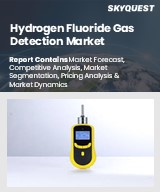
Hydrogen Fluoride Gas Detection Market
Report ID: SQMIG20D2354
Report ID: SQMIG20D2354
[email protected]
USA +1 351-333-4748
Report ID:
SQMIG20D2354 |
Region:
Global |
Published Date: December, 2025
Pages:
185
|Tables:
91
|Figures:
69


Global Hydrogen Fluoride Gas Detection Market size was valued at USD 2.81 Billion in 2024 and is poised to grow from USD 2.91 Billion in 2025 to USD 3.96 Billion by 2033, growing at a CAGR of 3.9% during the forecast period (2026–2033).
There is consistent growth happening in the market due to the heightened attention being paid to the industrial safety standards in the chemicals, semiconductors, and metallurgy industries. Hydrogen fluoride (HF) is dangerous and corrosive and can only be adequately detected and monitored accurately and in real-time to avoid death from accidents and to meet occupational health and safety standards. Furthermore, environmental regulations frame many laws that require the installation of HF detectors at manufacturing sites, which continues to work in favor of growing this market. Finally, there is further growth in the market driven by the increased quantity of semiconductor fabrication units that will use HF when etching wafers.
Although the market faces constraints, the steep price of advanced detection systems and the potential challenge of leveraging existing infrastructure to merge identifying systems will be one limitation. Smaller businesses may not always be able to pay such substantive up-front capital expenditures for advanced gas monitoring systems or sometimes justify it. Technical constraints can also present challenges, as factors such as calibration drift, sensor poisoning and maintenance in dynamic, industrial environments will limit the dependability of some detection technologies.
How are Emerging Technologies like AI and IOT Transforming the Hydrogen Fluoride Gas Detection Market?
Artificial intelligence (AI) and the Internet of Things (IoT) are advancing rapidly, providing efficiencies in the hydrogen fluoride (HF) gas detection market strategies, through improved safety in its management. AI-enabled sensor fusion models are capable of processing multiple streams of real-time data from various sensors, such as electrochemical, optical, thermal, and radar from many sensors to differentiate and identify the presence of HF, and to mitigate false alarms. IoT connectivity provides streams of data to cloud-based platforms that provide centralized monitoring, alerts, analytics, and predictive analytics across entire industrial facilities. This provides operators with enhanced visibility into their operations, while also assisting organizations to comply with often strict workplace and environmental standards and regulations.
In July 2024, Honeywell International introduced an IoT-enabled detector for hydrogen fluoride gas that offers real-time remote monitoring. This smart sensor system enhances industrial safety with predictive maintenance alerts, early leak detection and improved access to digital platforms in the critical manufacturing environment, which reduces downtime and enhances response to hazards.
Market snapshot - 2026-2033
Global Market Size
USD 2.7 billion
Largest Segment
Portable Hydrogen Fluoride Gas Detectors
Fastest Growth
Fixed Hydrogen Fluoride Gas Detectors
Growth Rate
3.9% CAGR
To get more insights on this market click here to Request a Free Sample Report
Global Hydrogen Fluoride Gas Detection Market is segmented by Technology, Application, Accuracy Level and region. Based on Technology, the market is segmented into Portable Hydrogen Fluoride Gas Detectors, Fixed Hydrogen Fluoride Gas Detectors and Detector Tubes. Based on Application, the market is segmented into Semiconductor Industry, Chemical Industry, Medical Industry and Aerospace Industry. Based on Accuracy Level, the market is segmented into High Accuracy, Medium Accuracy and Low Accuracy. Based on region, the market is segmented into North America, Europe, Asia Pacific, Latin America and Middle East & Africa.
Based on the global hydrogen fluoride gas detection market forecast, fixed hydrogen fluoride gas detectors dominate the market due to the use of fixed detection systems in high-risk industries that work on a continuous-process basis, such as chemical manufacturing and semiconductor fabrication, found fixed detectors replacing portable detectors. More recently, workplace safety and stringent environmental regulations in developed countries have increased demand for fixed detection systems in new and existing industrial applications.
Portable hydrogen fluoride gas detectors are the fastest growing, due to flexibility, mobility and increasing utilization in temporary or mobile use situations. The compact nature, ease of calibration and affordability of portable units facilitate small and medium sized enterprises. There ongoing developments, like IoT integration, are making portable devices more intelligent via logging and accessible for use in developing world situations.
The chemical sector dominates the hydrogen fluoride gas detection market statistics, as it implements hydrogen fluoride to produce fluorinated chemicals, refrigerants, and high-octane fuels. Fixed gas detectors are commonly used in chemical sites, as they provide continuous leak detection, real-time alerts, and emergency shutdown integration. Increasing investments in the chemical sector's infrastructure along with tightening occupational health and safety standards will reinforce the existing dominance of this segment of the HF gas detection market.
The semiconductor sector is the fastest growing application area as more and more hydrogen fluoride is utilized for cleaning and etching wafers. There has been an added concern with the integration of smart HF detection systems to meet cleanroom standards and environmental regulations. Subsequently, HF detection solutions with accuracy, connectivity, and minimal to no maintenance are in high demand in this sector.
To get detailed segments analysis, Request a Free Sample Report
As per the global hydrogen fluoride gas detection market analysis, North America dominates the global hydrogen fluoride gas detection market due to strict regulations for worker safety and environmental regulations in the U.S. and Canada. Investments for automation in these markets, investment in real time monitoring technologies is supporting growth of markets across several industries, including semiconductors, chemical, petrochemical supply and demand, and various environmentally regulated items or their industrial processes.
The United States is way ahead of the game in North America as per global hydrogen fluoride gas detection market regional outlook, largely due to the greater number of HF detectors in semiconductor fabs & chemical plants. In the United States OSHA and EPA have instated significant regulations, which compel real time HF monitoring in high-risk areas of the plants. Also, improvements in detection systems featuring digital interfaces and wirelessly have been implemented across major industrial plants, which have multiplied safety responsiveness and predictive maintenance.
Canada is witnessing rapid growth due to increased HF use in pharma and energy sectors. The government is focused on strengthening safety in industry, which has provided a better opportunity to use a modern detection system especially in refining and chemical processing units. They have updated safety protocols in chemical zones, privileged the deployment of IoT based HF detectors, to ensure, both that there are alerts in real time for things like regulatory compliance.
Europe continues to be a leading growth in as per global hydrogen fluoride gas detection market regional forecast, with great growth potential frameworks such as, REACH and reinforced environmental and compliance expectations. Increased uptake of safety technologies related to hydrogen fluoride across the chemical, pharmaceutical, and electronics industries in Germany, France and the U.K., has helped to facilitate demand. The combined drive for automating and ensuring worker safety along with the funding for clean manufacturing has propelled more industries to upgrade to modern hydrogen fluoride detection devices.
Germany is the key stakeholder in Europe's HF detection market, given its powerful chemical industry portfolio and extensive use of hydrogen fluoride, which has resulted in enforcement of regulations and applications of fixed and smart HF sensors across industrial plants. The development of HF sensors has included the application of advanced optical sensors at larger chemical sites for meeting new EU safety standards and to help improve early leak detection with little maintenance.
France is quickly moving toward becoming a real leader in the global hydrogen fluoride gas detection market growth, leveraged by increases in specialty chemicals and pharmaceuticals. The intensely growing need for accurate gas monitoring in production and research facilities meant that their upgrade in the pharmaceutical investing industrial zone led to the ability to run networked HF gas sensors with real-time alerts and ultimately allowed for a far greater awareness to comply with EU compliance and commitment to improving occupational health.
The U.K. is moving steadily along the path of regulatory pressure and technology readiness in the aerospace, electronics, and laboratory spheres. Safety modernization projects associated with legacy manufacturing sites have created increased demand for portable HF detectors and centralized gas monitoring systems. It was there, at a defense-related facility, that AI-enabled HF detection systems were incorporated. This indicates the new role of innovation to prevent hazards and better monitor the environment.
Asia Pacific has a sizable global hydrogen fluoride gas detection market share from quick industrialization stemming from the electronics, semiconductor, and chemicals market. There are expanding clearroom operations, investments in worker safety in Japan and South Korea is driving demand for highly sensitive HF detection systems. Additionally, the region supports the innovation of technological advances, and government initiatives providing favorable policy on smart infrastructure and automation of monitoring systems in high-risk industries.
Japan leads the way because of its premier semiconductor and electronics industries where HF is prevalent. When there are manufacturing buildings where they are relying on cleanroom standards there will be a demand for high levels of detection solutions that are accurate. They then began to institute the deployment of IoT capable HF detectors into their semiconductor fabs which helped improve early leak detection and reduce downtime in the industry with the focus of digital transformation and highly accurate safety systems.
South Korea is the fastest-growing country in the Asia pacific region, given the rapid growth in chip and display manufacturing. The combination of the government prioritizing digitalization of industries and environmental sustainability is driving demand for smart gas detection. They also initiated national safety reform, which included creating an action plan that included the installation of wireless HF sensors in electronic component factories, facilitating real-time hazard identification and compliance with revised safety standards.
To know more about the market opportunities by region and country, click here to
Buy The Complete Report
Stringent Workplace Safety and Environmental Regulations
Expansion of Semiconductor and Chemical Manufacturing
High Cost of Advanced Detection Technologies
Technical Challenges in Harsh Environments
Request Free Customization of this report to help us to meet your business objectives.
The global hydrogen fluoride gas detection market outlook is highly competitive, shaped by leaders in technology investing in strategic mergers, IoT-enabled products, and selective expansion. A global industrial safety organization has introduced AI-integrated fixed HF detectors with enhanced sensitivity and cloud-based analytics. A European specialist has partnered to roll out smart optical HF sensors in chemical plants. The actions of these leading organizations show how the leading companies compete through products with accuracy, digital connectivity, and regulatory-enabled solutions.
As per the global hydrogen fluoride gas detection industry analysis, the startup scene is rapidly evolving, new players are leveraging new sensor technologies including electrochemical and infrared-based detection systems to improve detection accuracy, and response times. Many start-ups are planning to leverage the Internet of Things (IoT) by providing monitoring and data analytics of hazards to assist in industrial safety in real-time. The start-ups are focused on developing simple and affordable products to compete with established brands and provide solutions to niche markets around the world.
SkyQuest’s ABIRAW (Advanced Business Intelligence, Research & Analysis Wing) is our Business Information Services team that Collects, Collates, Correlates, and Analyses the Data collected by means of Primary Exploratory Research backed by robust Secondary Desk research.
As per SkyQuest analysis, the global hydrogen fluoride gas detection industry is currently experiencing rapid growth, driven by the rapid development of AI and IoT technologies. AI-powered predictive analytics can help to improve overall accuracy of detection, while IoT-enabled sensors allow for real-time viewing of data remotely, workplace safety in chemical, oil & gas sectors can be greatly improved. However, there are still issues that the current market faces due to training and costs such as the high costs of advanced detection systems, while also still managing skilled personnel to better use the necessary technology.
While there may be constraints, the market is primed for growth, pulled that startup focuses are on cost effective, scalable solutions, and so are some of the solid players. Worker safety and legislation sound like the major priority for industries, but AI and IOT will continue to advance hydrogen fluoride gas detection as an important enabler.
| Report Metric | Details |
|---|---|
| Market size value in 2024 | USD 2.81 Billion |
| Market size value in 2033 | USD 3.96 Billion |
| Growth Rate | 3.9% |
| Base year | 2024 |
| Forecast period | 2026-2033 |
| Forecast Unit (Value) | USD Billion |
| Segments covered |
|
| Regions covered | North America (US, Canada), Europe (Germany, France, United Kingdom, Italy, Spain, Rest of Europe), Asia Pacific (China, India, Japan, Rest of Asia-Pacific), Latin America (Brazil, Rest of Latin America), Middle East & Africa (South Africa, GCC Countries, Rest of MEA) |
| Companies covered |
|
| Customization scope | Free report customization with purchase. Customization includes:-
|
To get a free trial access to our platform which is a one stop solution for all your data requirements for quicker decision making. This platform allows you to compare markets, competitors who are prominent in the market, and mega trends that are influencing the dynamics in the market. Also, get access to detailed SkyQuest exclusive matrix.
Table Of Content
Executive Summary
Market overview
Parent Market Analysis
Market overview
Market size
KEY MARKET INSIGHTS
COVID IMPACT
MARKET DYNAMICS & OUTLOOK
Market Size by Region
KEY COMPANY PROFILES
Methodology
For the Hydrogen Fluoride Gas Detection Market, our research methodology involved a mixture of primary and secondary data sources. Key steps involved in the research process are listed below:
1. Information Procurement: This stage involved the procurement of Market data or related information via primary and secondary sources. The various secondary sources used included various company websites, annual reports, trade databases, and paid databases such as Hoover's, Bloomberg Business, Factiva, and Avention. Our team did 45 primary interactions Globally which included several stakeholders such as manufacturers, customers, key opinion leaders, etc. Overall, information procurement was one of the most extensive stages in our research process.
2. Information Analysis: This step involved triangulation of data through bottom-up and top-down approaches to estimate and validate the total size and future estimate of the Hydrogen Fluoride Gas Detection Market.
3. Report Formulation: The final step entailed the placement of data points in appropriate Market spaces in an attempt to deduce viable conclusions.
4. Validation & Publishing: Validation is the most important step in the process. Validation & re-validation via an intricately designed process helped us finalize data points to be used for final calculations. The final Market estimates and forecasts were then aligned and sent to our panel of industry experts for validation of data. Once the validation was done the report was sent to our Quality Assurance team to ensure adherence to style guides, consistency & design.
Analyst Support
Customization Options
With the given market data, our dedicated team of analysts can offer you the following customization options are available for the Hydrogen Fluoride Gas Detection Market:
Product Analysis: Product matrix, which offers a detailed comparison of the product portfolio of companies.
Regional Analysis: Further analysis of the Hydrogen Fluoride Gas Detection Market for additional countries.
Competitive Analysis: Detailed analysis and profiling of additional Market players & comparative analysis of competitive products.
Go to Market Strategy: Find the high-growth channels to invest your marketing efforts and increase your customer base.
Innovation Mapping: Identify racial solutions and innovation, connected to deep ecosystems of innovators, start-ups, academics, and strategic partners.
Category Intelligence: Customized intelligence that is relevant to their supply Markets will enable them to make smarter sourcing decisions and improve their category management.
Public Company Transcript Analysis: To improve the investment performance by generating new alpha and making better-informed decisions.
Social Media Listening: To analyze the conversations and trends happening not just around your brand, but around your industry as a whole, and use those insights to make better Marketing decisions.
REQUEST FOR SAMPLE
 REQUEST FREE CUSTOMIZATION


Want to customize this report? This report can be personalized according to your needs. Our analysts and industry experts will work directly with you to understand your requirements and provide you with customized data in a short amount of time. We offer $1000 worth of FREE customization at the time of purchase.
Feedback From Our Clients


 USA (+1) 351-333-4748

