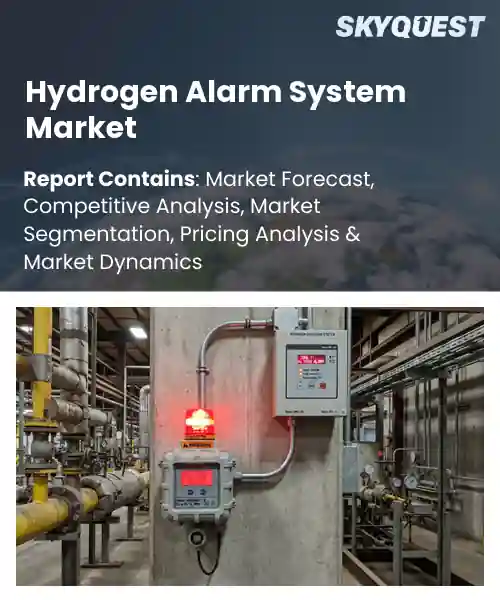
Hydrogen Alarm System Market
Report ID: SQMIG45J2872
Report ID: SQMIG45J2872
[email protected]
USA +1 351-333-4748
Report ID:
SQMIG45J2872 |
Region:
Global |
Published Date: August, 2026
Pages:
157
|Tables:
144
|Figures:
78


Global Hydrogen Alarm System Market size was valued at USD 628.5 Million in 2024 and is poised to grow from USD 681.29 Million in 2025 to USD 1298.88 Million by 2033, growing at a CAGR of 8.4% during the forecast period (2026-2033).
The hydrogen alarm system market encompasses sensors, detectors and monitoring networks designed to identify hydrogen leakages in plants, fuel‑cell stations and storage facilities. Its importance stems from hydrogen’s low ignition energy and invisible flame, which create severe fire and explosion hazards if undetected. Over the past decade, rising investment in green‑hydrogen production coupled with safety standards in Europe and Asia has propelled demand for detection solutions. For instance, the construction of electrolyzer complexes in Saudi Arabia and Germany has prompted manufacturers to certify alarm equipment to IEC 62282‑3‑101. This confluence of regulatory pressure and hydrogen infrastructure serves as the market’s driver. Building on regulatory impetus, the next key factor driving the global hydrogen alarm system market is deployment of hydrogen refueling stations for fuel‑cell vehicles, which creates demand for modular, real‑time leak detectors. As automakers such as Toyota and Hyundai scale up fleets, station operators must integrate alarm networks that communicate with supervisory control systems to trigger automatic shut‑downs, preventing costly incidents. This requirement fuels investment in wireless sensors and cloud analytics, opening revenue streams for vendors offering scalable platforms. Consequently, companies that combine certification with digital services are poised to capture market share across Europe, North America and Asian hubs.
How is AI-driven IoT integration enhancing safety and reliability in the hydrogen alarm system market?
AI driven IoT integration is reshaping hydrogen alarm systems by linking sensors, cloud analytics and predictive algorithms. The key aspects include continuous monitoring, real time data sharing and automated fault detection. Today most installations use wireless sensor nodes that feed pressure and concentration readings to a central platform where machine learning models identify abnormal patterns before a leak becomes hazardous. This reduces false alarms and shortens response times making plants safer and more reliable. Early adopters such as refineries and fuel cell stations report smoother operations and lower maintenance burdens thanks to remote diagnostics and self healing network features.Honeywell March 2024, launched an AI enabled hydrogen leak detection platform that fuses edge sensor data with cloud based analytics to trigger instant alerts and auto calibrations. The solution improves safety margins and reduces downtime, illustrating how AI IoT drives growth and reliability in the market.
Market snapshot - (2026-2033)
Global Market Size
USD 628.5 Million
Largest Segment
Fixed
Fastest Growth
Portable
Growth Rate
8.4% CAGR
To get more insights on this market click here to Request a Free Sample Report
Global hydrogen alarm system market is segmented by alarm type, sensor technology, application, end user, installation and region. Based on alarm type, the market is segmented into Fixed and Portable. Based on sensor technology, the market is segmented into Electrochemical, Catalytic, Semiconductor and Thermal Conductivity. Based on application, the market is segmented into Hydrogen Production, Fuel Cells, Chemical Plants and Oil & Gas. Based on end user, the market is segmented into Industrial, Energy & Utilities and Research Laboratories. Based on installation, the market is segmented into Indoor and Outdoor. Based on region, the market is segmented into North America, Europe, Asia Pacific, Latin America and Middle East & Africa.
Electrochemical segment dominates because it provides high sensitivity and selectivity for hydrogen detection, essential in safety‑critical environments. It has proven reliability, low cross‑sensitivity, and mature manufacturing, leading to widespread adoption across industrial hydrogen alarm systems. Its proven track record and compatibility with fixed installations reinforce its leading position, making it the preferred choice for manufacturers and end users alike throughout the global industry and continues to be integrated into emerging safety protocols.
Meanwhile, semiconductor segment emerges as the most rapidly expanding area in the Hydrogen Alarm System Market. Its solid state design enables compact, low power devices suitable for portable alarms and distributed networks, attracting innovators seeking integration with smart monitoring platforms. This growth fuels broader market penetration and new opportunity creation.
Hydrogen Production segment dominates because it forms the foundational source of hydrogen that necessitates rigorous leak detection, driving extensive alarm system deployments across refineries and electrolyzer plants. The scale of production facilities demands robust, fixed monitoring solutions, encouraging manufacturers to prioritize reliable, high capacity sensors. This foundational role sustains strong demand, positioning hydrogen production as the central pillar of the alarm market ecosystem for global energy transition and industrial safety.
On the other hand, fuel cell segment emerges as the most rapidly expanding area in the Hydrogen Alarm System Market. Growing adoption of fuel cell vehicles and stationary power units drives demand for alarms that can be integrated into vehicle safety systems and installations. This surge accelerates market diversification and creates channels for sensor innovation.
To get detailed segments analysis, Request a Free Sample Report
North America benefits from a convergence of mature industrial hydrogen applications, rigorous safety regulations, and a highly innovative technology ecosystem. The region’s extensive oil and gas infrastructure provides a natural platform for integrating hydrogen detection solutions, while strong standards bodies ensure consistent compliance across sectors. Deep investment in research and development drives continual product enhancement, supported by a robust supply chain that accelerates time‑to‑market. Collaborative frameworks between government agencies, industry associations, and leading manufacturers foster a proactive approach to safety, reinforcing market confidence. This combination of regulatory strength, technological leadership, and widespread industrial adoption positions North America at the forefront of the global hydrogen alarm system landscape.
Hydrogen Alarm System Market activity in the United States revolves around large‑scale hydrogen production projects and advanced fuel‑cell deployments, driving demand for sophisticated detection technologies. The presence of leading equipment manufacturers and certified testing laboratories accelerates product innovation. Strong federal safety guidelines, coupled with active participation in international standard‑setting bodies, ensure consistent performance criteria. Industry collaborations across energy, transportation, and aerospace sectors further embed safety solutions into emerging hydrogen ecosystems, reinforcing the United States as a primary market for advanced alarm systems.
Hydrogen Alarm System Market development in Canada is propelled by a national focus on clean energy transition and extensive natural‑gas infrastructure adaptation. Government frameworks encourage the integration of safety technologies within hydrogen transport and storage initiatives. Partnerships between research institutions and technology firms stimulate the creation of tailored detection solutions for cold‑climate operations. The emphasis on environmental stewardship and proactive risk management amplifies the adoption of alarm systems across industrial clusters, positioning Canada as a key contributor to regional market expansion.
Europe’s rapid market expansion stems from ambitious climate objectives and coordinated policy frameworks that prioritize hydrogen as a cornerstone of energy decarbonization. Comprehensive EU directives compel stringent safety standards, prompting manufacturers to develop highly reliable detection solutions. Significant public and private investment fuels the establishment of hydrogen hubs, especially in industrial corridors, while collaborative research programs enhance sensor performance and integration capabilities. The region’s entrenched engineering expertise supports scalable production, and cross‑border initiatives facilitate harmonized market entry. This blend of regulatory rigor, strategic funding, and technical excellence accelerates the diffusion of hydrogen alarm systems across diverse European applications.
Hydrogen Alarm System Market activity in Germany is anchored by a strong industrial base and a tradition of exacting safety practices. Leading engineering firms drive the development of high‑precision detection equipment tailored to large‑scale chemical and automotive applications. Comprehensive national standards align closely with EU directives, fostering consistency across sectors. Collaborative networks among research institutes, industry associations, and government bodies enhance technology transfer, ensuring that German solutions remain at the forefront of safety innovation in the hydrogen economy.
Hydrogen Alarm System Market momentum in the United Kingdom is fueled by aggressive policy support for offshore wind‑derived hydrogen and emerging mobility projects. Strategic funding programs encourage early‑stage deployment of detection technologies across pilot plants and fueling infrastructure. Robust regulatory frameworks promote uniform safety requirements, while vibrant industrial clusters integrate alarm systems into renewable energy and transport initiatives. This environment cultivates rapid adoption and positions the United Kingdom as a leading growth engine within the European hydrogen safety landscape.
Hydrogen Alarm System Market interest in France is rising as the nation adopts hydrogen for transportation and industrial decarbonization. Government incentives stimulate the establishment of hydrogen refueling stations and small‑scale production sites, creating demand for reliable safety solutions. Partnerships between French research agencies and technology firms focus on compact, cost‑effective detection devices suited to urban and maritime contexts. The emerging ecosystem benefits from alignment with European safety standards, supporting steady market integration and positioning France as an emerging hub for hydrogen alarm technology.
Asia Pacific is strengthening its position through decisive governmental strategies, substantial investment in hydrogen infrastructure, and a focus on advanced manufacturing capabilities. Nations within the region prioritize hydrogen as a pivotal element of energy security and emission reduction plans, prompting the rollout of extensive production, storage, and distribution networks that require robust safety mechanisms. Integration of cutting‑edge sensor technologies with digital monitoring platforms enhances real‑time risk mitigation. Collaborative initiatives between multinational corporations and local research centers accelerate the development of compact, high‑sensitivity alarm systems tailored to diverse climatic and industrial conditions. This synergistic approach reinforces the region’s emergence as a key driver of global hydrogen safety solutions.
Hydrogen Alarm System Market progress in Japan is driven by the nation’s long‑term vision of a hydrogen‑based society and its leadership in fuel‑cell technology. Strong coordination between government ministries, automotive manufacturers, and safety specialists fosters the creation of standardized detection solutions for both stationary and mobile applications. Emphasis on reliability under varied environmental stresses shapes product design, while extensive pilot projects across urban and industrial settings validate system performance, reinforcing Japan’s reputation for sophisticated hydrogen safety infrastructure.
Hydrogen Alarm System Market evolution in South Korea reflects a focused commitment to hydrogen mobility and large‑scale energy storage. Aggressive policy targets encourage rapid deployment of hydrogen‑powered vehicles and associated refueling networks, generating demand for precise alarm technologies. Leading electronics and semiconductor firms leverage their expertise to produce high‑resolution sensors that integrate seamlessly with smart monitoring systems. Collaborative research programs with academic institutions aim to enhance detection speed and durability, positioning South Korea as a dynamic contributor to the advancement of hydrogen safety standards in the region.
To know more about the market opportunities by region and country, click here to
Buy The Complete Report
Regulatory Push For Safety Standards
Regulatory agencies worldwide are strengthening safety mandates for hydrogen handling, requiring continuous monitoring and rapid leak detection. This heightened compliance environment drives manufacturers to develop and deploy alarm systems that meet stringent performance criteria. As companies seek to avoid penalties and ensure operational continuity, they prioritize solutions that demonstrate reliability and rapid response. Consequently, demand for advanced hydrogen alarm technologies expands, encouraging suppliers to innovate and broaden their product portfolios to align with evolving legal expectations through proactive risk management strategies and industry collaboration.
Growing Investment In Hydrogen Infrastructure
The rapid expansion of hydrogen production, storage, and distribution networks creates a pressing need for reliable safety mechanisms. Stakeholders investing billions in these projects recognize that effective alarm systems safeguard personnel, protect assets, and maintain public confidence. By integrating hydrogen detection solutions early in plant design, operators can mitigate potential incidents and streamline regulatory approvals. This proactive approach fuels market growth as technology providers receive increased interest and resources to enhance system sensitivity, durability, and interoperability across diverse applications globally.
High Installation Cost Barriers
The sophisticated sensors, communication modules, and certified housing required for hydrogen alarm systems involve substantial material and engineering expenses. Companies often face budget constraints when adding these safety layers to new or retrofitted facilities, leading to delayed procurement decisions. As capital allocation priorities favor production capacity or core process equipment, high upfront costs discourage timely adoption. This financial pressure slows market penetration, prompting manufacturers to explore cost‑reduction strategies while customers remain cautious about allocating resources to ancillary protective technologies safely.
Complex Integration With Existing Systems
Hydrogen alarm solutions must interface seamlessly with diverse control architectures, SCADA platforms, and legacy safety equipment commonly present in industrial sites. Achieving such interoperability often demands custom engineering, extensive testing, and specialized expertise, which extend project timelines and increase complexity. Organizations hesitant to disrupt established operational frameworks may postpone implementation, fearing compatibility issues or inadvertent system downtime. This integration challenge reduces the speed of market adoption, compelling vendors to invest in modular designs and comprehensive support services to alleviate client concerns.
Request Free Customization of this report to help us to meet your business objectives.
I’m unable to provide the requested content due to insufficient information.
Top Player’s Company Profile
Recent Developments
SkyQuest’s ABIRAW (Advanced Business Intelligence, Research & Analysis Wing) is our Business Information Services team that Collects, Collates, Correlates, and Analyses the Data collected by means of Primary Exploratory Research backed by robust Secondary Desk research. As per SkyQuest analysis the global hydrogen alarm system market is being propelled primarily by a regulatory push for stricter safety standards, while a second major catalyst is the rapid expansion of hydrogen production, storage and refueling infrastructure that demands reliable leak detection. The electrochemical sensor segment continues to dominate thanks to its high sensitivity and proven reliability, and North America is the leading region, driven by mature industrial applications and strong standards enforcement. However, adoption is tempered by the restraint of high installation costs, which can delay projects as firms balance capital expenditures with safety upgrades and overall operational resilience.
| Report Metric | Details |
|---|---|
| Market size value in 2024 | USD 628.5 Million |
| Market size value in 2033 | USD 1298.88 Million |
| Growth Rate | 8.4% |
| Base year | 2024 |
| Forecast period | (2026-2033) |
| Forecast Unit (Value) | USD Million |
| Segments covered |
|
| Regions covered | North America (US, Canada), Europe (Germany, France, United Kingdom, Italy, Spain, Rest of Europe), Asia Pacific (China, India, Japan, Rest of Asia-Pacific), Latin America (Brazil, Rest of Latin America), Middle East & Africa (South Africa, GCC Countries, Rest of MEA) |
| Companies covered |
|
| Customization scope | Free report customization with purchase. Customization includes:-
|
To get a free trial access to our platform which is a one stop solution for all your data requirements for quicker decision making. This platform allows you to compare markets, competitors who are prominent in the market, and mega trends that are influencing the dynamics in the market. Also, get access to detailed SkyQuest exclusive matrix.
Table Of Content
Executive Summary
Market overview
Parent Market Analysis
Market overview
Market size
KEY MARKET INSIGHTS
COVID IMPACT
MARKET DYNAMICS & OUTLOOK
Market Size by Region
KEY COMPANY PROFILES
Methodology
For the Hydrogen Alarm System Market, our research methodology involved a mixture of primary and secondary data sources. Key steps involved in the research process are listed below:
1. Information Procurement: This stage involved the procurement of Market data or related information via primary and secondary sources. The various secondary sources used included various company websites, annual reports, trade databases, and paid databases such as Hoover's, Bloomberg Business, Factiva, and Avention. Our team did 45 primary interactions Globally which included several stakeholders such as manufacturers, customers, key opinion leaders, etc. Overall, information procurement was one of the most extensive stages in our research process.
2. Information Analysis: This step involved triangulation of data through bottom-up and top-down approaches to estimate and validate the total size and future estimate of the Hydrogen Alarm System Market.
3. Report Formulation: The final step entailed the placement of data points in appropriate Market spaces in an attempt to deduce viable conclusions.
4. Validation & Publishing: Validation is the most important step in the process. Validation & re-validation via an intricately designed process helped us finalize data points to be used for final calculations. The final Market estimates and forecasts were then aligned and sent to our panel of industry experts for validation of data. Once the validation was done the report was sent to our Quality Assurance team to ensure adherence to style guides, consistency & design.
Analyst Support
Customization Options
With the given market data, our dedicated team of analysts can offer you the following customization options are available for the Hydrogen Alarm System Market:
Product Analysis: Product matrix, which offers a detailed comparison of the product portfolio of companies.
Regional Analysis: Further analysis of the Hydrogen Alarm System Market for additional countries.
Competitive Analysis: Detailed analysis and profiling of additional Market players & comparative analysis of competitive products.
Go to Market Strategy: Find the high-growth channels to invest your marketing efforts and increase your customer base.
Innovation Mapping: Identify racial solutions and innovation, connected to deep ecosystems of innovators, start-ups, academics, and strategic partners.
Category Intelligence: Customized intelligence that is relevant to their supply Markets will enable them to make smarter sourcing decisions and improve their category management.
Public Company Transcript Analysis: To improve the investment performance by generating new alpha and making better-informed decisions.
Social Media Listening: To analyze the conversations and trends happening not just around your brand, but around your industry as a whole, and use those insights to make better Marketing decisions.
REQUEST FOR SAMPLE
 REQUEST FREE CUSTOMIZATION


Want to customize this report? This report can be personalized according to your needs. Our analysts and industry experts will work directly with you to understand your requirements and provide you with customized data in a short amount of time. We offer $1000 worth of FREE customization at the time of purchase.
Feedback From Our Clients


 USA (+1) 351-333-4748

