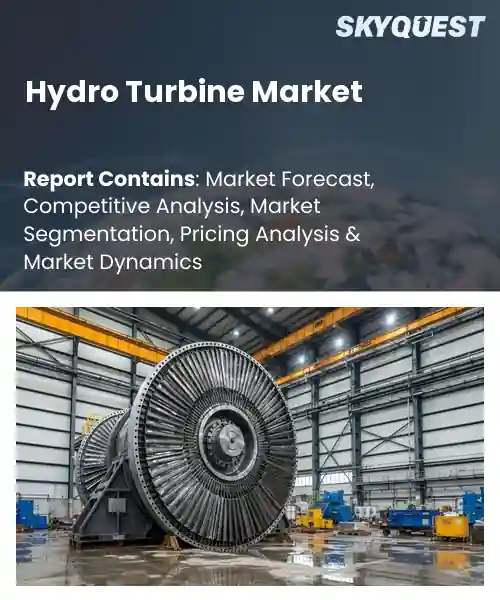
Hydro Turbine Market
Report ID: SQMIG20I3125
Report ID: SQMIG20I3125
[email protected]
USA +1 351-333-4748
Report ID:
SQMIG20I3125 |
Region:
Global |
Published Date: June, 2026
Pages:
157
|Tables:
172
|Figures:
79


Global Hydro Turbine Market size was valued at USD 50.23 Billion in 2024 and is poised to grow from USD 51.69 Billion in 2025 to USD 64.97 Billion by 2033, growing at a CAGR of 2.9% during the forecast period (2026-2033).
The global hydro turbine market comprises manufacturers and suppliers of equipment that converts flowing water into mechanical energy for electricity generation. Its significance drives from the ability of hydropower to deliver low‑carbon electricity with stable output, a trait increasingly prized as nations pursue net‑zero targets.
This trajectory illustrates how policy incentives, grid reliability demands, and technological refinements have collectively propelled market expansion. The dominant growth factor now is the integration of hydro turbines into hybrid renewable systems, which creates a cause‑and‑effect loop that amplifies market demand. As wind and solar output fluctuates, operators install turbine‑storage combos that smooth dispatch, prompting utilities to invest in retrofits of older dams and in low‑head projects.
For instance, Brazil’s partnership with a turbine OEM added adjustable‑blade Francis units to a cascade of small reservoirs, boosting capacity factor by 12 percent while reducing reliance on fossil peaker plants. This synergy fuels revenue opportunities for manufacturers, spurs innovation in variable‑speed designs, and attracts financing linked to climate‑resilient infrastructure.
How is AI-driven automation influencing efficiency in the hydro turbine market?
Automation driven by AI is transforming the operations of hydro turbines through real-time condition monitoring, predictive maintenance and better flow management. Sensors give data to machine learning models that identify wear, predict outages and recommend tweaks to the blades before efficiency lowers. Plant operators also use autonomous control loops to maintain turbines performing at their peak and to reduce the number of human inspections. This change mirrors the wider expansion of the hydro turbine industry where manufacturers are making use of digital twins and cloud analytics to reduce downtime and prolong asset life, leading to more dependable renewable energy.
In March 2025, Andritz AG showed the implementation of AI driven automation in its turbine portfolio, how intelligent monitoring and self optimizing controls are increasing plant efficiency and driving the sector’s growth. The project highlights the market’s shift to data centric operations and gives comfort to investors and utilities seeking increased output at lower operating costs.
Market snapshot - (2026-2033)
Global Market Size
USD 50.23 Billion
Largest Segment
Reaction Turbines
Fastest Growth
Impulse Turbines
Growth Rate
2.9% CAGR
To get more insights on this market click here to Request a Free Sample Report
Global hydro turbine market is segmented by type, capacity, head type, installation type, application, end user and region. Based on type, the market is segmented into Impulse Turbines and Reaction Turbines. Based on capacity, the market is segmented into Up to 10 MW, 10 MW–100 MW and Above 100 MW. Based on head type, the market is segmented into Low Head, Medium Head and High Head. Based on installation type, the market is segmented into New Installation and Retrofit & Modernization. Based on application, the market is segmented into Large Hydropower Plants, Small Hydropower Plants, Mini Hydropower Plants, Micro Hydropower Plants and Pumped Storage Hydropower Plants. Based on end user, the market is segmented into Utilities, Independent Power Producers (IPPs), Industrial & Captive Power Users and Government & Public Sector Organizations. Based on region, the market is segmented into North America, Europe, Asia Pacific, Latin America and Middle East & Africa.
As per hydro turbine market analysis, impulse turbines segment dominates because they excel in converting kinetic energy from high velocity water jets, making them ideally suited for low to medium head applications where efficiency and simplicity are paramount. Their rugged design requires minimal maintenance, which appeals to operators seeking reliable performance under variable flow conditions. Consequently, project developers favor impulse technology for new installations and retrofits, reinforcing its leadership in the hydro turbine market.
As per hydro turbine market outlook, reaction turbines segment is witnessing the strongest growth momentum as advances in blade aerodynamics and generator integration enable higher efficiencies at medium and high head sites. This innovation expands suitability for larger capacity plants and pumped storage projects, attracting investment and driving the next wave of market expansion.
Up to 10 MW segment leads with large hydro turbine market share because it aligns with the rapid deployment of small and mini hydropower schemes that address distributed energy needs in remote and off grid locations. Simpler logistics, lower capital outlay and shorter construction periods make these projects attractive to independent power producers and captive users, delivering reliable performance and fueling steady demand for turbines in this capacity class.
As per hydro turbine market forecast, ten to one hundred MW segment emerges as the key high growth area as utilities and IPPs pursue medium scale plants to balance grid stability and renewable targets. Technological improvements in turbine efficiency and modular design reduce installation timelines, encouraging broader adoption and unlocking new revenue streams, thereby accelerating market expansion.
To get detailed segments analysis, Request a Free Sample Report
As per hydro turbine market regional outlook, Asia Pacific market is anticipated to witness growth on account of the presence of multiple natural, regulatory & industrial variables which will collectively augment the market position. The region has large riverine networks as well as steep topography that provide adequate hydraulic head and flow that allow for high-efficiency turbine deployment. The mature manufacturing ecosystems of Japan and South Korea provide robust turbine designs and fast prototyping to enable continual innovation. Regional enterprises are well-placed to serve export markets, with healthy domestic demand and export-oriented capacity. Technology transfer is further enhanced by collaborative research institutes and cross-border information exchanges, keeping Asia Pacific at the forefront of cost reduction and performance improvement for hydro turbine solutions. These attributes together form a resilient supply chain that supports domestic growth and global reach.
As per hydro turbine market regional forecast, Japan is driven by a mature industrial base and a long history of hydroelectric development, which supports sophisticated engineering expertise. Domestic utilities pursue upgrades to aging assets, emphasizing efficiency gains and digital monitoring. Collaborative efforts between manufacturers and research institutes focus on modular designs that suit the country’s variable topography. Export initiatives leverage this technical pedigree, positioning Japan as a preferred supplier for high‑performance turbine solutions in overseas projects.
As per hydro turbine industry analysis, South Korea benefits from strong governmental commitment to renewable diversification and a robust engineering sector that emphasizes precision manufacturing. Domestic power producers are modernizing existing hydro facilities with advanced turbine concepts that enhance output while minimizing environmental impact. Close cooperation with global partners accelerates adoption of next‑generation blade geometries and control systems. Export strategies target emerging economies, leveraging cost‑effective yet high‑quality turbine packages that align with international sustainability standards.
Europe’s hydro turbine business is seeing significant growth driven by policy ambition, grid resilience demands and technological excellence. Continental carbon neutrality obligations have encouraged hydro power as a dependable baseload complement to intermittent renewables, with significant renovation programmes and new installations in favourable catchments. In Germany, the United Kingdom and France, strong engineering traditions drive ongoing advancements in the efficiency and environmental friendliness of turbines. Collaborative research frameworks across the EU can be used to jointly fund better blade materials and sophisticated control algorithms. In addition, the growing focus on managing water resources and addressing flooding issues brings hydro projects into the wider climate adaption framework, creating a more appealing market for both domestic and foreign participants.
Germany is propelled by a deep engineering heritage and a proactive stance on renewable integration. Industry leaders collaborate closely with research institutes to refine turbine designs that achieve higher efficiency with reduced ecological footprints. Nationwide grid upgrades demand flexible, high‑performance turbine solutions that can respond rapidly to variable renewable outputs. Investment in digital twins and condition‑based monitoring enhances operational reliability, while export activities benefit from Germany’s reputation for precision and durability in turbine manufacturing.
United Kingdom is emerging as a focal point for decarbonization of the energy mix, supported by favorable policy incentives and a growing interest in small‑scale hydro schemes. Collaborative initiatives between academia and turbine manufacturers are fostering innovative designs suited to the country’s diverse river systems. Emphasis on community‑owned projects encourages localized investment and knowledge transfer. Integration of advanced monitoring technologies ensures that new installations meet stringent environmental standards while contributing to grid stability.
France benefits from extensive mountainous terrain and a long legacy of hydroelectric generation, establishing a solid foundation for continual turbine advancement. National energy strategies prioritize modernisation of ageing plants, driving demand for high‑efficiency, low‑impact turbine models. Strong public‑private partnerships facilitate research into new materials and hydrodynamic optimisation, reinforcing France’s position as a benchmark for performance standards. Export outreach leverages this expertise, positioning French turbine manufacturers as preferred partners for international infrastructure projects.
North America is reinforcing its hydro turbine footprint through a combination of infrastructure renewal, strategic investment, and integration with emerging renewable portfolios. In the United States, extensive legacy hydro assets are undergoing comprehensive retrofits that incorporate cutting‑edge turbine technology to boost generation efficiency and ecological compliance. Canada leverages its abundant water resources and robust regulatory environment to advance both large‑scale and run‑of‑river projects, emphasizing sustainability and indigenous collaboration. Cross‑border research initiatives promote shared advancements in turbine aerodynamics and digital control systems, while growing interest in pumped storage supports grid reliability. This coordinated approach enhances market resilience and positions North America as a leader in delivering modern, high‑performance hydro turbine solutions.
United States is characterised by extensive retrofitting programmes that replace aging equipment with high‑efficiency turbines, extending the operational life of historic plants. Federal and state policies encourage low‑impact designs that balance energy production with riverine ecosystem protection. Partnerships between turbine manufacturers and technology firms accelerate the adoption of smart monitoring and predictive maintenance tools. Emerging market segments, such as small‑scale community hydro, are gaining traction, diversifying the domestic supply chain and fostering innovation across the sector.
Canada capitalises on the nation’s abundant freshwater reserves and a regulatory framework that supports sustainable development. Emphasis on low‑impact turbine technology aligns with indigenous stewardship principles and environmental preservation goals. Collaborative projects between provincial utilities and research laboratories focus on enhancing turbine efficiency while minimising fish mortality. Export initiatives draw on Canada’s reputation for reliable, climate‑resilient turbine designs, strengthening its presence in international markets seeking robust hydro solutions.
To know more about the market opportunities by region and country, click here to
Buy The Complete Report
Increasing Renewable Energy Policies
Advancements in Turbine Efficiency
High Capital Expenditure Requirements
Environmental Permitting Challenges
Request Free Customization of this report to help us to meet your business objectives.
The global hydro turbine industry is dominated by established OEMs such as Andritz AG and Voith GmbH & Co., whose rivalry intensifies as the U.S. fleet expands; both firms are accelerating technology innovation with next‑generation turbine designs and forging collaborative projects with regional utilities to capture new capacity, while leveraging their extensive service networks to out‑compete emerging entrants.
SkyQuest’s ABIRAW (Advanced Business Intelligence, Research & Analysis Wing) is our Business Information Services team that Collects, Collates, Correlates, and Analyses the Data collected by means of Primary Exploratory Research backed by robust Secondary Desk research.
As per SkyQuest analysis the global hydro turbine market growth is being propelled mainly by increasing renewable energy policies that provide incentives and funding certainty, while advancements in turbine efficiency serve as a second catalyst by lowering levelized costs and opening low‑head sites. The primary restraint remains the high capital expenditure required for civil works and turbine procurement, which can deter investors especially in emerging economies. Asia Pacific dominates the market due to abundant water resources, supportive regulations and strong manufacturing bases. In terms of product type, impulse turbines continue to lead because of their simplicity and suitability for low‑to‑medium head projects, reinforcing demand across new installations and retrofits. The global hydro turbine market trend driven by increasing investments in renewable energy infrastructure, modernization of aging hydropower plants and rising deployment of pumped-storage hydropower projects worldwide.
| Report Metric | Details |
|---|---|
| Market size value in 2024 | USD 50.23 Billion |
| Market size value in 2033 | USD 64.97 Billion |
| Growth Rate | 2.9% |
| Base year | 2024 |
| Forecast period | (2026-2033) |
| Forecast Unit (Value) | USD Billion |
| Segments covered |
|
| Regions covered | North America (US, Canada), Europe (Germany, France, United Kingdom, Italy, Spain, Rest of Europe), Asia Pacific (China, India, Japan, Rest of Asia-Pacific), Latin America (Brazil, Rest of Latin America), Middle East & Africa (South Africa, GCC Countries, Rest of MEA) |
| Companies covered |
|
| Customization scope | Free report customization with purchase. Customization includes:-
|
To get a free trial access to our platform which is a one stop solution for all your data requirements for quicker decision making. This platform allows you to compare markets, competitors who are prominent in the market, and mega trends that are influencing the dynamics in the market. Also, get access to detailed SkyQuest exclusive matrix.
Table Of Content
Executive Summary
Market overview
Parent Market Analysis
Market overview
Market size
KEY MARKET INSIGHTS
COVID IMPACT
MARKET DYNAMICS & OUTLOOK
Market Size by Region
KEY COMPANY PROFILES
Methodology
For the Hydro Turbine Market, our research methodology involved a mixture of primary and secondary data sources. Key steps involved in the research process are listed below:
1. Information Procurement: This stage involved the procurement of Market data or related information via primary and secondary sources. The various secondary sources used included various company websites, annual reports, trade databases, and paid databases such as Hoover's, Bloomberg Business, Factiva, and Avention. Our team did 45 primary interactions Globally which included several stakeholders such as manufacturers, customers, key opinion leaders, etc. Overall, information procurement was one of the most extensive stages in our research process.
2. Information Analysis: This step involved triangulation of data through bottom-up and top-down approaches to estimate and validate the total size and future estimate of the Hydro Turbine Market.
3. Report Formulation: The final step entailed the placement of data points in appropriate Market spaces in an attempt to deduce viable conclusions.
4. Validation & Publishing: Validation is the most important step in the process. Validation & re-validation via an intricately designed process helped us finalize data points to be used for final calculations. The final Market estimates and forecasts were then aligned and sent to our panel of industry experts for validation of data. Once the validation was done the report was sent to our Quality Assurance team to ensure adherence to style guides, consistency & design.
Analyst Support
Customization Options
With the given market data, our dedicated team of analysts can offer you the following customization options are available for the Hydro Turbine Market:
Product Analysis: Product matrix, which offers a detailed comparison of the product portfolio of companies.
Regional Analysis: Further analysis of the Hydro Turbine Market for additional countries.
Competitive Analysis: Detailed analysis and profiling of additional Market players & comparative analysis of competitive products.
Go to Market Strategy: Find the high-growth channels to invest your marketing efforts and increase your customer base.
Innovation Mapping: Identify racial solutions and innovation, connected to deep ecosystems of innovators, start-ups, academics, and strategic partners.
Category Intelligence: Customized intelligence that is relevant to their supply Markets will enable them to make smarter sourcing decisions and improve their category management.
Public Company Transcript Analysis: To improve the investment performance by generating new alpha and making better-informed decisions.
Social Media Listening: To analyze the conversations and trends happening not just around your brand, but around your industry as a whole, and use those insights to make better Marketing decisions.
REQUEST FOR SAMPLE
 REQUEST FREE CUSTOMIZATION
Global Hydro Turbine Market size was valued at USD 50.23 Billion in 2024 and is poised to grow from USD 51.69 Billion in 2025 to USD 64.97 Billion by 2033, growing at a CAGR of 2.9% during the forecast period (2026-2033).
The global hydro turbine market is dominated by established OEMs such as Andritz AG and Voith GmbH & Co., whose rivalry intensifies as the U.S. fleet expands; both firms are accelerating technology innovation with next‑generation turbine designs and forging collaborative projects with regional utilities to capture new capacity, while leveraging their extensive service networks to out‑compete emerging entrants. 'Voith Hydro Holding GmbH & Co. KG', 'ANDRITZ Hydro GmbH', 'GE Vernova Hydro Power', 'Toshiba Energy Systems & Solutions Corporation', 'Mitsubishi Power, Ltd.', 'Harbin Electric Machinery Company Limited', 'Dongfang Electric Corporation', 'Power Machines PJSC', 'Bharat Heavy Electricals Limited', 'Litostroj Power d.o.o.', 'Gilkes Energy Limited', 'Canyon Hydro, Inc.', 'Natel Energy, Inc.', 'Obermeyer Hydro, Inc.', 'WWS Wasserkraft GmbH', 'ČKD Blansko Engineering, a.s.', 'Global Hydro Energy GmbH', 'Mavel, a.s.', 'Zhejiang Jinlun Electromechanic Co., Ltd.', 'Gugler Water Turbines GmbH'
Governmental incentives and regulatory frameworks promoting low‑carbon electricity generation are encouraging utilities and independent power producers to adopt hydro turbine technologies, thereby expanding project pipelines and accelerating investment decisions across regions with adequate water resources. The supportive policy environment reduces permitting uncertainties, provides financial assistance, and creates long‑term revenue certainty, which together stimulate market confidence and drive demand for modern, efficient turbine solutions that can meet evolving grid reliability and sustainability requirements while also fostering collaboration among technology providers, research institutions, and end‑users.
Digital Twin Integration: Manufacturers are embedding digital twin technology into hydro turbine design, operation, and maintenance cycles, enabling real‑time virtual replication of physical assets. This creates a predictive environment where performance parameters can be simulated under varying water flow conditions, facilitating proactive adjustments that boost efficiency and extend equipment lifespan. Stakeholders leverage these insights to reduce unplanned outages, streamline commissioning processes, and align turbine output with grid demand, ultimately delivering more resilient renewable energy generation for long‑term sustainability and climate resilience across regions.
Why does Asia Pacific Dominate the Global Hydro Turbine Market? |@12


Want to customize this report? This report can be personalized according to your needs. Our analysts and industry experts will work directly with you to understand your requirements and provide you with customized data in a short amount of time. We offer $1000 worth of FREE customization at the time of purchase.
Feedback From Our Clients


 USA (+1) 351-333-4748

