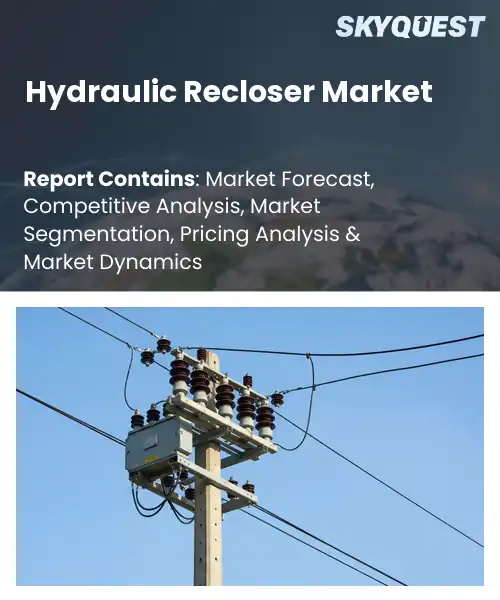
Hydraulic Recloser Market
Report ID: SQMIG20E2207
Report ID: SQMIG20E2207
[email protected]
USA +1 351-333-4748
Report ID:
SQMIG20E2207 |
Region:
Global |
Published Date: June, 2026
Pages:
157
|Tables:
168
|Figures:
79


Global Hydraulic Recloser Market size was valued at USD 1.3 Billion in 2024 and is poised to grow from USD 1.38 Billion in 2025 to USD 2.22 Billion by 2033, growing at a CAGR of 6.1% during the forecast period (2026-2033).
The hydraulic recloser market is driven primarily by utilities' need to improve distribution reliability and reduce outage costs, a pressure that has intensified as networks age and distributed generation expands. Hydraulic reclosers are automatic switching devices that detect faults and restore service by reclosing lines, making them vital in distribution systems. Over decades these devices moved from electromechanical switches to units with remote communications and sectionalizing functions, illustrated by North American and European utility deployments that lowered customer minutes interrupted. With more severe weather and urban electrification, adoption of automated protection has emerged as the dominant imperative to grid owners.Integration of communications and analytics into hydraulic reclosers is a principal growth factor because improved situational awareness enables FLISR schemes that shorten outages and lower operational costs. When reclosers include cellular telemetry, operators remotely monitor fault signatures, coordinate sectionalizing and reclose sequences, and prioritize crews, reducing truck rolls and response times. That capability prompted pilots in which utilities paired reclosers with AMI and SCADA to manage bidirectional flows from rooftop solar, preventing nuisance trips and enabling safer restoration. As a result vendors provide retrofit modules and managed services, creating recurring revenue opportunities across mature and emerging markets and resilience benefits.
How is IoT improving reliability in the hydraulic recloser market?
IoT is raising reliability in the hydraulic recloser market by enabling continuous condition monitoring and remote diagnostics. Key aspects include onboard sensors that track mechanical health, secure connectivity that feeds data to control centers, and edge analytics that flag deteriorating components before they fail. The market is moving from routine manual inspections to connectivity enabled fleet oversight which extends service life and reduces emergency calls. Utilities see fewer sustained outages and faster isolation of faults. Real examples include retrofitted controllers and rugged gateways that bring telemetry to remote distribution equipment and let operators act before small issues become outages.Rockwill June 2026, announced a new automatic circuit recloser with smartphone connectivity and onboard analytics that uses telemetry to detect hydraulic wear and to adjust settings remotely. This rollout shows how IoT enabled sensing and communications improve uptime and make maintenance more efficient.
Market snapshot - (2026-2033)
Global Market Size
USD 1.3 Billion
Largest Segment
Three Phase
Fastest Growth
Three Phase
Growth Rate
6.1% CAGR
To get more insights on this market click here to Request a Free Sample Report
Global hydraulic recloser market is segmented by phase, voltage rating, control type, interruption type, installation type, application and region. Based on phase, the market is segmented into Single Phase and Three Phase. Based on voltage rating, the market is segmented into Up to 15 kV, 16–27 kV and 28–38 kV. Based on control type, the market is segmented into Hydraulic and Electronic. Based on interruption type, the market is segmented into Oil-Based and Vacuum. Based on installation type, the market is segmented into Pole-Mounted and Pad-Mounted. Based on application, the market is segmented into Utility, Industrial, Commercial and Others. Based on region, the market is segmented into North America, Europe, Asia Pacific, Latin America and Middle East & Africa.
Single Phase segment dominates because it aligns with the prevalent distribution topology, enabling simpler installation and lower lifecycle costs which encourages widespread utility adoption. Its compatibility with existing line configurations reduces retrofit complexity and maintenance demands, driving manufacturers to prioritize product availability and reliability. This familiarity leads to procurement inertia and focused support ecosystems, reinforcing its lead through operational ease, supply chain depth, and predictable performance in standard networks.
However, Three Phase segment is emerging as the fastest growing due to rising demand for higher load handling and complex grid resilience. Advanced three phase reclosers integrate with automation and offer scalable fault management, stimulating investments from utilities seeking to modernize distribution, thus unlocking new product designs and aftermarket services.
Hydraulic segment leads because its mechanical oil-based mechanisms have long-established reliability in traditional distribution networks, offering robust interruption response and tolerance to harsh field conditions that utilities trust. Familiar maintenance practices and existing inventory of spare parts reduce lifecycle disruption, prompting continued procurement. Its proven performance under varied load profiles and resilience to transient faults drives conservative replacement strategies and steady demand, sustaining leadership through operational certainty and vendor support.
However, Electronic segment is emerging as the most rapidly expanding area as microprocessor controllers enable advanced protection, real-time communications, and grid analytics aligned with modernization agendas. Programmability and remote diagnostics drive adoption for automated fault isolation and predictive maintenance, creating demand for integrated solutions and unlocking opportunities for software-enabled services.
To get detailed segments analysis, Request a Free Sample Report
Asia Pacific dominance stems from a convergence of robust grid modernization efforts, concentrated industrial capability, and proactive utility strategies that prioritize network reliability and outage mitigation. Regional manufacturers and technology providers cultivate advanced hydraulic recloser solutions through focused research and development, tailored product portfolios, and close collaboration with transmission and distribution operators. High infrastructure investment intensity, growing renewable generation integration, and a need for resilient distribution networks in rapidly urbanizing areas further amplify adoption. Well-established supply chains and competitive manufacturing ecosystems enable cost efficiencies and timely deployment, while regulatory emphasis on system reliability and service continuity drives utilities to standardize recloser installations. The combination of market maturity in some economies and accelerating modernization in others creates a dynamic landscape that elevates Asia Pacific to a dominant position.
Hydraulic Recloser Market in Japan benefits from advanced engineering expertise, dense transmission networks, and utility focus on resilience. Domestic manufacturers and system integrators emphasize high-reliability products and precision testing, fostering strong interoperability with grid automation platforms. Adoption is encouraged by collaborative pilot programs and technical standards that support incremental upgrades. Service and aftermarket networks ensure long life cycles and localized support, reinforcing replacement and modernization activity across urban distribution systems.
Hydraulic Recloser Market in South Korea is shaped by robust manufacturing capabilities and proactive utility modernization. Local suppliers focus on compact, high-performance units that integrate with smart distribution controls and renewable energy interfaces. Collaborative innovation between utilities and technology providers accelerates field validation, while skilled service ecosystems support commissioning and maintenance. Emphasis on reliability and adaptability drives targeted deployments in urban and industrial distribution zones, reinforcing regional competence and scale.
Rapid expansion in North America is driven by a combination of utility-led modernization programs, heightened emphasis on grid resilience, and widespread integration of distributed energy resources. Utilities pursue targeted upgrades to aging distribution networks, prioritizing solutions that reduce outage duration and support automated fault isolation. Regulatory and stakeholder focus on reliability and safety encourages adoption of advanced recloser technologies that interface with modern control systems. Vendor ecosystems and service providers offer tailored deployment, testing, and aftermarket support, smoothing large scale rollouts. Cross-border technology exchange between markets fosters standardization and interoperability, while attention to extreme weather preparedness and urban growth further elevates demand for robust hydraulic recloser solutions that balance performance with maintainability. Collaborations among manufacturers, utilities, and research institutions drive iterative enhancements and create frameworks for scalable deployment across diverse climatic and regulatory environments.
Hydraulic Recloser Market in United States is driven by grid modernization and utility investment in resilience. Utilities emphasize fault isolation, integration with distribution automation and compatibility with distributed generation. Vendor support for testing, field trials and aftermarket services enables incremental replacements across varied system configurations. Regulatory scrutiny and stakeholder demand for reliability drive procurement of recloser solutions that emphasize operational transparency and ease of maintenance across complex networks and scalability.
Hydraulic Recloser Market in Canada reflects utility priorities for reliability across varied service territories. Solutions are selected for durability in harsh climates, ease of maintenance, and compatibility with distributed generation. Local utilities and cooperatives collaborate with suppliers on pilots and tailored configurations that suit remote feeder systems. Strong service networks and emphasis on lifecycle support influence procurement choices, while interoperability with modern grid controls facilitates smooth upgrades to distribution infrastructure.
Europe strengthens its position through coordinated modernization efforts, emphasis on interoperability, and a mature supplier base that blends industrial expertise with advanced grid control capabilities. Regulatory focus on reliability and environmental considerations motivates utilities to adopt solutions that accommodate distributed generation and facilitate flexible network operations. Cross-border collaboration, standardization initiatives, and funding mechanisms encourage pilot deployments and the scaling of proven technologies. Manufacturers in key markets refine product offerings for retrofitting legacy infrastructure while service providers expand testing and lifecycle management capabilities. The resulting environment supports incremental adoption across diverse network architectures, enabling Europe to consolidate technical leadership and promote harmonized deployment practices. Investment in digital grid platforms and analytics enhances decision making for recloser deployment and maintenance. Public-private partnerships accelerate commercialization of innovations and ensure that retrofit programs align with broader decarbonization objectives.
Hydraulic Recloser Market in Germany benefits from a strong engineering ecosystem prioritizing precision and durability. Utilities integrate reclosers within sophisticated distribution automation to manage renewable penetration and varied load patterns. Local suppliers offer modular designs for retrofitting legacy lines and provide comprehensive testing and lifecycle services. Alignment with rigorous technical standards and participation in standardization forums supports interoperability, while industrial expertise fosters continuous product refinement for domestic and export markets.
Hydraulic Recloser Market in United Kingdom is shaped by utility focus on network resilience and integration of distributed generation. Suppliers deliver adaptable recloser platforms compatible with advanced grid management systems and monitoring capabilities. Pilot programs and public-private collaborations validate solutions for urban and rural feeders, while attention to extreme weather preparedness informs procurement priorities. Strong service networks and emphasis on lifecycle cost effectiveness support retrofitting and modernization across distribution landscapes.
Hydraulic Recloser Market in France reflects strong utility engagement in distribution automation and renewable integration. Suppliers focus on robust designs suitable for mixed urban and rural networks, with modularity to accommodate phased upgrades. Collaborative testing between operators and manufacturers accelerates technology validation, while attention to safety and environmental performance shapes procurement criteria. Expanded service and maintenance frameworks support longer equipment lifecycles, enabling replacement and targeted modernization across regional distribution systems.
To know more about the market opportunities by region and country, click here to
Buy The Complete Report
Growing Grid Modernization Efforts
Increasing Renewable Energy Integration
High Installation and Maintenance Complexity
Regulatory and Standards Fragmentation
Request Free Customization of this report to help us to meet your business objectives.
Competition in the global hydraulic recloser market is intensifying as utilities demand wildfire risk reduction and remote asset visibility, driving concrete competitive moves around M&A, strategic alliances, and product innovation; recent activity includes acquisitions to consolidate fire intelligence, vendor partnerships to integrate recloser controls with pole level analytics, and new compact recloser launches that accelerate field automation and monitoring.
Top Player’s Company Profile
Recent Developments
SkyQuest’s ABIRAW (Advanced Business Intelligence, Research & Analysis Wing) is our Business Information Services team that Collects, Collates, Correlates, and Analyses the Data collected by means of Primary Exploratory Research backed by robust Secondary Desk research. As per SkyQuest analysis, the hydraulic recloser market is poised for steady growth. One key driver is growing grid modernization efforts that push utilities to adopt automated fault isolation and telemetry-enabled reclosers, and a second driver is increasing renewable energy integration which demands adaptive protection for bidirectional flows. One restraint is the high installation and maintenance complexity associated with fluid-based mechanisms and specialized commissioning. The dominating region is Asia Pacific due to heavy investment, urbanization and strong manufacturing ecosystems, and the dominating segment is Single Phase reflecting common distribution topologies and lower lifecycle costs. Vendors offering retrofit communications modules and analytics-enabled services stand to capture recurring revenue as utilities prioritize resilience and reduced outage costs.
| Report Metric | Details |
|---|---|
| Market size value in 2024 | USD 1.3 Billion |
| Market size value in 2033 | USD 2.22 Billion |
| Growth Rate | 6.1% |
| Base year | 2024 |
| Forecast period | (2026-2033) |
| Forecast Unit (Value) | USD Billion |
| Segments covered |
|
| Regions covered | North America (US, Canada), Europe (Germany, France, United Kingdom, Italy, Spain, Rest of Europe), Asia Pacific (China, India, Japan, Rest of Asia-Pacific), Latin America (Brazil, Rest of Latin America), Middle East & Africa (South Africa, GCC Countries, Rest of MEA) |
| Companies covered |
|
| Customization scope | Free report customization with purchase. Customization includes:-
|
To get a free trial access to our platform which is a one stop solution for all your data requirements for quicker decision making. This platform allows you to compare markets, competitors who are prominent in the market, and mega trends that are influencing the dynamics in the market. Also, get access to detailed SkyQuest exclusive matrix.
Table Of Content
Executive Summary
Market overview
Parent Market Analysis
Market overview
Market size
KEY MARKET INSIGHTS
COVID IMPACT
MARKET DYNAMICS & OUTLOOK
Market Size by Region
KEY COMPANY PROFILES
Methodology
For the Hydraulic Recloser Market, our research methodology involved a mixture of primary and secondary data sources. Key steps involved in the research process are listed below:
1. Information Procurement: This stage involved the procurement of Market data or related information via primary and secondary sources. The various secondary sources used included various company websites, annual reports, trade databases, and paid databases such as Hoover's, Bloomberg Business, Factiva, and Avention. Our team did 45 primary interactions Globally which included several stakeholders such as manufacturers, customers, key opinion leaders, etc. Overall, information procurement was one of the most extensive stages in our research process.
2. Information Analysis: This step involved triangulation of data through bottom-up and top-down approaches to estimate and validate the total size and future estimate of the Hydraulic Recloser Market.
3. Report Formulation: The final step entailed the placement of data points in appropriate Market spaces in an attempt to deduce viable conclusions.
4. Validation & Publishing: Validation is the most important step in the process. Validation & re-validation via an intricately designed process helped us finalize data points to be used for final calculations. The final Market estimates and forecasts were then aligned and sent to our panel of industry experts for validation of data. Once the validation was done the report was sent to our Quality Assurance team to ensure adherence to style guides, consistency & design.
Analyst Support
Customization Options
With the given market data, our dedicated team of analysts can offer you the following customization options are available for the Hydraulic Recloser Market:
Product Analysis: Product matrix, which offers a detailed comparison of the product portfolio of companies.
Regional Analysis: Further analysis of the Hydraulic Recloser Market for additional countries.
Competitive Analysis: Detailed analysis and profiling of additional Market players & comparative analysis of competitive products.
Go to Market Strategy: Find the high-growth channels to invest your marketing efforts and increase your customer base.
Innovation Mapping: Identify racial solutions and innovation, connected to deep ecosystems of innovators, start-ups, academics, and strategic partners.
Category Intelligence: Customized intelligence that is relevant to their supply Markets will enable them to make smarter sourcing decisions and improve their category management.
Public Company Transcript Analysis: To improve the investment performance by generating new alpha and making better-informed decisions.
Social Media Listening: To analyze the conversations and trends happening not just around your brand, but around your industry as a whole, and use those insights to make better Marketing decisions.
REQUEST FOR SAMPLE
 REQUEST FREE CUSTOMIZATION


Want to customize this report? This report can be personalized according to your needs. Our analysts and industry experts will work directly with you to understand your requirements and provide you with customized data in a short amount of time. We offer $1000 worth of FREE customization at the time of purchase.
Feedback From Our Clients


 USA (+1) 351-333-4748

