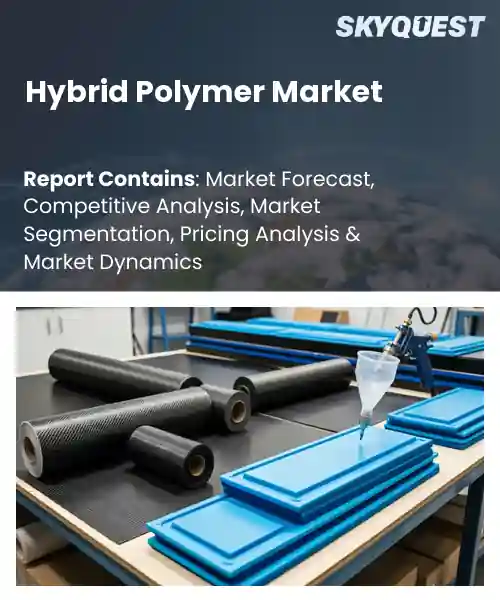
Hybrid Polymer Market
Report ID: SQMIG15E3615
Report ID: SQMIG15E3615
[email protected]
USA +1 351-333-4748
Report ID:
SQMIG15E3615 |
Region:
Global |
Published Date: June, 2026
Pages:
157
|Tables:
155
|Figures:
78


Global Hybrid Polymer Market size was valued at USD 9.5 Billion in 2024 and is poised to grow from USD 10.12 Billion in 2025 to USD 16.74 Billion by 2033, growing at a CAGR of 6.5% during the forecast period (2026-2033).
The primary driver of the hybrid polymer market is the increasing need for materials that reconcile competing performance and sustainability objectives across sectors such as automotive, aerospace and consumer electronics. Hybrid polymers combine polymers with inorganic fillers, fibers or other polymers to achieve targeted stiffness, impact resistance and thermal stability while enabling weight reduction, and this capability matters because it allows substitution of heavier metals and simplified assemblies, reducing lifecycle emissions and costs. Over the last decades the market evolved from simple blends to nanocomposites and bio-based hybrids, evidenced by carbon-fiber reinforced thermoplastics in vehicles and polymer-metal hybrid airframe structures adopted by major OEMs.
Building on those technological shifts, regulatory pressure and total-cost-of-ownership considerations operate as a key factor driving global market growth because tighter emissions rules and electrification trends compel manufacturers to prioritize lightweight, thermally stable materials for battery housings, structural parts and thermal management. Consequently material suppliers accelerate development of high-performance formulations and scalable processing methods, which reduces costs and expands use into electronics panels and wind turbine skins, creating demand for recycled and bio-based hybrid options. This cause-and-effect sequence opens opportunities for circular supply chains and collaborative commercialization between material producers and end-use manufacturers.
How is AI optimizing product design and performance in the hybrid polymer market?
AI is optimizing product design and performance in the hybrid polymer market by combining data driven property prediction, generative formulation and physics aware simulation. Key aspects include predicting behavior of multi component systems, proposing formulations to meet competing targets and linking lab results to manufacturing through digital twins. The current state shows widespread adoption of materials informatics tools that reduce trial and error and speed concept to prototype. This shift is making suppliers more agile and enabling more reliable performance in coatings, adhesives and composite blends. Real world validations of generative design and predictive analytics make the technology practical for product teams.
Citrine Informatics April 2026, announced a partnership with Perstorp to apply its AI platform to alkyd emulsion innovation, demonstrating how AI driven formulation and predictive analytics improve development throughput and formulation consistency to support market growth and efficiency.
Market snapshot - (2026-2033)
Global Market Size
USD 9.5 Billion
Largest Segment
Organic-Inorganic Hybrid Polymers
Fastest Growth
Conductive Hybrid Polymers
Growth Rate
6.5% CAGR
To get more insights on this market click here to Request a Free Sample Report
Global hybrid polymer market is segmented by type, material type, technology, application, end user and region. Based on type, the market is segmented into Organic-Inorganic Hybrid Polymers, Nanocomposite Hybrid Polymers, Conductive Hybrid Polymers and Others. Based on material type, the market is segmented into Silicone-Based, Epoxy-Based, Polyurethane-Based, Acrylic-Based and Others. Based on technology, the market is segmented into Sol-Gel Technology, Polymer Blending, In-Situ Polymerization and Others. Based on application, the market is segmented into Adhesives & Sealants, Coatings, Electronics, Automotive Components, Biomedical Applications, Packaging and Others. Based on end user, the market is segmented into Automotive, Construction, Electronics & Electrical, Healthcare, Packaging Industry and Others. Based on region, the market is segmented into North America, Europe, Asia Pacific, Latin America and Middle East & Africa.
Conductive Hybrid Polymers segment dominates because their intrinsic electrical pathways combined with polymer flexibility enable seamless integration into compact electronic assemblies. By embedding conductive phases within polymer matrices, they enhance signal integrity, electromagnetic compatibility and thermal dissipation while preserving processability for printing and coating techniques. This capability resolves device-level reliability and manufacturability constraints, driving adoption among designers and manufacturers focused on compact, multifunctional electronic components and systems.
However, nanocomposite hybrid polymers are the most rapidly expanding area due to their ability to tailor electrical and mechanical properties with nanoscale fillers. Improved dispersion methods and scalable processing enable flexible form factors and sensor integration, unlocking new product differentiation and accelerating adoption in advanced electronics applications.
Sol-Gel Technology segment dominates because its chemistry permits molecular level incorporation of inorganic networks into organic matrices, yielding coatings with enhanced barrier properties, hardness and adhesion while retaining polymer flexibility. The tunable processing window and broad precursor compatibility let formulators engineer surface functionality, optical clarity and thermal resilience, which supports uptake across demanding coating and surface modification applications that require multifunctional performance and durable protection.
On the other hand, in situ polymerization is emerging as the key high-growth area because it creates interpenetrating networks with strong interfacial bonding and controlled morphology. Its one pot processing and compatibility with nanoscale additives simplify production and enable higher performance formulations for coatings, adhesives and biomedical applications, unlocking new commercialization pathways and expanding application-driven opportunities.
To get detailed segments analysis, Request a Free Sample Report
Asia Pacific dominates the global hybrid polymer market because it combines a dense manufacturing ecosystem, technological leadership, and deeply integrated supply chains that support scale and innovation. Leading industrial clusters in electronics, automotive, and advanced materials create consistent demand for multifunctional polymers and foster close collaboration between material developers and end users. Strong research and development centers accelerate formulation refinement and performance validation. Local producers benefit from specialized processing capabilities and flexible production networks that shorten time to market. Proximity to major component manufacturers enables iterative development and rapid commercialization of application specific solutions. Policy frameworks and industrial strategies that prioritize advanced materials further reinforce regional competence and attract investment in next generation polymer chemistry and composite integration. This combination creates a competitive environment for continuous material advancement.
Hybrid Polymer Market in Japan is characterized by advanced material research, precision manufacturing and close collaboration between academia and industry. Demand stems from high performance electronics, automotive components and specialized industrial applications. Manufacturers emphasize quality control, process optimization and tailored formulations to meet demanding application requirements. The ecosystem supports pilot scale validation and strong supplier networks that facilitate iterative improvement and reliable delivery across key sectors.
Hybrid Polymer Market in South Korea benefits from strong electronics manufacturing, advanced assembly ecosystems and focus on lightweight materials for mobility applications. Research institutes and corporate laboratories collaborate on application driven formulations, emphasizing performance and process compatibility. Local firms leverage responsive supply chains and specialized processing to adapt blends for coating, adhesive and composite roles. Partnerships with OEMs and materials integrators support testing, refinement and scaling across industrial networks efficiently.
North America is experiencing rapid expansion in the hybrid polymer market driven by a combination of innovation in end use sectors, strong commercialization pathways and demand for materials that deliver multifunctional performance. Cross sector collaboration among chemical innovators, automotive and aerospace manufacturers, and electronics firms accelerates adoption of tailored polymer solutions. Robust prototyping and pilot manufacturing capacity enable faster product validation and scale up. Supply chain flexibility and emphasis on advanced materials integration support application specific customization. Environmental considerations and regulatory frameworks encourage development of more efficient, higher performing materials. Investment in translational research and partnerships between material suppliers and original equipment manufacturers fosters practical deployment of hybrid polymers across diverse industrial applications. Regional clusters provide access to specialized testing facilities and collaborative innovation programs that reduce barriers to adoption. Focused supply partnerships enable domestic scaling and broadened commercial reach.
Hybrid Polymer Market in United States benefits from extensive industrial diversification, strong venture and corporate investment in advanced materials and a pronounced focus on high performance applications in mobility and aerospace. Collaborative networks among universities, national laboratories and private firms support technology translation and scale up. Prototyping and pilot facilities enable practical validation. Market actors emphasize application driven customization, sustainable processing approaches and integration of hybrid polymers into complex systems.
Hybrid Polymer Market in Canada is driven by collaborative research, materials science expertise and proximity to advanced manufacturing. Research and development centers and university partnerships focus on sustainable formulations and application driven development for transportation, energy and coatings. Local suppliers emphasize process adaptability and quality assurance to meet end use needs. Collaborative pilot projects and regional supply networks support scaling from laboratory validation to commercial implementation across national value chains.
Europe is strengthening its position in the hybrid polymer market through coordinated research initiatives, strong industrial clusters and emphasis on sustainable, high performance materials. Collaborative frameworks between material science institutes and manufacturing sectors accelerate application specific development in automotive, aerospace and construction markets. European firms focus on lifecycle considerations and process efficiency, integrating hybrid polymers with circular economy principles. Advanced testing facilities and pilot lines support technical validation and scaling. Cross border supply networks and standards alignment facilitate market access and interoperability. Strategic partnerships between suppliers and OEMs enable tailored formulations and application adaptation, enhancing regional competitiveness in complex, performance driven markets. Investment in pilot production and digital materials characterization tools improves development cycles and reduces technical risk. Skills development programs and cross disciplinary collaboration ensure that material innovations translate into manufacturable solutions and support adoption across established industrial value chains.
Hybrid Polymer Market in Germany is anchored by a strong industrial base, engineering expertise and integration with automotive and manufacturing clusters. Research institutes and application laboratories work closely with manufacturers to optimize formulations for performance and processability. Emphasis on quality assurance and manufacturing reproducibility supports adoption in demanding applications. Suppliers prioritize scalable pilot production, testing protocols and collaboration with original equipment manufacturers to embed hybrid polymers in complex engineered systems.
Hybrid Polymer Market in United Kingdom reflects strong academic research, flexible manufacturing and emphasis on advanced composites for aerospace and specialty uses. Universities and innovation hubs collaborate with industry to translate novel chemistries into manufacturable materials. Suppliers prioritize tailored formulations, compatibility with processing lines and validation under application conditions. Market participants leverage testing facilities and pilot production to derisk commercialization. Strategic alliances with OEMs facilitate adoption across targeted industrial segments.
Hybrid Polymer Market in France combines strong chemical industry capability, research excellence and focus on materials for mobility, energy and industrial applications. Public research organizations and developers collaborate to design formulations that meet stringent performance and sustainability objectives. Suppliers emphasize adaptable processing, validation and compliance with technical standards. Pilot production facilities and innovation networks support iterative development and facilitate integration with manufacturer requirements, promoting broader adoption across targeted application areas.
To know more about the market opportunities by region and country, click here to
Buy The Complete Report
Rising Adoption In Automotive Applications
Expansion In Construction And Infrastructure
High Production And Processing Costs
Regulatory And Environmental Compliance
Request Free Customization of this report to help us to meet your business objectives.
Competitive activity in the global hybrid polymer market centers on M&A, partnerships, and targeted technology innovation. Stratasys completed the acquisition of Covestro’s additive manufacturing materials business to consolidate materials IP and broaden polymer portfolios. Established chemical producers now form co development partnerships with AI and materials startups to speed formulation cycles and commercialisation. Rising lightweighting demand in automotive and aerospace intensifies these competition dynamics.
SkyQuest’s ABIRAW (Advanced Business Intelligence, Research & Analysis Wing) is our Business Information Services team that Collects, Collates, Correlates, and Analyses the Data collected by means of Primary Exploratory Research backed by robust Secondary Desk research.
As per SkyQuest analysis, the global hybrid polymer market is being propelled primarily by the need for lightweight, multifunctional materials that enable substitution of heavier metals and simplified assemblies, while a key restraint is high production and processing costs that limit broader adoption. Asia Pacific is the dominating region due to dense manufacturing ecosystems and tight supply chains, and Conductive Hybrid Polymers are the dominating segment because they enhance electrical pathways and thermal management in compact electronics. A second driver is regulatory pressure and electrification trends pushing demand for thermally stable, low-emission materials. Together these dynamics favor innovation in scalable processing, AI-enabled formulation and sustainable feedstocks.
| Report Metric | Details |
|---|---|
| Market size value in 2024 | USD 9.5 Billion |
| Market size value in 2033 | USD 16.74 Billion |
| Growth Rate | 6.5% |
| Base year | 2024 |
| Forecast period | (2026-2033) |
| Forecast Unit (Value) | USD Billion |
| Segments covered |
|
| Regions covered | North America (US, Canada), Europe (Germany, France, United Kingdom, Italy, Spain, Rest of Europe), Asia Pacific (China, India, Japan, Rest of Asia-Pacific), Latin America (Brazil, Rest of Latin America), Middle East & Africa (South Africa, GCC Countries, Rest of MEA) |
| Companies covered |
|
| Customization scope | Free report customization with purchase. Customization includes:-
|
To get a free trial access to our platform which is a one stop solution for all your data requirements for quicker decision making. This platform allows you to compare markets, competitors who are prominent in the market, and mega trends that are influencing the dynamics in the market. Also, get access to detailed SkyQuest exclusive matrix.
Table Of Content
Executive Summary
Market overview
Parent Market Analysis
Market overview
Market size
KEY MARKET INSIGHTS
COVID IMPACT
MARKET DYNAMICS & OUTLOOK
Market Size by Region
KEY COMPANY PROFILES
Methodology
For the Hybrid Polymer Market, our research methodology involved a mixture of primary and secondary data sources. Key steps involved in the research process are listed below:
1. Information Procurement: This stage involved the procurement of Market data or related information via primary and secondary sources. The various secondary sources used included various company websites, annual reports, trade databases, and paid databases such as Hoover's, Bloomberg Business, Factiva, and Avention. Our team did 45 primary interactions Globally which included several stakeholders such as manufacturers, customers, key opinion leaders, etc. Overall, information procurement was one of the most extensive stages in our research process.
2. Information Analysis: This step involved triangulation of data through bottom-up and top-down approaches to estimate and validate the total size and future estimate of the Hybrid Polymer Market.
3. Report Formulation: The final step entailed the placement of data points in appropriate Market spaces in an attempt to deduce viable conclusions.
4. Validation & Publishing: Validation is the most important step in the process. Validation & re-validation via an intricately designed process helped us finalize data points to be used for final calculations. The final Market estimates and forecasts were then aligned and sent to our panel of industry experts for validation of data. Once the validation was done the report was sent to our Quality Assurance team to ensure adherence to style guides, consistency & design.
Analyst Support
Customization Options
With the given market data, our dedicated team of analysts can offer you the following customization options are available for the Hybrid Polymer Market:
Product Analysis: Product matrix, which offers a detailed comparison of the product portfolio of companies.
Regional Analysis: Further analysis of the Hybrid Polymer Market for additional countries.
Competitive Analysis: Detailed analysis and profiling of additional Market players & comparative analysis of competitive products.
Go to Market Strategy: Find the high-growth channels to invest your marketing efforts and increase your customer base.
Innovation Mapping: Identify racial solutions and innovation, connected to deep ecosystems of innovators, start-ups, academics, and strategic partners.
Category Intelligence: Customized intelligence that is relevant to their supply Markets will enable them to make smarter sourcing decisions and improve their category management.
Public Company Transcript Analysis: To improve the investment performance by generating new alpha and making better-informed decisions.
Social Media Listening: To analyze the conversations and trends happening not just around your brand, but around your industry as a whole, and use those insights to make better Marketing decisions.
REQUEST FOR SAMPLE
 REQUEST FREE CUSTOMIZATION
Global Hybrid Polymer Market size was valued at USD 9.5 Billion in 2024 and is poised to grow from USD 10.12 Billion in 2025 to USD 16.74 Billion by 2033, growing at a CAGR of 6.5% during the forecast period (2026-2033).
Competitive activity in the global hybrid polymer market centers on M&A, partnerships, and targeted technology innovation. Stratasys completed the acquisition of Covestro’s additive manufacturing materials business to consolidate materials IP and broaden polymer portfolios. Established chemical producers now form co development partnerships with AI and materials startups to speed formulation cycles and commercialisation. Rising lightweighting demand in automotive and aerospace intensifies these competition dynamics. 'Wacker Chemie AG', 'Evonik Industries AG', 'Dow Inc.', 'Henkel AG & Co. KGaA', 'BASF SE', 'Arkema S.A.', 'Momentive Performance Materials Inc.', 'Shin-Etsu Chemical Co., Ltd.', 'Sika AG', '3M Company', 'H.B. Fuller Company', 'Master Bond Inc.', 'Mitsubishi Chemical Group Corporation', 'Kaneka Corporation', 'Nitto Denko Corporation', 'Dymax Corporation', 'Panacol-Elosol GmbH', 'Permabond LLC', 'Jowat SE', 'DELO Industrie Klebstoffe GmbH & Co. KGaA'
The growing preference for lightweight, durable materials in automotive manufacturing supports hybrid polymers as manufacturers seek components that improve fuel efficiency and performance while meeting design flexibility requirements. Hybrid polymers enable integration of multiple functional properties, allowing designers to replace heavier metal parts and simplify assemblies. Their compatibility with existing processing methods encourages adoption across structural and interior applications, fostering collaboration between material suppliers and automakers and stimulating investment in tailored grades and supply chains that expand availability and confidence among manufacturers.
Sustainable Material Innovation: Demand for hybrid polymers formulated from bio-based feedstocks and circular sources is driving research into renewable monomers and novel copolymer architectures, enabling improved lifecycle characteristics and reduced reliance on virgin petrochemicals. Manufacturers increasingly prioritize integration of recyclable design, end-of-life consideration, and compatibility with existing recycling streams to enhance product circularity. Collaboration across value chains and material scientists accelerates scalable pilot programs and adoption of greener chemistries that maintain performance while responding to sustainability expectations from brand owners and end users.
Why does Asia Pacific Dominate the Global Hybrid Polymer Market? |@12


Want to customize this report? This report can be personalized according to your needs. Our analysts and industry experts will work directly with you to understand your requirements and provide you with customized data in a short amount of time. We offer $1000 worth of FREE customization at the time of purchase.
Feedback From Our Clients


 USA (+1) 351-333-4748

