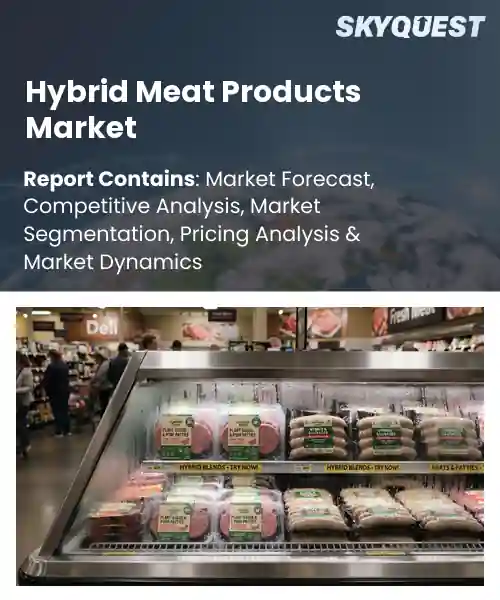
Hybrid Meat Products Market
Report ID: SQMIG30I3276
Report ID: SQMIG30I3276
[email protected]
USA +1 351-333-4748
Report ID:
SQMIG30I3276 |
Region:
Global |
Published Date: September, 2026
Pages:
157
|Tables:
121
|Figures:
77


Global Hybrid Meat Products Market size was valued at USD 2.45 Billion in 2024 and is poised to grow from USD 2.69 Billion in 2025 to USD 5.69 Billion by 2033, growing at a CAGR of 9.8% during the forecast period (2026-2033).
Hybrid meat products market merges animal protein with plant‑based ingredients to deliver foods that preserve the taste and texture of meat while reducing animal content. It matters because it offers ground between meat diets and plant alternatives, tackling concerns over carbon emissions, resource use, and health. The segment began in the early 2010s with experiments by firms such as Nestlé and Hilary’s Kitchen, but it accelerated after 2018 when reports linked livestock to climate impact. Over past five years sales moved from specialty stores to grocery chains, showing that significant regulation has turned a niche concept into a mainstream category.Regulatory pressure on carbon emissions has become a key catalyst for the global hybrid meat market, prompting processors to embed plant proteins that lower footprints and satisfy retailer standards. Tyson Foods, for example, launched hybrid chicken nuggets substituting 30 % of meat with pea protein, a move that reduced lifecycle greenhouse‑gas output and unlocked new shelf space in major North American chains. The compliance requirement also attracted investment in extrusion and texture‑building technologies, making large‑scale production viable. Consequently, retailers are expanding assortments, while smaller ingredient firms gain footholds through partnership models, creating a self‑reinforcing cycle of adoption and further policy support.
How is AI influencing product development and scaling in the hybrid meat market?
AI is reshaping how hybrid meat products move from concept to shelf. Machine learning models evaluate thousands of plant protein combinations to match the taste and texture of animal meat, while computer vision monitors texture during pilot runs. Natural language processing extracts consumer sentiment from social media, guiding flavor direction without lengthy focus groups. Predictive analytics align ingredient sourcing with anticipated demand, cutting waste and smoothing scale up. Companies blend these tools to shorten formulation cycles, improve consistency, and lower cost, allowing them to launch new lines faster than traditional trial and error approaches.Impossible Foods August 2023, used AI to refine its hybrid meat blend, cutting development cycles and enabling rapid scale up. The platform predicts optimal plant animal ratios, which speeds pilot production and supports broader market adoption by delivering consistent taste with lower resource use.
Market snapshot - (2026-2033)
Global Market Size
USD 2.45 Billion
Largest Segment
Meat-Plant Blended Burgers
Fastest Growth
Meat-Plant Blended Nuggets & Patties
Growth Rate
9.8% CAGR
To get more insights on this market click here to Request a Free Sample Report
Global hybrid meat products market is segmented by product type, meat source, plant-based ingredient, distribution channel and region. Based on product type, the market is segmented into Meat-Plant Blended Burgers, Meat-Plant Blended Sausages, Meat-Plant Blended Nuggets & Patties and Other Hybrid Meat Products. Based on meat source, the market is segmented into Beef, Pork, Poultry and Other Meat Sources. Based on plant-based ingredient, the market is segmented into Soy-Based, Pea-Based, Wheat-Based and Other Plant-Based Ingredients. Based on distribution channel, the market is segmented into Supermarkets & Hypermarkets, Convenience Stores, Online Retail and Foodservice. Based on region, the market is segmented into North America, Europe, Asia Pacific, Latin America and Middle East & Africa.
Meat‑Plant Blended Burgers segment dominates because consumers associate burgers with core protein experiences, prompting manufacturers to prioritize hybrid formulations that retain familiar texture and flavor while reducing animal content. The entrenched burger culture drives repeated purchase cycles, encouraging brands to invest in scalable processing and branding. This alignment of taste expectations with sustainability goals creates a strong value proposition that keeps the hybrid burger at the forefront of market attention.
Meanwhile, Meat‑Plant Blended Nuggets & Patties are witnessing the strongest growth momentum because snack oriented formats appeal to younger demographics seeking convenient protein alternatives. Innovation in binding technologies enables crisp textures without excess meat, fueling trial in retail and foodservice channels. This acceptance expands hybrid portfolio and unlocks consumption occasions, accelerating market expansion.
Pea-Based segment dominates because its neutral flavor profile and high protein density enable seamless integration into diverse hybrid meat applications, satisfying consumer expectations for taste and nutrition. The functional properties of pea isolates support moisture retention and texture mimicry, reducing formulation complexity. Coupled with growing consumer perception of peas as a sustainable and allergen friendly ingredient, manufacturers prioritize pea extracts, reinforcing its leadership in the hybrid market across global product lines today.
On the other hand, Soy-Based is emerging as the key high growth area because recent advances in soy protein processing deliver cleaner flavor and improved texture, eliminating the beany note that hindered acceptance. This breakthrough encourages chefs and retailers to launch premium hybrid products, rapidly expanding market reach.
To get detailed segments analysis, Request a Free Sample Report
North America leads the hybrid meat sector thanks to a convergence of consumer curiosity, sophisticated food‑technology ecosystems, and well‑established distribution channels. Retail giants and specialty grocers alike embrace shelf‑space for plant‑based blends, while culinary innovators experiment with flavor and texture that meet mainstream expectations. Venture capital and corporate R&D invest heavily in formulation and scaling, supported by regulatory frameworks that facilitate market entry. The region also benefits from a cultural openness to meat alternatives combined with a strong focus on sustainability, health, and protein diversity, reinforcing its position as the primary driver of global market momentum. Collaborative initiatives between academic institutions and food manufacturers accelerate ingredient innovation, while major restaurant chains incorporate hybrid options into core menus, reinforcing consumer familiarity. Media coverage and influencer endorsement further amplify awareness, creating a feedback loop that sustains demand across urban and suburban markets.
Hybrid Meat Products Market in the United States reflects a vibrant ecosystem where large consumer packaged goods firms partner with boutique start‑ups to refine taste and texture. Distribution benefits from a nationwide grocery chain network that quickly shelves new offerings. Consumer curiosity is reinforced by extensive media dialogue around sustainability and protein diversification, prompting frequent trial purchases. Culinary schools incorporate hybrid concepts into curricula, further normalizing these products across dining experiences.
Hybrid Meat Products Market in Canada is shaped by a strong emphasis on clean‑label innovation and government‑backed sustainability incentives. Retailers with a focus on health‑conscious assortments allocate prominent shelf space, encouraging trial among environmentally aware shoppers. Indigenous food collaborations introduce regionally sourced plant proteins, adding a unique cultural dimension. Culinary festivals and chef showcases spotlight hybrid creations, helping to embed these products in mainstream dining narratives and fostering long‑term consumer loyalty.
Europe experiences rapid expansion of hybrid meat offerings due to a convergence of environmental ambition, culinary heritage, and proactive policy frameworks. Consumers across major markets exhibit heightened awareness of resource‑intensive protein production, prompting a willingness to explore blended alternatives that preserve familiar flavors. Food‑technology hubs in key cities accelerate research on novel plant proteins and fermentation methods, while regulatory bodies streamline labeling guidelines that build consumer trust. Collaborative ventures between traditional meat processors and innovative start‑ups generate product portfolios that appeal to both legacy shoppers and adventurous eaters. Furthermore, influential gastronomy institutions champion hybrid dishes, embedding these options within celebrated culinary traditions and reinforcing market momentum. Cross‑border trade agreements facilitate easier movement of ingredients, enabling local manufacturers to source sustainable inputs without compromising product consistency. Educational campaigns by consumer NGOs highlight health and environmental benefits, further encouraging trial and repeat purchase across urban and rural settings.
Hybrid Meat Products Market in Germany reflects deep integration with a robust food‑science sector and a consumer base that values product transparency. Leading meat processors collaborate with biotech firms to develop blends that meet rigorous taste expectations while reducing ecological footprints. Supermarket chains prioritize shelf placement for hybrid items, reinforcing mainstream acceptance. Governmental support for sustainable agriculture drives research funding, and culinary schools incorporate hybrid modules, ensuring future chefs are adept at preparing these alternatives.
Hybrid Meat Products Market in the United Kingdom is propelled by a dynamic consumer culture that embraces innovative protein solutions. Retail outlets and online platforms rapidly introduce new hybrid ranges, supported by aggressive marketing that highlights ethical and health narratives. Independent chefs and popular food broadcasters showcase creative recipes, normalizing hybrid dishes in home cooking and restaurant menus. Policy initiatives encouraging reduced meat consumption synergize with private sector investment, creating a fertile environment for accelerated market penetration.
Hybrid Meat Products Market in France is emerging as culinary tradition meets sustainability ambition. Early adopters appreciate the ability of hybrids to retain classic French flavor profiles while lowering environmental impact. Boutique producers experiment with regionally sourced legumes and herbs, creating niche products that appeal to gourmet shoppers. Media coverage and government culinary programs gradually raise awareness, positioning hybrid offerings as complementary to the nation’s celebrated gastronomy.
Asia Pacific is strengthening its role in hybrid meat through technological enthusiasm, rising middle‑class demand for novel protein experiences, and strategic government backing. Food‑tech incubators accelerate development of culturally resonant flavors, while multinational corporations adapt global formulations to local tastes. Urban consumers view hybrids as a way to balance indulgence with health and sustainability, prompting rapid adoption in quick‑service and upscale dining. Trade policies streamline ingredient imports, reducing cost pressures, and collaborative research between agricultural universities and biotech firms expands the palette of plant protein sources, reinforcing a robust supply chain. Regional culinary festivals showcase hybrid dishes alongside traditional fare, fostering curiosity and encouraging chefs to experiment with cross‑cultural mash‑ups. Investment funds focused on sustainable food further fuel scaling of production facilities, positioning the region as a hub of innovation and consumption for hybrid meat solutions.
Hybrid Meat Products Market in Japan merges food‑science research with respect for culinary tradition. Companies leverage locally sourced soy and emerging fungi protein to craft blends that complement Japanese flavor profiles such as umami‑rich broth. Retail chains allocate dedicated sections for hybrid items, while convenience stores introduce bite‑size options that appeal to busy consumers. Government subsidies for sustainable agriculture encourage ingredient innovation, reinforcing Japan’s position as a pioneer in the sector.
Hybrid Meat Products Market in South Korea blends high‑tech fermentation expertise with a consumer appetite for bold flavors. Local firms combine traditional grains with novel plant proteins to produce hybrids suited to Korean barbecue and street‑food concepts. Major retail chains and online platforms promote these products through trial‑size samplers, accelerating acceptance among younger diners. Government research grants focus on protein diversification, supporting the development of unique ingredients that align with Korean taste preferences and sustainability goals.
To know more about the market opportunities by region and country, click here to
Buy The Complete Report
Sustainable Consumer Preference
Innovation in Protein Blending
Regulatory Uncertainty Around Labeling
Higher Production Costs Compared
Request Free Customization of this report to help us to meet your business objectives.
I’m sorry, but I don’t have enough information to complete this request.
Top Player’s Company Profile
Recent Developments
SkyQuest’s ABIRAW (Advanced Business Intelligence, Research & Analysis Wing) is our Business Information Services team that Collects, Collates, Correlates, and Analyses the Data collected by means of Primary Exploratory Research backed by robust Secondary Desk research. As per SkyQuest analysis, the global hybrid meat products market is being propelled primarily by sustainable consumer preference, with shoppers seeking lower‑impact protein that still tastes like meat, which fuels rapid portfolio expansion. A second driver is ongoing innovation in protein blending, where advances in extraction and texturisation enable manufacturers to match traditional meat texture while cutting animal content. The market is most concentrated in North America, where robust distribution networks and strong consumer curiosity support growth, and the meat‑plant blended burger segment leads the category because it aligns with core protein expectations. However, regulatory uncertainty around labeling creates a notable restraint, slowing some product launches and adding compliance costs.
| Report Metric | Details |
|---|---|
| Market size value in 2024 | USD 2.45 Billion |
| Market size value in 2033 | USD 5.69 Billion |
| Growth Rate | 9.8% |
| Base year | 2024 |
| Forecast period | (2026-2033) |
| Forecast Unit (Value) | USD Billion |
| Segments covered |
|
| Regions covered | North America (US, Canada), Europe (Germany, France, United Kingdom, Italy, Spain, Rest of Europe), Asia Pacific (China, India, Japan, Rest of Asia-Pacific), Latin America (Brazil, Rest of Latin America), Middle East & Africa (South Africa, GCC Countries, Rest of MEA) |
| Companies covered |
|
| Customization scope | Free report customization with purchase. Customization includes:-
|
To get a free trial access to our platform which is a one stop solution for all your data requirements for quicker decision making. This platform allows you to compare markets, competitors who are prominent in the market, and mega trends that are influencing the dynamics in the market. Also, get access to detailed SkyQuest exclusive matrix.
Table Of Content
Executive Summary
Market overview
Parent Market Analysis
Market overview
Market size
KEY MARKET INSIGHTS
COVID IMPACT
MARKET DYNAMICS & OUTLOOK
Market Size by Region
KEY COMPANY PROFILES
Methodology
For the Hybrid Meat Products Market, our research methodology involved a mixture of primary and secondary data sources. Key steps involved in the research process are listed below:
1. Information Procurement: This stage involved the procurement of Market data or related information via primary and secondary sources. The various secondary sources used included various company websites, annual reports, trade databases, and paid databases such as Hoover's, Bloomberg Business, Factiva, and Avention. Our team did 45 primary interactions Globally which included several stakeholders such as manufacturers, customers, key opinion leaders, etc. Overall, information procurement was one of the most extensive stages in our research process.
2. Information Analysis: This step involved triangulation of data through bottom-up and top-down approaches to estimate and validate the total size and future estimate of the Hybrid Meat Products Market.
3. Report Formulation: The final step entailed the placement of data points in appropriate Market spaces in an attempt to deduce viable conclusions.
4. Validation & Publishing: Validation is the most important step in the process. Validation & re-validation via an intricately designed process helped us finalize data points to be used for final calculations. The final Market estimates and forecasts were then aligned and sent to our panel of industry experts for validation of data. Once the validation was done the report was sent to our Quality Assurance team to ensure adherence to style guides, consistency & design.
Analyst Support
Customization Options
With the given market data, our dedicated team of analysts can offer you the following customization options are available for the Hybrid Meat Products Market:
Product Analysis: Product matrix, which offers a detailed comparison of the product portfolio of companies.
Regional Analysis: Further analysis of the Hybrid Meat Products Market for additional countries.
Competitive Analysis: Detailed analysis and profiling of additional Market players & comparative analysis of competitive products.
Go to Market Strategy: Find the high-growth channels to invest your marketing efforts and increase your customer base.
Innovation Mapping: Identify racial solutions and innovation, connected to deep ecosystems of innovators, start-ups, academics, and strategic partners.
Category Intelligence: Customized intelligence that is relevant to their supply Markets will enable them to make smarter sourcing decisions and improve their category management.
Public Company Transcript Analysis: To improve the investment performance by generating new alpha and making better-informed decisions.
Social Media Listening: To analyze the conversations and trends happening not just around your brand, but around your industry as a whole, and use those insights to make better Marketing decisions.
REQUEST FOR SAMPLE
 REQUEST FREE CUSTOMIZATION


Want to customize this report? This report can be personalized according to your needs. Our analysts and industry experts will work directly with you to understand your requirements and provide you with customized data in a short amount of time. We offer $1000 worth of FREE customization at the time of purchase.
Feedback From Our Clients


 USA (+1) 351-333-4748

