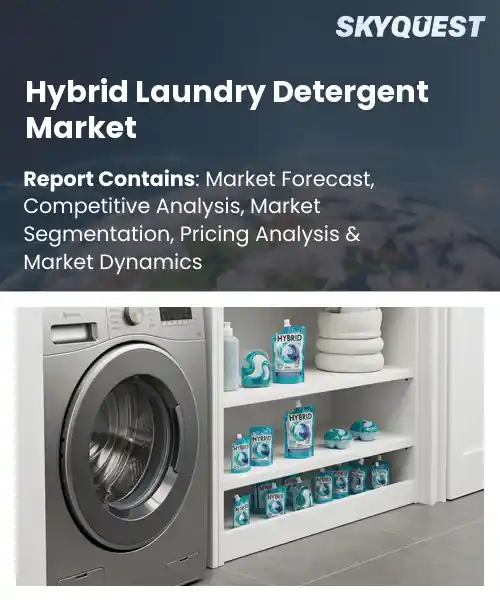
Hybrid Laundry Detergent Market
Report ID: SQMIG30K2125
Report ID: SQMIG30K2125
[email protected]
USA +1 351-333-4748
Report ID:
SQMIG30K2125 |
Region:
Global |
Published Date: July, 2026
Pages:
157
|Tables:
117
|Figures:
77


Global Hybrid Laundry Detergent Market size was valued at USD 12.84 Billion in 2024 and is poised to grow from USD 13.62 Billion in 2025 to USD 21.88 Billion by 2033, growing at a CAGR of 6.1% during the forecast period (2026-2033).
The hybrid laundry detergent market blends traditional surfactant chemistry with biotechnology‑derived enzymes and encapsulated fragrance boosters, creating a product that cleans efficiently while reducing environmental impact. This convergence matters because consumers increasingly demand performance without compromising sustainability, prompting manufacturers to invest in eco‑friendly formulations. Historically, the sector evolved from powder detergents in the 1960s to liquid concentrates in the 1990s, and finally to hybrid blends after 2015 when regulatory pressure on phosphates intensified. For example, a European brand introduced a bio‑enhanced detergent that cuts water usage by 30 percent, illustrating how regulatory and consumer trends have reshaped the market globally. The principal growth driver for the global hybrid laundry detergent market is the rising demand for energy‑efficient washing cycles that align with smart‑home ecosystems. As households adopt high‑efficiency machines, detergents must dissolve rapidly at lower temperatures, a capability that hybrid formulas provide through enzyme encapsulation and low‑suds surfactants. This technical advantage enables consumers to shave up to 40 % of heating costs, prompting retailers such as a major North American chain to allocate shelf space to hybrid brands. Consequently, manufacturers are expanding R&D budgets to create region‑specific variants, opening opportunities for partnership with appliance makers and reinforcing market expansion in 2024.
How is AI-driven formulation impacting the hybrid laundry detergent market?
AI-driven formulation is reshaping the hybrid laundry detergent market by using machine learning to predict how different surfactants, enzymes and polymers interact. This approach replaces lengthy lab testing with virtual simulations, allowing formulators to fine‑tune performance, fragrance and biodegradability in a fraction of the time. Hybrid products that blend liquid concentrates with pod technology benefit especially, because AI can balance solubility and release profiles across temperature ranges. Companies are leveraging large datasets from consumer use, sensor feedback and sustainability targets to create cleaners that work effectively in cold washes while lowering chemical load. The result is a more agile development pipeline and products that resonate with eco conscious shoppers.Procter & Gamble, March 2023, introduced an AI designed hybrid detergent that combines liquid and pod formats, delivering stronger stain removal in cold water while cutting water usage. The launch illustrates how AI accelerates formulation, supports sustainability goals and fuels market growth.
Market snapshot - (2026-2033)
Global Market Size
USD 12.84 Billion
Largest Segment
Liquid Detergents
Fastest Growth
Detergent Pods
Growth Rate
6.1% CAGR
To get more insights on this market click here to Request a Free Sample Report
Global hybrid laundry detergent market is segmented by product type, formulation, application, distribution channel and region. Based on product type, the market is segmented into Liquid Detergents, Powder Detergents and Detergent Pods. Based on formulation, the market is segmented into Bio-Based, Synthetic and Hybrid Bio-Synthetic. Based on application, the market is segmented into Household, Commercial Laundry and Industrial Laundry. Based on distribution channel, the market is segmented into Supermarkets, Online Retail and Specialty Stores. Based on region, the market is segmented into North America, Europe, Asia Pacific, Latin America and Middle East & Africa.
Liquid Detergents segment dominates because it aligns with consumer preference for easy dispensing and quick dissolution, which enhances perceived cleaning efficiency. Its fluid nature enables seamless integration of hybrid bio‑synthetic actives, delivering strong stain removal while maintaining low residue. Moreover, retailers favor liquid formats for shelf‑space flexibility, reinforcing brand visibility and repeat purchase loops that solidify its leading position in the Hybrid Laundry Detergent Market and drive consumer loyalty.
However, Detergent Pods is witnessing the strongest growth momentum as convenience‑oriented shoppers gravitate toward pre‑measured doses that eliminate guesswork. Innovative biodegradable film technologies and appealing compact packaging are opening new retail avenues, accelerating adoption and positioning pods as a pivotal catalyst for market expansion and long‑term strategic brand differentiation.
Hybrid Bio‑Synthetic formulation segment dominates because it merges the environmental benefits of renewable ingredients with the robust cleaning power of synthetic surfactants, delivering superior stain removal without compromising sustainability goals. This dual chemistry satisfies eco‑conscious consumers while meeting rigorous performance expectations across diverse fabric types. Manufacturers leverage this versatility to differentiate products, fostering brand loyalty and reinforcing the formulation’s central role in the Hybrid Laundry Detergent Market.
Meanwhile, Bio Based formulation is emerging as a high growth area as consumers intensify demand for fully plant derived cleaning solutions. Advances in enzyme engineering and natural surfactant extraction narrow performance gaps, encouraging wider acceptance across household and commercial use. This surge expands market opportunities and drives investment in sustainable sourcing.
To get detailed segments analysis, Request a Free Sample Report
The region benefits from a convergence of high consumer awareness of sustainability, rapid adoption of innovative cleaning technologies, and robust manufacturing ecosystems that support advanced formulation development. Consumer preferences in key markets emphasize gentle yet effective performance on a variety of fabrics, encouraging manufacturers to invest in hybrid blends that combine bio‑based surfactants with traditional agents. Strong distribution networks and close collaboration between ingredient suppliers and detergent producers accelerate product rollout. Additionally, governmental incentives for eco‑friendly products reinforce market expansion, while cultural emphasis on cleanliness drives consistent demand across household and commercial segments.
Hybrid Laundry Detergent Market in Japan reflects deep consumer commitment to quality and environmental stewardship, prompting manufacturers to prioritize product efficacy alongside reduced ecological impact. Innovation ecosystems in the country facilitate integration of cutting‑edge surfactant technologies, resulting in formulations that balance high stain removal with gentle fabric care. Retail channels emphasize premium positioning, reinforcing consumer willingness to adopt hybrid solutions that align with both performance expectations and sustainability values.
Hybrid Laundry Detergent Market in South Korea is shaped by a tech‑savvy consumer base that rapidly embraces novel cleaning solutions offering superior performance with lower environmental footprints. Collaborative research between local chemical firms and global brands drives formulation advancements that cater to diverse fabric requirements. Market dynamics favor products that deliver convenience and efficacy, encouraging the proliferation of hybrid detergents across both urban and suburban households. Regulatory emphasis on greener consumer goods further supports market momentum.
Consumer demand for high‑performance cleaning options that also address environmental concerns fuels market momentum, with shoppers increasingly seeking products that combine effective stain removal with reduced ecological impact. Retail environments prioritize shelf space for hybrid offerings, reflecting confidence in product differentiation and brand storytelling around sustainability. Collaboration between ingredient innovators and major detergent manufacturers accelerates the introduction of formulations that blend bio‑derived surfactants with traditional components, ensuring compatibility with existing washing technology. Lifestyle trends emphasizing convenience and health also reinforce attraction to hybrid detergents that promise gentle care for fabrics and skin while minimizing chemical load in wastewater.
Hybrid Laundry Detergent Market in the United States is characterized by strong consumer advocacy for greener household solutions, prompting brands to expand their hybrid portfolios. Marketing narratives focus on performance parity with conventional products, while emphasizing reduced environmental strain, resonating with eco‑conscious shoppers. Distribution networks across mass‑market and specialty retailers facilitate widespread availability, reinforcing the shift toward hybrid blends that meet rigorous cleaning standards and sustainability expectations.
Hybrid Laundry Detergent Market in Canada reflects a national emphasis on environmental responsibility, driving consumer preference for products that balance cleaning efficiency with sustainability. Retail chains increasingly allocate prominent placement to hybrid options, encouraging trial and adoption. Collaborative efforts between local suppliers and multinational producers ensure that formulations align with Canadian regulatory frameworks and consumer expectations for effective yet gentle cleaning solutions.
Europe’s regulatory landscape championing reduced chemical footprints and enhanced product transparency provides a catalyst for hybrid detergent development, compelling manufacturers to innovate within stringent standards. Consumers across the region demonstrate a sophisticated appetite for high‑efficacy solutions that also align with broader sustainability goals, prompting brands to invest in research that integrates renewable surfactants with proven cleaning agents. Collaborative industry initiatives foster knowledge sharing on best practices for formulation performance and environmental impact. Retail platforms emphasize product labeling that clearly communicates hybrid benefits, reinforcing consumer confidence and accelerating market penetration throughout both household and professional laundering sectors.
Hybrid Laundry Detergent Market in Germany benefits from a strong engineering heritage that underpins precise formulation techniques, delivering products that meet exacting performance criteria while adhering to rigorous environmental standards. Consumer expectations for reliability and sustainability drive manufacturers to prioritize hybrid blends that assure effective stain removal and fabric care without compromising ecological considerations.
Hybrid Laundry Detergent Market in the United Kingdom is shaped by heightened consumer awareness of product lifecycle impacts, encouraging demand for detergents that marry efficacy with reduced environmental burden. Retail environments highlight hybrid options through dedicated sustainability sections, supporting consumer shift toward solutions that promise both cleaning power and responsible resource use.
Hybrid Laundry Detergent Market in France reflects a cultural emphasis on refined textile care combined with ecological mindfulness, prompting brands to formulate hybrids that ensure gentle yet thorough cleaning. Market dynamics favor products that align with French consumer preferences for high‑quality performance paired with transparent, eco‑friendly ingredient profiles.
To know more about the market opportunities by region and country, click here to
Buy The Complete Report
Eco‑Friendly Consumer Preference
Regulatory Incentives For Cleaner Products
Higher Production Costs
Consumer Skepticism Toward New Formulas
Request Free Customization of this report to help us to meet your business objectives.
The competitive landscape of the global hybrid laundry detergent market is shaped by intense rivalry among established brands and emerging biotech‑focused players. A key driver is the shift toward probiotic and microbiome‑friendly formulations, prompting companies to pursue strategic M&A, cross‑industry partnerships, and rapid tech‑innovation cycles. Recent examples include a major detergent manufacturer acquiring a niche probiotic cleaning startup to integrate microbiome technology, and another leading brand forming a joint venture with a biotech firm to co‑develop enzyme‑enhanced hybrid formulas, accelerating time‑to‑market and expanding distribution channels.
Top Player’s Company Profile
Recent Developments
SkyQuest’s ABIRAW (Advanced Business Intelligence, Research & Analysis Wing) is our Business Information Services team that Collects, Collates, Correlates, and Analyses the Data collected by means of Primary Exploratory Research backed by robust Secondary Desk research. As per SkyQuest analysis, the global hybrid laundry detergent market is being propelled primarily by the surge in demand for energy‑efficient washing cycles that require low‑temperature, fast‑dissolving formulas, while regulatory incentives that push for reduced phosphates and volatile organics act as a second catalyst accelerating reformulation investments. The market’s growth is tempered by higher production costs associated with specialized blending of bio‑synthetic ingredients, which can limit pricing flexibility. Asia Pacific emerges as the dominant region, driven by strong consumer sustainability awareness and advanced manufacturing ecosystems, and the liquid‑detergent segment leads the market thanks to its ease of use, quick dissolution and compatibility with hybrid bio‑synthetic actives.
| Report Metric | Details |
|---|---|
| Market size value in 2024 | USD 12.84 Billion |
| Market size value in 2033 | USD 21.88 Billion |
| Growth Rate | 6.1% |
| Base year | 2024 |
| Forecast period | (2026-2033) |
| Forecast Unit (Value) | USD Billion |
| Segments covered |
|
| Regions covered | North America (US, Canada), Europe (Germany, France, United Kingdom, Italy, Spain, Rest of Europe), Asia Pacific (China, India, Japan, Rest of Asia-Pacific), Latin America (Brazil, Rest of Latin America), Middle East & Africa (South Africa, GCC Countries, Rest of MEA) |
| Companies covered |
|
| Customization scope | Free report customization with purchase. Customization includes:-
|
To get a free trial access to our platform which is a one stop solution for all your data requirements for quicker decision making. This platform allows you to compare markets, competitors who are prominent in the market, and mega trends that are influencing the dynamics in the market. Also, get access to detailed SkyQuest exclusive matrix.
Table Of Content
Executive Summary
Market overview
Parent Market Analysis
Market overview
Market size
KEY MARKET INSIGHTS
COVID IMPACT
MARKET DYNAMICS & OUTLOOK
Market Size by Region
KEY COMPANY PROFILES
Methodology
For the Hybrid Laundry Detergent Market, our research methodology involved a mixture of primary and secondary data sources. Key steps involved in the research process are listed below:
1. Information Procurement: This stage involved the procurement of Market data or related information via primary and secondary sources. The various secondary sources used included various company websites, annual reports, trade databases, and paid databases such as Hoover's, Bloomberg Business, Factiva, and Avention. Our team did 45 primary interactions Globally which included several stakeholders such as manufacturers, customers, key opinion leaders, etc. Overall, information procurement was one of the most extensive stages in our research process.
2. Information Analysis: This step involved triangulation of data through bottom-up and top-down approaches to estimate and validate the total size and future estimate of the Hybrid Laundry Detergent Market.
3. Report Formulation: The final step entailed the placement of data points in appropriate Market spaces in an attempt to deduce viable conclusions.
4. Validation & Publishing: Validation is the most important step in the process. Validation & re-validation via an intricately designed process helped us finalize data points to be used for final calculations. The final Market estimates and forecasts were then aligned and sent to our panel of industry experts for validation of data. Once the validation was done the report was sent to our Quality Assurance team to ensure adherence to style guides, consistency & design.
Analyst Support
Customization Options
With the given market data, our dedicated team of analysts can offer you the following customization options are available for the Hybrid Laundry Detergent Market:
Product Analysis: Product matrix, which offers a detailed comparison of the product portfolio of companies.
Regional Analysis: Further analysis of the Hybrid Laundry Detergent Market for additional countries.
Competitive Analysis: Detailed analysis and profiling of additional Market players & comparative analysis of competitive products.
Go to Market Strategy: Find the high-growth channels to invest your marketing efforts and increase your customer base.
Innovation Mapping: Identify racial solutions and innovation, connected to deep ecosystems of innovators, start-ups, academics, and strategic partners.
Category Intelligence: Customized intelligence that is relevant to their supply Markets will enable them to make smarter sourcing decisions and improve their category management.
Public Company Transcript Analysis: To improve the investment performance by generating new alpha and making better-informed decisions.
Social Media Listening: To analyze the conversations and trends happening not just around your brand, but around your industry as a whole, and use those insights to make better Marketing decisions.
REQUEST FOR SAMPLE
 REQUEST FREE CUSTOMIZATION


Want to customize this report? This report can be personalized according to your needs. Our analysts and industry experts will work directly with you to understand your requirements and provide you with customized data in a short amount of time. We offer $1000 worth of FREE customization at the time of purchase.
Feedback From Our Clients


 USA (+1) 351-333-4748

