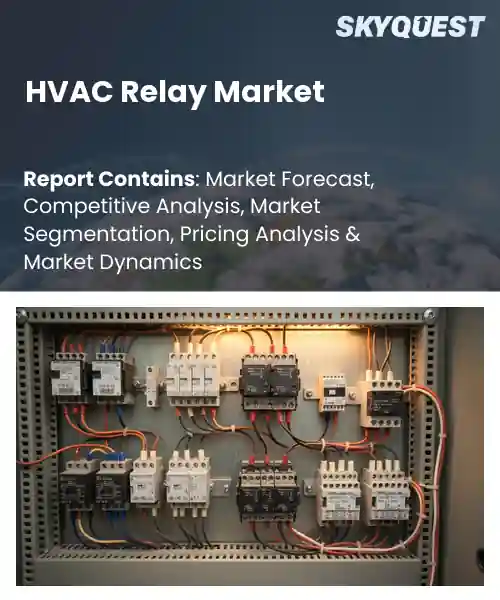
HVAC Relay Market
Report ID: SQMIG45K2320
Report ID: SQMIG45K2320
[email protected]
USA +1 351-333-4748
Report ID:
SQMIG45K2320 |
Region:
Global |
Published Date: June, 2026
Pages:
157
|Tables:
175
|Figures:
79


Global Hvac Relay Market size was valued at USD 1.29 Billion in 2024 and is poised to grow from USD 1.38 Billion in 2025 to USD 2.39 Billion by 2033, growing at a CAGR of 7.1% during the forecast period (2026-2033).
The global HVAC relay market consists of products that switch power to heating, ventilation, and air-conditioning systems, allowing for control and efficiency. The product’s importance is due to the growing demand for climate control in residential, commercial and industrial buildings, spurred by stricter energy-conservation standards worldwide. The market began in the 1970s when electromechanical relays were introduced to replace pneumatic controls and gained momentum in the 1990s when solid state technology provided faster response with lower maintenance. For example, European manufacturers have integrated intelligent relays in building projects, reducing the peak load by up to 15 %, which shows the value of the sector.
The HVAC relay market is driven by the growth of the building ecosystem that requires relays to communicate with IoT platforms and diagnostics. Building owners are looking to predictive maintenance to reduce downtime and manufacturers are adding wireless modules and cloud analytics to relays to create a data-driven feedback loop to make energy-saving adjustments. One popular application is the retrofit of university campuses in North America, where networked relays have reduced HVAC consumption by 12% while notifying crews of coil failures before loss. This convergence of connectivity and efficiency unlocks new revenue streams for suppliers and accelerates adoption across commercial and industrial sectors.
How is AI-driven automation impacting the HVAC relay market?
The AI enabled automation is revolutionizing the relay market for HVAC by incorporating intelligent control logic within the relay devices. Manufacturers are adding machine-learning algorithms that predict system behavior and adjust switching actions in real time. It cuts down time, improves energy use and makes it easier for technicians to install. The technology also provides remote diagnostics that can assist service teams in troubleshooting issues without having to visit the site. Owners are demanding smarter infrastructure and that is creating a more responsive and sustainable market space with AI enabled relays being the option of choice for new builds and retrofits.
March 2026 Bosch Home Comfort Solutions: Launched AI-powered relay that learns from your operating patterns and optimizes switching to reduce energy waste. This highlights the benefits of AI-driven automation for efficiency and market growth.
Market snapshot - (2026-2033)
Global Market Size
USD 1.29 Billion
Largest Segment
Electromechanical Relays
Fastest Growth
Solid-State Relays
Growth Rate
7.1% CAGR
To get more insights on this market click here to Request a Free Sample Report
Global hvac relay market is segmented by product type, relay configuration, voltage type, application, end user, distribution channel and region. Based on product type, the market is segmented into Electromechanical Relays, Solid-State Relays, Time Delay Relays, Control Relays and Others. Based on relay configuration, the market is segmented into Single Pole Single Throw (SPST), Single Pole Double Throw (SPDT), Double Pole Double Throw (DPDT) and Others. Based on voltage type, the market is segmented into Low Voltage Relays, Medium Voltage Relays and Others. Based on application, the market is segmented into Heating Systems, Ventilation Systems, Air Conditioning Systems, Refrigeration Systems and Others. Based on end user, the market is segmented into Residential, Commercial and Industrial. Based on distribution channel, the market is segmented into OEM Sales and Aftermarket. Based on region, the market is segmented into North America, Europe, Asia Pacific, Latin America and Middle East & Africa.
Electromechanical Relays segment is dominating due to HVAC systems relying on their proven durability and tactile feedback, which simplifies installation and maintenance for technicians. The mechanical contacts provide reliable switching over a range of loads and therefore are the contact of choice for legacy equipment and cost sensitive projects. This reliability inspires confidence among OEMs, underpinning stable procurement cycles and maintaining market momentum for heating, ventilation and air conditioning platforms, while enabling compatibility with nascent smart-control modules, thus prolonging product life cycles.
Meanwhile Solid-State Relays are fastest growing, matching digital HVAC controllers that demand quiet operation and fast switching. That means no moving parts, so there is no arcing. This allows for higher efficiency standards, and also compact designs. This innovation is attracting new installations in energy-optimized buildings, driving demand and opening the door to advanced monitoring solutions that accelerate market expansion.
The residential end user segment, in particular homeowners, is increasingly concerned about comfort and energy saving, and therefore is the main driver of demand for compact and easy-to-use HVAC relay solutions. These relays are a standard feature in split-system units and smart thermostats and are easy to install with user-friendly interfaces that cater to the DIY trend. Low noise, space efficiency and compatibility with platforms for home automation are important factors for continued purchase and relevance in the market. Incentive programs to help drive energy efficient upgrades also solidify adoption and build a resilient demand base.
By end user, the commercial segment is projected to grow at the highest CAGR as large facilities are adopting integrated building management systems which require scalable relay architectures. The need for more reliability in continuous operation and more stringent compliance standards increases the purchase of sophisticated control relays with networked diagnostics. This provides new revenues streams and spurs innovation. Commercial projects are fueling growth in the HVAC relay market.
To get detailed segments analysis, Request a Free Sample Report
Asia Pacific HVAC relay market is expected to dominate owing to its strong manufacturing ecosystem, deep engineering expertise and increasing focus on energy efficient climate control. The region has strong electronics supply chains that allow for fast scaling up of high quality components at competitive prices. Strong investment in smart building initiatives and government incentives for greener infrastructure is fueling demand across residential, commercial and industrial segments. The spectrum of climates from humid subtropical to cold temperate requires the continual development of relays capable of surviving various environmental stresses. Further, the region is witnessing a trend of bringing digital monitoring and IoT connectivity into HVAC systems, which is adding to the value proposition of advanced relays and is prompting the OEMs to adopt more advanced solutions. Japan and South Korea are establishing collaborative research centers that accelerate product differentiation and reinforce the region’s leadership.
HVAC Relay Market Japan’s tradition of precision engineering and strong focus on reliability matches the country’s high standards for building automation. Advanced ceramic and solid-state technologies are being used by domestic manufacturers to make relays that can take punishing temperature changes. The close collaboration of component suppliers with large HVAC systems integrators accelerates the deployment of smart energy saving solutions that can be applied to both new construction and extensive retrofit projects.
HVAC Relay Market Report South Korea is propelled by the rapid uptake of intelligent building platforms and a strong export orientation that drives manufacturers to high performance standards. The industry is focused on small size, high frequency relay designs that are compatible with advanced control algorithms. Continuous improvement is encouraged by government support for green building certifications, and strong linkages to the global automotive and electronics industries spur cross-industry innovation, increasing reliability and functionality for both local and international use.
Europe’s HVAC relay market is booming. Stringent energy efficiency directives, widespread retro-fit programmes and a deep commitment to sustainable building practices are driving the growth. Manufacturers and system integrators are being forced by regulatory frameworks to use components that provide accurate control and low power loss, making relays key enablers of smart climate management. The area has a mature pool of engineering talent and a dense network of specialist suppliers that promote continuous innovation, especially in the field of solid state and digital relay technologies. In addition, collaborative efforts by industry associations and research institutions promote the adoption of advanced control solutions in residential, commercial and industrial applications, reinforcing Europe’s position as a hub for high-performance HVAC components. Growing consumer awareness about indoor air quality is driving demand for intelligent relay solutions that can interface with ventilation and filtration systems. The forces together create a fertile ground for manufacturers to introduce differentiated, eco-friendly products that are aligned with the continent’s climate goals.
HVAC Relay Market Germany has an industrial base and stringent performance standards that necessitate highly reliable components. In the field of complex building automation and heavy-duty industrial applications relays are produced by domestic producers through the combination of precision casting and advanced semiconductor processes. Working in close collaboration with engineering consultants, we ensure that new relay designs comply with ever-changing energy-saving regulations, and our emphasis on modularity simplifies integration into existing and next-generation HVAC systems across the country.
Growth of the UK HVAC Relay Market is being driven by construction and the transition to net-zero building standards. The suppliers are looking for small networked relays that can be retrofitted into the existing infrastructure but still enable accurate energy management. Digital relay solutions integrated with cloud-based building management platforms are being prototyped by academic research centres and industry players. This collaboration drives market uptake and positions the UK as a hub of innovation in smart HVAC control.
HVAC Relay Market The increasing renovation activities and the awareness of energy performance are making France a fertile ground for relay technologies. Modular solid-state designs are being adopted by local manufacturers that dovetail with France’s growing smart grid initiatives. Cooperation with government energy agencies is spurring the development of standards for interoperability of HVAC systems and building automation networks. These efforts promote an ecosystem which allows for the incremental rollout of advanced relay solutions for residential and commercial projects.
The growing automation of smart buildings, strict regulations on indoor air quality and a thriving ecosystem of technology developers are cementing the position of North America in the HVAC relay market. Major manufacturers are investing heavily in research to combine relay functionality with IoT connectivity to develop smart components that can automatically perform real-time diagnostics and predictive maintenance. Demand for reliable, high-performance relays that can be seamlessly upgraded is driving a widespread retrofit activity as aging infrastructure in the region pushes the need for such equipment. These collaborations between semiconductor companies, HVAC system designers and energy service providers speed up the implementation of energy-optimizing solutions, with North America becoming a catalyst for next-generation HVAC control technologies. Further, OEMs are also integrating intelligent relay modules with voice controlled assistants and mobile applications given the rising consumer demand for smart home environments. And it is compatible with a large number of equipment platforms, with good standards being put in place by industry consortia, which also helps the market.
The U.S. HVAC Relay market is influenced by broad new construction and a high focus on digital twin technologies for the management of buildings. Suppliers have targeted fast, low power relays to enable granular control of heating and cooling loads with cloud analytics platforms. Top HVAC OEMs and semiconductor manufacturers are collaborating closely and quickly to develop adaptive relay solutions that can respond in real time to trends in occupancy and utility demand response initiatives.
The Canadian HVAC Relay Market is driven by a high emphasis on sustainable construction and a regulatory environment that promotes low-emission heating and cooling technologies. Local manufacturers usually produce durable relays that can endure the weather conditions of the different climate zones of the country. The relays work reliably even in extreme cold as well as moderate conditions. Collaborations of research universities are producing energy-efficient relay architectures that are compatible with future smart grid efforts in residential and commercial domains.
To know more about the market opportunities by region and country, click here to
Buy The Complete Report
Increasing Energy Efficiency Regulations
Growth of Smart Building Technologies
High Initial Cost of Advanced Relays
Complex Integration with Legacy Systems
Request Free Customization of this report to help us to meet your business objectives.
The competitive landscape is shaped by legacy OEMs such as Honeywell, Schneider Electric and Siemens pursuing strategic M&A and joint‑development agreements to embed advanced digital controls into relay modules, while newer entrants leverage AI‑driven predictive maintenance and cloud‑based integration to differentiate their offerings; recent partnerships between Siemens and Google Cloud for IoT analytics and Honeywell’s acquisition of Resideo’s smart‑home relay portfolio illustrate how consolidation and technology alliances are accelerating market consolidation.
SkyQuest’s Business Information Services team, ABIRAW (Advanced Business Intelligence, Research & Analysis Wing) collects, compiles, correlates and analyzes the data collected through Primary Exploratory Research supported by strong Secondary Desk research.
The global HVAC relay market is being driven by stringent energy-efficiency regulations, which require manufacturers to include accurate control relays, and the rapid growth of smart-building platforms which require IoT-ready, data-rich devices, according to SkyQuest analysis. Asia Pacific continues to dominate the region, due to strong electronics supply chains and government incentives driving adoption across the region. Electromechanical relays continue to rule the segment landscape with their proven durability and cost advantage in legacy and new installations. However, high upfront costs of sophisticated solid-state and AI-enabled relays impede adoption in cost-sensitive projects and developing nations.
| Report Metric | Details |
|---|---|
| Market size value in 2024 | USD 1.29 Billion |
| Market size value in 2033 | USD 2.39 Billion |
| Growth Rate | 7.1% |
| Base year | 2024 |
| Forecast period | (2026-2033) |
| Forecast Unit (Value) | USD Billion |
| Segments covered |
|
| Regions covered | North America (US, Canada), Europe (Germany, France, United Kingdom, Italy, Spain, Rest of Europe), Asia Pacific (China, India, Japan, Rest of Asia-Pacific), Latin America (Brazil, Rest of Latin America), Middle East & Africa (South Africa, GCC Countries, Rest of MEA) |
| Companies covered |
|
| Customization scope | Free report customization with purchase. Customization includes:-
|
To get a free trial access to our platform which is a one stop solution for all your data requirements for quicker decision making. This platform allows you to compare markets, competitors who are prominent in the market, and mega trends that are influencing the dynamics in the market. Also, get access to detailed SkyQuest exclusive matrix.
Table Of Content
Executive Summary
Market overview
Parent Market Analysis
Market overview
Market size
KEY MARKET INSIGHTS
COVID IMPACT
MARKET DYNAMICS & OUTLOOK
Market Size by Region
KEY COMPANY PROFILES
Methodology
For the HVAC Relay Market, our research methodology involved a mixture of primary and secondary data sources. Key steps involved in the research process are listed below:
1. Information Procurement: This stage involved the procurement of Market data or related information via primary and secondary sources. The various secondary sources used included various company websites, annual reports, trade databases, and paid databases such as Hoover's, Bloomberg Business, Factiva, and Avention. Our team did 45 primary interactions Globally which included several stakeholders such as manufacturers, customers, key opinion leaders, etc. Overall, information procurement was one of the most extensive stages in our research process.
2. Information Analysis: This step involved triangulation of data through bottom-up and top-down approaches to estimate and validate the total size and future estimate of the HVAC Relay Market.
3. Report Formulation: The final step entailed the placement of data points in appropriate Market spaces in an attempt to deduce viable conclusions.
4. Validation & Publishing: Validation is the most important step in the process. Validation & re-validation via an intricately designed process helped us finalize data points to be used for final calculations. The final Market estimates and forecasts were then aligned and sent to our panel of industry experts for validation of data. Once the validation was done the report was sent to our Quality Assurance team to ensure adherence to style guides, consistency & design.
Analyst Support
Customization Options
With the given market data, our dedicated team of analysts can offer you the following customization options are available for the HVAC Relay Market:
Product Analysis: Product matrix, which offers a detailed comparison of the product portfolio of companies.
Regional Analysis: Further analysis of the HVAC Relay Market for additional countries.
Competitive Analysis: Detailed analysis and profiling of additional Market players & comparative analysis of competitive products.
Go to Market Strategy: Find the high-growth channels to invest your marketing efforts and increase your customer base.
Innovation Mapping: Identify racial solutions and innovation, connected to deep ecosystems of innovators, start-ups, academics, and strategic partners.
Category Intelligence: Customized intelligence that is relevant to their supply Markets will enable them to make smarter sourcing decisions and improve their category management.
Public Company Transcript Analysis: To improve the investment performance by generating new alpha and making better-informed decisions.
Social Media Listening: To analyze the conversations and trends happening not just around your brand, but around your industry as a whole, and use those insights to make better Marketing decisions.
REQUEST FOR SAMPLE
 REQUEST FREE CUSTOMIZATION
Global Hvac Relay Market size was valued at USD 1.29 Billion in 2024 and is poised to grow from USD 1.38 Billion in 2025 to USD 2.39 Billion by 2033, growing at a CAGR of 7.1% during the forecast period (2026-2033).
The competitive landscape is shaped by legacy OEMs such as Honeywell, Schneider Electric and Siemens pursuing strategic M&A and joint‑development agreements to embed advanced digital controls into relay modules, while newer entrants leverage AI‑driven predictive maintenance and cloud‑based integration to differentiate their offerings; recent partnerships between Siemens and Google Cloud for IoT analytics and Honeywell’s acquisition of Resideo’s smart‑home relay portfolio illustrate how consolidation and technology alliances are accelerating market consolidation. 'Schneider Electric', 'ABB', 'Siemens AG', 'Eaton Corporation', 'Honeywell International', 'Emerson Electric', 'TE Connectivity', 'Omron Corporation', 'Panasonic Holdings', 'Finder S.p.A.', 'Sensata Technologies', 'Littelfuse', 'Phoenix Contact', 'Rockwell Automation', 'Fuji Electric', 'Mitsubishi Electric', 'Carrier Global', 'Johnson Controls', 'Danfoss', 'Hubbell Incorporated'
The adoption of stricter energy efficiency standards by governments worldwide compels HVAC manufacturers to integrate advanced relay technologies that enable precise control of compressor and fan operations. These relays reduce power consumption and improve system responsiveness, aligning products with regulatory expectations. As builders and facility managers prioritize compliance, demand for relays that support smart monitoring and adaptive performance rises, fostering product innovation and expanding market opportunities across residential, commercial, and industrial segments. This shift also encourages OEMs to invest in research and development for next‑generation relay solutions.
Smart Building Integration: Growing adoption of IoT-enabled building management systems is compelling HVAC manufacturers to embed advanced, communication‑ready relays that can interact seamlessly with sensors, actuators, and cloud analytics platforms. This shift encourages the development of modular, firmware‑upgradable devices, allowing operators to implement predictive maintenance, optimize energy use, and respond to occupancy patterns in real time. Consequently, relay suppliers are prioritizing open protocols, cybersecurity certifications, and easy retrofit options to meet the expectations of facilities managers seeking holistic, data‑driven control.
Why does Asia Pacific Dominate the Global HVAC Relay Market? |@12


Want to customize this report? This report can be personalized according to your needs. Our analysts and industry experts will work directly with you to understand your requirements and provide you with customized data in a short amount of time. We offer $1000 worth of FREE customization at the time of purchase.
Feedback From Our Clients


 USA (+1) 351-333-4748

