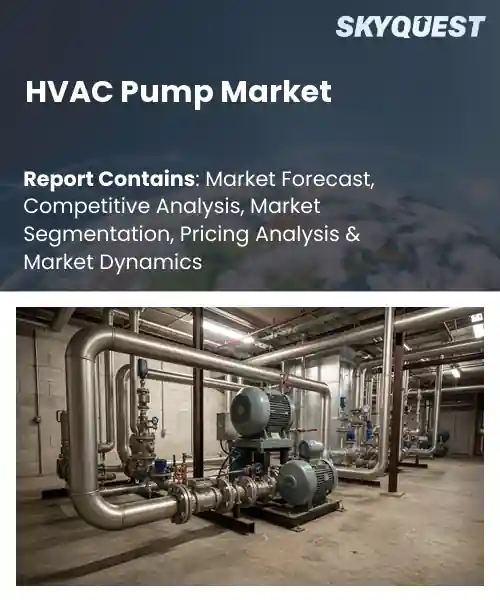
HVAC Pump Market
Report ID: SQMIG20I3001
Report ID: SQMIG20I3001
[email protected]
USA +1 351-333-4748
Report ID:
SQMIG20I3001 |
Region:
Global |
Published Date: May, 2026
Pages:
157
|Tables:
202
|Figures:
80


Global HVAC Pump Market size was valued at USD 38.5 Billion in 2024 and is poised to grow from USD 40.93 Billion in 2025 to USD 66.72 Billion by 2033, growing at a CAGR of 6.3% during the forecast period (2026-2033).
High demand for energy-efficient building systems, increasing focus on reducing carbon emissions, rising adoption of smart HVAC technologies, expansion of commercial infrastructure, and stringent energy efficiency regulations are driving demand for HVAC pumps.
Surge in adoption of remote monitoring platforms, analytics-driven maintenance solutions, and connected chilled-water and district cooling systems is further creating new commercialization opportunities for HVAC pump manufacturers. An increasing integration of digital building management systems as well as advanced predictive maintenance tools will also positively contribute to increased demands on HVAC pumps. The increasing adoption of centrifugal pumps, circulator pumps, variable frequency drive systems, and smart pumping technologies across residential, commercial, industrial, and district cooling applications is also promoting market expansion. The trend here involves spending more money on retrofits to upgrade traditional constant-speed systems with smarter and environmentally friendly variable-flow systems. Growing emphasis on energy-efficient heating and cooling systems around the world coupled with rising pressure to reduce building operating costs and carbon emissions are expected to primarily drive HVAC pump market growth.
On the contrary, high installation and retrofit costs, complexity associated with integrating advanced pumping systems into older infrastructure, fluctuations in raw material and energy prices, and dependence on construction and commercial real estate activity are anticipated to slow down HVAC pump market penetration in the long run.
How is AI Optimizing Predictive Maintenance Capabilities of HVAC Pumps?
Predictive maintenance is being enhanced in the HVAC pump industry through the use of AI by employing continuous data generated by sensors and the Internet of Things technology to make sense of it using machine learning techniques and thereby predict equipment malfunctioning. AI is helping engineers predict the condition of systems, alert the maintenance team about it, to make changes that can be done in advance to improve their functioning. Predictive maintenance services are chosen by businesses because of the efforts being made by facility managers to increase uptime and cut down on maintenance costs.
Market snapshot - (2026-2033)
Global Market Size
USD 38.5 Billion
Largest Segment
Centrifugal Pumps
Fastest Growth
Circulator Pumps
Growth Rate
6.3% CAGR
To get more insights on this market click here to Request a Free Sample Report
Global HVAC pump market is segmented by pump type, operation, capacity, technology, application, end-use industry, distribution channel, and region. Based on pump type, the market is segmented into centrifugal pumps, circulator pumps, booster pumps, inline pumps, end suction pumps, and multistage pumps. Based on operation, the market is segmented into single-stage and multi-stage. Based on capacity, the market is segmented into small capacity, medium capacity, and high capacity. Based on technology, the market is segmented into variable speed pumps, constant speed pumps, and smart pumps. Based on application, the market is segmented into heating systems, ventilation systems, air conditioning systems, chilled water systems, hot water circulation, and others. Based on end-use industry, the market is segmented into residential, commercial, and industrial. Based on distribution channel, the market is segmented into OEMs and aftermarket. Based on region, the market is segmented into North America, Europe, Asia Pacific, Latin America, and Middle East & Africa.
The variable speed pumps segment is slated to lead the global HVAC pump market revenue generation in the long run. They provide exact control of flow and excellent part load efficiencies, thus directly resulting in energy savings. Their capability of varying their output according to building loads helps achieve better balancing of systems and minimizes the strain on mechanical parts, resulting in longer equipment life. The emphasis from manufacturers on integration and energy performance further helps promote procurement decisions in favor of these devices.
However, smart pumps are estimated to emerge as the fastest-growing segment owing to sensor-based systems, which make predictive maintenance possible and help achieve demand-responsive operations through remote optimization. The increased adoption of smart buildings and procurement strategies will fuel the growth in retrofitting and installations, which will generate continuous revenue opportunities for manufacturers.
The centrifugal pumps segment is predicted to account for the highest global HVAC pump market share going forward. Their inherently simple nature and extensive performance capabilities, pumps serve as the de facto standard for many HVAC applications. Pumps have a history of reliability and stable supply chain logistics, which help decrease risks when purchasing equipment. In addition, familiarity with pump components among engineers makes their application less complicated and easier to maintain. Through experience optimizing their impellers and casings, manufacturers offer reliable component selections, making them attractive for installations.
On the other hand, Inline Pumps have been discovered to be the fastest growing segment because of their small and light form which allows for their direct installation in confined piping networks and HVAC systems. Their ease of installation, reduction in installation costs, and suitability for decentralized systems is leading to their wider use during retrofits in different niche markets.
To get detailed segments analysis, Request a Free Sample Report
The presence of strong industrial manufacturing centers, fast-paced infrastructure growth in urban areas, and adoption of high-end HVAC technology in the commercial and domestic segments are enabling the region to retain its dominant position. Both local manufacturers of pumps and foreign Original Equipment Manufacturers collaborate with engineering companies to offer pumps that are customized according to different climatic requirements of the region. The presence of favorable regulatory policies, along with the focus on energy efficiency, has increased the adoption of pumping equipment in the region. The existence of strong supply chains and close relationships with component suppliers have also contributed to short lead times and competitive prices for products sold into the Asia Pacific market. Investment in R&D and expanding service ecosystems for installing and maintaining pumps are further examples of how the Asia Pacific region continues to lead the global pump market by fostering a continuously reinforcing cycle of innovation, scale, and preference for products manufactured in the region.
HVAC pump demand in Japan leverages advanced manufacturing and engineering expertise to deliver high-quality and reliable pumps for commercial, industrial, and residential applications. Close links between manufacturers, utilities, and installers encourage the adoption of energy-efficient and smart control solutions. A focus on lifecycle performance and incremental innovation strengthens Japan's position in regional equipment supply and export markets offering premium service capabilities and technical support for complex projects in urban centers.
Technology integration and rapid urban development are expected to govern HVAC pump sales across commercial, industrial, and district heating networks in South Korea. Cooperation with engineering services and expanding maintenance networks ensures market sustainability and competitive advantages through specialized applications and system exports. Local producers and vendors of electrical equipment specialize in small-sized and intelligent equipment to facilitate automation, remote control, and fast installation.
Strong emphasis on building energy performance, widespread retrofit programs for aging infrastructure, and increasing integration of smart building technologies are helping create new opportunities in the region. A mature construction industry, an abundance of aftermarket servicing companies, and established standards of performance will facilitate fast deployment with shorter maintenance cycles for HVAC pump systems than previously possible. Continued capital investment in commercial, healthcare and institutional construction; as well as efforts to enhance resilience and improve indoor air quality; will support on-going purchases of modern pump solutions. Cooperation among local pump manufacturers and international suppliers, as well as through partnerships with engineering companies, is helping to rapidly accelerate customized product development and distribution; making North America one of the most dynamic and growing markets for advanced HVAC pumping systems. As developers and facility managers focus on acquiring systems that will decrease operational costs while improving occupant comfort, adoption of higher efficiency pumps and controls will become commonplace.
HVAC pump market in the United States benefits from a diverse construction and facilities landscape, including commercial, industrial, and institutional sectors. Robust demand for energy efficiency upgrades and smart building integration drives the adoption of modular and serviceable pump solutions. Extensive distribution networks, strong aftermarket service providers, and collaboration between manufacturers and engineering consultants support rapid deployment and tailored product offerings. Policy and industry guidance encourage performance improvements and longer-term asset optimization.
Regional climate variation that drives demand for both retrofit projects and new construction are forecasted to help govern the sales of HVAC pumps in Canada. Cross-border supply connections with the adjacent markets to improve access to special systems and technical assistance. Energy efficiency, resilience, and sustainability form the core of our procurement strategy. Local manufacturing and services cooperate with engineering companies to provide us with small, energy-efficient pumps that include their control system as well as a proper maintenance program.
Strong regulatory focus on energy performance, widespread emphasis on building retrofits, and active promotion of sustainable heating and cooling solutions are helping boost adoption of HVAC pumps in the region. Manufacturers place a strong emphasis on creating high-efficiency products with renewable energy integration capabilities, as well as having advanced controls that allow them to achieve the required levels of performance. The existence of robust standards and certification systems provides customer confidence in the interoperability of different products. Equipment manufacturers, engineering companies and research institutions cooperatively develop new technologies that can produce smart, energy-efficient pumping systems like real-time monitoring systems. Financial resources and incentives from the public sector encourage more widespread modernization of the technology, as well as providing digital servicing tools, and training of installers that lead to continued improved performance of systems throughout the region.
HVAC pump market in Germany is anchored in strong engineering tradition and industrial capability, with manufacturers delivering robust, highly efficient pump solutions for commercial, industrial, and district heating systems. Emphasis on rigorous standards, reliability, and lifecycle performance drives innovation in materials, controls, and service models. Close ties between research institutes and industry accelerate development of integrated and sustainable pumping technologies suited to complex project requirements and export positioning in global supply.
Refurbishment of existing building stock, where energy performance targets and efficiency schemes drive upgrades are helping boost HVAC pump demand in the country. Systems integrators, mechanical contractors, and service providers all collaborate in order to provide customized solutions that emphasize efficiency and occupant comfort, thus reaffirming the United Kingdom’s status as a regional leader in advanced HVAC pump systems. The need for efficient, compact, and controllable pumps along with intelligent monitoring capabilities continues to be in demand.
Low carbon heating solutions and integration with renewable energy sources are predicted to govern HVAC pump sales in France. The importance placed on life cycle economics and retrofitting will help foster business opportunities for local manufacturers and specialized servicing companies. Manufacturing and engineering firms provide systems where high hydraulic performance goes hand in hand with sophisticated control systems to boost the performance and maintainability of systems.
To know more about the market opportunities by region and country, click here to
Buy The Complete Report
Urbanization and Construction Growth
Stricter Efficiency Standards Promote Adoption
High Initial Capital Investment
Supply Chain Complexity and Delays
Request Free Customization of this report to help us to meet your business objectives.
The competitive landscape is driven by consolidation and digital differentiation as incumbents pursue acquisitions and software partnerships to add IoT and building system controls, exemplified by Grundfos’s acquisition of Metasphere and Xylem’s strategic deals to expand water technology and analytics capabilities, while product-level innovation focuses on ECM motors and smart control integration to win specification contracts.
SkyQuest’s ABIRAW (Advanced Business Intelligence, Research & Analysis Wing) is our Business Information Services team that Collects, Collates, Correlates, and Analyses the Data collected by means of Primary Exploratory Research backed by robust Secondary Desk research.
As per SkyQuest analysis, high demand for energy-efficient building systems and increasing adoption of smart HVAC technologies are anticipated to drive the demand for HVAC pumps going forward. However, high installation and retrofit costs and complexity associated with integrating advanced pumping systems into older infrastructure are slated to slow down the adoption of HVAC pumps in the future. North America is slated to spearhead the demand for HVAC pumps owing to strong adoption of smart building technologies and stringent energy efficiency regulations. Development of AI-enabled predictive maintenance platforms and increasing integration of IoT-connected variable-flow pumping systems are anticipated to be key trends driving the HVAC pump industry over the coming years.
| Report Metric | Details |
|---|---|
| Market size value in 2024 | USD 38.5 Billion |
| Market size value in 2033 | USD 66.72 Billion |
| Growth Rate | 6.3% |
| Base year | 2024 |
| Forecast period | (2026-2033) |
| Forecast Unit (Value) | USD Billion |
| Segments covered |
|
| Regions covered | North America (US, Canada), Europe (Germany, France, United Kingdom, Italy, Spain, Rest of Europe), Asia Pacific (China, India, Japan, Rest of Asia-Pacific), Latin America (Brazil, Rest of Latin America), Middle East & Africa (South Africa, GCC Countries, Rest of MEA) |
| Companies covered |
|
| Customization scope | Free report customization with purchase. Customization includes:-
|
To get a free trial access to our platform which is a one stop solution for all your data requirements for quicker decision making. This platform allows you to compare markets, competitors who are prominent in the market, and mega trends that are influencing the dynamics in the market. Also, get access to detailed SkyQuest exclusive matrix.
Table Of Content
Executive Summary
Market overview
Parent Market Analysis
Market overview
Market size
KEY MARKET INSIGHTS
COVID IMPACT
MARKET DYNAMICS & OUTLOOK
Market Size by Region
KEY COMPANY PROFILES
Methodology
For the HVAC Pump Market, our research methodology involved a mixture of primary and secondary data sources. Key steps involved in the research process are listed below:
1. Information Procurement: This stage involved the procurement of Market data or related information via primary and secondary sources. The various secondary sources used included various company websites, annual reports, trade databases, and paid databases such as Hoover's, Bloomberg Business, Factiva, and Avention. Our team did 45 primary interactions Globally which included several stakeholders such as manufacturers, customers, key opinion leaders, etc. Overall, information procurement was one of the most extensive stages in our research process.
2. Information Analysis: This step involved triangulation of data through bottom-up and top-down approaches to estimate and validate the total size and future estimate of the HVAC Pump Market.
3. Report Formulation: The final step entailed the placement of data points in appropriate Market spaces in an attempt to deduce viable conclusions.
4. Validation & Publishing: Validation is the most important step in the process. Validation & re-validation via an intricately designed process helped us finalize data points to be used for final calculations. The final Market estimates and forecasts were then aligned and sent to our panel of industry experts for validation of data. Once the validation was done the report was sent to our Quality Assurance team to ensure adherence to style guides, consistency & design.
Analyst Support
Customization Options
With the given market data, our dedicated team of analysts can offer you the following customization options are available for the HVAC Pump Market:
Product Analysis: Product matrix, which offers a detailed comparison of the product portfolio of companies.
Regional Analysis: Further analysis of the HVAC Pump Market for additional countries.
Competitive Analysis: Detailed analysis and profiling of additional Market players & comparative analysis of competitive products.
Go to Market Strategy: Find the high-growth channels to invest your marketing efforts and increase your customer base.
Innovation Mapping: Identify racial solutions and innovation, connected to deep ecosystems of innovators, start-ups, academics, and strategic partners.
Category Intelligence: Customized intelligence that is relevant to their supply Markets will enable them to make smarter sourcing decisions and improve their category management.
Public Company Transcript Analysis: To improve the investment performance by generating new alpha and making better-informed decisions.
Social Media Listening: To analyze the conversations and trends happening not just around your brand, but around your industry as a whole, and use those insights to make better Marketing decisions.
REQUEST FOR SAMPLE
 REQUEST FREE CUSTOMIZATION
Global Hvac Pump Market size was valued at USD 38.5 Billion in 2024 and is poised to grow from USD 40.93 Billion in 2025 to USD 66.72 Billion by 2033, growing at a CAGR of 6.3% during the forecast period (2026-2033).
The competitive landscape is driven by consolidation and digital differentiation as incumbents pursue acquisitions and software partnerships to add IoT and building system controls, exemplified by Grundfos’s acquisition of Metasphere and Xylem’s strategic deals to expand water technology and analytics capabilities, while product level innovation focuses on ECM motors and smart control integration to win specification contracts. 'Grundfos Holding A/S', 'Xylem Inc.', 'Wilo SE', 'KSB SE & Co. KGaA', 'Armstrong Fluid Technology', 'Sulzer Ltd.', 'Pentair plc', 'Flowserve Corporation', 'Danfoss A/S', 'Taco Comfort Solutions', 'ITT Inc.', 'Ebara Corporation', 'Kirloskar Brothers Limited', 'Torishima Pump Mfg. Co., Ltd.', 'Ingersoll Rand Inc.', 'SPX FLOW, Inc.', 'Atlas Copco AB', 'Johnson Controls International plc', 'Daikin Industries, Ltd.', 'Bosch Thermotechnology'
Increasing urbanization and building construction activity drives demand for efficient heating, ventilation and air conditioning systems, which in turn increases requirements for reliable pumps; manufacturers respond by developing modular, scalable pump solutions that integrate with modern building management systems, encouraging wider adoption across commercial and residential projects. This alignment between infrastructure growth and product development reduces barriers to installation and promotes lifecycle service offerings, strengthening supplier confidence and investment in capacity expansion while enabling system planners to prioritize pump selection that supports overall HVAC performance objectives.
Energy Efficiency Retrofit Demand: Building owners and facility managers prioritize reducing energy consumption through targeted HVAC pump upgrades driven by tighter performance expectations and sustainability commitments. Retrofit demand grows as stakeholders seek lower operating expenses and improved system responsiveness without full plant replacement. Manufacturers emphasize modular plug and play solutions, performance based contracts and integrated services to simplify implementation and guarantee results. This trend favors vendors offering end to end assessment, project oversight and long term maintenance aligned with corporate decarbonization and resiliency objectives.
Why does Asia Pacific Dominate the Global HVAC Pump Market? |@12


Want to customize this report? This report can be personalized according to your needs. Our analysts and industry experts will work directly with you to understand your requirements and provide you with customized data in a short amount of time. We offer $1000 worth of FREE customization at the time of purchase.
Feedback From Our Clients


 USA (+1) 351-333-4748

