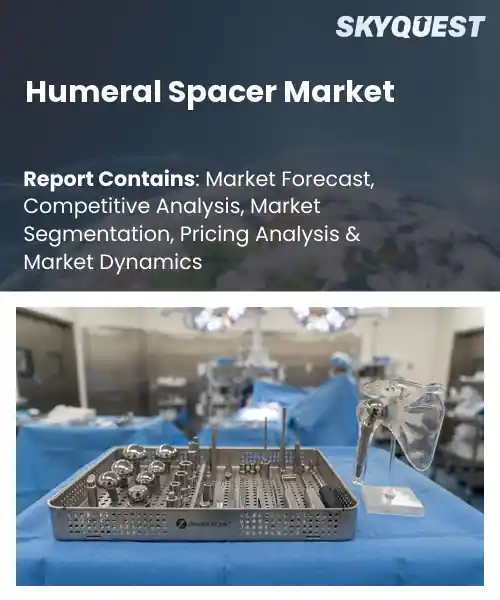
Humeral Spacer Market
Report ID: SQMIG35A4424
Report ID: SQMIG35A4424
[email protected]
USA +1 351-333-4748
Report ID:
SQMIG35A4424 |
Region:
Global |
Published Date: August, 2026
Pages:
157
|Tables:
170
|Figures:
79


Global Humeral Spacer Market size was valued at USD 624.3 Million in 2024 and is poised to grow from USD 670.5 Million in 2025 to USD 1186.95 Million by 2033, growing at a CAGR of 7.4% during the forecast period (2026-2033).
Another pivotal factor shaping the humeral spacer market is the advancement of biomaterial engineering, which creates opportunities for drug‑eluting implants that address infection and pain management. As manufacturers integrate antibiotics such as vancomycin into spacer matrices, clinicians can achieve localized therapy while minimizing toxicity, a benefit demonstrated in a 2021 case series where infection eradication rates rose to 92 % compared with conventional regimens. This progress triggers a cascade: improved outcomes encourage hospitals to allocate substantial budget toward spacer solutions, prompting suppliers to expand product portfolios and invest in approvals across North America and Europe, thereby accelerating global significant market growth.
How is AI-driven design influencing the Humeral spacer market?
AI driven design is reshaping the humeral spacer segment by enabling rapid virtual prototyping, personalized geometry and material optimization. Engineers feed imaging data into generative algorithms that explore thousands of shape variations and select configurations that balance load distribution with low profile. The result is implants that fit patient anatomy more precisely and reduce intra operative adjustments. Manufacturers are integrating these tools into their product pipelines, shortening development cycles and allowing quicker response to surgeon feedback. This shift is raising expectations for performance and accelerating adoption across orthopedic centers.Shoulder Innovations May 2026, launched a fully AI optimized humeral spacer line that reduces manufacturing lead time and improves fit, supporting faster market uptake and operational efficiency. The platform uses patient CT scans to generate custom molds, allowing surgeons to select the best size during the procedure and decreasing inventory burden for hospitals.
Market snapshot - (2026-2033)
Global Market Size
USD 624.3 Million
Largest Segment
Temporary Humeral Spacers
Fastest Growth
Permanent Humeral Spacers
Growth Rate
7.4% CAGR
To get more insights on this market click here to Request a Free Sample Report
Global humeral spacer market is segmented by product type, material, application, end user, fixation type, distribution channel and region. Based on product type, the market is segmented into Temporary Humeral Spacers and Permanent Humeral Spacers. Based on material, the market is segmented into Antibiotic-Loaded Bone Cement, Non-Antibiotic Bone Cement and Others. Based on application, the market is segmented into Shoulder Joint Infection, Revision Shoulder Arthroplasty and Others. Based on end user, the market is segmented into Hospitals, Orthopedic Specialty Clinics, Ambulatory Surgical Centers and Others. Based on fixation type, the market is segmented into Articulating Spacers and Static Spacers. Based on distribution channel, the market is segmented into Direct Sales, Medical Device Distributors and Others. Based on region, the market is segmented into North America, Europe, Asia Pacific, Latin America and Middle East & Africa.
Antibiotic loaded bone cement segment dominates because it integrates infection control directly into the spacer, offering surgeons an immediate therapeutic advantage during two stage revisions. The intrinsic antimicrobial property reduces postoperative infection risk, simplifying care protocols and improving patient outcomes. Clinicians favor this material for its ability to sustain high local antibiotic concentrations while maintaining structural integrity, which drives its preference across a broad range of clinical scenarios in the humeral spacer market.
However, Non antibiotic bone cement segment is witnessing the strongest growth momentum as manufacturers innovate polymer blends that enhance mechanical strength while avoiding antibiotics. This evolution opens opportunities for patients with allergy concerns and supports prophylactic use in elective procedures, expanding the addressable market and fueling product development in the humeral spacer arena.
Shoulder joint infection segment dominates because it drives the primary clinical need for spacers, compelling surgeons to select devices that can deliver local antimicrobial therapy while preserving joint biomechanics. The urgency to manage infection effectively elevates demand for specialized spacers, prompting manufacturers to prioritize infection focused designs and material coatings. This clinical pressure consolidates market attention around infection related applications, cementing its central role in shaping product pipelines.
Meanwhile, Revision shoulder arthroplasty segment emerges as the key high growth area as an aging population increasingly requires complex reconstructive procedures. Advances in surgical techniques and stronger evidence of functional benefits encourage surgeons to adopt spacers that support staged revisions, stimulating demand for innovative designs and expanding the market’s future trajectory.
To get detailed segments analysis, Request a Free Sample Report
North America benefits from a mature healthcare ecosystem that emphasizes cutting‑edge orthopedic solutions and rapid technology diffusion. Leading academic institutions drive continuous innovation in joint reconstruction, while a dense network of specialized surgeons accelerates adoption of advanced implants. Robust reimbursement mechanisms remove financial barriers for both providers and patients, encouraging the use of premium devices. Established multinational manufacturers maintain strong R&D facilities and supply chains within the region, ensuring timely product availability. Collaborative partnerships among clinicians, insurers, and device firms create a feedback loop that refines product design and enhances clinical outcomes, reinforcing the region’s leadership position.
United States Humeral Spacer Market
Humeral Spacer Market in United States is propelled by extensive research funding, sophisticated surgical training programmes, and a broad payer landscape that supports advanced arthroplasty technologies. High procedural volumes in major medical centres generate consistent demand, while leading device firms invest heavily in local clinical trials and post‑market surveillance, fostering confidence among orthopedic specialists.
Canada Humeral Spacer Market
Humeral Spacer Market in Canada is shaped by a publicly funded system that prioritises evidence‑based interventions and cost‑effective care pathways. Strong clinical guidelines promote the integration of innovative spacer solutions, and collaboration between provincial health authorities and academic hospitals accelerates knowledge transfer. A focus on patient‑centric outcomes encourages the adoption of devices that demonstrate clear functional benefits.
European expansion is driven by harmonised regulatory frameworks that streamline product approvals across member states, facilitating broader market access for innovative spacers. Health systems increasingly adopt value‑based reimbursement models, rewarding technologies that improve recovery time and reduce complications. A dense concentration of world‑renowned orthopedic research centres fuels continuous clinical evaluation and optimization of spacer designs. Collaborative initiatives between manufacturers, professional societies, and government agencies nurture a culture of shared expertise, while the region’s aging demographic creates sustained demand for joint preservation and reconstruction solutions.
Germany Humeral Spacer Market
Humeral Spacer Market in Germany benefits from a strong industrial base that integrates precision engineering with medical device development. Comprehensive hospital networks and specialized arthroplasty centres prioritize high‑performance implants, driving early adoption of next‑generation spacers. Close cooperation between academia and industry enables rapid translation of research findings into clinical practice, reinforcing Germany’s position as a market leader.
United Kingdom Humeral Spacer Market
Humeral Spacer Market in United Kingdom experiences accelerated growth through extensive NHS commissioning that emphasizes clinical efficacy and cost containment. Robust evidence generation through multicentre trials supports swift integration of innovative spacers into treatment pathways. Focus on training and skill development among orthopedic surgeons ensures proficient implementation, while emerging health technology assessment frameworks promote informed decision‑making.
France Humeral Spacer Market
Humeral Spacer Market in France is emerging as hospitals and specialty clinics explore new options to enhance patient recovery. Growing interest from local biotech firms and academic surgeons stimulates early‑stage trials and product customization. National health policy initiatives that encourage adoption of advanced orthopedic solutions further catalyse market development.
Asia Pacific is consolidating its role through expanding healthcare infrastructure and rising surgical capacity across major economies. Government programmes that endorse medical device innovation and streamline approval processes attract investment from global manufacturers. A growing pool of skilled orthopedic surgeons, supported by intensive training collaborations, accelerates the integration of sophisticated spacer technologies. Regional trade agreements facilitate cross‑border supply chains, while increasing patient awareness drives demand for solutions that enhance postoperative mobility and reduce rehabilitation duration. Together, these forces elevate the region’s visibility in the global market landscape.
Japan Humeral Spacer Market
Humeral Spacer Market in Japan leverages a tradition of meticulous surgical technique combined with high‑quality manufacturing standards. An ageing population creates persistent need for joint preservation approaches, prompting hospitals to adopt spacer solutions that demonstrate reliable outcomes. Strong collaboration between research universities and device companies fuels continuous product refinement, positioning Japan as a hub for clinically validated innovations.
South Korea Humeral Spacer Market
Humeral Spacer Market in South Korea advances rapidly owing to an emphasis on digital health integration and precision engineering. Aggressive government incentives support domestic device developers, while leading medical centres pilot advanced spacer technologies to improve patient throughput. The convergence of high‑tech manufacturing expertise and proactive clinical adoption consolidates South Korea’s emerging influence in the regional market.
To know more about the market opportunities by region and country, click here to
Buy The Complete Report
Increasing Elderly Population
Advancements In Implant Materials
High Cost Of Devices
Regulatory Approval Complexity
Request Free Customization of this report to help us to meet your business objectives.
The humeral spacer market is shaped by intense competition among medtech firms, with recent M&A activity and strategic partnerships driving innovation and market entry. Companies are accelerating technology development through collaborations with orthopedic specialists and investing in next‑generation spacer designs, while some are expanding their product portfolios via acquisitions of niche device manufacturers.
Top Player’s Company Profile
Recent Developments
SkyQuest’s ABIRAW (Advanced Business Intelligence, Research & Analysis Wing) is our Business Information Services team that Collects, Collates, Correlates, and Analyses the Data collected by means of Primary Exploratory Research backed by robust Secondary Desk research. As per SkyQuest analysis the global humeral spacer market is propelled primarily by the growing elderly population that fuels demand for shoulder reconstruction while breakthroughs in biomaterials and surface engineering serve as a second driver by improving durability and patient recovery. The antibiotic‑loaded bone cement segment leads the market because it combines infection control with structural support and North America dominates thanks to its mature healthcare system strong reimbursement and rapid technology adoption. However the high cost of devices restrains broader uptake especially in budget‑constrained settings slowing penetration despite the clear clinical benefits. Overall the market is expected to expand from $670.5 million in 2025 to $1.19 billion by 2033 reflecting a 7.4% CAGR.
| Report Metric | Details |
|---|---|
| Market size value in 2024 | USD 624.3 Million |
| Market size value in 2033 | USD 1186.95 Million |
| Growth Rate | 7.4% |
| Base year | 2024 |
| Forecast period | (2026-2033) |
| Forecast Unit (Value) | USD Million |
| Segments covered |
|
| Regions covered | North America (US, Canada), Europe (Germany, France, United Kingdom, Italy, Spain, Rest of Europe), Asia Pacific (China, India, Japan, Rest of Asia-Pacific), Latin America (Brazil, Rest of Latin America), Middle East & Africa (South Africa, GCC Countries, Rest of MEA) |
| Companies covered |
|
| Customization scope | Free report customization with purchase. Customization includes:-
|
To get a free trial access to our platform which is a one stop solution for all your data requirements for quicker decision making. This platform allows you to compare markets, competitors who are prominent in the market, and mega trends that are influencing the dynamics in the market. Also, get access to detailed SkyQuest exclusive matrix.
Table Of Content
Executive Summary
Market overview
Parent Market Analysis
Market overview
Market size
KEY MARKET INSIGHTS
COVID IMPACT
MARKET DYNAMICS & OUTLOOK
Market Size by Region
KEY COMPANY PROFILES
Methodology
For the Humeral Spacer Market, our research methodology involved a mixture of primary and secondary data sources. Key steps involved in the research process are listed below:
1. Information Procurement: This stage involved the procurement of Market data or related information via primary and secondary sources. The various secondary sources used included various company websites, annual reports, trade databases, and paid databases such as Hoover's, Bloomberg Business, Factiva, and Avention. Our team did 45 primary interactions Globally which included several stakeholders such as manufacturers, customers, key opinion leaders, etc. Overall, information procurement was one of the most extensive stages in our research process.
2. Information Analysis: This step involved triangulation of data through bottom-up and top-down approaches to estimate and validate the total size and future estimate of the Humeral Spacer Market.
3. Report Formulation: The final step entailed the placement of data points in appropriate Market spaces in an attempt to deduce viable conclusions.
4. Validation & Publishing: Validation is the most important step in the process. Validation & re-validation via an intricately designed process helped us finalize data points to be used for final calculations. The final Market estimates and forecasts were then aligned and sent to our panel of industry experts for validation of data. Once the validation was done the report was sent to our Quality Assurance team to ensure adherence to style guides, consistency & design.
Analyst Support
Customization Options
With the given market data, our dedicated team of analysts can offer you the following customization options are available for the Humeral Spacer Market:
Product Analysis: Product matrix, which offers a detailed comparison of the product portfolio of companies.
Regional Analysis: Further analysis of the Humeral Spacer Market for additional countries.
Competitive Analysis: Detailed analysis and profiling of additional Market players & comparative analysis of competitive products.
Go to Market Strategy: Find the high-growth channels to invest your marketing efforts and increase your customer base.
Innovation Mapping: Identify racial solutions and innovation, connected to deep ecosystems of innovators, start-ups, academics, and strategic partners.
Category Intelligence: Customized intelligence that is relevant to their supply Markets will enable them to make smarter sourcing decisions and improve their category management.
Public Company Transcript Analysis: To improve the investment performance by generating new alpha and making better-informed decisions.
Social Media Listening: To analyze the conversations and trends happening not just around your brand, but around your industry as a whole, and use those insights to make better Marketing decisions.
REQUEST FOR SAMPLE
 REQUEST FREE CUSTOMIZATION


Want to customize this report? This report can be personalized according to your needs. Our analysts and industry experts will work directly with you to understand your requirements and provide you with customized data in a short amount of time. We offer $1000 worth of FREE customization at the time of purchase.
Feedback From Our Clients


 USA (+1) 351-333-4748

