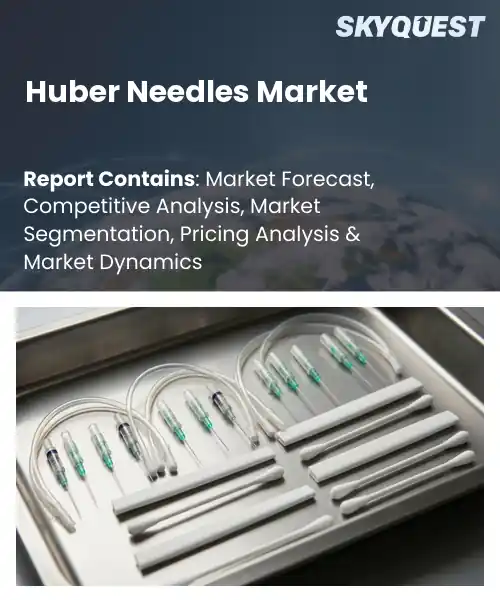
Huber Needles Market
Report ID: SQMIG35A3255
Report ID: SQMIG35A3255
[email protected]
USA +1 351-333-4748
Report ID:
SQMIG35A3255 |
Region:
Global |
Published Date: March, 2026
Pages:
157
|Tables:
116
|Figures:
77


Global Huber Needles Market size was valued at USD 2.2 Billion in 2024 and is poised to grow from USD 2.37 Billion in 2025 to USD 4.33 Billion by 2033, growing at a CAGR of 7.8% during the forecast period (2026-2033).
Huber needles are specialized, noncoring access devices used to access implanted vascular ports for repeated intravenous therapies, and the market for these devices has expanded as oncology treatment shifted from inpatient bolus care to prolonged outpatient and home infusion. This primary driver, rising cancer prevalence coupled with increased use of central venous access for chemotherapy, parenteral nutrition, and biologic therapies, has elevated demand for reliable, low trauma access needles. Over the past two decades manufacturers responded with refinements such as sharp, atraumatic tips, integrated safety shields, and single use packaging, improving patient comfort and reducing catheter damage in clinical settings.Because demand for implantable ports rose alongside expanding outpatient infusion, manufacturers prioritized safety, convenience, and regulatory compliance, which opened growth opportunities across product differentiation and geographic expansion. As companies introduced safety engineered Huber needles with ergonomic hubs and power injectable ratings, hospitals and ambulatory centers adopted them to reduce needlestick injuries and streamline contrast injections during CT imaging, boosting margins. Simultaneously, rising healthcare investment in Asia Pacific and Latin America drove volume growth as governments expanded cancer care networks, prompting contract manufacturers to scale low cost sterile production. They enable innovation, partnerships, and training that sustain market share and growth globally.
How is automation impacting precision manufacturing in the Huber needles market?
Automation is raising the bar for precision manufacturing of Huber needles by applying repeatable micromachining, robotic assembly, machine vision inspection and automated traceability to processes that were once manual. Key aspects include tighter control of bevel geometry, improved surface finish, consistent noncoring performance and easier verification of sterility and safety features. The current market context shows demand from oncology and home infusion driving suppliers to adopt automated CNC and vision guided systems to scale reliably. Instances of automated assembly and inline inspection make new curved or safety engineered needle variants easier to validate and produce, improving reliability and speeding new product introductions.Becton Dickinson January 2025, announced investments to add needle production lines in U.S. plants, showing how automation boosts consistent quality and production capacity and supports faster, more reliable delivery of safety focused Huber needle designs.
Market snapshot - (2026-2033)
Global Market Size
USD 2.2 Billion
Largest Segment
Disposable Huber Needles
Fastest Growth
Safety Huber Needles
Growth Rate
7.8% CAGR
To get more insights on this market click here to Request a Free Sample Report
Global huber needles market is segmented by product type, material type, end user, distribution channel and region. Based on product type, the market is segmented into Disposable Huber Needles, Reusable Huber Needles and Safety Huber Needles. Based on material type, the market is segmented into Plastic Huber Needles and Metal Huber Needles. Based on end user, the market is segmented into Hospitals, Clinics and Home Healthcare. Based on distribution channel, the market is segmented into Direct Sales, Online Retail and Wholesale. Based on region, the market is segmented into North America, Europe, Asia Pacific, Latin America and Middle East & Africa.
Disposable Huber Needles segment leads because its single use design aligns with stringent infection control priorities, simplifying procurement and inventory for institutional buyers. The low cross contamination risk and predictable performance reduce clinical workflow complexity, prompting preference among hospital supply managers and home infusion providers. Manufacturers focus on scalable production and packaging efficiency, driving widespread adoption through value based purchasing and streamlined regulatory pathways that favor disposables for many infusion protocols.
However, Safety Huber Needles are the fastest growing area as emphasis on clinician protection drives adoption. Innovations in integrated safety features and improved usability are increasing acceptance in outpatient and home care. Regulatory encouragement for safer devices and rising procurement focus on needlestick prevention are accelerating market opportunities and promoting broader uptake.
Direct Sales segment dominates because direct relationships with institutional buyers enable tailored contracts, product training, and integrated service offerings that are critical for complex infusion devices. Sales teams facilitate clinical evaluations and bulk procurement processes, ensuring consistent supply to major care providers. The ability to offer bundled consumables, inventory management solutions and responsive technical support fosters deep customer trust and long term purchasing agreements that anchor the Huber Needles Market.
Meanwhile, online retail is the fastest growing channel as convenience and direct access to home healthcare users rise. E commerce platforms enable subscription ordering, rapid replenishment and detailed product information, extending reach beyond traditional procurement. Digital marketplaces and telehealth integration are unlocking direct to consumer models and new avenues for market expansion.
To get detailed segments analysis, Request a Free Sample Report
North America dominates the global Huber needles market due to a confluence of structural advantages and market dynamics. The region combines advanced healthcare infrastructure with widespread adoption of infusion therapies and oncology treatment protocols that rely on specialized access devices. Established medical device manufacturers and contract suppliers maintain deep distribution networks and strong relationships with major hospitals and specialty clinics. Rigorous regulatory and quality frameworks raise market expectations and favor suppliers that can meet demanding standards, while reimbursement mechanisms and hospital procurement practices support steady demand for premium devices. A culture of clinical research, frequent collaboration between clinicians and industry, and focused training programs further accelerate adoption of improved Huber needle designs, materials, and safety features across professional care settings.
Huber Needles Market United States Huber needle demand is driven by concentration of specialty oncology centers, large hospital systems, and extensive outpatient infusion services. Commercial and academic research centers foster early clinical adoption of device innovations, while procurement teams prioritize quality and safety. Close collaboration between clinicians and manufacturers supports customization for complex infusion needs, and training programs for nursing and interventional teams reinforce consistent clinical practice and device utilization.
Huber Needles Market Canada adoption reflects strong hospital networks and integrated provincial procurement that favor standardized, high quality access devices. Prominent cancer treatment centers and expanding home infusion programs drive clinical need, while collaboration between healthcare institutions and suppliers supports careful selection of safety oriented designs. Emphasis on training for nursing teams and coordinated supply chain management sustains consistent device availability across urban and regional care settings and procurement practices.
Europe has seen rapid expansion in the Huber needles market driven by converging clinical priorities and favorable ecosystem dynamics. Robust hospital systems and established oncology treatment pathways create consistent need for reliable port access devices, while an emphasis on patient safety and infection prevention elevates demand for refined needle designs. Strong medtech manufacturing capabilities across core European markets enable rapid iteration and supply responsiveness. Harmonized regulatory expectations and coordinated procurement frameworks facilitate cross border adoption of proven products, and active collaboration between clinicians, suppliers, and national health bodies supports clinical training and guidelines. Regional diversity in care delivery models, including growth of outpatient infusion and home care services, opens additional channels for adoption and innovation in needle safety and usability.
Huber Needles Market Germany benefits from a dense network of advanced hospitals and a strong medtech manufacturing base that supports both domestic supply and innovation. Clinical centers often collaborate with manufacturers on design refinements, and procurement processes within hospitals emphasize product reliability and regulatory compliance. A focus on specialized oncology care pathways and training for interventional teams sustains demand for high quality Huber needle variants across inpatient and ambulatory settings.
Huber Needles Market United Kingdom growth is fueled by strong adoption in both hospital and community care, including expanding home infusion and outpatient oncology services. Centralized procurement frameworks and clinical guideline development encourage standardized use of safety focused access devices. Active engagement between health system stakeholders and medtech suppliers supports evaluation of new needle designs, while emphasis on clinician training and infection control practices drives consistent implementation across care settings.
Huber Needles Market France is characterized by steady uptake in ambulatory oncology and increasing use within regional cancer centers and outpatient infusion services. National health guidelines and hospital procurement emphasize safety and device quality, encouraging suppliers to align products with clinical workflow. Collaboration between clinical teams and distributors helps tailor offerings for varied care environments, and expanding training initiatives for nursing staff support broader adoption of safer Huber needle solutions.
Asia Pacific is strengthening its position in the Huber needles market through a mix of domestic innovation, improved clinical infrastructure, and closer ties with global medtech partners. In core markets, established device manufacturers and specialized suppliers invest in product refinement and local production that aligns with regional clinical preferences. Hospitals and oncology centers increasingly adopt standardized protocols and safety oriented devices, while regulatory frameworks evolve to support faster evaluation of proven technologies. Expanding outpatient and home infusion services create new routes for device use, and targeted clinician training improves confidence in newer needle designs. Strategic collaborations between international and local companies also accelerate transfer of manufacturing expertise and commercial distribution, enhancing regional supply resilience. Local clinical evaluations and targeted product customization build clinician trust and support procurement choices.
Huber Needles Market Japan reflects a strong medtech ecosystem with advanced manufacturing and rigorous quality standards that align closely with clinician expectations. Major hospitals and specialized oncology centers participate in product evaluation and adoption, while suppliers focus on ergonomic design and material performance to meet procedural preferences. Supply chains and emphasis on clinical training support reliable device deployment across inpatient and outpatient settings, enhancing clinician confidence in Huber needle configurations.
Huber Needles Market South Korea demonstrates growing sophistication driven by strong hospital networks, active domestic device developers, and close collaboration with international medtech firms. Clinical centers emphasize safety and procedural efficiency, prompting suppliers to adapt needle design and packaging for local practice. Regulatory modernization and focused clinician education programs support timely evaluation and adoption, while distribution partnerships enhance reach into both tertiary hospitals and expanding outpatient and home infusion services.
To know more about the market opportunities by region and country, click here to
Buy The Complete Report
Expansion Of Ambulatory Care Settings
Preference For Minimally Invasive Devices
High Cost Of Advanced Devices
Stringent Regulatory Approval Processes
Request Free Customization of this report to help us to meet your business objectives.
Competitive intensity in the global Huber needles market centers on product differentiation, safety features, and integrated access solutions, with consolidation and targeted M&A reshaping supplier portfolios. Incumbents pursue technology partnerships and needle tip innovations while startups push sensorized ports and needle free delivery as disruptive routes to market; recent examples include Vygon's acquisition of Perouse Medical and B. Braun's Onvision needle tip tracking collaborations.
Top Player’s Company Profile
Recent Developments
SkyQuest’s ABIRAW (Advanced Business Intelligence, Research & Analysis Wing) is our Business Information Services team that Collects, Collates, Correlates, and Analyses the Data collected by means of Primary Exploratory Research backed by robust Secondary Desk research. As per SkyQuest analysis, the global Huber needles market is being driven by numerous factors with the key driver being rising cancer prevalence that increases outpatient infusion and port access demand, and the second driver being expansion of ambulatory care settings that shifts therapies to home and outpatient environments. A major restraint is the high cost of advanced, safety engineered needles which can slow adoption in budget-constrained settings. North America remains the dominating region due to advanced healthcare infrastructure and strong clinician-industry collaboration, while the Disposable Huber Needles segment is the dominating segment as single-use designs align with infection control and procurement preferences.
| Report Metric | Details |
|---|---|
| Market size value in 2024 | USD 2.2 Billion |
| Market size value in 2033 | USD 4.33 Billion |
| Growth Rate | 7.8% |
| Base year | 2024 |
| Forecast period | (2026-2033) |
| Forecast Unit (Value) | USD Billion |
| Segments covered |
|
| Regions covered | North America (US, Canada), Europe (Germany, France, United Kingdom, Italy, Spain, Rest of Europe), Asia Pacific (China, India, Japan, Rest of Asia-Pacific), Latin America (Brazil, Rest of Latin America), Middle East & Africa (South Africa, GCC Countries, Rest of MEA) |
| Companies covered |
|
| Customization scope | Free report customization with purchase. Customization includes:-
|
To get a free trial access to our platform which is a one stop solution for all your data requirements for quicker decision making. This platform allows you to compare markets, competitors who are prominent in the market, and mega trends that are influencing the dynamics in the market. Also, get access to detailed SkyQuest exclusive matrix.
Table Of Content
Executive Summary
Market overview
Parent Market Analysis
Market overview
Market size
KEY MARKET INSIGHTS
COVID IMPACT
MARKET DYNAMICS & OUTLOOK
Market Size by Region
KEY COMPANY PROFILES
Methodology
For the Huber Needles Market, our research methodology involved a mixture of primary and secondary data sources. Key steps involved in the research process are listed below:
1. Information Procurement: This stage involved the procurement of Market data or related information via primary and secondary sources. The various secondary sources used included various company websites, annual reports, trade databases, and paid databases such as Hoover's, Bloomberg Business, Factiva, and Avention. Our team did 45 primary interactions Globally which included several stakeholders such as manufacturers, customers, key opinion leaders, etc. Overall, information procurement was one of the most extensive stages in our research process.
2. Information Analysis: This step involved triangulation of data through bottom-up and top-down approaches to estimate and validate the total size and future estimate of the Huber Needles Market.
3. Report Formulation: The final step entailed the placement of data points in appropriate Market spaces in an attempt to deduce viable conclusions.
4. Validation & Publishing: Validation is the most important step in the process. Validation & re-validation via an intricately designed process helped us finalize data points to be used for final calculations. The final Market estimates and forecasts were then aligned and sent to our panel of industry experts for validation of data. Once the validation was done the report was sent to our Quality Assurance team to ensure adherence to style guides, consistency & design.
Analyst Support
Customization Options
With the given market data, our dedicated team of analysts can offer you the following customization options are available for the Huber Needles Market:
Product Analysis: Product matrix, which offers a detailed comparison of the product portfolio of companies.
Regional Analysis: Further analysis of the Huber Needles Market for additional countries.
Competitive Analysis: Detailed analysis and profiling of additional Market players & comparative analysis of competitive products.
Go to Market Strategy: Find the high-growth channels to invest your marketing efforts and increase your customer base.
Innovation Mapping: Identify racial solutions and innovation, connected to deep ecosystems of innovators, start-ups, academics, and strategic partners.
Category Intelligence: Customized intelligence that is relevant to their supply Markets will enable them to make smarter sourcing decisions and improve their category management.
Public Company Transcript Analysis: To improve the investment performance by generating new alpha and making better-informed decisions.
Social Media Listening: To analyze the conversations and trends happening not just around your brand, but around your industry as a whole, and use those insights to make better Marketing decisions.
REQUEST FOR SAMPLE
 REQUEST FREE CUSTOMIZATION


Want to customize this report? This report can be personalized according to your needs. Our analysts and industry experts will work directly with you to understand your requirements and provide you with customized data in a short amount of time. We offer $1000 worth of FREE customization at the time of purchase.
Feedback From Our Clients


 USA (+1) 351-333-4748

