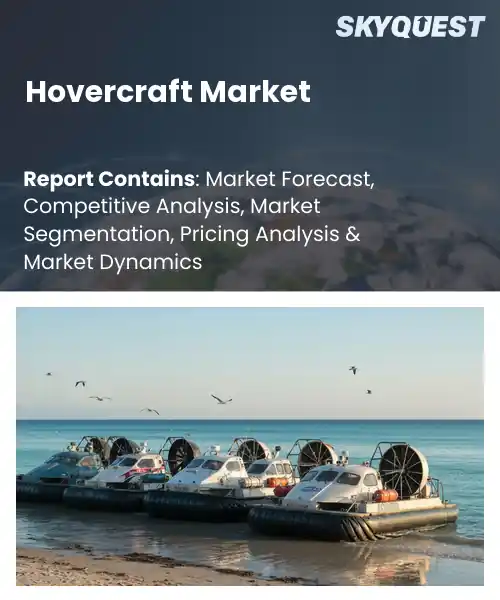
Hovercraft Market
Report ID: SQMIG25C2274
Report ID: SQMIG25C2274
[email protected]
USA +1 351-333-4748
Report ID:
SQMIG25C2274 |
Region:
Global |
Published Date: July, 2026
Pages:
157
|Tables:
178
|Figures:
79


Global Hovercraft Market size was valued at USD 322.0 Million in 2024 and is poised to grow from USD 337.78 Million in 2025 to USD 495.26 Million by 2033, growing at a CAGR of 4.9% during the forecast period (2026-2033).
The global hovercraft market comprises vehicles that skim along on a cushion of air, enabling smooth travel over water, ice, marshland and flat terrain. It matters because it offers quick, gentle transport in places where regular ships or trucks can’t go—a need that’s become more pressing as coastal development booms and we respond to climate disasters. The sector goes back to the 1950s when the SR-N4 operated cross-Channel routes, evolving into military logistics, offshore oil support and niche tourism in places like the Finnish archipelago. This evolution signifies an increasing dependence on flexible, amphibious mobility solutions for commercial and humanitarian missions. Environmental regulation is an important driver of the hovercraft market, as stricter emission limits are driving operators to seek low-fuel, low-vibration alternatives.
Natural advantages of hovercraft include the fact that they consume less diesel per ton-kilometre than conventional vessels. That pressure has led Norway and Canada to back pilot projects to replace diesel ferries with electric-assist hovercraft on fjord and Arctic routes, cutting greenhouse-gas output while keeping year-round service. Manufacturers are responding by rapidly developing hybrid power trains and lightweight composites, and winning contracts with coastal municipalities and offshore wind farms that need quiet, shallow-draft access. And so incentives, advances and demand all help to increase revenue and wider adoption in commercial, energy and rescue applications.
How is AI-driven Automation Influencing The Hovercraft Market?
The commercial hovercraft market is in the midst of a transformation driven by AI-powered automation. AI-enabled control systems are being implemented to monitor surface conditions, modulate cushion pressure, and optimize propulsion for fuel efficiency and safety. Manufacturers are embedding machine-learning algorithms that predict wear patterns on skirts and engines, enabling pre-emptive maintenance that reduces downtime. Operators can use autonomous navigation modules deployable on low-visibility routes, improving the reliability of passenger ferry and cargo services in coastal and riverine environments.
These technologies also allow data to be shared between vessels and control centers in real time, allowing coordinated fleet management and faster response to changes in the weather. As a consequence, the sector is drawing interest from logistics companies looking for faster, low-impact transportation options that combine speed with a lower environmental footprint.
Market snapshot - (2026-2033)
Global Market Size
USD 322.0 Million
Largest Segment
Passenger Hovercraft
Fastest Growth
Recreational Hovercraft
Growth Rate
4.9% CAGR
To get more insights on this market click here to Request a Free Sample Report
Global hovercraft market is segmented by type, propulsion type, application, payload capacity, end user, surface type and region. Based on type, the market is segmented into Passenger Hovercraft, Military Hovercraft, Rescue & Patrol Hovercraft, Commercial Utility Hovercraft and Recreational Hovercraft. Based on propulsion type, the market is segmented into Diesel-Powered, Gasoline-Powered and Hybrid/Electric Powered. Based on application, the market is segmented into Transportation, Defense & Military Operations, Search & Rescue, Tourism & Recreation, Industrial Operations and Others. Based on payload capacity, the market is segmented into Light Duty, Medium Duty and Heavy Duty. Based on end user, the market is segmented into Defense Organizations, Commercial Operators, Government Agencies, Tourism Operators and Others. Based on surface type, the market is segmented into Water Operations, Land Operations and Amphibious Operations. Based on region, the market is segmented into North America, Europe, Asia Pacific, Latin America and Middle East & Africa.
The passenger hovercraft segment is leading as it combines speed, comfort and low-draft operation in a unique way, which is attractive to crowded coastal and riverine routes. The ability to glide over water and thin ice without traditional ports reduces infrastructure costs and adds route flexibility. The smooth ride and fast boarding is what operators want, and it pushes utilization up, which keeps it in the center of market development.
In contrast, the commercial utility hovercraft segment is the major high growth area in the hovercraft market. Innovations in modular cargo bays and automated loading systems are enabling new applications in logistics, especially in remote or flood-prone areas. This growing use is stimulating investment and widening the market scope, opening new frontiers for manufacturers and service providers.
The hybrid/ electric propulsion segment is unique in that it responds to environmental regulation and operating cost pressure and provides the thrust to travel on a cushion. It offers a combination of fuel efficiency and lower emissions, helping operators to meet sustainability goals and gain acceptance from the community, which is driving wider adoption across multiple use cases. The technology’s quieter operation allows access to sensitive areas, reinforcing its market leadership.
The rescue & patrol hovercraft segment, in contrast, is witnessing the strongest growth momentum in hovercraft market. Reliability improvements and rapid deployment capabilities are essential for emergency response and advances in power-train efficiency extend mission endurance. Growing focus on public safety and disaster resilience drives the procurement, thus making the segment a growth engine of the overall market.
To get detailed segments analysis, Request a Free Sample Report
Asia Pacific has the advantage of advanced engineering capabilities, large coastlines, and a strategic focus on island and delta connectivity. Deep experience in marine propulsion and lightweight composites continues to stimulate creativity, with government programmes supporting uptake in both civilian transport and defence applications. With robust supply chains and collaborative research clusters, leading manufacturers are able to develop rapidly and manufacture inexpensively. Furthermore, the existence of major shipbuilding hubs and a culture of maritime resilience underpin a wide range of commercial, rescue and patrol deployments, strengthening the region’s leadership in the hovercraft industry.
Hovercraft Market Japan is based on a long history of aerospace and shipbuilding, which serves as the basis for designing high performance vehicles. Electric-driven lift systems Partnerships between universities, defense agencies, and private companies speed up technology transfer. The country’s archipelagic geography drives a constant demand for versatile craft to serve remote islands and coastal tourism routes, while strict safety standards push continuous improvement in reliability and passenger comfort.
The South Korea Hovercraft Market is driven by a strong industrial base and aggressive government incentives in an effort to expand the amphibious mobility solutions. The integration of state-of-the-art digital control platforms with locally sourced propulsion components accelerates prototype validation. The country’s focus on maritime security and rapid response capabilities is driving adoption by naval forces and emergency services, while increasing interest in eco-friendly tourism corridors along its vast coastline is stimulating commercial interest.
Europe’s expansion is propelled by a strong regulatory focus on emissions reduction and a renewed interest in versatile transport across water‑rich regions. Collaborative research across leading engineering institutes promotes hybrid and low‑noise propulsion technologies, aligning with sustainability goals. Defence modernization programmes across the continent seek agile platforms for littoral patrol and rapid deployment, while tourism operators explore niche experiences on rivers and coastal lagoons. The region’s dense network of inland waterways and strategic investment in multimodal infrastructure provide fertile ground for hovercraft integration, positioning Europe as a dynamic growth hub.
Hovercraft Market Germany benefits from a tradition of precision engineering and a vibrant automotive supply ecosystem that translates into high‑efficiency lift and drive components. Federal research funding emphasizes sustainable propulsion, encouraging hybrid powertrains suited to environmental standards. The country’s focus on coastal protection and flood‑response operations creates a steady demand for agile craft capable of operating in shallow and variable depth waters, reinforcing its position as a fast‑growing market within Europe.
Hovercraft Market United Kingdom leverages its historic maritime heritage and a strong defence sector that prioritizes rapid response vessels for both security and rescue missions. Government procurement frameworks support domestic innovation, while tourism corridors along the Scottish isles and English river systems drive commercial interest. Partnerships between naval research establishments and private manufacturers foster continuous improvement in hull design and fuel efficiency, sustaining a dominant market presence.
Hovercraft Market France is emerging as a focal point for niche applications in coastal tourism and environmental monitoring along its varied shoreline. Emphasis on green technology research encourages the development of electric‑powered lift systems, aligning with national sustainability targets. Collaborative projects between regional ports and technology start‑ups aim to showcase hovercraft versatility in passenger transport and marine research, laying the groundwork for incremental market expansion.
North America advances its role through a blend of defence procurement, commercial innovation and a growing emphasis on emergency response capabilities. Federal and state agencies invest in high‑performance craft for border security, search and rescue, and oil spill mitigation, driving demand for robust, all‑weather platforms. Private sector partnerships accelerate the integration of advanced materials and autonomous control systems, enhancing operational efficiency. The continent’s extensive coastline, numerous inland waterways and burgeoning interest in eco‑tourism create diverse deployment scenarios, reinforcing a strategic push toward broader market adoption.
Hovercraft Market United States capitalizes on extensive defence contracts that prioritize rapid‑deployment amphibious vehicles for coastal surveillance and disaster relief. Academic research centers collaborate with industry leaders to refine lightweight composite structures and low‑emission propulsion technologies. Commercial interest grows among tourism operators seeking unique experiences in the Gulf and Pacific regions, while federal agencies support pilot programmes that showcase hovercraft utility in remote and flood‑prone areas.
Hovercraft Market Canada leverages its expansive northern river systems and rugged coastline to address transportation challenges in remote communities. Government initiatives focus on sustainable mobility solutions, encouraging the development of low‑fuel‑consumption lift mechanisms suited to icy and shallow waters. Indigenous partnerships and environmental stewardship programs drive the adoption of hovercraft for wildlife monitoring and emergency response, positioning Canada as a progressive market within the broader North American landscape.
To know more about the market opportunities by region and country, click here to
Buy The Complete Report
Growing Demand For Sustainable Transport
Advancements In Air‑Cushion Technology
High Initial Capital Expenditure
Limited Infrastructure Support
Request Free Customization of this report to help us to meet your business objectives.
The hovercraft market's competitive landscape is moderately fragmented, with nearly 52% of share dominated by leading defense contractors, shipbuilders, and specialized hovercraft producers. Key players such as Griffon Hoverwork, Textron Systems, BHC Marine, and Aerohod compete across defense, commercial, and recreational segments, with North America and companies like Aerohod and Textron holding a strong revenue share, serving both defense and commercial applications. Product development remains the core competitive lever: firms are emphasizing continuous innovation and increasing R&D investment to boost efficiency and capability, exemplified by Griffon Hoverwork's 2023 launch of the Wyvern class LCAC, an advanced, versatile amphibious landing craft. Broader strategic priorities include M&A activity, new product development, and sharpening competitive positioning across propulsion, size, and end-use segments.
SkyQuest’s ABIRAW (Advanced Business Intelligence, Research & Analysis Wing) is our Business Information Services team that Collects, Collates, Correlates, and Analyses the Data collected by means of Primary Exploratory Research backed by robust Secondary Desk research.
As per SkyQuest analysis the global hovercraft market is driven primarily by growing demand for sustainable transport that offers low‑impact mobility across water and land, while advancements in air‑cushion technology further improve lift efficiency and lower operating costs. Additionally, expanding eco‑tourism creates new commercial opportunities that further boost demand. The passenger hovercraft segment leads the market due to its speed, comfort and shallow‑draft capability. Asia Pacific dominates geographically due to extensive coastlines, strong engineering expertise and supportive government programmes. However, high initial capital expenditure remains a restraint, tempering adoption especially in cost‑sensitive regions.
| Report Metric | Details |
|---|---|
| Market size value in 2024 | USD 322.0 Million |
| Market size value in 2033 | USD 495.26 Million |
| Growth Rate | 4.9% |
| Base year | 2024 |
| Forecast period | (2026-2033) |
| Forecast Unit (Value) | USD Million |
| Segments covered |
|
| Regions covered | North America (US, Canada), Europe (Germany, France, United Kingdom, Italy, Spain, Rest of Europe), Asia Pacific (China, India, Japan, Rest of Asia-Pacific), Latin America (Brazil, Rest of Latin America), Middle East & Africa (South Africa, GCC Countries, Rest of MEA) |
| Companies covered |
|
| Customization scope | Free report customization with purchase. Customization includes:-
|
To get a free trial access to our platform which is a one stop solution for all your data requirements for quicker decision making. This platform allows you to compare markets, competitors who are prominent in the market, and mega trends that are influencing the dynamics in the market. Also, get access to detailed SkyQuest exclusive matrix.
Table Of Content
Executive Summary
Market overview
Parent Market Analysis
Market overview
Market size
KEY MARKET INSIGHTS
COVID IMPACT
MARKET DYNAMICS & OUTLOOK
Market Size by Region
KEY COMPANY PROFILES
Methodology
For the Hovercraft Market, our research methodology involved a mixture of primary and secondary data sources. Key steps involved in the research process are listed below:
1. Information Procurement: This stage involved the procurement of Market data or related information via primary and secondary sources. The various secondary sources used included various company websites, annual reports, trade databases, and paid databases such as Hoover's, Bloomberg Business, Factiva, and Avention. Our team did 45 primary interactions Globally which included several stakeholders such as manufacturers, customers, key opinion leaders, etc. Overall, information procurement was one of the most extensive stages in our research process.
2. Information Analysis: This step involved triangulation of data through bottom-up and top-down approaches to estimate and validate the total size and future estimate of the Hovercraft Market.
3. Report Formulation: The final step entailed the placement of data points in appropriate Market spaces in an attempt to deduce viable conclusions.
4. Validation & Publishing: Validation is the most important step in the process. Validation & re-validation via an intricately designed process helped us finalize data points to be used for final calculations. The final Market estimates and forecasts were then aligned and sent to our panel of industry experts for validation of data. Once the validation was done the report was sent to our Quality Assurance team to ensure adherence to style guides, consistency & design.
Analyst Support
Customization Options
With the given market data, our dedicated team of analysts can offer you the following customization options are available for the Hovercraft Market:
Product Analysis: Product matrix, which offers a detailed comparison of the product portfolio of companies.
Regional Analysis: Further analysis of the Hovercraft Market for additional countries.
Competitive Analysis: Detailed analysis and profiling of additional Market players & comparative analysis of competitive products.
Go to Market Strategy: Find the high-growth channels to invest your marketing efforts and increase your customer base.
Innovation Mapping: Identify racial solutions and innovation, connected to deep ecosystems of innovators, start-ups, academics, and strategic partners.
Category Intelligence: Customized intelligence that is relevant to their supply Markets will enable them to make smarter sourcing decisions and improve their category management.
Public Company Transcript Analysis: To improve the investment performance by generating new alpha and making better-informed decisions.
Social Media Listening: To analyze the conversations and trends happening not just around your brand, but around your industry as a whole, and use those insights to make better Marketing decisions.
REQUEST FOR SAMPLE
 REQUEST FREE CUSTOMIZATION
Global Hovercraft Market size was valued at USD 322.0 Million in 2024 and is poised to grow from USD 337.78 Million in 2025 to USD 495.26 Million by 2033, growing at a CAGR of 4.9% during the forecast period (2026-2033).
Top Player’s Company Profile 'Textron Inc.', 'Griffon Hoverwork', 'The British Hovercraft Company', 'Ivanoff Hovercraft', 'Neoteric Hovercraft', 'Vanair Hovercraft', 'Hovertechnics', 'Christy Hovercraft', 'Universal Hovercraft', 'Airlift Hovercraft', 'Meyer Neptun Engineering', 'Mercier-Jones Hovercraft', 'Hoverstream', 'Flightship Ground Effect', 'Korean Hovercraft', 'Composite Effects', 'Hovertrans Solutions', 'Aerohod', 'United Shipbuilding Corporation', 'Hovercraft d.o.o.'
The industry is experiencing heightened interest from governments and commercial operators seeking low‑impact mobility solutions, particularly in coastal and marshland regions where traditional infrastructure is limited. Hovercraft provide the ability to traverse both water and land without extensive dredging or road construction, aligning with environmental policies that prioritize reduced habitat disruption. This alignment encourages investment and adoption, fostering a supportive regulatory environment that accelerates market expansion through increased project pipelines and broader stakeholder participation across multiple jurisdictions globally and beyond.
Maritime Rescue Modernization: Governments and coast‑guard agencies are prioritizing faster, more versatile rescue platforms, driving demand for hovercraft capable of operating in shallow waters, ice‑covered coasts, and flood‑prone regions. The ability to transition seamlessly between land and water reduces response times and expands operational reach, prompting investment in next‑generation air‑cushion vessels equipped with advanced navigation, remote‑control features, and low‑maintenance powertrains. This shift reshapes procurement strategies and positions hovercraft as essential assets in national emergency preparedness and humanitarian assistance programs for global disaster response.
Why does Asia Pacific Dominate the Global Hovercraft Market? |@12


Want to customize this report? This report can be personalized according to your needs. Our analysts and industry experts will work directly with you to understand your requirements and provide you with customized data in a short amount of time. We offer $1000 worth of FREE customization at the time of purchase.
Feedback From Our Clients


 USA (+1) 351-333-4748

