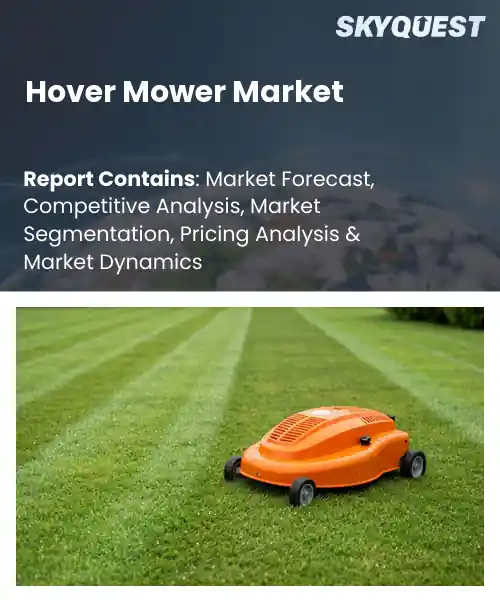
Hover Mower Market
Report ID: SQMIG20D2570
Report ID: SQMIG20D2570
[email protected]
USA +1 351-333-4748
Report ID:
SQMIG20D2570 |
Region:
Global |
Published Date: March, 2026
Pages:
157
|Tables:
151
|Figures:
78


Global Hover Mower Market size was valued at USD 1.20 Billion in 2024 and is poised to grow from USD 1.34 Billion in 2025 to USD 3.25 Billion by 2033, growing at a CAGR of 11.7% during the forecast period (2026-2033).
Growing demand for lightweight and maneuverable lawn care equipment, increasing adoption of electric gardening tools, rising focus on noise and emission reduction, advancements in battery technology, and growing popularity of urban gardening are driving sales of hover mowers.
Technological electrification, enabled by advances in battery technology and motor efficiency, has led to the creation of lightweight cordless hover mowers with improved usability and maintenance advantages. Increasing environmental regulations and noise restrictions are prompting landscaping professionals and contractors to embrace electric hover mowers for their operations. The machines provide the advantages of quiet running and environmentally friendly operations. The low TCO and usability factors are driving the adoption of electric hover mowers for landscaping operations. The scope for integrating battery technology with other components is also driving the market for electric hover mowers. Growing preference for efficient lawn maintenance solutions among homeowners and commercial users coupled with a shift toward electric and eco-friendly equipment is expected to primarily drive hover mower market growth.
On the contrary, limited power compared to traditional wheeled mowers, shorter battery runtime, performance constraints on dense grass, higher upfront costs of advanced models, and limited awareness in developing regions are projected to hamper hover mower market penetration in the long run.
How is AI Enhancing Autonomy in the Hover Mower Market?
The role of AI is growing in terms of autonomy within the market for hover mowers. Machine learning, sensor fusion, and real-time perception are all playing an important role in terms of autonomy for these types of mowers. Currently, there is a available that make use of a combination of LiDAR, stereo cameras, satellite positioning, and AI. All of these technologies help with object detection, different conditions such as lighting, etc., which ultimately increases safety.
In January 2026, Mammotion introduced the LUBA 3 AWD with Tri-Fusion navigation. It combines 360-degree LiDAR, RTK positioning, and AI vision to enable reliable wire-free operation and precise obstacle detection, improving uptime and making it easier to scale for both homeowners and commercial users.
Market snapshot - (2026-2033)
Global Market Size
USD 1.2 Billion
Largest Segment
Hover Lawn Mowers (Petrol)
Fastest Growth
Hover Lawn Mowers (Battery-Powered)
Growth Rate
11.7% CAGR
To get more insights on this market click here to Request a Free Sample Report
Global hover mower market is segmented by product type, blade / cutting system, application, end-user, distribution channel, and region. Based on product type, the market is segmented into hover lawn mowers (petrol), hover lawn mowers (electric), hover lawn mowers (battery-powered), robotic hover mowers, and commercial hover mowers. Based on blade / cutting system, the market is segmented into single blade, and multi-blade. Based on application, the market is segmented into residential use, commercial landscaping, sports turf & grounds maintenance, golf courses & parks, and municipal & public spaces. Based on end-user, the market is segmented into homeowners, landscaping companies, grounds maintenance contractors, municipal & government bodies, and golf courses & sports facilities. Based on distribution channel, the market is segmented into Direct OEM sales, dealers & distributors, retail / garden equipment stores, and online sales. Based on region, the market is segmented into North America, Europe, Asia Pacific, Latin America, and Middle East & Africa.
The hover lawn mowers (battery-powered) segment is estimated to account for the highest global hover mower market share in the future. Its combination of cordless convenience and quiet operation aligns with changing customer preferences to help cement the dominance of this segment. The better performance of the batteries in terms of energy density and power management allows for the design of specific motor configurations for the hovers that minimize the operational barriers for different types of lawns. The loop of cause and effect for consumer demand driving suppliers to make improvements to their products maintains the leaders in the market standards for battery technology.
However, robotic hover mowers are witnessing the strongest growth momentum as per this hover mower industry analysis. Surge in demand for automation and smart control broaden application convenience for end users to create new opportunities. The advancement in navigation sensors and creates the possibility for subscription and remote maintenance approaches, which increases the likelihood of adoption across a wide range of property sizes.
The dealers & distributors segment is estimated to spearhead the global hover mower market revenue generation through 2033. Established channel partners combine technical expertise, localized inventory, and after sales service, which allows this segment to maintain a dominant stance. Their capacity to demonstrate products, offer maintenance services, and assist with compatibility, which is a key reason manufacturer are turning to them for market penetration. Thus, relationships within distribution channels create trust among consumers, as well as a steady demand for their products.
Nevertheless, online sales are proving to be the most dynamic segment in growth terms, driven by increasing reach of e commerce, digital configurators, and logistics solutions that make purchasing a hover mower easier. Improved product information, reviews, and home delivery services help build consumer confidence, creating opportunities for direct-to-consumer strategies.
To get detailed segments analysis, Request a Free Sample Report
Robust manufacturing heritage, dense distribution networks, and pronounced consumer preference for precision garden care are helping Europe lead hover mower sales. Well-educated tool makers and specialty brands provide significant engineering ability and good after-sales service, allowing them to create distinct products by way of reliable and productive results. Urban and suburban landscaping, along with changing professional standards for ground maintenance, will provide ongoing demand for advanced mowing solutions; legislation around environmental performance and noise reduction will promote the growth of electric and low emission technology faster than in other countries where regulations aren't in place; strong trade relationships and close commercial proximity between countries will enhance the speed at which products enter new markets throughout Europe. Good working relationships between retailers, contractors/installers/mowers, and landscape designers are also important for market depth and have made Europe premium hover mower products.
Deep engineering tradition and strong dealer networks that emphasize quality and durability are shaping hover mower procurement in Germany going forward. Close cooperation with producers and landscapers enables customization of products and services to increase market penetration with discerning users in both urban and rural care segments. Consumers and professional landscapers require highly advanced technology with strong support. Requirements for environmentally friendly and noise-friendly products drive manufacturers to design electric or low-noise versions.
Strong gardening culture and professional grounds care needs, prompting demand for adaptable and user-friendly hover mowers in the United Kingdom. Landscaping services help manufacturers design products for different conditions of grass. Growing brand awareness and strong relationships with customers in urban estates also ensure sustained revenue generation. Retailers and landscape suppliers emphasize product availability and service.
Private garden owners and professional landscapers in France are driving demand for efficient and quiet hover mowers. Homegrown companies and international companies offer customized products according to local conditions of turf and terrain, thereby further strengthening the network of suppliers, which helps boost loyalty. Buyers value environmental performance and serviceability. Specialized dealers and garden stores are important for product introduction and support programs.
Widespread hover mower adoption among both homeowners and commercial landscape contractors, supported by extensive retail footprints and online channels are driving sales in North America. Demand for non-fuel powered, low maintenance, quiet operating hover mowers supports the strong interest in hover mower designs. As users demand convenience in mowing their lawns, manufacturers are able to use their regional product development capabilities and service networks to accommodate the different turf care needs of their customers. Manufacturers are collaborating with rental services and landscape contractors to help facilitate the trial and scaling of advanced hover mowers. In addition, manufacturers have developed targeted marketing campaigns to demonstrate the efficiencies and total cost of ownership of hover mowers to various customer segments. The relatively strong professional landscaping sector and the growing number of municipalities with green space programs continue to create a strong demand for reliable equipment, while shifts toward cleaner, more energy-efficient products keeps the market evolving in terms of reduced emissions and improved user ergonomics across the region.
Homeowner interest and professional landscaping demand for convenient, durable, and low noise equipment are supporting steady sales of hover mowers in the United States. Rental services and contractors are influential channels, raising awareness. Partnerships with services guarantee maintenance support, which instills trust in mowing solutions. Wide availability of retailers helps with purchase and replacement. Emphasis on ergonomics and ease of cleaning has a bearing on product development.
Homeowner demand and landscape sector needs for quiet, efficient machines suited to varied turf environments is shaping hover mower sales in Canada. Environmental friendliness and better ergonomics are key considerations for manufacturers. Associations with rental companies and service operators facilitate the introduction of models. Target marketing and networks help to gain confidence and preference of buyers at both residential and commercial levels.
Targeted investments in manufacturing capacity, local research and development, and adaptation of products to regional turf are creating new opportunities for hover mower vendors in this region. Collaborative relationships with landscape and rental services are enhancing product demonstration and adoption; incremental advancements in the design of battery and motor technologies are aligning the product offerings with environmental and operational expectations, thereby adding to the ability for this area of the world to become a major contributor to global supply and production innovation networks. Manufacturers in this region are continuing to invest to develop products with lower cost designs while maintaining the essential performance standards and noise characteristics that users expect. In addition, the availability of expanded distribution channels offer more access to consumers. Government programs that promote the use of cleaner equipment, combined with changing consumer preference for low noise, low emission products, are driving investment in the improvement of product designs and the local service ecosystem supports steady demand across all countries in this region.
Engineering strengths and consumer preference for compact, efficient, quiet garden machines are shaping procurement of hover mowers across Japan. Quiet operation and eco-friendly design appeal to a broad range of residential consumers. Manufacturers emphasize accuracy, reliability, and sophisticated motor and battery technology integration. Specialized garden stores and service standards contribute to high-end product positioning. Joint efforts between equipment manufacturers and landscape industry professionals result in products tailored for specific lawn types and terrain.
The need for urban landscaping and the interest of residents and groundskeepers are driving the steady demand for hover mowers. Partnerships with landscape companies help verify the product. Environmental-friendly and comfort-oriented product design help gain traction with consumers worldwide. Domestic companies are dedicated to further technological development and battery integration for more convenience. The product is made more accessible through specialty retailers.
To know more about the market opportunities by region and country, click here to
Buy The Complete Report
Increasing Adoption Of Battery Technology
Growing Interest In Sustainable Landscaping
High Initial Purchase Price
Limited Awareness Among Consumers
Request Free Customization of this report to help us to meet your business objectives.
Competitive landscape is consolidation and capability capture as incumbents and service providers chase autonomy and fleet economics; recent M&A and strategic investment illustrate this shift with Toro acquiring Left Hand Robotics and Husqvarna expanding investment in Robin Autopilot, while new commercial leasing and service models and autonomous fairway mower deployments are being used to differentiate offerings and accelerate customer adoption.
SkyQuest’s ABIRAW (Advanced Business Intelligence, Research & Analysis Wing) is our Business Information Services team that Collects, Collates, Correlates, and Analyses the Data collected by means of Primary Exploratory Research backed by robust Secondary Desk research.
As per SkyQuest analysis, rising demand for electric and eco-friendly lawn care equipment and growing preference for lightweight and maneuverable tools are anticipated to drive the demand for hover mowers going forward. However, limited power compared to traditional mowers and higher upfront costs are slated to slow down the adoption of hover mowers in the future. Europe is slated to spearhead the demand for hover mowers owing to high adoption of smart gardening equipment, strong presence of residential lawn care culture, and increasing demand for automated solutions. Development of AI-enabled autonomous navigation, advancements in battery technology, and integration of wire-free and sensor-based mowing systems are anticipated to be key trends driving the hover mower industry over the coming years.
| Report Metric | Details |
|---|---|
| Market size value in 2024 | USD 1.2 Billion |
| Market size value in 2033 | USD 3.25 Billion |
| Growth Rate | 11.7% |
| Base year | 2024 |
| Forecast period | (2026-2033) |
| Forecast Unit (Value) | USD Billion |
| Segments covered |
|
| Regions covered | North America (US, Canada), Europe (Germany, France, United Kingdom, Italy, Spain, Rest of Europe), Asia Pacific (China, India, Japan, Rest of Asia-Pacific), Latin America (Brazil, Rest of Latin America), Middle East & Africa (South Africa, GCC Countries, Rest of MEA) |
| Companies covered |
|
| Customization scope | Free report customization with purchase. Customization includes:-
|
To get a free trial access to our platform which is a one stop solution for all your data requirements for quicker decision making. This platform allows you to compare markets, competitors who are prominent in the market, and mega trends that are influencing the dynamics in the market. Also, get access to detailed SkyQuest exclusive matrix.
Table Of Content
Executive Summary
Market overview
Parent Market Analysis
Market overview
Market size
KEY MARKET INSIGHTS
COVID IMPACT
MARKET DYNAMICS & OUTLOOK
Market Size by Region
KEY COMPANY PROFILES
Methodology
For the Hover Mower Market, our research methodology involved a mixture of primary and secondary data sources. Key steps involved in the research process are listed below:
1. Information Procurement: This stage involved the procurement of Market data or related information via primary and secondary sources. The various secondary sources used included various company websites, annual reports, trade databases, and paid databases such as Hoover's, Bloomberg Business, Factiva, and Avention. Our team did 45 primary interactions Globally which included several stakeholders such as manufacturers, customers, key opinion leaders, etc. Overall, information procurement was one of the most extensive stages in our research process.
2. Information Analysis: This step involved triangulation of data through bottom-up and top-down approaches to estimate and validate the total size and future estimate of the Hover Mower Market.
3. Report Formulation: The final step entailed the placement of data points in appropriate Market spaces in an attempt to deduce viable conclusions.
4. Validation & Publishing: Validation is the most important step in the process. Validation & re-validation via an intricately designed process helped us finalize data points to be used for final calculations. The final Market estimates and forecasts were then aligned and sent to our panel of industry experts for validation of data. Once the validation was done the report was sent to our Quality Assurance team to ensure adherence to style guides, consistency & design.
Analyst Support
Customization Options
With the given market data, our dedicated team of analysts can offer you the following customization options are available for the Hover Mower Market:
Product Analysis: Product matrix, which offers a detailed comparison of the product portfolio of companies.
Regional Analysis: Further analysis of the Hover Mower Market for additional countries.
Competitive Analysis: Detailed analysis and profiling of additional Market players & comparative analysis of competitive products.
Go to Market Strategy: Find the high-growth channels to invest your marketing efforts and increase your customer base.
Innovation Mapping: Identify racial solutions and innovation, connected to deep ecosystems of innovators, start-ups, academics, and strategic partners.
Category Intelligence: Customized intelligence that is relevant to their supply Markets will enable them to make smarter sourcing decisions and improve their category management.
Public Company Transcript Analysis: To improve the investment performance by generating new alpha and making better-informed decisions.
Social Media Listening: To analyze the conversations and trends happening not just around your brand, but around your industry as a whole, and use those insights to make better Marketing decisions.
REQUEST FOR SAMPLE
 REQUEST FREE CUSTOMIZATION
Global Hover Mower Market size was valued at USD 1.2 Billion in 2024 and is poised to grow from USD 1.34 Billion in 2025 to USD 3.25 Billion by 2033, growing at a CAGR of 11.7% during the forecast period (2026-2033).
Competitive landscape is consolidation and capability capture as incumbents and service providers chase autonomy and fleet economics; recent M&A and strategic investment illustrate this shift with Toro acquiring Left Hand Robotics and Husqvarna expanding investment in Robin Autopilot, while new commercial leasing and service models and autonomous fairway mower deployments are being used to differentiate offerings and accelerate customer adoption. 'Husqvarna', 'Robomow', 'Worx', 'Gardena', 'Greenworks', 'Bosch', 'Stihl', 'iRobot', 'Honda', 'Ryobi', 'Echo', 'Cub Cadet', 'Toro', 'LawnBott', 'Ambrogio', 'Billy Goat', 'McCulloch', 'AL-KO', 'Yard Force', 'Flymo'
Electric propulsion and advanced battery technology have expanded the appeal of hover mowers by reducing operational noise, eliminating direct emissions, and simplifying maintenance, which makes these products more attractive to environmentally conscious consumers and municipal buyers. Improved battery energy density and charging convenience extend run times and usability, encouraging wider adoption among homeowners and professional landscapers who value reliability and lower lifetime operating complexity. These attributes foster positive user experiences and repeat purchases, supporting broader market acceptance and stimulating demand for newer model introductions.
𝐄𝐧𝐞𝐫𝐠𝐲 𝐄𝐟𝐟𝐢𝐜𝐢𝐞𝐧𝐜𝐲 𝐅𝐨𝐜𝐮𝐬: Manufacturers are prioritizing lighter materials, improved blade design, and aerodynamic housing to extend runtime and reduce maintenance demands while preserving cutting performance. Emphasis on efficient power conversion, regenerative braking analogs for electric models, and modular battery platforms supports longer operational cycles and easier servicing. This shift responds to consumer preference for lower operating costs and reduced environmental footprint, enabling premium positioning for models that promise dependable performance with simplified ownership experiences and stronger resale value through demonstrable efficiency advantages benefits.
Why does Europe Dominate the Global Hover Mower Market? |@12


Want to customize this report? This report can be personalized according to your needs. Our analysts and industry experts will work directly with you to understand your requirements and provide you with customized data in a short amount of time. We offer $1000 worth of FREE customization at the time of purchase.
Feedback From Our Clients


 USA (+1) 351-333-4748

