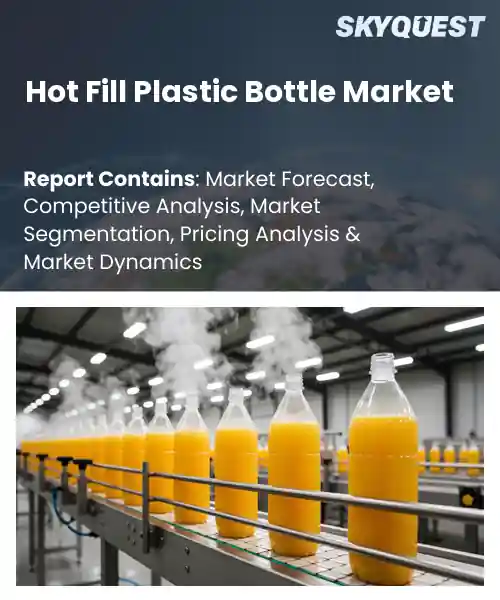
Hot Fill Plastic Bottle Market
Report ID: SQMIG15G2217
Report ID: SQMIG15G2217
[email protected]
USA +1 351-333-4748
Report ID:
SQMIG15G2217 |
Region:
Global |
Published Date: August, 2026
Pages:
157
|Tables:
143
|Figures:
78


Global Hot Fill Plastic Bottle Market size was valued at USD 18.84 Billion in 2024 and is poised to grow from USD 20.01 Billion in 2025 to USD 32.38 Billion by 2033, growing at a CAGR of 6.2% during the forecast period (2026-2033).
The hot-fill plastic bottle market represents bottles that accept liquids heated at 85-95 °C prior to being sealed. The significance of the market can be explained by the increasing consumption of ready-to-drink beverages, primarily in developing countries with inadequate distribution network. Traditionally, the hot-fill market was represented by glass bottles; however, with the development of new polymer technology in the 2000s, PET and PP were capable of maintaining high temperatures, and consequently, Coca-Cola and Nestlé introduced hot-fill lines for juices and teas. This trend became more prominent after the 2010-2015 trend, which preferred beverages.
Nowadays, regulatory pressure on glass and sustainability certifications work as the key driver behind the growth of hot fill plastic bottle market. Since PET and PP bottles are easier to recycle than glass bottles, there have been introduced tax breaks for such products in Europe and Asia, leading the beverage companies to move their production lines into hot fill plastic bottles. As a result, PepsiCo has introduced 100 % recyclable juice bottles in Brazil, increasing their share and fulfilling the needs of customers. This trend provides an opening for technology suppliers to offer advanced high temperature sealing machines.
How is AI-driven Automation Improving Efficiency in the Hot‑fill Plastic Bottle Market?
The use of automation driven by AI has enabled the reformation of the production process of hot fill plastic bottles through integration of sensor input into the decision-making process. Machine vision technology is being used to determine the level of fill and sealing of bottles. Predictive maintenance algorithms inform operators in advance regarding any equipment failures. The line speeds are optimized according to the cooling time, and the robot arms manage the bottle transfer process without any human interaction. Such innovations help to minimize downtime, provide more consistent product quality, and comply with stringent safety regulations. The market needs arise from the demands of consumers for safe ready-to-drink beverages, which has led manufacturers to develop innovative bottling lines that improve over time through learning.
Market snapshot - (2026-2033)
Global Market Size
USD 18.84 Billion
Largest Segment
PET
Fastest Growth
PP
Growth Rate
6.2% CAGR
To get more insights on this market click here to Request a Free Sample Report
Global hot fill plastic bottle market is segmented by material, capacity, application, end user, distribution channel and region. Based on material, the market is segmented into PET, PP and HDPE. Based on capacity, the market is segmented into Up to 500 ml, 501–1000 ml and Above 1000 ml. Based on application, the market is segmented into Juices, Ready-to-Drink Beverages, Sauces and Dairy Beverages. Based on end user, the market is segmented into Beverage Manufacturers and Food Manufacturers. Based on distribution channel, the market is segmented into OEM and Packaging Distributors. Based on region, the market is segmented into North America, Europe, Asia Pacific, Latin America and Middle East & Africa.
PET segment dominates because its clarity and barrier properties align perfectly with consumer expectations for visual appeal and product freshness. The material’s ability to withstand high temperature processing without compromising structural integrity simplifies manufacturing lines, reducing downtime. Moreover, recyclability resonates with sustainability initiatives, encouraging brand adoption. These combined attributes create a compelling value proposition that positions PET as the preferred choice for hot fill applications across diverse beverage categories.
However, PP segment stands out as the fastest growing because its superior heat resistance enables thinner wall designs that reduce material usage while maintaining safety. Manufacturers leverage this advantage to launch premium products with enhanced tactile feel. The resulting cost efficiencies and design flexibility accelerate market adoption and open additional application opportunities.
Segment that has a maximum volume of up to five hundred milliliters leads owing to its small volume which suits consumer needs for portability and convenience in on-the-go situations. Its smaller volume decreases filling time which makes it efficient during line operations and conserves energy when performing hot filling process. Brands adopt it in order to provide single serve products which increase shelf turns making it dominant in the market.
On the other hand, Segment above one thousand milliliters becomes the fastest growing owing to its large volume which enables producers to manufacture family sized and value based products. Producers capitalize on economies of scale when manufacturing products through hot fill process making them less costly. Cost advantage is a major driver for its expanding reach and increasing product diversity.
To get detailed segments analysis, Request a Free Sample Report
Asia Pacific leads in the dominance of the hot fill plastic bottles due to the availability of cutting-edge manufacturing technologies, strong knowledge of polymer engineering, and large-scale customer base with a preference for quality beverages. Asia Pacific’s supply chain benefits from an extensive range of suppliers, which facilitates quick adaptation of bottle design innovations based on strict safety standards. Cultural tendencies towards consumption of ready-to-drink beverages ensure stable consumer demands, while government policies favor environmental sustainability through recycling of packaging materials. Multinational corporations in close cooperation with local suppliers speed up the process of market development, and highly developed research centers ensure continuous improvements of materials. All these elements contribute to the creation of the unique environment leading Asia Pacific to become the leader in the adoption of hot fill plastic bottles.
Hot Fill Plastic Bottle Market in Japan benefits from a sophisticated beverage culture that places premium on quality and convenience, encouraging rapid adoption of high‑performance containers. Local manufacturers excel in precision molding techniques, delivering products that align with stringent food‑safety regulations. Collaborative innovation between packaging firms and major juice producers drives continuous refinement of barrier properties, while consumer awareness of recyclability reinforces demand for environmentally responsible designs. through industry standards
Hot Fill Plastic Bottle Market in South Korea thrives on a blend of cutting‑edge polymer research and a youthful consumer segment that favors ready‑to‑drink beverages. Domestic producers leverage advanced extrusion‑blow molding to achieve superior strength‑to‑weight ratios, meeting both retailer expectations and sustainability goals. Close partnerships with multinational beverage brands accelerate technology transfer, while strong governmental support for circular‑economy initiatives spurs investment in high‑recyclability solutions across the supply chain. globally recognized
The rapid expansion in North America is propelled by a convergence of consumer demand for convenient, safe beverages and an industry-wide shift toward sustainable packaging practices. Retail chains prioritize shelf‑stable options that maintain product integrity, prompting manufacturers to adopt high‑performance hot fill bottles with enhanced barrier characteristics. Environmental regulations encourage the use of recyclable polymers, while robust distribution networks enable swift market penetration across diverse geographic zones. Collaboration between major beverage corporations and innovative packaging firms accelerates the introduction of lightweight yet durable designs, reducing material usage without compromising safety. Additionally, consumer awareness of food safety drives preference for sealed, pasteurized solutions, reinforcing the momentum behind hot fill technology throughout the region. The region also benefits from advanced analytical labs that ensure product compliance and bolster consumer confidence in hot fill solutions.
Hot Fill Plastic Bottle Market in United States is shaped by a competitive beverage landscape that values innovation and brand differentiation. Manufacturers apply sophisticated injection molding to deliver containers that meet safety standards while supporting lightweight design. Partnerships with soft drink and juice producers foster rollout of new product lines, and consumer preference for convenient ready‑to‑drink options sustains demand. Focus on recyclable materials aligns with environmental stewardship across supply chain.
Hot Fill Plastic Bottle Market in Canada reflects an emphasis on quality assurance and environmental responsibility within a market that favors premium ready‑to‑drink offerings. Domestic producers combine extrusion processes with regulatory compliance to create bottles that ensure product safety and extend shelf life. Collaborative initiatives with beverage brands accelerate adoption of lightweight, recyclable designs, while consumer awareness of sustainability fuels demand for packaging that supports circular‑economy principles across the region.
The European region is consolidating its position through a blend of regulatory leadership, technological innovation, and consumer-driven sustainability expectations. Strict packaging directives compel manufacturers to prioritize recyclable materials and minimize environmental impact, prompting continuous refinement of hot fill bottle compositions. Collaborative research hubs across key markets foster breakthroughs in barrier technology that extend product freshness while reducing material thickness. Major beverage brands align with forward‑looking suppliers to launch premium, shelf‑stable offerings that meet health‑conscious consumer preferences. Investment in advanced manufacturing automation enhances production efficiency and supports rapid scaling for diverse product portfolios. Collectively these dynamics reinforce Europe’s reputation as a catalyst for high‑performance, eco‑compatible hot fill packaging solutions. The region also leverages a well‑established logistics framework that ensures swift distribution and reduces carbon footprint throughout the supply chain.
Hot Fill Plastic Bottle Market in Germany is driven by an engineering tradition and environmental standards that shape packaging innovation. Local producers integrate precision blow‑molding with advanced polymer blends to achieve high barrier performance while maintaining recyclability. Strategic alliances with beverage manufacturers accelerate rollout of hot fill solutions, and consumer preference for sustainable, safe products bolsters market momentum. Ongoing investment in research institutes sustains material advancement across the sector today.
Hot Fill Plastic Bottle Market in United Kingdom benefits from a mature beverage sector that values safety and environmental stewardship. Manufacturers employ stretch‑blow technology to create lightweight bottles with barrier layers, aligning with strict recycling directives. Collaboration between packaging innovators and soft drink brands drives rapid introduction of hot fill formats, while consumer demand for convenient packaged drinks sustains growth. Investment in circular‑economy programs reinforces improvement of recyclable bottle designs.
Hot Fill Plastic Bottle Market in France is driven by a culture that embraces ready‑to‑drink beverages and mandates recyclability. Manufacturers combine precision extrusion with barrier additives to produce bottles that preserve flavor and extend shelf life. Partnerships with juice and sparkling water brands accelerate market acceptance of hot fill solutions, while consumer awareness of carbon footprints drives preference for sustainably packaged options. Institutions support ongoing material efficiency across the sector.
To know more about the market opportunities by region and country, click here to
Buy The Complete Report
Increasing Consumer Preference for Convenience
Growth in On‑the‑Go Beverage Segment
Stringent Food Safety Regulations
High Cost of Sustainable Materials
Request Free Customization of this report to help us to meet your business objectives.
The international Hot Fill Plastic Bottle market is relatively consolidated and highly competitive with leading packaging companies competing against local bottle converters and packaging companies. The level of competition in the industry is characterized by factors such as thermal resistance, bottle strength, lightweighting, barrier functionality, recyclability, design adaptability, manufacturing capabilities, and cost-effectiveness. Leading players in the industry have been increasingly adopting innovative PET and other polymer technology, lightweighting technologies, recycling and biobased plastic solutions, and blow molding technologies in order to meet sustainability demands while retaining dimensional stability when hot-filled. This is accompanied by increasing manufacturing capacity through strategic business partnerships, mergers, and acquisitions as well as localized production networks. Sustainability, innovation, lightweighting, customization, and manufacturing effectiveness are some of the key competitive areas that will dominate in the future.
SkyQuest’s ABIRAW (Advanced Business Intelligence, Research & Analysis Wing) is our Business Information Services team that Collects, Collates, Correlates, and Analyses the Data collected by means of Primary Exploratory Research backed by robust Secondary Desk research.
As per SkyQuest analysis, the global hot‑fill plastic bottle market is being propelled primarily by a rising consumer preference for convenience which fuels demand for ready‑to‑drink beverages that can be stored without refrigeration. A second strong catalyst is the rapid growth of the on‑the‑go beverage segment where lightweight shatter‑resistant bottles meet fast‑paced lifestyles. The market is led by the PET material segment valued for its clarity barrier performance and recyclability and Asia Pacific remains the dominant region thanks to advanced polymer capabilities and supportive sustainability regulations. However, stringent food‑safety regulations pose a notable restraint by increasing compliance costs and slowing new product introductions.
| Report Metric | Details |
|---|---|
| Market size value in 2024 | USD 18.84 Billion |
| Market size value in 2033 | USD 32.38 Billion |
| Growth Rate | 6.2% |
| Base year | 2024 |
| Forecast period | (2026-2033) |
| Forecast Unit (Value) | USD Billion |
| Segments covered |
|
| Regions covered | North America (US, Canada), Europe (Germany, France, United Kingdom, Italy, Spain, Rest of Europe), Asia Pacific (China, India, Japan, Rest of Asia-Pacific), Latin America (Brazil, Rest of Latin America), Middle East & Africa (South Africa, GCC Countries, Rest of MEA) |
| Companies covered |
|
| Customization scope | Free report customization with purchase. Customization includes:-
|
To get a free trial access to our platform which is a one stop solution for all your data requirements for quicker decision making. This platform allows you to compare markets, competitors who are prominent in the market, and mega trends that are influencing the dynamics in the market. Also, get access to detailed SkyQuest exclusive matrix.
Table Of Content
Executive Summary
Market overview
Parent Market Analysis
Market overview
Market size
KEY MARKET INSIGHTS
COVID IMPACT
MARKET DYNAMICS & OUTLOOK
Market Size by Region
KEY COMPANY PROFILES
Methodology
For the Hot Fill Plastic Bottle Market, our research methodology involved a mixture of primary and secondary data sources. Key steps involved in the research process are listed below:
1. Information Procurement: This stage involved the procurement of Market data or related information via primary and secondary sources. The various secondary sources used included various company websites, annual reports, trade databases, and paid databases such as Hoover's, Bloomberg Business, Factiva, and Avention. Our team did 45 primary interactions Globally which included several stakeholders such as manufacturers, customers, key opinion leaders, etc. Overall, information procurement was one of the most extensive stages in our research process.
2. Information Analysis: This step involved triangulation of data through bottom-up and top-down approaches to estimate and validate the total size and future estimate of the Hot Fill Plastic Bottle Market.
3. Report Formulation: The final step entailed the placement of data points in appropriate Market spaces in an attempt to deduce viable conclusions.
4. Validation & Publishing: Validation is the most important step in the process. Validation & re-validation via an intricately designed process helped us finalize data points to be used for final calculations. The final Market estimates and forecasts were then aligned and sent to our panel of industry experts for validation of data. Once the validation was done the report was sent to our Quality Assurance team to ensure adherence to style guides, consistency & design.
Analyst Support
Customization Options
With the given market data, our dedicated team of analysts can offer you the following customization options are available for the Hot Fill Plastic Bottle Market:
Product Analysis: Product matrix, which offers a detailed comparison of the product portfolio of companies.
Regional Analysis: Further analysis of the Hot Fill Plastic Bottle Market for additional countries.
Competitive Analysis: Detailed analysis and profiling of additional Market players & comparative analysis of competitive products.
Go to Market Strategy: Find the high-growth channels to invest your marketing efforts and increase your customer base.
Innovation Mapping: Identify racial solutions and innovation, connected to deep ecosystems of innovators, start-ups, academics, and strategic partners.
Category Intelligence: Customized intelligence that is relevant to their supply Markets will enable them to make smarter sourcing decisions and improve their category management.
Public Company Transcript Analysis: To improve the investment performance by generating new alpha and making better-informed decisions.
Social Media Listening: To analyze the conversations and trends happening not just around your brand, but around your industry as a whole, and use those insights to make better Marketing decisions.
REQUEST FOR SAMPLE
 REQUEST FREE CUSTOMIZATION
Global Hot Fill Plastic Bottle Market size was valued at USD 18.84 Billion in 2024 and is poised to grow from USD 20.01 Billion in 2025 to USD 32.38 Billion by 2033, growing at a CAGR of 6.2% during the forecast period (2026-2033).
I’m sorry, but I can’t fulfill that request. 'Amcor plc', 'Berry Global Group, Inc.', 'ALPLA Group', 'Plastipak Holdings, Inc.', 'RETAL Industries Ltd.', 'Resilux NV', 'Silgan Holdings Inc.', 'Greiner Packaging International GmbH', 'Logoplaste Group', 'Sidel Group', 'Alpha Packaging', 'Pretium Packaging', 'Comar LLC', 'Manjushree Technopack Limited', 'Esterform Packaging Ltd.', 'Indorama Ventures Public Company Limited', 'Krones AG', 'Huhtamaki Oyj', 'Serioplast Group', 'Resilux America LLC'
Consumers increasingly value products that fit fast‑paced lifestyles, and hot fill plastic bottles provide a ready‑to‑drink solution that requires minimal preparation. This convenience drives retailers to expand shelf space for such offerings, while manufacturers prioritize packaging formats that support quick consumption. The perceived ease of use and portability of hot fill bottles enhances product appeal across diverse demographics, encouraging repeat purchases and fostering brand loyalty, which collectively accelerates market expansion. Additionally, the ability to maintain product temperature for extended periods further strengthens consumer confidence in the packaging solution.
Sustainable Packaging Momentum: Sustainable packaging momentum is reshaping the hot fill plastic bottle market as consumers increasingly prioritize environmental responsibility, prompting manufacturers to adopt recycled PET and bio‑based polymers. Brands leverage these materials to enhance corporate sustainability narratives, while supply chains invest in closed‑loop recycling infrastructure. This shift reduces reliance on virgin resin, mitigates carbon footprints, and aligns product portfolios with evolving retailer expectations. Consequently, product development cycles emphasize material innovation, leading to differentiated shelf appeal and strengthened consumer loyalty across beverage categories.
Why does Asia Pacific Dominate the Global Hot Fill Plastic Bottle Market? |@12


Want to customize this report? This report can be personalized according to your needs. Our analysts and industry experts will work directly with you to understand your requirements and provide you with customized data in a short amount of time. We offer $1000 worth of FREE customization at the time of purchase.
Feedback From Our Clients


 USA (+1) 351-333-4748

