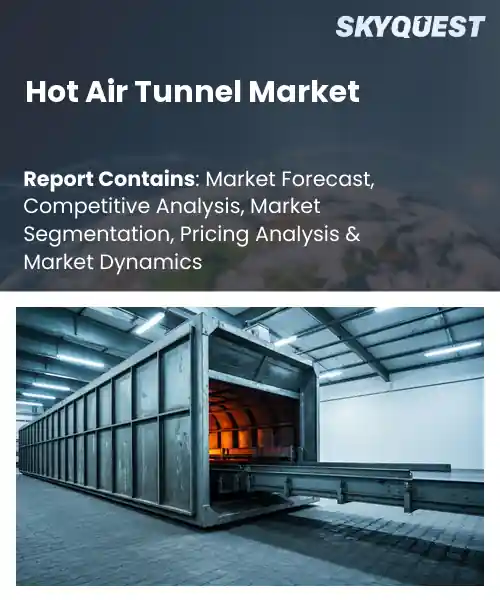
Hot Air Tunnel Market
Report ID: SQMIG20I3373
Report ID: SQMIG20I3373
[email protected]
USA +1 351-333-4748
Report ID:
SQMIG20I3373 |
Region:
Global |
Published Date: July, 2026
Pages:
157
|Tables:
151
|Figures:
78


Global Hot Air Tunnel Market size was valued at USD 342.6 Million in 2024 and is poised to grow from USD 364.53 Million in 2025 to USD 598.78 Million by 2033, growing at a CAGR of 6.4% during the forecast period (2026-2033).
The global hot-air tunnel market growth is pushed by industrial chambers that make a managed air stream and temperature to test or process textiles, composites and even electronic parts, in a practical way. It’s crucial so this can mimic real life conditions, because otherwise it’s hard to check durability, and also meet safety regulation compliance.
The main reason is the increasing need for energy-efficient production, which forces companies to use hot-air tunnels for fast drying and heat treatment. These tunnels require a small amount of energy compared to traditional ovens. These technologies provide a cost saving loop and also meet carbon reduction targets, by recycling hot air with no risk to product integrity. This advantage has led to investment in higher capacity automobile upholstery facilities. Volkswagen, for example, is cutting assembly time by some thirty percent drying composite panels in tunnels. Thus, suppliers are developing long-term service contracts and modular designs, creating a large opportunity in green production-centric areas.
Artificial intelligence is changing how hot-air tunnels operate, automating flow-field analysis, predictive maintenance and real-time control. Sensor data fed into machine-learning models can predict turbulence patterns, allowing engineers to adjust temperature gradients without the need for lengthy trial runs. Instant detection of surface flaws on test specimens can reduce the post-test inspection time for vision systems. All performance parameters are presented in one view, and AI-powered Dashboards help teams to find bottlenecks and allocate resources in the most efficient way possible. These capabilities can provide more accurate aerodynamic data, reduce the development cycle time for automotive and aerospace components and, ultimately, improve product quality and competitiveness in the market.
Market snapshot - (2026-2033)
Global Market Size
USD 342.6 Million
Largest Segment
Gas-Fired Hot Air Tunnels
Fastest Growth
Electric Hot Air Tunnels
Growth Rate
6.4% CAGR
To get more insights on this market click here to Request a Free Sample Report
The global hot air tunnel market is segmented by product type, application, temperature range, end user, distribution channel and region. Based on product type, the market is segmented into Electric Hot Air Tunnels, Gas-Fired Hot Air Tunnels, Infrared Hot Air Tunnels and Others. Based on application, the market is segmented into Shrink Packaging, Drying, Heat Treatment, Food Processing and Others. Based on temperature range, the market is segmented into Up to 100°C, 101°C–250°C, Above 250°C and Others. Based on end user, the market is segmented into Packaging Industry, Food & Beverage, Pharmaceutical Industry, Industrial Manufacturing and Others. Based on distribution channel, the market is segmented into Direct Sales, Industrial Distributors, System Integrators and Others. Based on region, the market is segmented into North America, Europe, Asia Pacific, Latin America and Middle East & Africa.
As per the hot air tunnel market analysis, the electric hot air tunnel segment dominates the market with accurate temperature control, lower operating emissions, and ease of integration with automated lines, supporting manufacturers’ efficiency and sustainability goals. They are energy-efficient, driving their use in high-mix production environments and lowering the cost of ownership over the long term. Multiple zone programming makes complex shrink packaging and sensitive drying procedures possible, making them more attractive to modern facilities looking for flexibility and dependability in today’s market.
However, the highest growth momentum is seen in the infrared hot air tunnels, as the quick heating technique reduces cycle time and enhances surface quality, making it attractive to industries requiring quick results and throughput. Infrared solutions are driving market growth. This is due to its increasing usage in pharmaceutical coating and food blanching.
According to the hot air tunnel market forecast, drying application segment is leading the way as it meets the primary requirement to remove moisture in different manufacturing lines while providing product stability, weight consistency and prolonged shelf life. The hot air tunnels distribute the heat evenly preventing hot spots, ensuring the integrity of the material. This constant attempt to increase production speed and reduce energy consumption further worsens the dependence on efficient drying solutions. This establishes its prominent role in the market penetration in the industry.
Whereas the fastest-growing application is heat treatment. Manufacturers are looking to improve the properties of materials such as strength and chemical resistance without the use of chemical agents. The continuous flow of regulated high temperature exposure in hot air tunnels is a great attraction for manufacturers of automotive and aerospace components, which is propelling the market growth.
To get detailed segments analysis, Request a Free Sample Report
As per the hot air tunnel market regional forecast, North America has a very strong agricultural base and now they are using precise technology to increase the resilience of crops and extend growing seasons,” he said. Strong research organizations work with equipment makers to accelerate innovation and deliver better tunnel designs. The policy frameworks support climate-controlled agriculture and encourage sustainable practices. There are well-established logistics networks enabling fast distribution of inputs and finished goods. When growers have an early adopter mindset and there is plenty of capital available, it creates a self-reinforcing ecosystem that continuously drives the industry forward and cements the region’s leadership.
Hot Air Tunnel Market in the US
As large-scale research collaborations between US institutions and private companies are put in place, creative solutions for varied climate zones are driving the hot air tunnel market. Growers’ need for production stability and quality is fueling demand for complex tunnel systems with climate monitoring and automation. Scale-up prospects are supported by regional extension offices and large agribusiness firms, so widespread adoption may be possible in the commodity and specialty crop sectors.
Hot Air Tunnel Market in Canada
The hot air tunnel industry is growing significantly. Canada’s cold climate and short growing season necessitates season extending technologies to enable agricultural production. Technology companies and government organizations are teaming up to develop energy-efficient solutions for northern climates. Growers appreciate the opportunity to protect valuable horticultural products, and strong environmental stewardship programs promote investment in low-impact tunnel solutions that highlight Canada’s role as a major player in the North American market.
Europe’s fast growth is driven by an engineering excellence culture, consumer demand for local food and high sustainability standards. Countries are showing resource efficiency by adding renewable energy sources and sophisticated temperature control systems to their tunnel infrastructure. Legislative frameworks are driving low-carbon farming techniques, while collaborative innovation hubs are fast-tracking the adoption of modular and scalable solutions across the continent. Premium market positioning, strong research networks and supportive legislation create an environment that favors faster market growth across the region.
Hot Air Tunnel Market in Germany
The German hot air tunnel sector is based on a strong engineering tradition with a focus on accuracy and reliability. Research institutions are working with manufacturers to develop highly automated tunnel solutions that control ventilation, humidity and temperature. Farmers are increasingly using these systems to grow specialty crops for the domestic market and for export under strict food safety regulations. Furthermore, strict environmental legislation favors the development of energy-saving technologies, which consolidates Germany’s leading role in Europe.
Hot Air Tunnel Market in the UK
The hot air tunnel market share in the UK is booming as farmers try to extend harvest seasons and beat erratic weather patterns. Startups are working with academic institutions on designing modular tunnels that can be quickly deployed on farms of different sizes. The UK is Europe's fastest growing market due to government initiatives to support sustainable agriculture, and investment in climate controlled environments driven by consumer demand for locally sourced products.
Hot Air Tunnel Market in France
The French hot air tunnel market is driven by increasing horticultural legacy and increased focus on terroir-specific products. Agronomists also collaborate with equipment suppliers to develop tunnel systems for delicate fruit and vegetable species. The longer season and the French market’s demand for premium produce support the use of climate-controlled structures aligned with culinary heritage. The industry is growing with the increase of funding programs and attention to eco-friendly techniques.
Asia Pacific is leveraging its varied agricultural landscape to strengthen its position with flexible and high-performance tunnel solutions. Countries have invested heavily in local manufacturing capacity and knowledge transfer, leading to the development of sophisticated, affordable systems that perform well in many climate zones. Strong government promotion of climate resiliency and food security is driving policy support for controlled-environment agriculture. Asia Pacific’s position in the global market continues to evolve and cooperative research across the region is accelerating improvements in energy efficiency and automated climate control, driven by consumers’ year-round need for fresh food.
Hot Air Tunnel Market in Japan
The Japan Hot Air Tunnel Market is driven by culture of premium produce and lack of arable land. Experts stress the need to design tunnels that yield maximum per square meter of space and incorporate advanced sensor networks to ensure optimal climate conditions. Manufacturers and research institutions collaborate to create solutions to extreme seasonal variations, from traditional staples to specialized niche crops. “There’s a demand for freshness and so tunnel technology is constantly developing.
Hot Air Tunnel Market in South Korea
The South Korean hot air tunnel market is undergoing a strategic shift towards technology-intensive agriculture to address demographic challenges. Developing smart tunnel systems with renewable energy. Implementing AI-based climate predictions together with industry partners. Government initiatives are present that incentivize environmentally friendly behavior to encourage uptake. Growers require high standards to ensure good crops and food self-sufficiency. South Korea is gaining popularity in the regional market due to a blend of policy and innovation.
To know more about the market opportunities by region and country, click here to
Buy The Complete Report
Increasing Adoption In Training Programs
Manufacturers are now also using hot air tunnels in pilot and astronaut training, to help the practitioners experience the critical situations repeatedly in a safe environment . This is a way to simulate the aerodynamic conditions of the high stakes environment without being limited by the availability of wind tunnels . The approach enhances skills acquisition, reduces reliance on expensive flight testing and speeds up certification schedules. Consequently, there is a steady demand for flexible tunnel systems from defense, aerospace and research institutions that need comprehensive performance validation under a controlled environment. The sessions also create a feedback loop that enables incremental design improvements, increasing industry confidence and encouraging further investment in advanced tunnel capabilities.
Growing Interest In Sustainable Testing
Hot air tunnels are a low energy alternative to standard wind tunnels which require lots of energy to generate large scale airflow. The industry is moving to environmentally friendly testing methods. They also recycle warm air and provide effective insulation, in addition to reducing carbon footprints, to support the same aerodynamics requirements. Such sustainability certifications align with corporate ESG goals and improve market penetration in industries that are focused on green engineering methods as companies select tunnel solutions that meet stakeholder expectations and regulatory requirements.
High Capital Expenditure Requirements
The design, build and installation of a hot air tunnel is very costly. It requires specialized heating components, accurate controls and sturdy structure. The approval process is very lengthy and organizations have to allocate large budgetary resources, and the project schedules are often extended. The investment may be expensive for smaller players and adoption may be slowed when alternative testing techniques appear to be more economical in the near run. The need for detailed capital planning, risk mitigation methods and long-term operating forecasts slows down market expansion.
Limited Skilled Workforce Availability
Although a hot air tunnel is operated by people who are experts in thermal dynamics, instrumentation and safety, the number of experts with this multidisciplinary set of skills is still very small. The lack of skills can increase operating costs, restrict the use of systems to their full potential and slow the pace of new installations. Many businesses have difficulty finding qualified engineers and technicians, so they spend a lot of time training employees or hiring outside consultants. This suggests that market participants may be reluctant to increase capacity until there is a larger pool of qualified workers.
Request Free Customization of this report to help us to meet your business objectives.
Recent partnerships between some of the world’s leading tunnel builders and university labs underscore the cut-throat competition in the global hot-air tunnel market as manufacturers look to expand their product portfolios through strategic mergers and acquisitions, partner with aerospace research organizations to co-develop next-generation flow-control systems, and speed up technological progress by adopting AI-driven simulation tools.
Top Player’s Company Profile
Recent Developments in the Hot Air Tunnel Market
In July 2025, Syntegon Technology GmbH and Fuji Machinery Co., Ltd. announced a strategic alliance to jointly develop modular hot-air tunnel systems with integrated sensor arrays and AI-based temperature optimization. This will provide real-time process analytics for quality monitoring and allow companies to achieve faster drying cycles while reducing energy consumption and footprint on European and Asian packaging lines.
Launched in May 2025, ULMA Packaging S.Coop.’s EcoDry 3000 hot-air tunnel features unique heat-recirculation technology and a small design that fits with conventional manufacturing lines. It meets the most stringent sustainability demands and continuously removes moisture from baked goods and confections. The intuitive touchscreen interface reduces changeover time and makes it easy to train operators.
SkyQuest’s ABIRAW (Advanced Business Intelligence, Research & Analysis Wing) is our Business Information Services team that Collects, Collates, Correlates, and Analyses the Data collected by means of Primary Exploratory Research backed by robust Secondary Desk research.
As per SkyQuest analysis, the increasing demand for energy-efficient production, which is compelling companies to opt for tunnels that reuse heated air and consume less electricity, is driving the global hot-air tunnel market. A second powerful driver is the use of AI-enabled control and predictive maintenance, which reduces operating costs and improves throughput and product quality. The electric hot-air tunnel segment is dominating the market due to its accurate temperature control, and low emission. Market is still dominated by the developed industrial and agricultural bases in North America. But the high upfront costs of putting in tunnels, especially for small firms, continue to impede expansion.
| Report Metric | Details |
|---|---|
| Market size value in 2024 | USD 342.6 Million |
| Market size value in 2033 | USD 598.78 Million |
| Growth Rate | 6.4% |
| Base year | 2024 |
| Forecast period | (2026-2033) |
| Forecast Unit (Value) | USD Million |
| Segments covered |
|
| Regions covered | North America (US, Canada), Europe (Germany, France, United Kingdom, Italy, Spain, Rest of Europe), Asia Pacific (China, India, Japan, Rest of Asia-Pacific), Latin America (Brazil, Rest of Latin America), Middle East & Africa (South Africa, GCC Countries, Rest of MEA) |
| Companies covered |
|
| Customization scope | Free report customization with purchase. Customization includes:-
|
To get a free trial access to our platform which is a one stop solution for all your data requirements for quicker decision making. This platform allows you to compare markets, competitors who are prominent in the market, and mega trends that are influencing the dynamics in the market. Also, get access to detailed SkyQuest exclusive matrix.
Table Of Content
Executive Summary
Market overview
Parent Market Analysis
Market overview
Market size
KEY MARKET INSIGHTS
COVID IMPACT
MARKET DYNAMICS & OUTLOOK
Market Size by Region
KEY COMPANY PROFILES
Methodology
For the Hot Air Tunnel Market, our research methodology involved a mixture of primary and secondary data sources. Key steps involved in the research process are listed below:
1. Information Procurement: This stage involved the procurement of Market data or related information via primary and secondary sources. The various secondary sources used included various company websites, annual reports, trade databases, and paid databases such as Hoover's, Bloomberg Business, Factiva, and Avention. Our team did 45 primary interactions Globally which included several stakeholders such as manufacturers, customers, key opinion leaders, etc. Overall, information procurement was one of the most extensive stages in our research process.
2. Information Analysis: This step involved triangulation of data through bottom-up and top-down approaches to estimate and validate the total size and future estimate of the Hot Air Tunnel Market.
3. Report Formulation: The final step entailed the placement of data points in appropriate Market spaces in an attempt to deduce viable conclusions.
4. Validation & Publishing: Validation is the most important step in the process. Validation & re-validation via an intricately designed process helped us finalize data points to be used for final calculations. The final Market estimates and forecasts were then aligned and sent to our panel of industry experts for validation of data. Once the validation was done the report was sent to our Quality Assurance team to ensure adherence to style guides, consistency & design.
Analyst Support
Customization Options
With the given market data, our dedicated team of analysts can offer you the following customization options are available for the Hot Air Tunnel Market:
Product Analysis: Product matrix, which offers a detailed comparison of the product portfolio of companies.
Regional Analysis: Further analysis of the Hot Air Tunnel Market for additional countries.
Competitive Analysis: Detailed analysis and profiling of additional Market players & comparative analysis of competitive products.
Go to Market Strategy: Find the high-growth channels to invest your marketing efforts and increase your customer base.
Innovation Mapping: Identify racial solutions and innovation, connected to deep ecosystems of innovators, start-ups, academics, and strategic partners.
Category Intelligence: Customized intelligence that is relevant to their supply Markets will enable them to make smarter sourcing decisions and improve their category management.
Public Company Transcript Analysis: To improve the investment performance by generating new alpha and making better-informed decisions.
Social Media Listening: To analyze the conversations and trends happening not just around your brand, but around your industry as a whole, and use those insights to make better Marketing decisions.
REQUEST FOR SAMPLE
 REQUEST FREE CUSTOMIZATION
Global Hot Air Tunnel Market size was valued at USD 342.6 Million in 2024 and is poised to grow from USD 364.53 Million in 2025 to USD 598.78 Million by 2033, growing at a CAGR of 6.4% during the forecast period (2026-2033).
The global hot‑air tunnel market is shaped by intense rivalry as manufacturers pursue strategic M&A to broaden product portfolios, forge partnerships with aerospace research institutes to co‑develop advanced flow‑control systems, and accelerate tech innovation through the integration of AI‑driven simulation tools, exemplified by recent joint ventures between leading tunnel builders and university labs. 'Syntegon Technology GmbH', 'ULMA Packaging S. Coop.', 'PDC International Corporation', 'Aetna Group S.p.A.', 'Kallfass Verpackungsmaschinen GmbH', 'Minipack-Torre S.p.A.', 'SMIPACK S.p.A.', 'Eastey Enterprises', 'Texwrap Packaging Systems', 'Shanklin Corporation', 'Fuji Machinery Co., Ltd.', 'Maripak Packaging Ltd.', 'Sealpac International B.V.', 'Polypack, Inc.', 'Promarks Vac Corporation', 'Benison & Co., Ltd.', 'Henkelman B.V.', 'Zhejiang Dingye Machinery Co., Ltd.', 'Accutek Packaging Equipment Companies, Inc.', 'Paxiom Group'
Manufacturers are integrating hot air tunnels into pilot and astronaut training curricula to simulate aerodynamic conditions safely, allowing repeated exposure to critical scenarios without the constraints of wind tunnel availability. This approach enhances skill acquisition, reduces reliance on costly flight tests, and accelerates certification timelines, thereby creating sustained demand for versatile tunnel systems across defense, aerospace, and research institutions seeking comprehensive performance validation in controlled environments. The feedback loop generated by these sessions also supports iterative design improvements, fostering industry confidence and encouraging further investment in advanced tunnel capabilities.
Sustainable Design Integration: The industry is increasingly prioritizing environmentally responsible construction, prompting manufacturers to adopt recycled composites, low‑emission heating systems, and energy‑recovery technologies within tunnel enclosures. Clients seek certifications that verify reduced carbon footprints, and suppliers respond with modular designs that minimize material waste and simplify end‑of‑life disassembly. This shift toward circular‑economy principles not only aligns with global sustainability mandates but also enhances brand reputation, unlocking new contracts with manufacturers committed to greener production practices through innovative processes and stakeholder collaboration across industries.
Why does North America Dominate the Global Hot Air Tunnel Market? |@12


Want to customize this report? This report can be personalized according to your needs. Our analysts and industry experts will work directly with you to understand your requirements and provide you with customized data in a short amount of time. We offer $1000 worth of FREE customization at the time of purchase.
Feedback From Our Clients


 USA (+1) 351-333-4748

