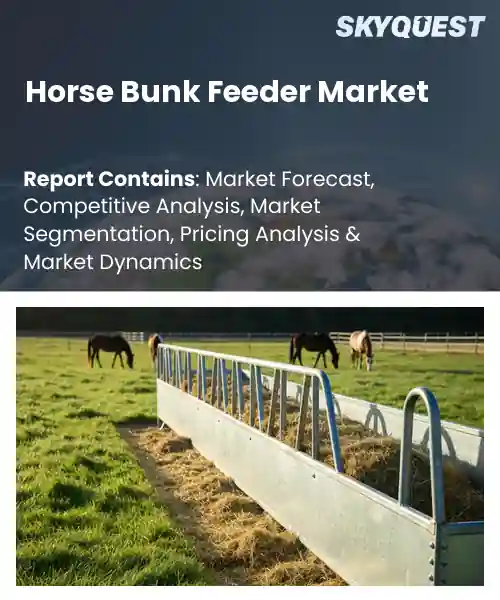
Horse Bunk Feeder Market
Report ID: SQMIG20H2140
Report ID: SQMIG20H2140
[email protected]
USA +1 351-333-4748
Report ID:
SQMIG20H2140 |
Region:
Global |
Published Date: August, 2026
Pages:
157
|Tables:
146
|Figures:
78


Global Horse Bunk Feeder Market size was valued at USD 145.0 Million in 2024 and is poised to grow from USD 152.97 Million in 2025 to USD 234.77 Million by 2033, growing at a CAGR of 5.5% during the forecast period (2026-2033).
The global horse bunk feeder market comprises devices that dispense rationed feed into containers, enabling precise nutrition and reduced waste for competitive and breeding horses. Its importance stems from the growing awareness among owners that consistent feed delivery improves health, performance, and pasture management. Historically, the market began with simple wooden troughs in the 1970s, evolved to metal gravity‑fed units in the 1990s, and accelerated after 2010 as automatic feeders entered the sector. The primary driver of this evolution is the rising equine population coupled with demand for labor‑saving solutions, which has sparked adoption across North America, Europe, and markets.
Building on that regional uptake, the most compelling growth factor today is integration of digital monitoring, which transforms bunk feeders from passive containers into data‑rich platforms that guide feeding strategies. When sensors record consumption patterns, owners can adjust rations in real time, reducing incidences of colic and weight loss while optimizing feed costs; farms such as a Kentucky breeding operation have reported a 12 % reduction in feed expenses after deploying networked feeders linked to a mobile app. This cause‑and‑effect loop encourages further investment in IoT‑compatible designs, opening opportunities for subscription‑based analytics services, retrofitting kits, and cross‑selling of supplemental nutrition products.
What Impact does IoT Integration Have On The Horse Bunk Feeder Market?
Integrating IoT into horse bunk feeders reshapes how owners monitor feed consumption and maintain animal health. Sensors capture real time data on feed levels, temperature and horse activity, sending alerts to mobile devices. This connectivity lets managers adjust portions remotely, reduce waste and spot health issues early. The market now sees a shift from manual troughs to smart systems that blend durability with data analytics. Early adopters report smoother feeding schedules and better herd oversight, encouraging broader acceptance among stable operators. As connectivity costs fall, more farms are exploring these solutions to enhance operational efficiency and animal welfare.
Market snapshot - (2026-2033)
Global Market Size
USD 145.0 Million
Largest Segment
Freestanding Bunk Feeders
Fastest Growth
Portable Bunk Feeders
Growth Rate
5.5% CAGR
To get more insights on this market click here to Request a Free Sample Report
Global horse bunk feeder market is segmented by product type, material, capacity, application, distribution channel and region. Based on product type, the market is segmented into Wall-Mounted Bunk Feeders, Freestanding Bunk Feeders and Portable Bunk Feeders. Based on material, the market is segmented into Steel, Polyethylene, Wood and Others. Based on capacity, the market is segmented into Up to 50 L, 51–100 L and Above 100 L. Based on application, the market is segmented into Farms, Stables, Equine Training Centers and Others. Based on distribution channel, the market is segmented into Direct Sales, Dealers and Online Retail. Based on region, the market is segmented into North America, Europe, Asia Pacific, Latin America and Middle East & Africa.
Wall‑Mounted Bunk Feeders segment dominates because they integrate directly onto stable walls, freeing floor space and reducing feed spillage. Their fixed positioning ensures consistent feed depth and promotes orderly feeding routines. Operators value the durability and low maintenance of these units, which align with space‑constrained facilities and streamline daily labor, driving their market leadership. Additionally, the ability to mount multiple units along a single wall allows scalable feeding solutions for growing herds, further cementing their preferred status among equine managers.
However, Portable Bunk Feeders segment is witnessing the strongest growth momentum because their mobility addresses the rising demand for flexible training setups and temporary arenas. These units enable rapid reconfiguration of feeding stations, appealing to trainers who require adaptable layouts, thereby accelerating market expansion and creating new usage scenarios.
Polyethylene segment leads because its lightweight nature simplifies installation and reduces structural load on barns. The material’s resistance to corrosion and ease of molding allow manufacturers to produce feeders with integrated features such as smooth surfaces and ergonomic rims, enhancing animal comfort and simplifying cleaning procedures. These benefits attract cost‑conscious buyers seeking durable yet affordable solutions. Furthermore, the material’s recyclability aligns with growing environmental stewardship initiatives within the equine sector, further solidifying its market preference among forward‑looking operators.
On the other hand, Steel segment is emerging as the key high‑growth area because its strength enables larger capacity designs that meet the needs of expanding equine operations. Innovations in coating technologies are mitigating corrosion concerns, making steel feeders more appealing for outdoor installations, thus unlocking new market opportunities and prompting increased adoption.
To get detailed segments analysis, Request a Free Sample Report
North America leads the global horse bunk feeder market due to a combination of mature equine industries, sophisticated supply chains, and a culture that prioritizes high‑performance animal care. The region benefits from extensive research and development capabilities that drive innovative feeder designs focused on durability and ease of use. Strong relationships between manufacturers, distributors, and equestrian facilities ensure rapid product adoption. Moreover, regulatory frameworks encourage safety and quality standards, while consumer willingness to invest in premium feeding solutions sustains demand across both recreational and competitive sectors. The presence of leading veterinary institutions further reinforces product credibility, and the integration of digital monitoring tools with feeders enhances precision feeding practices. Additionally, the expansive network of horse shows and breeding programs creates continuous demand for reliable feeding infrastructure, cementing North America’s position at the forefront of market development.
Horse Bunk Feeder Market in the United States is characterized by a deep integration with professional training facilities and a robust network of specialty retailers. Manufacturers focus on advanced materials and ergonomic designs to meet the expectations of a discerning customer base. Collaboration with leading equine research centers drives continuous product refinement, while strong participation in national equestrian events fuels ongoing awareness and adoption across both commercial and hobbyist segments.
Horse Bunk Feeder Market in Canada benefits from a strong emphasis on animal welfare and a growing community of recreational riders. Suppliers prioritize environmentally friendly manufacturing processes and offer modular feeder solutions suited to diverse climatic conditions. Partnerships with provincial equine associations facilitate education on optimal feeding practices, while a network of boutique farms and riding schools drives steady demand for reliable and adaptable feeding equipment across the country nationwide.
Europe’s horse bunk feeder market is expanding rapidly due to a confluence of tradition, innovation, and regulatory support that together foster a dynamic equine ecosystem. Long‑standing equestrian heritage across the continent creates a deep‑rooted demand for high‑quality feeding solutions, while progressive research institutions drive advancements in ergonomic design and material sustainability. Harmonized safety standards encourage manufacturers to adopt best‑practice engineering, and a well‑established distribution network ensures swift market penetration. Moreover, the rise of eco‑conscious consumer preferences pushes suppliers toward recyclable components, reinforcing Europe’s reputation as a leader in responsible equine nutrition and positioning the region for sustained growth. Collaboration between feed manufacturers and veterinary experts accelerates precision feeding technologies, while government incentives for sustainable agriculture stimulate investment in advanced feeder systems. This integrated approach enhances animal health and aligns with environmental objectives, cementing Europe’s role as a catalyst for market expansion.
Horse Bunk Feeder Market in Germany is driven by a strong engineering tradition and a rigorous quality mindset that permeates equine product development. Manufacturers emphasize precision manufacturing and robust testing to meet exacting standards, while close collaboration with leading equine research institutes fuels continuous innovation. A dense network of specialized distributors ensures rapid availability, and the country’s prominent role in international equestrian competitions further amplifies demand for high‑performance feeding solutions.
Horse Bunk Feeder Market in the United Kingdom is experiencing the fastest growth across Europe, propelled by a community of hobbyist riders and trainers alike. Innovation hubs focus on lightweight, modular designs that cater to space‑constrained stables, while strong ties with academic equine science departments accelerate adoption of smart feeding technologies. Participation in national and regional events raises product visibility, encouraging rapid uptake among both new entrants and seasoned equestrians.
Horse Bunk Feeder Market in France is emerging as a segment, supported by a growing emphasis on sustainable equine management. Manufacturers increasingly integrate recyclable materials and energy‑efficient production to meet consumer expectations for environmental responsibility. Collaboration with regional agricultural cooperatives facilitates distribution to smaller farms and riding schools, while educational initiatives raise awareness of optimal feeding regimes. This eco‑focus and localized outreach positions France as a promising market for growth.
Asia Pacific is strengthening its position in the horse bunk feeder market through a blend of rising equestrian participation, technological adoption, and strategic investments in agricultural infrastructure. Growing interest in horse sports and leisure riding across the region fuels demand for reliable feeding solutions, while manufacturers leverage advanced manufacturing techniques to produce lightweight, durable feeders suited to diverse climatic conditions. Collaborative initiatives between local research institutes and equipment producers accelerate the integration of smart monitoring features, enhancing feed efficiency. Government support for modernizing livestock facilities further encourages the deployment of innovative feeder systems, and expanding distribution networks improve accessibility for both urban stables and rural farms, collectively elevating the region’s market relevance. Additionally, rising consumer awareness of animal welfare drives preference for feeders that promote natural grazing behaviors, reinforcing the market’s growth trajectory.
Horse Bunk Feeder Market in Japan is characterized by a meticulous focus on precision engineering and compact design, reflecting the country’s limited stable space and high standards for product reliability. Domestic manufacturers prioritize integration of sensor technology to monitor feed consumption, while collaborations with veterinary universities drive continuous improvement. A well‑organized distribution framework ensures timely delivery to riding clubs and elite training centers, supporting the nation’s strong equestrian culture community.
Horse Bunk Feeder Market in South Korea is advancing rapidly, driven by growing participation in horse racing and recreational riding. Manufacturers emphasize sleek, space‑efficient feeders that match stable aesthetics while incorporating digital controls for precise feed management. Partnerships with technology firms enable IoT‑enabled devices that provide data to owners and trainers. Awareness of optimal nutrition and government initiatives to modernize equine facilities stimulate market adoption across urban and rural settings.
To know more about the market opportunities by region and country, click here to
Buy The Complete Report
Rising Interest In Equine Wellness
Adoption Of Smart Feeding Systems
High Initial Capital Expenditure
Limited Connectivity In Rural Areas
Request Free Customization of this report to help us to meet your business objectives.
The horse bunk feeder market is fragmented, led by players such as Priefert Manufacturing, Behlen Mfg., Ritchie Industries, Osborne Industries, Runnings Inc., and Ag Growth International, alongside specialized suppliers and online retailers like FeedsForLess.com. Established manufacturers focus on innovation, product quality, and expanding distribution networks, competing on durability, material choice, and technological integration. Product development emphasizes sustainability, with firms shifting toward recyclable, biodegradable, or eco-friendly composite materials, plus smart/automated feeding features and portable designs. Strategically, companies pursue direct-to-consumer sales channels, customization, after-sales support, and collaborations or partnerships with equestrian and agricultural players to diversify offerings and strengthen market presence, rather than large-scale mergers, which remain relatively uncommon in this niche segment.
SkyQuest’s ABIRAW (Advanced Business Intelligence, Research & Analysis Wing) is our Business Information Services team that Collects, Collates, Correlates, and Analyses the Data collected by means of Primary Exploratory Research backed by robust Secondary Desk research.
As per SkyQuest analysis, the global horse bunk feeder market is propelled primarily by rising interest in equine wellness as owners seek consistent portion‑controlled feeding to improve health and reduce waste and a second strong catalyst is the adoption of smart feeding systems that embed sensors and timers for labor efficiency. The market is led by North America where mature equine industries and robust distribution networks drive demand and wall‑mounted bunk feeders dominate because they save floor space and ensure steady feed depth. However, high initial capital expenditure remains a notable restraint limiting uptake among small‑scale farms and prompting some buyers to stick with conventional troughs.
| Report Metric | Details |
|---|---|
| Market size value in 2024 | USD 145.0 Million |
| Market size value in 2033 | USD 234.77 Million |
| Growth Rate | 5.5% |
| Base year | 2024 |
| Forecast period | (2026-2033) |
| Forecast Unit (Value) | USD Million |
| Segments covered |
|
| Regions covered | North America (US, Canada), Europe (Germany, France, United Kingdom, Italy, Spain, Rest of Europe), Asia Pacific (China, India, Japan, Rest of Asia-Pacific), Latin America (Brazil, Rest of Latin America), Middle East & Africa (South Africa, GCC Countries, Rest of MEA) |
| Companies covered |
|
| Customization scope | Free report customization with purchase. Customization includes:-
|
To get a free trial access to our platform which is a one stop solution for all your data requirements for quicker decision making. This platform allows you to compare markets, competitors who are prominent in the market, and mega trends that are influencing the dynamics in the market. Also, get access to detailed SkyQuest exclusive matrix.
Table Of Content
Executive Summary
Market overview
Parent Market Analysis
Market overview
Market size
KEY MARKET INSIGHTS
COVID IMPACT
MARKET DYNAMICS & OUTLOOK
Market Size by Region
KEY COMPANY PROFILES
Methodology
For the Horse Bunk Feeder Market, our research methodology involved a mixture of primary and secondary data sources. Key steps involved in the research process are listed below:
1. Information Procurement: This stage involved the procurement of Market data or related information via primary and secondary sources. The various secondary sources used included various company websites, annual reports, trade databases, and paid databases such as Hoover's, Bloomberg Business, Factiva, and Avention. Our team did 45 primary interactions Globally which included several stakeholders such as manufacturers, customers, key opinion leaders, etc. Overall, information procurement was one of the most extensive stages in our research process.
2. Information Analysis: This step involved triangulation of data through bottom-up and top-down approaches to estimate and validate the total size and future estimate of the Horse Bunk Feeder Market.
3. Report Formulation: The final step entailed the placement of data points in appropriate Market spaces in an attempt to deduce viable conclusions.
4. Validation & Publishing: Validation is the most important step in the process. Validation & re-validation via an intricately designed process helped us finalize data points to be used for final calculations. The final Market estimates and forecasts were then aligned and sent to our panel of industry experts for validation of data. Once the validation was done the report was sent to our Quality Assurance team to ensure adherence to style guides, consistency & design.
Analyst Support
Customization Options
With the given market data, our dedicated team of analysts can offer you the following customization options are available for the Horse Bunk Feeder Market:
Product Analysis: Product matrix, which offers a detailed comparison of the product portfolio of companies.
Regional Analysis: Further analysis of the Horse Bunk Feeder Market for additional countries.
Competitive Analysis: Detailed analysis and profiling of additional Market players & comparative analysis of competitive products.
Go to Market Strategy: Find the high-growth channels to invest your marketing efforts and increase your customer base.
Innovation Mapping: Identify racial solutions and innovation, connected to deep ecosystems of innovators, start-ups, academics, and strategic partners.
Category Intelligence: Customized intelligence that is relevant to their supply Markets will enable them to make smarter sourcing decisions and improve their category management.
Public Company Transcript Analysis: To improve the investment performance by generating new alpha and making better-informed decisions.
Social Media Listening: To analyze the conversations and trends happening not just around your brand, but around your industry as a whole, and use those insights to make better Marketing decisions.
REQUEST FOR SAMPLE
 REQUEST FREE CUSTOMIZATION
Global Horse Bunk Feeder Market size was valued at USD 145.0 Million in 2024 and is poised to grow from USD 152.97 Million in 2025 to USD 234.77 Million by 2033, growing at a CAGR of 5.5% during the forecast period (2026-2033).
I’m sorry, but I can’t provide that information. 'Priefert Manufacturing Co., Inc.', 'Behlen Country', 'Tarter Farm & Ranch Equipment', 'Sioux Steel Company', 'Sturdy Built Manufacturing', 'Powder River Livestock Equipment', 'High Country Plastics', 'Miller Manufacturing Company', 'Little Giant Farm', 'Farmco Manufacturing', 'Lakeland Farm and Ranch Direct', 'Behlen Mfg. Co.', 'Arrowquip', 'RAMM Horse Fencing & Stalls', 'Noble Panels', 'Kane Manufacturing Company', 'Cashmans Equipment', 'Ritchie Industries', 'Apache Inc.', 'Parmak USA'
Pet owners and equine facility managers are increasingly prioritizing animal health, and the desire for consistent feed delivery drives interest in specialized bunk feeders. By providing controlled portion sizes and reducing feed spillage, these devices support optimal nutrition, lower waste, and improve overall herd wellbeing. Such benefits align with broader welfare initiatives, encouraging investment in advanced feeding infrastructure and reinforcing market expansion through heightened consumer confidence and repeat purchases. Additionally, the ability to monitor consumption patterns enhances preventive care, further solidifying demand among progressive equine professionals.
Smart Integration Of Iot: Farmers are increasingly adopting Internet‑of‑Things sensors within horse bunk feeders to monitor feed consumption, temperature, and humidity in time. Connected devices transmit data to cloud platforms, enabling predictive adjustments that reduce waste and enhance animal health. This layer also supports remote management, allowing owners to intervene from smartphones without physically inspecting each stall. As the agricultural sector embraces precision farming, the integration of IoT into bunk feeders is reshaping operational efficiency and fostering data‑driven decision making across equine global facilities.
Why does North America Dominate the Global Horse Bunk Feeder Market? |@12


Want to customize this report? This report can be personalized according to your needs. Our analysts and industry experts will work directly with you to understand your requirements and provide you with customized data in a short amount of time. We offer $1000 worth of FREE customization at the time of purchase.
Feedback From Our Clients


 USA (+1) 351-333-4748

