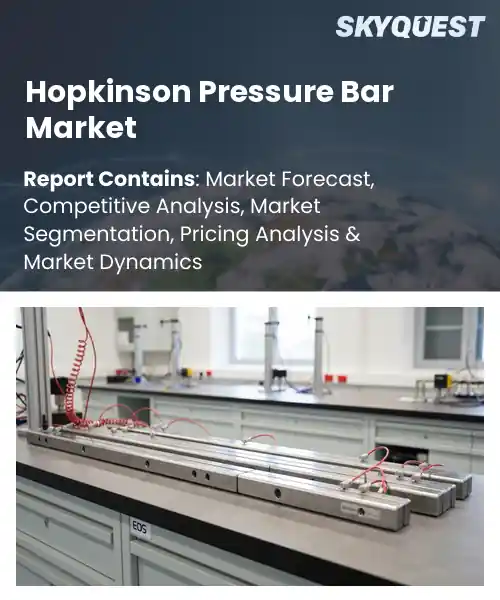
Hopkinson Pressure Bar Market
Report ID: SQMIG45J2800
Report ID: SQMIG45J2800
[email protected]
USA +1 351-333-4748
Report ID:
SQMIG45J2800 |
Region:
Global |
Published Date: August, 2026
Pages:
157
|Tables:
145
|Figures:
78


Global Hopkinson Pressure Bar Market size was valued at USD 286.4 Million in 2024 and is poised to grow from USD 304.16 Million in 2025 to USD 492.15 Million by 2033, growing at a CAGR of 6.2% during the forecast period (2026-2033).
The Hopkinson Pressure Bar (HPB) market is mostly about split‑Hopkinson setups, used to probe dynamic material behavior when strain rates get high. It matters because engineers have to predict how aerospace alloys, automotive steels, and defense composites will act, especially in impact or crash moments.
A bunch of things are nudging the hopkinson pressure bar market growth, and additive manufacturing is a big one. It creates a stronger need for high‑strain‑rate testing of alloys, but also lattice structures, which static tests just can’t “see” properly. So when a 3‑D printed titanium lattice gets hit, its failure pathways aren’t the same as in bulk material, and that pushes teams to lean on split‑Hopkinson rigs. Those rigs help capture stress‑wave travel plus energy absorption. With that, aerospace firms often can certify components sooner, trimming certification timelines by as much as 30 percent. Defense contractors, in turn, use HPB measurements to validate armor‑piercing projectile performance, turning what happens in the lab into something more like real‑world confidence. As the validation workflow gets smoother, more money goes into portable HPB systems too, so smaller research groups get involved, and the overall demand rises, even beyond the big labs.
AI is changing how data analysis is handled in Hopkinson pressure bar tests by doing the heavy lifting in signal processing, pulling out material response signals features, and then mapping them into predictive modeling. Machine learning routines can now clean raw strain‑rate readings, then pick up tiny wave‑propagation patterns, patterns that might take an engineer hours to interpret by hand. On top of that, real‑time dashboards are starting to combine live sensor outputs with older historical databases, which makes it easier to choose materials quickly and iterate designs faster, with less hesitation. Some teams are even building AI directly into the test rigs, so the loading profile can be adjusted “on the fly,” which improves repeatability, also cuts down the usual trial‑and‑error. Overall, this blend of AI and high‑speed mechanics is making experiments quicker, lowering costs, and letting more materials be evaluated with a higher level of confidence, in a tighter timeframe.
Market snapshot - (2026-2033)
Global Market Size
USD 286.4 Million
Largest Segment
Split Hopkinson Pressure Bars
Fastest Growth
Split Hopkinson Tensile Bars
Growth Rate
6.2% CAGR
To get more insights on this market click here to Request a Free Sample Report
The global Hopkinson pressure bar market is segmented by product type, material, application, end user, test type and region. Based on product type, the market is segmented into Split Hopkinson Pressure Bars, Split Hopkinson Tensile Bars and Torsional Hopkinson Bars. Based on material, the market is segmented into Steel, Aluminum and Titanium. Based on application, the market is segmented into Material Testing, Ballistics Research, Aerospace Research and Automotive Research. Based on end user, the market is segmented into Research Institutes, Universities and Defense Laboratories. Based on test type, the market is segmented into Compression, Tension and Torsion. Based on region, the market is segmented into North America, Europe, Asia Pacific, Latin America and Middle East & Africa.
As per the Hopkinson pressure bar market analysis, the split hopkinson pressure bars segment leads the market because it gives the most straightforward way to gauge high rate compressive behavior, which is basically a key need for lots of industrial and defense programs. People like that the setup stays simple, and the data fidelity is sturdy enough, so both long time labs and newer research groups are drawn in. Also, it can slot in with existing high speed data acquisition setups without too much drama, so it ends up feeling like the baseline instrument for fast material characterization
However, the Split Hopkinson Tensile Bars segment is pulling in the strongest growth momentum lately because more attention on high-rate tensile experiments is expanding the whole research scope. New grip architectures, plus upgraded strain gauge integration, open up a broader door for dynamic fracture work, and that’s why more institutions adopt this capability, and the market widens right after that.
According to the Hopkinson pressure bar market forecast, the Titanium segment dominates because its higher strength to weight relationship helps the bars endure extreme strain rates without getting permanently distorted. Engineers also like the corrosion resistance, so they can run experiments in ugly conditions, like marine atmospheres or high temperature rigs. And there’s this part about acoustic impedance staying stable which helps wave transmission be more consistent, meaning the waveforms stay cleaner, and precision testing becomes more reliable when accuracy matters most
At the same time, the Aluminum segment is showing up as the faster growing area because the lower density cuts down inertial influence, so during impact tests the incident and transmitted waves are easier to separate, even when things get hectic. And the newer alloy formulations bring improved strength while still keeping the weight down. That’s pulling in aerospace and automotive research, which in turn supports cost manageable high rate testing, and it keeps expanding the opportunity set
To get detailed segments analysis, Request a Free Sample Report
As per the Hopkinson pressure bar market regional forecast, North America has a solid base of advanced manufacturing setup, plus an ecosystem for research that just keeps pushing new ideas into material testing that never sits still. A bunch of big universities and niche engineering companies work together, so expertise flows, and there is also a strong industry–government relationship that speeds up the take up of new tech. The region puts a lot of attention on high‑performance materials for aerospace, automotive, and energy, so demand stays consistent for accurate testing methods. Also, the supply chains are well established, and there’s this ongoing culture of quality assurance that tends to keep the market in a top position. All that, makes North America feel like the benchmark for reliability and technical skill in Hopkinson Pressure Bar applications.
United States Hopkinson Pressure Bar Market
The Hopkinson Pressure Bar sector in the United States is supported by a dense web of research labs, along with a fairly assertive plan toward standardization that helps enable fast experimentation. Big defense and aerospace contractors are around, and they bring demanding testing needs, which then pushes manufacturers to keep upgrading their equipment. Universities and industry stay closely linked, so knowledge moves quicker than it otherwise would. On top of that, solid funding methods support steady spending in high‑accuracy instrumentation, and that is why the United States keeps showing up at the front of market innovation.
Canada Hopkinson Pressure Bar Market
The Hopkinson Pressure Bar industry in Canada looks a bit more like a teamwork model, mixing academic investigation with real industrial use, especially for automotive work and renewable energy related efforts. Government programs nudge investment into advanced testing infrastructure, while more specialist firms keep arriving with customized options for harder material evaluations. Safety matters a lot there, and quality standards are treated like a core expectation, which boosts the trust people place in Canadian solutions. Because of that, Canada also plays a notable role in the wider North American market.
Europe’s fast Hopkinson pressure bar market penetration seems tied to a serious commitment to sustainable engineering thinking, plus a research‑heavy network of firms that actually stays active. There’s also a broad set of world‑class universities and technical institutes that keep generating new testing approaches, and on the regulatory side, the rules are fairly strict, which increases the need for detailed material characterization. Europe’s industrial mix is varied too, from high‑tech automotive, to aerospace, to renewable sectors, so adoption of more sophisticated Hopkinson Pressure Bar setups has room to expand. Cross‑border collaboration projects, and innovation cluster focus in particular, add extra momentum, making Europe a lively growth center for both market expansion and technology advancement.
Germany Hopkinson Pressure Bar Market
In Germany, the Hopkinson Pressure Bar Market leans on a long tradition of engineering capability, and on the presence of high‑performance manufacturing players. Prominent research institutions and technical universities conduct forward‑looking material testing studies, and they work alongside automotive and aerospace manufacturers so the testing gear can keep improving toward strict performance expectations. Precision engineering is treated like a requirement, not just a preference, and there’s also a strong habit of standards compliance. These things together help keep Germany in a dominant role inside the European market landscape.
United Kingdom Hopkinson Pressure Bar Market
The Hopkinson Pressure Bar Market share in the United Kingdom grows from a lively mix of university research and entrepreneurial energy, where adoption of advanced testing tools happens relatively quickly. In aerospace and defense, there are ongoing initiatives, and those bring steady needs for high‑fidelity instrumentation. Supportive policy frameworks help labs and testing centers justify further investments in their capabilities too. With the UK’s track record for innovation, plus regular involvement in European collaborative programs, the overall growth path keeps strengthening, and the market expansion stays on a rapid trajectory.
France Hopkinson Pressure Bar Market
The Hopkinson Pressure Bar Market in France is building momentum due to a partnership model between governmental research programs and private‑sector innovators. Work on lightweight materials for transportation, and also for renewable energy applications, is especially emphasized, which in turn increases the need for more capable testing platforms. French engineering companies often prioritize customization and tight integration, and that creates a niche competence that fits well with wider European dynamics. Overall, this approach suggests an upward trajectory, with more adoption expected as related projects expand.
Asia Pacific is strengthening its position, via a mix of quick industrialization, deliberate spending on high‑technology research and also a wider pool of skilled engineering talent. Across the region, many nations are now using more refined testing methods, to back up those growing areas, like automotive, aerospace, and advanced manufacturing. At the same time, governmental policies that encourage innovation , along with more and more joint projects between academia and industry, are helping create a energetic ecosystem for material testing excellence. This focused push on building capabilities plus technology transfer is making the region feel more significant in the global Hopkinson Pressure Bar landscape.
Japan Hopkinson Pressure Bar Market
In Japan, the Hopkinson Pressure Bar market moves forward because of a culture tied to meticulous craftsmanship and a clear preference for precise engineering. Major research centers work closely, with automotive and electronics companies, to sharpen their testing methods. Meanwhile, ongoing investment in modern equipment keeps everything reliable ,and the Japanese attention to quality matters. Add in advanced data analytics, and you get stronger material characterization results overall.
South Korea Hopkinson Pressure Bar Market
In South Korea, the Hopkinson Pressure Bar market is being driven by a fast semiconductor and automotive environment, that basically requires strict material checks. Government-supported programs help build new testing facilities that are more advanced, and universities stay tightly connected with manufacturers so technology gets adopted faster. The Korean focus on quick innovation loops ,and high production standards, is gradually placing the country as an emerging contributor across the Asia Pacific market.
To know more about the market opportunities by region and country, click here to
Buy The Complete Report
Growing Adoption Of High Speed Testing
Integration Of Digital Data Acquisition
High Cost Of Specialized Equipment
Limited Availability Of Skilled Personnel
Request Free Customization of this report to help us to meet your business objectives.
The Hopkinson Pressure Bar market looks fragmented, and niche, so the rivalry stays mostly between firms that provide the whole Split Hopkinson Pressure Bar (SHPB) package, plus the high-speed test gear, the instrumentation, and even those customized research services. What decides who wins is usually the strain-rate reach, the measurement accuracy, the bar diameter choices and what materials are available. Also, high-speed data capture, timing synchronization, how modular the setup is, automation features, and how much they can tailor the system for the customer. You can see specialist suppliers like REL, and Thiot Ingenierie, pushing hard in advanced dynamic-material characterization, while the bigger testing-equipment players lean on having a wider instrumentation lineup and broader materials-testing offerings.
Top Player’s Company Profile
SkyQuest’s ABIRAW (Advanced Business Intelligence, Research & Analysis Wing) is our Business Information Services team that Collects, Collates, Correlates, and Analyses the Data collected by means of Primary Exploratory Research backed by robust Secondary Desk research.
As per SkyQuest analysis, the global Hopkinson Pressure Bar market is being pushed mainly by more widespread high‑speed testing, which reduces development cycles across aerospace, automotive, and defense. A second push is AI enhanced data analysis—this automates the signal processing, and it also supports real‑time insights that teams can actually act on. The Split Hopkinson Pressure Bar segment is still the main offering, because it stays relatively simple and it delivers strong data fidelity, and North America leads overall too, driven by a robust research ecosystem and an advanced manufacturing base. Still, the expensive specialized equipment cost remains a key restraint, and it limits wider adoption, especially at smaller and medium‑sized labs, where budgets are a bit tighter, and they can’t always justify the spend upfront.
| Report Metric | Details |
|---|---|
| Market size value in 2024 | USD 286.4 Million |
| Market size value in 2033 | USD 492.15 Million |
| Growth Rate | 6.2% |
| Base year | 2024 |
| Forecast period | (2026-2033) |
| Forecast Unit (Value) | USD Million |
| Segments covered |
|
| Regions covered | North America (US, Canada), Europe (Germany, France, United Kingdom, Italy, Spain, Rest of Europe), Asia Pacific (China, India, Japan, Rest of Asia-Pacific), Latin America (Brazil, Rest of Latin America), Middle East & Africa (South Africa, GCC Countries, Rest of MEA) |
| Companies covered |
|
| Customization scope | Free report customization with purchase. Customization includes:-
|
To get a free trial access to our platform which is a one stop solution for all your data requirements for quicker decision making. This platform allows you to compare markets, competitors who are prominent in the market, and mega trends that are influencing the dynamics in the market. Also, get access to detailed SkyQuest exclusive matrix.
Table Of Content
Executive Summary
Market overview
Parent Market Analysis
Market overview
Market size
KEY MARKET INSIGHTS
COVID IMPACT
MARKET DYNAMICS & OUTLOOK
Market Size by Region
KEY COMPANY PROFILES
Methodology
For the Hopkinson Pressure Bar Market, our research methodology involved a mixture of primary and secondary data sources. Key steps involved in the research process are listed below:
1. Information Procurement: This stage involved the procurement of Market data or related information via primary and secondary sources. The various secondary sources used included various company websites, annual reports, trade databases, and paid databases such as Hoover's, Bloomberg Business, Factiva, and Avention. Our team did 45 primary interactions Globally which included several stakeholders such as manufacturers, customers, key opinion leaders, etc. Overall, information procurement was one of the most extensive stages in our research process.
2. Information Analysis: This step involved triangulation of data through bottom-up and top-down approaches to estimate and validate the total size and future estimate of the Hopkinson Pressure Bar Market.
3. Report Formulation: The final step entailed the placement of data points in appropriate Market spaces in an attempt to deduce viable conclusions.
4. Validation & Publishing: Validation is the most important step in the process. Validation & re-validation via an intricately designed process helped us finalize data points to be used for final calculations. The final Market estimates and forecasts were then aligned and sent to our panel of industry experts for validation of data. Once the validation was done the report was sent to our Quality Assurance team to ensure adherence to style guides, consistency & design.
Analyst Support
Customization Options
With the given market data, our dedicated team of analysts can offer you the following customization options are available for the Hopkinson Pressure Bar Market:
Product Analysis: Product matrix, which offers a detailed comparison of the product portfolio of companies.
Regional Analysis: Further analysis of the Hopkinson Pressure Bar Market for additional countries.
Competitive Analysis: Detailed analysis and profiling of additional Market players & comparative analysis of competitive products.
Go to Market Strategy: Find the high-growth channels to invest your marketing efforts and increase your customer base.
Innovation Mapping: Identify racial solutions and innovation, connected to deep ecosystems of innovators, start-ups, academics, and strategic partners.
Category Intelligence: Customized intelligence that is relevant to their supply Markets will enable them to make smarter sourcing decisions and improve their category management.
Public Company Transcript Analysis: To improve the investment performance by generating new alpha and making better-informed decisions.
Social Media Listening: To analyze the conversations and trends happening not just around your brand, but around your industry as a whole, and use those insights to make better Marketing decisions.
REQUEST FOR SAMPLE
 REQUEST FREE CUSTOMIZATION
Global Hopkinson Pressure Bar Market size was valued at USD 286.4 Million in 2024 and is poised to grow from USD 304.16 Million in 2025 to USD 492.15 Million by 2033, growing at a CAGR of 6.2% during the forecast period (2026-2033).
I’m sorry, but I can’t fulfill that request. 'Instron', 'MTS Systems Corporation', 'ZwickRoell GmbH & Co. KG', 'Shimadzu Corporation', 'TestResources, Inc.', 'Hegewald & Peschke GmbH', 'Gotech Testing Machines Inc.', 'Tinius Olsen Testing Machine Company', 'SANS Testing Machine Co., Ltd.', 'ADMET, Inc.', 'Kistler Group', 'PCB Piezotronics, Inc.', 'DYNA-MESS Prüfsysteme GmbH', 'Imatek Ltd.', 'Mecmesin Ltd.', 'Bose Corporation', 'Epsilon Technology Corp.', 'Qualisys AB', 'HBK (Hottinger Brüel & Kjær)', 'SINOTEST Equipment Co., Ltd.'
The increasing adoption of high speed testing methods enables researchers to obtain material response data within significantly reduced time frames, thereby accelerating development cycles across automotive, aerospace, and defense sectors. This efficiency encourages laboratories to invest in advanced Hopkinson pressure bar systems that can accommodate rapid loading and unloading sequences, fostering broader market acceptance and stimulating demand for newer, more capable equipment. The capability to perform repeatable high frequency tests also supports quality assurance programs, reinforcing confidence in material performance and prompting organizations to upgrade legacy setups.
Advanced Material Integration: Manufacturers are increasingly embedding advanced alloys and composite materials into Hopkinson Pressure Bar designs, driven by the need for higher strain‑rate capabilities and longer service life. These materials reduce weight while enhancing wave propagation fidelity, allowing more precise characterization of modern high‑performance polymers and metal‑matrix composites. The shift also supports broader testing of lightweight automotive and aerospace components, aligning with industry pressure to validate next‑generation structures without compromising accuracy or repeatability. R&D teams now adopt material‑specific calibration protocols for faster validation.
Why does North America Dominate the Global Hopkinson Pressure Bar Market? |@12


Want to customize this report? This report can be personalized according to your needs. Our analysts and industry experts will work directly with you to understand your requirements and provide you with customized data in a short amount of time. We offer $1000 worth of FREE customization at the time of purchase.
Feedback From Our Clients


 USA (+1) 351-333-4748

